
Skin disease by fungal organism 10 marker for MD pathology rguhs university exam
Reading File
Now let me search the medical library for fungal skin diseases comprehensively.
Finding Sources
Finding Sources
Searching the Web
fungal skin disease 10 marks MD pathology RGUHS exam answer dermatophytosis candidiasis
Finding Sources
Finding Sources
Excellent - found Robbins Pathology and Fitzpatrick's Dermatology. Let me read the key pathology sections now.
Reading File
Reading File
Reading File
Reading File
Reading File
Finding Sources
I now have excellent material from Robbins Pathology and Fitzpatrick's Dermatology. Let me also get the Andrews' Diseases of the Skin section and fetch relevant histopathology images.
Finding Sources
Loading Image
I now have comprehensive material from Robbins Pathology, Fitzpatrick's Dermatology, and Sherris Microbiology. I have enough to write an excellent, exam-standard 10-marker answer for RGUHS MD Pathology.
Skin Diseases Caused by Fungal Organisms
[RGUHS MD Pathology - 10 Marks Answer]
Introduction
Fungal infections of the skin (cutaneous mycoses) are among the most common dermatological conditions worldwide. They are broadly classified into:
- Superficial mycoses - confined to the stratum corneum, hair, and nails
- Subcutaneous mycoses - involving dermis and subcutaneous tissue
- Deep/systemic mycoses - hematogenous spread, often in immunocompromised patients
Classification of Causative Organisms
I. Dermatophytes (Most Common)
Three genera cause superficial keratinolytic infections:
| Genus | Microconidia | Macroconidia | Key Species |
|---|---|---|---|
| Trichophyton | Smooth-walled; diagnostic | Absent/non-diagnostic | T. rubrum (most common), T. tonsurans |
| Microsporum | Absent/non-diagnostic | Rough-walled; diagnostic | M. canis, M. audouinii |
| Epidermophyton | Absent | Smooth-walled; diagnostic | E. floccosum |
Classified further by habitat:
- Anthropophilic (humans) - e.g. T. rubrum, T. tonsurans, E. floccosum
- Zoophilic (animals) - e.g. M. canis (cats/dogs), T. verrucosum (cattle)
- Geophilic (soil) - e.g. M. gypseum
(Source: Fitzpatrick's Dermatology, Table 160-1)
II. Non-Dermatophyte Yeasts
- Malassezia furfur - causes Pityriasis/Tinea versicolor
- Candida albicans - cutaneous candidiasis
Major Clinical Entities
1. Tinea Capitis
- Dermatophytosis of the scalp; mainly in children
- Patchy lesions with erythema, scaling, crust formation, and hair loss
- Causative agents: T. tonsurans (US), M. canis
- Types of hair invasion: ectothrix (Microsporum) vs endothrix (Trichophyton)
- Treatment requires oral antifungals (griseofulvin, terbinafine)
2. Tinea Corporis (Ringworm of the body)
- Most common superficial fungal infection of glabrous skin
- Affects all ages, especially children
- Predisposing factors: excessive heat, humidity, exposure to infected animals
- Clinical: Expanding round plaque with elevated, scaling, erythematous border and central clearing ("ringworm" appearance)
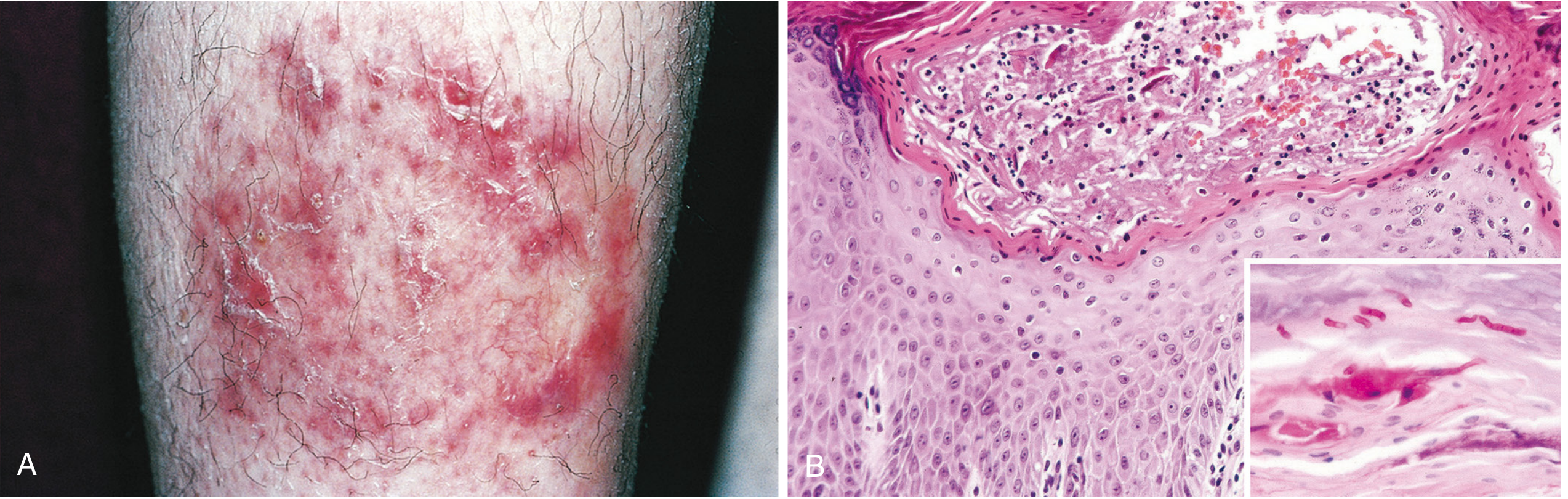
- Histopathology: Mild spongiotic (eczematous) dermatitis with intraepidermal neutrophils and neutrophilic microabscesses in the stratum corneum
3. Tinea Pedis (Athlete's foot)
- Most prevalent form; affects 30-40% of the population at some point
- Diffuse erythema and scaling, initially in toe web spaces
- Predisposing factors: occlusive footwear, communal bathing areas
4. Tinea Cruris (Jock Itch)
- Inguinal areas; predominantly obese males in warm weather
- Moist red patches with raised, scaly, well-defined borders
- Predisposed by heat, friction, and maceration
5. Tinea Unguium / Onychomycosis
- Dermatophytosis of the nails
- Nail thickening, discoloration, onycholysis (separation of nail plate)
- Requires prolonged oral antifungal therapy
6. Tinea Barbae
- Dermatophyte infection of the beard area in adult males
- Relatively uncommon
7. Tinea Versicolor (Pityriasis Versicolor)
- Caused by Malassezia furfur (a yeast, NOT a dermatophyte)
- Located on the upper trunk; highly distinctive
- Lesions: groups of macules of varied color (hypo- or hyperpigmented) with fine peripheral scale
- "Spaghetti and meatballs" pattern on KOH mount - short curved hyphae + round spores
- Hypopigmentation due to azelaic acid produced by Malassezia, which inhibits tyrosinase
8. Cutaneous Candidiasis
- Caused by Candida albicans
- Sites: intertriginous regions (axillary, inguinal, inframammary folds), oral mucosa, genitalia, nail folds
- Characteristic: Erythematous plaques with satellite lesions (small peripheral pustules/papules)
- Predisposed by diabetes, immunosuppression, antibiotic use, obesity, corticosteroid therapy
Histopathology of Dermatophyte Infections
(Robbins & Cotran Pathologic Basis of Disease)
The histologic features are variable depending on:
- Properties of the organism
- Host immune response
- Degree of secondary bacterial superinfection
Key histologic features:
- Mild spongiotic (eczematous) dermatitis in the epidermis
- Intraepidermal neutrophils and neutrophilic microabscesses - especially in the stratum corneum
- Superficial perivascular lymphocytic infiltrate in the dermis
- Fungi located in the anucleate cornified layer (stratum corneum) of lesional skin, hair, or nails
Special Stains for Diagnosis
| Stain | Appearance |
|---|---|
| PAS (Periodic Acid-Schiff) | Hyphae/spores stain bright pink to red (due to cell walls rich in mucopolysaccharides) |
| Gomori Methenamine Silver (GMS) | Fungi stain black against green background |
| KOH mount | Direct visualization of hyphae and spores in skin scrapings |
Culture & Laboratory Diagnosis
- Sabouraud Dextrose Agar (SDA) with cycloheximide + chloramphenicol: standard isolation medium; incubated at 20-25°C for up to 4 weeks
- Dermatophyte Test Medium (DTM): Contains phenol red indicator; turns red with dermatophyte growth (proteolytic activity raises pH)
- Wood's Lamp: Microsporum species fluoresce green (except M. audouinii/M. canis)
- KOH Preparation: Demonstration of septate hyphae confirms dermatophytosis
Pathogenesis
Dermatophytes produce keratinases that allow them to:
- Attach to and invade keratinized tissues (skin, hair, nails)
- Use keratin as a nutrient source
- Evoke innate immune response (neutrophil recruitment, epidermal spongiosis)
Malassezia is lipophilic and requires exogenous lipids for growth, explaining its predilection for sebaceous areas (upper trunk, scalp).
Treatment Summary
| Infection | Preferred Treatment |
|---|---|
| Tinea corporis/cruris/pedis | Topical azoles or allylamines (terbinafine) |
| Tinea capitis | Oral griseofulvin or terbinafine (6-8 weeks) |
| Onychomycosis | Oral terbinafine or itraconazole (pulse therapy) |
| Tinea versicolor | Topical selenium sulfide, ketoconazole shampoo, or oral itraconazole |
| Candidiasis | Topical/oral azoles; systemic fluconazole for recurrent cases |
Summary Table
| Disease | Organism | Characteristic Feature |
|---|---|---|
| Tinea capitis | Trichophyton / Microsporum | Scalp, children, hair loss |
| Tinea corporis | T. rubrum | Annular plaque, central clearing |
| Tinea pedis | T. rubrum, T. interdigitale | Toe webs, 30-40% prevalence |
| Tinea cruris | E. floccosum, T. rubrum | Inguinal, obese males |
| Onychomycosis | T. rubrum | Nail thickening, onycholysis |
| Tinea versicolor | Malassezia furfur | "Spaghetti & meatballs" on KOH, upper trunk |
| Candidiasis | Candida albicans | Satellite lesions, intertriginous |
Sources:
- Robbins & Cotran Pathologic Basis of Disease, Superficial Fungal Infections, Ch. 25
- Fitzpatrick's Dermatology, 9th Ed., Ch. 160 - Dermatophytes & Superficial Mycoses
- Sherris & Ryan's Medical Microbiology, 8th Ed., Ch. 6
Exam Writing Tip for RGUHS 10-marker: Structure your answer as: (1) Introduction + Classification [2 marks], (2) Clinical types with features [3 marks], (3) Histopathology with special stains [3 marks], (4) Diagnosis/Culture [1 mark], (5) Treatment outline [1 mark]. This covers all examiners' expected points for a complete answer.
Chaperone proteins 10 marker for md pathology rguhs exam
Chaperone proteins are molecules that assist in the folding, assembly, and transport of other proteins, preventing misfolding and aggregation. They include heat shock proteins (HSPs), the GroEL/GroES system, and others - and are deeply relevant to pathology through their role in diseases like amyloidosis, cancer, and neurodegeneration.
Searching sources...
Finding Sources
Finding Sources
Searching the Web
chaperone proteins heat shock proteins 10 marks MD pathology RGUHS exam
Reading File
Finding Sources
Finding Sources
Finding Sources
Finding Sources
Finding Sources
Reading File
Reading File
Reading File
Loading Image
Excellent - I now have outstanding material from Harrison's Principles of Internal Medicine (22nd Ed, 2025) and Robbins & Cotran Pathology, including a highly relevant diagram. Let me get one more section on HSP classification and disease associations.
Reading File
Loading Image
I now have outstanding material. Let me compile the comprehensive RGUHS MD Pathology 10-marker answer.
Chaperone Proteins
[RGUHS MD Pathology - 10 Marks Answer]
Definition
Chaperone proteins (also called molecular chaperones) are a class of proteins that assist in the folding, assembly, transport, and quality control of other proteins. They recognize non-native (unfolded or misfolded) polypeptides and either guide them to the correct native conformation or target them for degradation - without themselves being part of the final structure.
The term "chaperone" was coined by John Ellis (1987), derived from the social role of a chaperone who prevents improper interactions.
Classification of Chaperone Proteins
1. Heat Shock Proteins (HSPs) - Major Family
Named for their induction by heat stress; now recognized to respond to multiple stressors:
| Family | Molecular Weight | Location | Key Members | Function |
|---|---|---|---|---|
| HSP100 | ~100 kDa | Cytoplasm | ClpB (bacteria), HSP104 (yeast) | Disaggregation of protein aggregates |
| HSP90 | ~90 kDa | Cytoplasm/nucleus | HSP90α, HSP90β | Stabilizes signaling molecules (steroid receptors, kinases) |
| HSP70 | ~70 kDa | Cytoplasm, ER (BiP/GRP78) | HSP70, BiP | Assists co- and post-translational folding; prevents aggregation |
| HSP60 (Chaperonins) | ~60 kDa | Mitochondria | GroEL (bacteria), HSP60 | Forms barrel-shaped cage for protein folding |
| HSP40 (J-domain proteins) | ~40 kDa | Cytoplasm | DNAJ, HSP40 | Co-chaperone; stimulates HSP70 ATPase activity |
| Small HSPs (sHSPs) | 15-30 kDa | Cytoplasm | HSP27, αB-crystallin | Holdase activity; binds misfolded intermediates |
2. Non-HSP Chaperones (ER-specific)
- Calnexin / Calreticulin - Ca²⁺-dependent lectins; retain glycoproteins in ER until properly folded
- Protein Disulfide Isomerase (PDI) - Catalyzes disulfide bond formation/rearrangement
- GRP78 (BiP) - Master regulator of the Unfolded Protein Response (UPR) in ER
Mechanism of Action
Step-by-Step Chaperone Cycle (HSP70 example):
- Recognition - HSP70 (with co-chaperone HSP40/DNAJ) binds exposed hydrophobic segments of unfolded/nascent polypeptide
- ATP binding - ATP binding promotes low-affinity open state of substrate-binding domain
- ATP hydrolysis - Converts to ADP; causes high-affinity clamped state; polypeptide held in folding environment
- Release - Nucleotide exchange factor (GrpE/BAG) promotes ADP-ATP exchange; polypeptide released
- Iteration - Cycle repeats until native state achieved, or polypeptide is transferred to HSP60 chaperonin barrel
Chaperonin Mechanism (HSP60/GroEL-GroES):
- Forms a double-ring barrel structure
- Substrate polypeptide is encapsulated inside the barrel
- ATP hydrolysis drives conformational change, providing an isolated environment for folding ("Anfinsen cage")
- Prevents aggregation with other proteins during folding
(Source: Harrison's Principles of Internal Medicine, 22nd Ed., Ch. 504)
The Proteostasis Network (PN)
Chaperones operate as part of a broader Proteostasis Network:
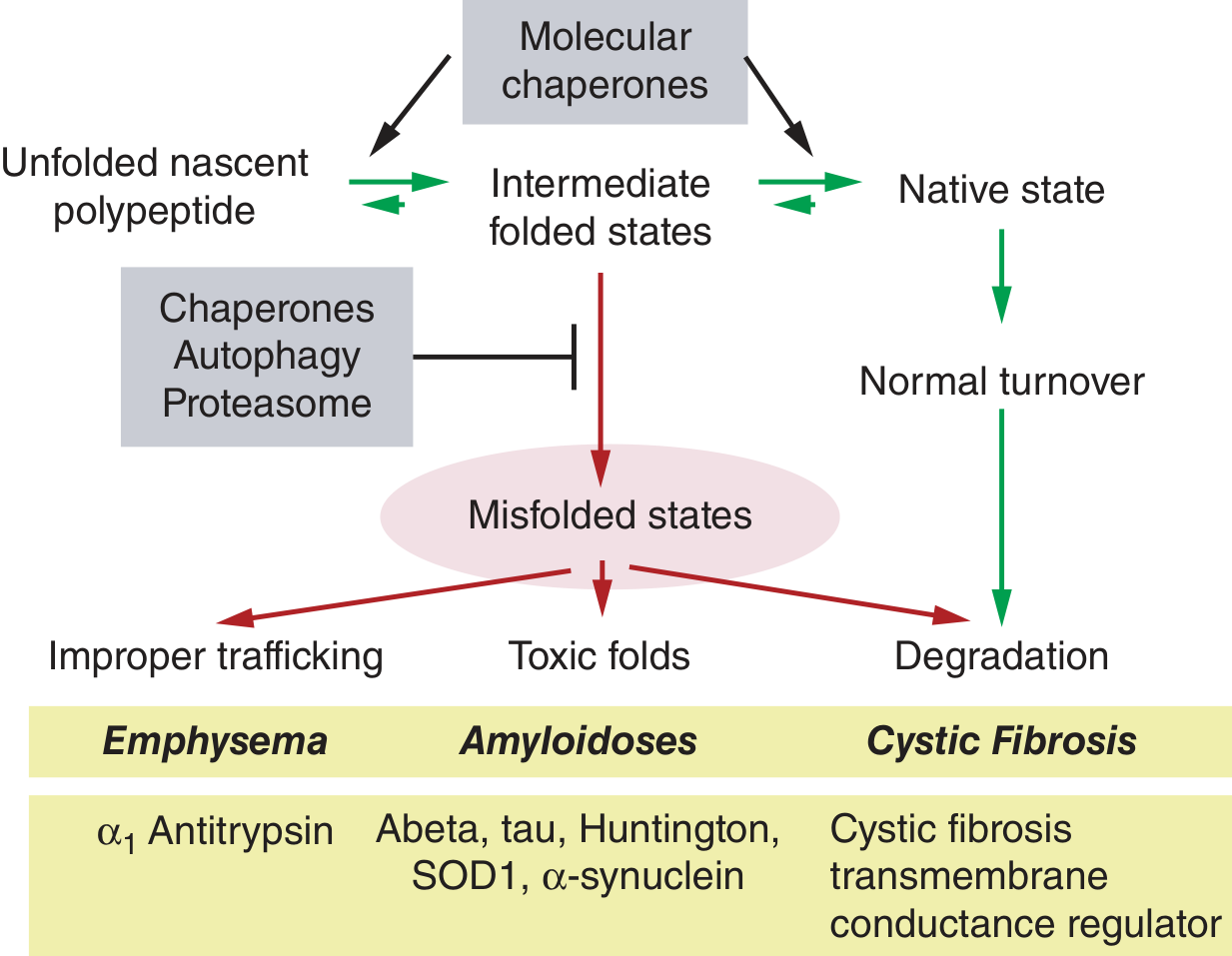
The three arms of proteostasis:
- Chaperones - promote correct folding / refolding
- Ubiquitin-Proteasome System (UPS) - E1-E2-E3 enzyme cascade tags misfolded proteins with ubiquitin chains for proteasomal degradation
- Autophagy-Lysosomal Pathway (ALP) - handles large aggregates and damaged organelles
Heat Shock Response (HSR)
The HSR is an evolutionarily conserved cellular defense against proteotoxicity:
- Trigger: Heat, hypoxia, UV, oxidative stress, chemicals - cause protein misfolding
- Sensor: HSF-1 (Heat Shock Factor 1) - transcription factor
- Normally: HSF-1 exists as an inactive monomer in cytoplasm, bound and repressed by HSP70 and HSP90
- Upon stress:
- HSP70/90 are titrated away to bind misfolded proteins
- Free HSF-1 trimerizes and translocates to nucleus
- Binds Heat Shock Elements (HSE) in promoters of HSP genes
- Massive upregulation of HSPs
- Attenuation: When stress resolves, HSP70 re-binds HSF-1, causing dissociation from trimer back to inactive monomer
Unfolded Protein Response (UPR) - ER Chaperones
When misfolded proteins accumulate in the ER beyond chaperone capacity:
- Sensor: GRP78/BiP - master ER chaperone; normally bound to and silencing three ER stress sensors
- Activation: BiP is titrated away to misfolded proteins, releasing three stress sensors:
- IRE1 (→ splices XBP1 mRNA → transcription of ER chaperones)
- ATF6 (→ translocates to Golgi → cleaved → activates chaperone genes)
- PERK (→ phosphorylates eIF2α → global reduction in protein translation)
- Outcomes:
- Upregulation of ER chaperones (calnexin, BiP, PDI)
- ERAD (ER-Associated Degradation) - misfolded proteins retrotranslocated to cytoplasm and degraded by UPS
- If stress is irreversible → apoptosis via CHOP
(Source: Robbins & Cotran Pathologic Basis of Disease)
Pathological Significance of Chaperone Dysfunction
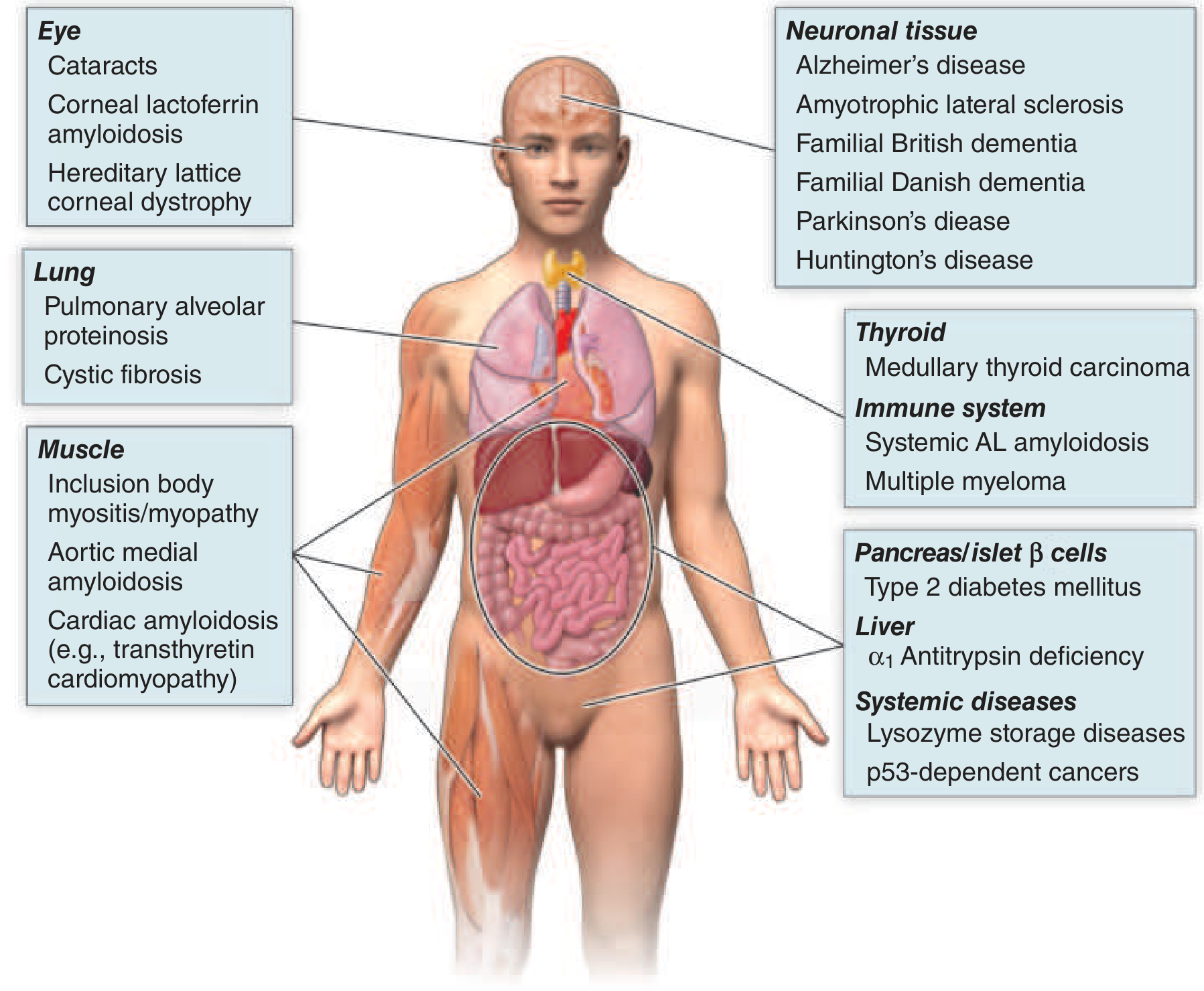
1. Neurodegenerative Diseases (Toxic Folds / Amyloidoses)
When chaperones fail to clear misfolded proteins, toxic aggregates accumulate:
| Disease | Misfolded Protein | Aggregate |
|---|---|---|
| Alzheimer's disease | β-amyloid (Aβ), Tau | Senile plaques, neurofibrillary tangles |
| Parkinson's disease | α-synuclein | Lewy bodies |
| Huntington's disease | Huntingtin (polyQ expansion) | Nuclear inclusions |
| ALS | SOD1, TDP-43 | Cytoplasmic inclusions |
| Prion diseases | PrP^C → PrP^Sc | Spongiform encephalopathy |
2. Improper Protein Trafficking
- α1-Antitrypsin Deficiency: Mutant α1-AT is misfolded, retained by ER chaperones (BiP), not secreted to lungs → emphysema; accumulation in hepatocytes causes liver cirrhosis
3. Premature Protein Degradation
- Cystic Fibrosis: ΔF508 CFTR mutation causes misfolding; BiP recognizes and retains it in ER; CFTR is degraded before reaching the cell surface → absent Cl⁻ transport
4. Cancer
- HSF-1 is constitutively activated in cancer cells
- HSP90 stabilizes oncoproteins (HER2/ERBB2, BCR-ABL, mutant p53)
- Overexpression of HSP70 suppresses apoptosis by blocking cytochrome c-mediated caspase activation
- HSP27 inhibits apoptosis by sequestering cytochrome c and blocking Bax oligomerization
- Clinical significance: HSP90 inhibitors (geldanamycin, 17-AAG) are in clinical trials as anticancer agents
5. Aging
- Chaperone activity declines with age
- Mutant mice deficient in HSP family chaperones age rapidly
- Mice overexpressing such chaperones are long-lived
- Loss of proteostasis in aging underlies age-related neurodegeneration
(Source: Robbins & Cotran Pathologic Basis of Disease, Ch. 2 - Cellular Responses to Stress and Toxic Insults)
Chaperones and Immunity
- HSP60, HSP70, HSP90 are immunogenic - act as "danger signals"
- Released from stressed/dying cells; activate dendritic cells and macrophages via TLR2/TLR4
- HSPs act as natural adjuvants - carry antigenic peptides from tumor cells and present them to the immune system
- Basis for HSP-peptide vaccine development in cancer immunotherapy
Summary Table
| Feature | Details |
|---|---|
| Definition | Proteins that assist folding, assembly, transport of other proteins |
| Major families | HSP100, HSP90, HSP70, HSP60, HSP40, small HSPs; ER chaperones (BiP, calnexin, PDI) |
| Mechanism | ATP-driven cycles of binding/release of hydrophobic segments |
| Regulation | HSF-1 (cytoplasmic) / BiP (ER) act as master sensors |
| Normal functions | Co-translational folding, refolding after stress, protein assembly, transport across membranes |
| Disease when defective | Neurodegeneration, amyloidosis, cancer, cystic fibrosis, α1-AT deficiency, aging |
| Therapeutic relevance | HSP90 inhibitors (anti-cancer), HSP-peptide vaccines |
Exam Writing Strategy for RGUHS 10-Marker:
Structure as: (1) Definition + Historical note [1 mark], (2) Classification with table [2 marks], (3) Mechanism of action - HSP70 cycle + Chaperonin barrel [2 marks], (4) Heat Shock Response / UPR - regulation [2 marks], (5) Pathological significance in disease with examples [2 marks], (6) Therapeutic relevance [1 mark]. Always draw the HSP70 cycle and the proteostasis network diagram for full marks.
Sources:
- Harrison's Principles of Internal Medicine, 22nd Ed., Ch. 504 - Protein Folding Diseases
- Robbins & Cotran Pathologic Basis of Disease, Ch. 1 & Ch. 2
This is a shared conversation. Sign in to Orris to start your own chat.