
Tibia
Reading File
Finding Sources
Searching Images
tibia anatomy bone
Reading File
Reading File
Reading File
Loading Image
Reading File
Loading Image
Here is a comprehensive overview of the tibia based on authoritative anatomy and imaging textbooks.
The Tibia
The tibia is the second largest bone in the body and is located anteromedially in relation to the fibula in the leg. It expands at both ends, articulating with the femur at the knee and the talus at the ankle. — Imaging Anatomy: Bones, Joints, Vessels and Nerves
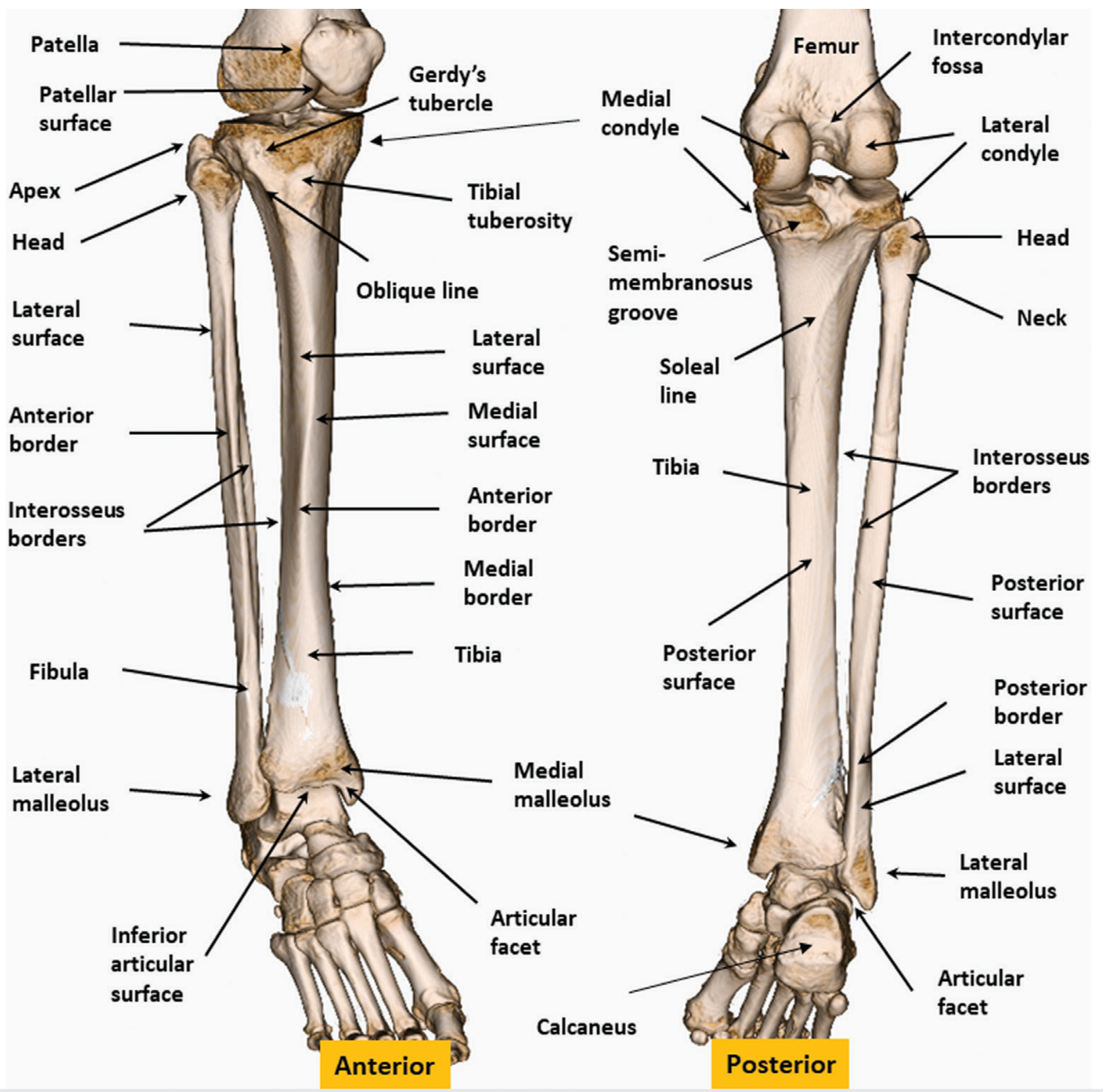
Regions
1. Proximal Tibia
- Expanded by the medial and lateral condyles, which facilitate weight bearing.
- The condyles articulate with the distal femoral condyles.
- The superior surfaces form the medial and lateral tibial plateaus (flat articulating surfaces).
- The intercondylar eminence lies between the two plateaus and consists of the medial and lateral intercondylar tubercles (spines). The anterior and posterior intercondylar areas are attachment sites for the ACL and PCL, respectively.
- The tibial tuberosity lies anteriorly, just inferior to the condyles — the attachment point of the patellar tendon.
- Gerdy's tubercle is a bony prominence on the anterolateral aspect, where the iliotibial tract inserts.
2. Shaft (Body)
The shaft has three borders and three surfaces:
| Borders | Features |
|---|---|
| Anterior border | Begins at the tibial tuberosity; palpable subcutaneously |
| Medial border | Convex, smooth; saphenous nerve and great saphenous vein course along it |
| Lateral (interosseous) border | Attachment of the interosseous membrane connecting tibia to fibula |
| Surfaces | Features |
|---|---|
| Medial surface | Wide and flat; covered proximally by pes anserinus (sartorius, gracilis, semitendinosus); otherwise subcutaneous |
| Posterior surface | Bears the soleal line (a diagonal ridge) where the soleus originates; contains the nutrient foramen (largest in the body) |
| Lateral surface | Site of origin of tibialis anterior proximally |
3. Distal Tibia
- Widens distally to aid weight bearing.
- The medial malleolus — a smooth convex projection on the medial side — articulates with the tarsal bones to form the ankle joint (talocrural joint).
- Laterally, the fibular notch is where the fibula binds at the tibiofibular syndesmosis.
- Posteriorly: a malleolar sulcus transmits the tibialis posterior and flexor digitorum longus tendons; a separate groove lodges the flexor hallucis longus.
Muscle Attachments
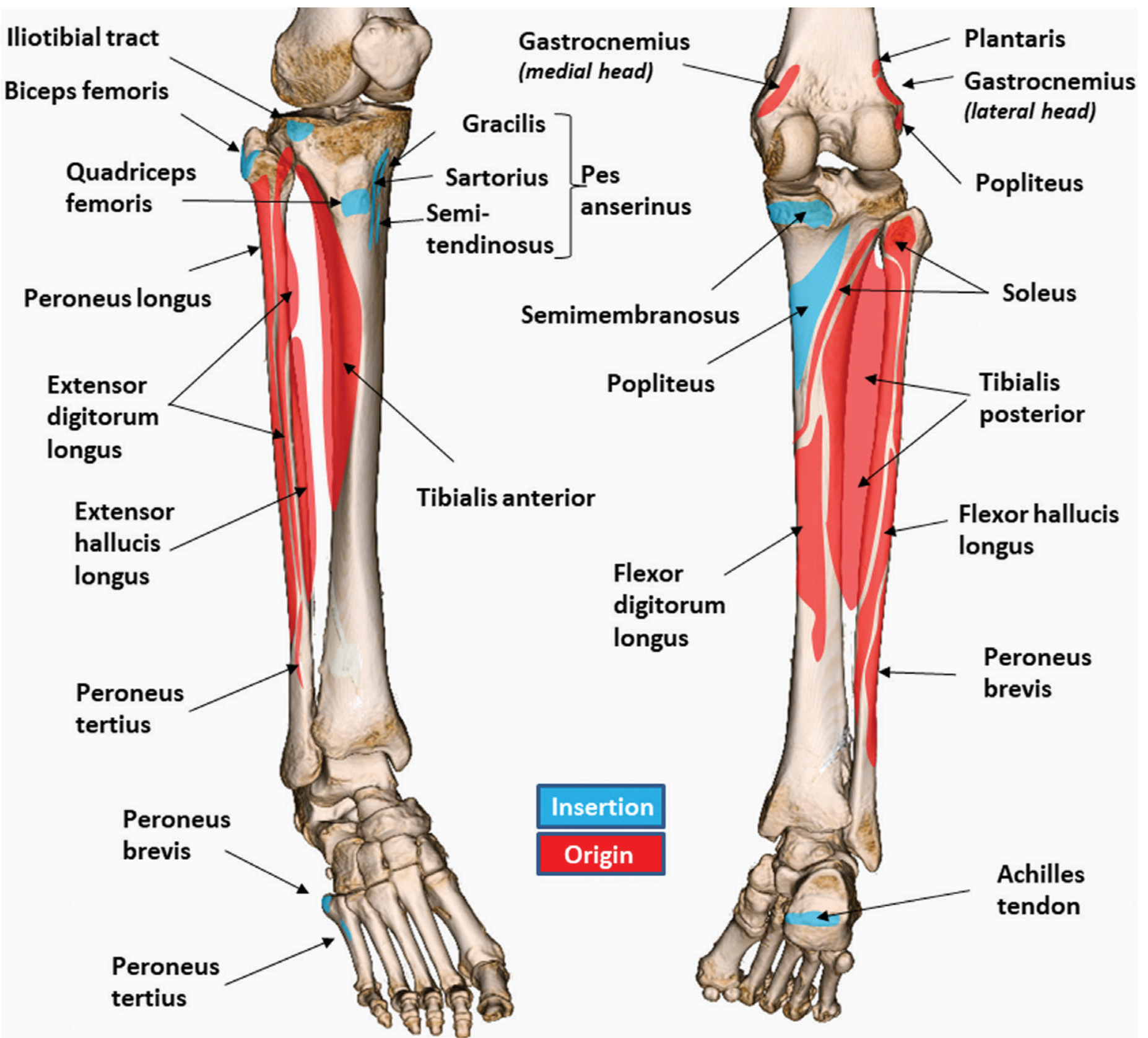
| Muscle | Attachment |
|---|---|
| Quadriceps femoris | Inserts via patellar tendon into tibial tuberosity |
| Pes anserinus (sartorius, gracilis, semitendinosus) | Inserts on proximal medial surface |
| Semimembranosus | Inserts on posterior medial condyle |
| Popliteus | Inserts on posterior proximal shaft |
| Tibialis anterior | Originates from proximal anterolateral shaft |
| Tibialis posterior | Originates from posterior surface / upper interosseous membrane |
| Soleus | Originates from soleal line |
| Extensor digitorum longus | Originates lateral to tibialis anterior |
| Flexor digitorum longus | Originates from posterior surface |
Key Articulations
| Joint | Bones | Type |
|---|---|---|
| Tibiofemoral | Tibia + femur | Synovial (condylar) |
| Superior tibiofibular | Lateral tibial condyle + fibular head | Synovial (arthrodial) |
| Inferior tibiofibular (syndesmosis) | Distal tibia + fibula | Fibrous |
| Ankle (talocrural) | Distal tibia/fibula + talus | Synovial (hinge) |
Blood Supply
The nutrient foramen on the posterior surface of the proximal tibia is the largest nutrient foramen in the body. The tibial nutrient artery enters here and is a critical structure in fracture healing — damage to it can lead to delayed union or non-union of tibial fractures.
Clinical Relevance
- Tibial tuberosity: vulnerable to traction apophysitis (Osgood-Schlatter disease) in adolescents.
- Medial surface: subcutaneous and unprotected — vulnerable to direct trauma and stress fractures.
- Proximal tibia: used as an intraosseous access site in emergencies (red marrow in adults).
- Tibial plateau fractures: classified by Schatzker classification (I–VI); high-energy fractures (type VI) often require circular wire or plate fixation.
- Tibial shaft fractures: the most common long bone fracture; often managed with intramedullary nailing.
- Medial malleolus: commonly fractured in ankle injuries (part of bimalleolar / trimalleolar fracture patterns).
This is a shared conversation. Sign in to Orris to start your own chat.