
Hypocalcaemia management
Reading File
Now I'll search the medical library and PubMed in parallel for comprehensive hypocalcaemia management coverage.
Finding Sources
Searching PubMed
"hypocalcemia"[MeSH Terms] AND "management"[MeSH Terms]
Finding Sources
Searching PubMed
"hypocalcemia" AND "treatment"
Good results. Now I'll read the most clinically relevant sections in parallel — Rosen's Emergency Medicine (acute/EM management), Family Medicine (general management), and Henry's Clinical Diagnosis (lab/treatment), plus search for treatment paragraphs.
Reading File
Reading File
Reading File
Excellent content. Now let me read more from Rosen's EM for the acute treatment section, and also get the Cummings Otolaryngology section (post-surgical hypocalcaemia) and search for specific treatment paragraphs.
Reading File
Finding Sources
Excellent — very rich content. Let me now read the Brenner & Rector treatment table and Comprehensive Clinical Nephrology treatment section, plus the Rosen's EM remaining management text.
Reading File
Reading File
Reading File
I now have comprehensive content. Let me also get the Brenner & Rector adult treatment section and Tintinalli's treatment table.
Reading File
Reading File
I now have comprehensive, multi-source coverage. Let me fetch the diagnostic algorithm image from Brenner & Rector and compile the full answer.
Loading Image
I now have everything needed for a comprehensive, well-cited response.
Hypocalcaemia: Management
Definition & Diagnostic Thresholds
- Total serum calcium < 8.5 mg/dL (2.1 mmol/L); or ionised calcium < 4.4 mg/dL (1.1 mmol/L)
- Always correct for albumin: for every 1 g/dL drop in albumin below 4 g/dL, measured calcium falls ~0.8 mg/dL — but ionised calcium is not affected and is more accurate
- Ionised calcium < 0.8 mmol/L = severe; > 0.8 mmol/L = moderate
Diagnostic Approach
Use the algorithm below (based on serum albumin → urinary calcium → PTH → phosphate):
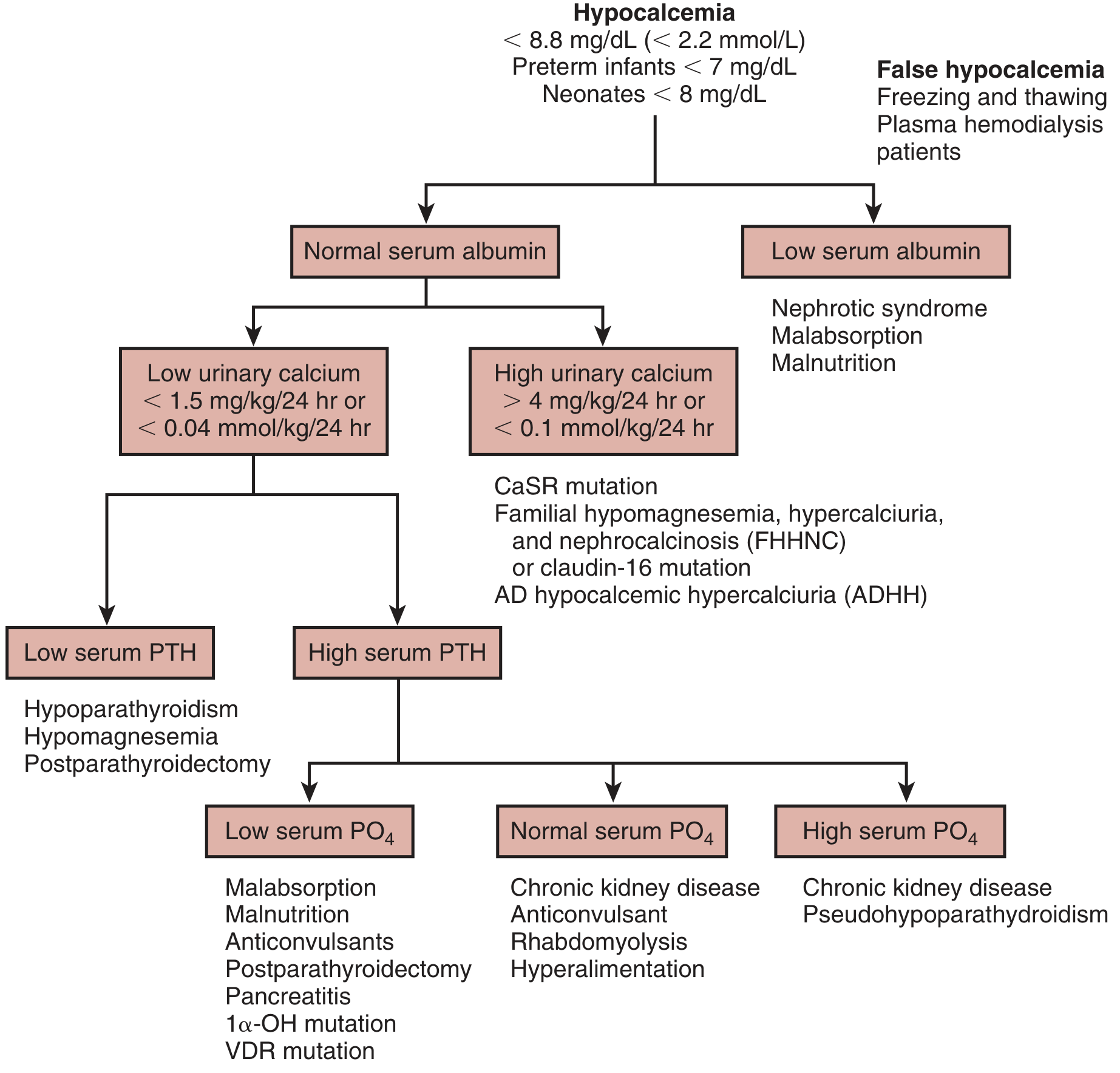
Key investigations: serum albumin, ionised calcium, phosphate, PTH, magnesium, creatinine, 25(OH)D, 24-hour urinary calcium.
Common Causes (Quick Reference)
| Category | Examples |
|---|---|
| Most common | Hypoalbuminaemia, chronic renal failure, hypomagnesaemia |
| PTH deficiency | Post-surgical (thyroidectomy/parathyroidectomy), autoimmune, infiltrative, DiGeorge syndrome |
| PTH resistance | Pseudohypoparathyroidism (Albright hereditary osteodystrophy) |
| Vitamin D | Deficiency (malnutrition, malabsorption, liver disease, lack of sunlight), VDR mutation |
| Acute causes | Pancreatitis, massive blood transfusion (citrate toxicity), rhabdomyolysis, tumour lysis syndrome, sepsis |
| Drugs | Bisphosphonates, phenytoin, calcitonin, cinacalcet, proton pump inhibitors |
| Other | Respiratory alkalosis (shifts ionised Ca²⁺ to bound state), hydrofluoric acid/ethylene glycol toxicity |
Clinical Features
Neuromuscular (predominant):
- Perioral and fingertip paraesthesias, muscle cramps, tetanic contractions
- Chvostek sign — facial twitching on tapping the facial nerve (less specific)
- Trousseau sign — carpal spasm when BP cuff inflated 20 mmHg above systolic for 3 minutes (more specific)
- Laryngospasm, bronchospasm, generalised seizures (severe)
Cardiovascular:
- QT prolongation (ST segment lengthening on ECG — can mimic MI)
- Dysrhythmias, hypotension, heart failure, cardiovascular collapse
- Calcium < 8.95 mg/dL carries a 2.3-fold higher risk of sudden cardiac death
Chronic features: cataracts, poor dentition, dry skin, coarse hair, extrapyramidal symptoms (in pseudohypoparathyroidism)
Management
Step 1 — Determine Severity
| Severity | Features | Approach |
|---|---|---|
| Mild / asymptomatic | Mildly low Ca, no symptoms | Oral supplementation |
| Moderate asymptomatic | Ionised Ca > 0.8 mmol/L, no tetany | IV calcium gluconate intermittent boluses |
| Severe / symptomatic | Tetany, seizures, dysrhythmia, ionised Ca < 0.8 mmol/L | IV calcium immediately |
Acute / Severe Symptomatic Hypocalcaemia
First-line: IV Calcium Gluconate (preferred over calcium chloride — less risk of tissue necrosis on extravasation)
- Initial bolus: 1–2 g calcium gluconate (10–20 mL of 10% solution) in 50 mL of 5% dextrose or normal saline, given IV over 10–20 minutes, with continuous ECG monitoring
- 10 mL of 10% calcium gluconate = 93 mg elemental calcium
- Maintenance infusion: 0.3–1.0 mg elemental Ca/kg/hour; titrate to keep calcium at the lower end of normal
- Ionised calcium should be rechecked every 4–6 hours initially
Calcium chloride (272 mg elemental Ca per 10 mL): more elemental calcium but caustic — use via central venous access only; reserve for critically ill without central line
ECG monitoring is mandatory throughout IV calcium therapy.
The infusion solution must not contain phosphates or bicarbonates (precipitation risk).
Moderate Asymptomatic Hypocalcaemia
- Repeat doses of 1–2 g calcium gluconate IV every 4 hours without continuous infusion
- Oral calcium and calcitriol can be started in parallel
Chronic / Maintenance Therapy (Oral)
Oral calcium salts — elemental calcium content varies:
| Salt | Elemental Ca content |
|---|---|
| Calcium carbonate | 40% (highest — preferred) |
| Calcium chloride | 36% |
| Calcium lactate | 12% |
| Calcium gluconate | 8% |
- Start at 500–1000 mg elemental calcium/day, increase up to 1000–2000 mg/day
- Target: low-normal serum calcium (correcting to full normal increases hypercalciuria risk)
Vitamin D — essential for chronic hypocalcaemia, especially hypoparathyroidism:
- Calcitriol (1,25-dihydroxyvitamin D) — active form, preferred in hypoparathyroidism and CKD; bypasses need for renal 1α-hydroxylation
- Colecalciferol (vitamin D3) or ergocalciferol — for nutritional deficiency
- Vitamin D receptor agonists are the conventional treatment for hypoparathyroidism
Thiazide diuretics — useful adjunct in hypoparathyroidism:
- Reduce urinary calcium excretion, thereby protecting against nephrocalcinosis/nephrolithiasis caused by high-dose calcium and active vitamin D
- Combine with low-salt diet for maximal effect
Treat Concurrent Electrolyte Abnormalities (Critical)
- Hypomagnesaemia must be corrected first — low Mg causes end-organ PTH resistance and inhibits PTH release, making hypocalcaemia refractory to treatment
- Oral: magnesium oxide/carbonate 100–300 mg elemental Mg/day
- IV: magnesium sulfate 20–40 mmol/day in D5W
- Hyperphosphataemia — correct with dietary phosphate restriction ± phosphate binders; consider dialysis if severe
- Alkalosis — correct respiratory or metabolic alkalosis, which worsens ionised hypocalcaemia by shifting Ca to bound state
Hypoparathyroidism-Specific Management
- Conventional: calcitriol + oral calcium ± thiazide
- PTH replacement (emerging/specialist):
- Teriparatide (PTH 1-34): 20 µg SC twice daily (off-label for hypoparathyroidism)
- PTH 1-84: 100 µg every other day; studied in 30 hypoparathyroid patients over 24 months with improvement/normalisation of calcium
- TransCon PTH (palopegteriparatide): Phase 3 RCT (PaTHway trial, 2025) showed efficacy and safety at 52 weeks [PMID: 39376010]
Post-Parathyroidectomy / "Hungry Bone Syndrome"
- Occurs after parathyroid or thyroid surgery due to massive calcium redistribution into bone
- Requires large doses of IV then oral calcium and active vitamin D for prolonged periods
- Monitor closely and frequently for rebound hypercalcaemia, hyperphosphataemia, and hypercalciuria
Special Populations
Neonates/Infants (symptomatic):
- Calcium gluconate 10% IV: 1 mL/kg (9 mg elemental Ca/mL) at 1 mL/min over 10 minutes; repeat as needed
- Continuous elemental Ca infusion: 1–3 mg/kg/hr if tetany/seizures persist
- If hypomagnesaemia: magnesium sulfate 50% solution, 0.1 mL/kg IV or IM
Asymptomatic infants: calcium carbonate oral, 50 mg elemental Ca/kg/day in 4 divided doses
Renal failure: use calcitriol (not standard vitamin D); monitor for hypercalciuria and hyperphosphataemia; dialysis if severe hyperphosphataemia
Monitoring
- Ionised calcium every 4–6 hours during IV therapy
- Serum Mg, phosphate, PTH, 25(OH)D — guide underlying cause
- ECG — monitor QT interval throughout acute management
- Once stable: regular outpatient monitoring to prevent hypercalciuria → nephrocalcinosis (especially in hypoparathyroidism)
Sources:
- Rosen's Emergency Medicine, 9th ed., Ch. 114
- Brenner and Rector's The Kidney, 2-Volume Set, Ch. 73
- Comprehensive Clinical Nephrology, 7th ed., Ch. 11
- Textbook of Family Medicine, 9th ed., Ch. 35
- Tintinalli's Emergency Medicine, Ch. 132
- TransCon PTH Phase 3 RCT (PaTHway trial) [PMID: 39376010] — 52-week data supporting PTH replacement in hypoparathyroidism
This is a shared conversation. Sign in to Orris to start your own chat.