
Full anatomy study cover with zero knowledge about it as 1st year
Reading File
Now let me check what anatomy books are available and pull foundational content for a 1st-year student.
Finding Sources
Searching the Web
first year medical anatomy topics syllabus complete overview 2025
Now let me pull the TOC and key foundational content from the best resources - Gray's Anatomy for Students and the THIEME General Anatomy book:
Finding Sources
Finding Sources
Reading File
Finding Sources
Reading File
Finding Sources
Reading File
Reading File
Reading File
I now have excellent foundational content from Gray's Anatomy for Students. Let me compile the full comprehensive study guide:
Loading Image
Loading Image
I now have everything I need for a thorough, beginner-to-confident 1st year anatomy study guide. Here it is:
🧠 Complete 1st Year Anatomy Study Guide
From Zero Knowledge to Exam-Ready
Based on Gray's Anatomy for Students & THIEME Atlas of Anatomy
MODULE 1 - What Is Anatomy? (Start Here)
Anatomy is the study of the structure of the body. The word comes from the Greek temnein meaning "to cut" - because historically it was learned through cadaver dissection.
Two main types:
- Gross (Macroscopic) Anatomy - structures visible to the naked eye
- Histology (Microscopic Anatomy) - cells and tissues studied under a microscope
Two ways to study anatomy:
| Approach | How it works | Strength |
|---|---|---|
| Regional | Study one body region at a time (thorax, abdomen, limbs, etc.) - all structures in that region together | Best for dissection labs |
| Systemic | Follow one system (e.g. cardiovascular) through the whole body | Best for understanding whole-body continuity |
Study tip: Most med school courses use the regional approach. Think of each region as a "chapter" you fully master before moving on.
MODULE 2 - Anatomical Language (Must Memorize)
Before studying any structure, you need to speak the language of anatomy. Everything is described relative to the anatomical position.
The Anatomical Position
Standing upright, feet together, face forward, palms facing forward, fingers straight. This is the universal reference point for ALL anatomical descriptions.
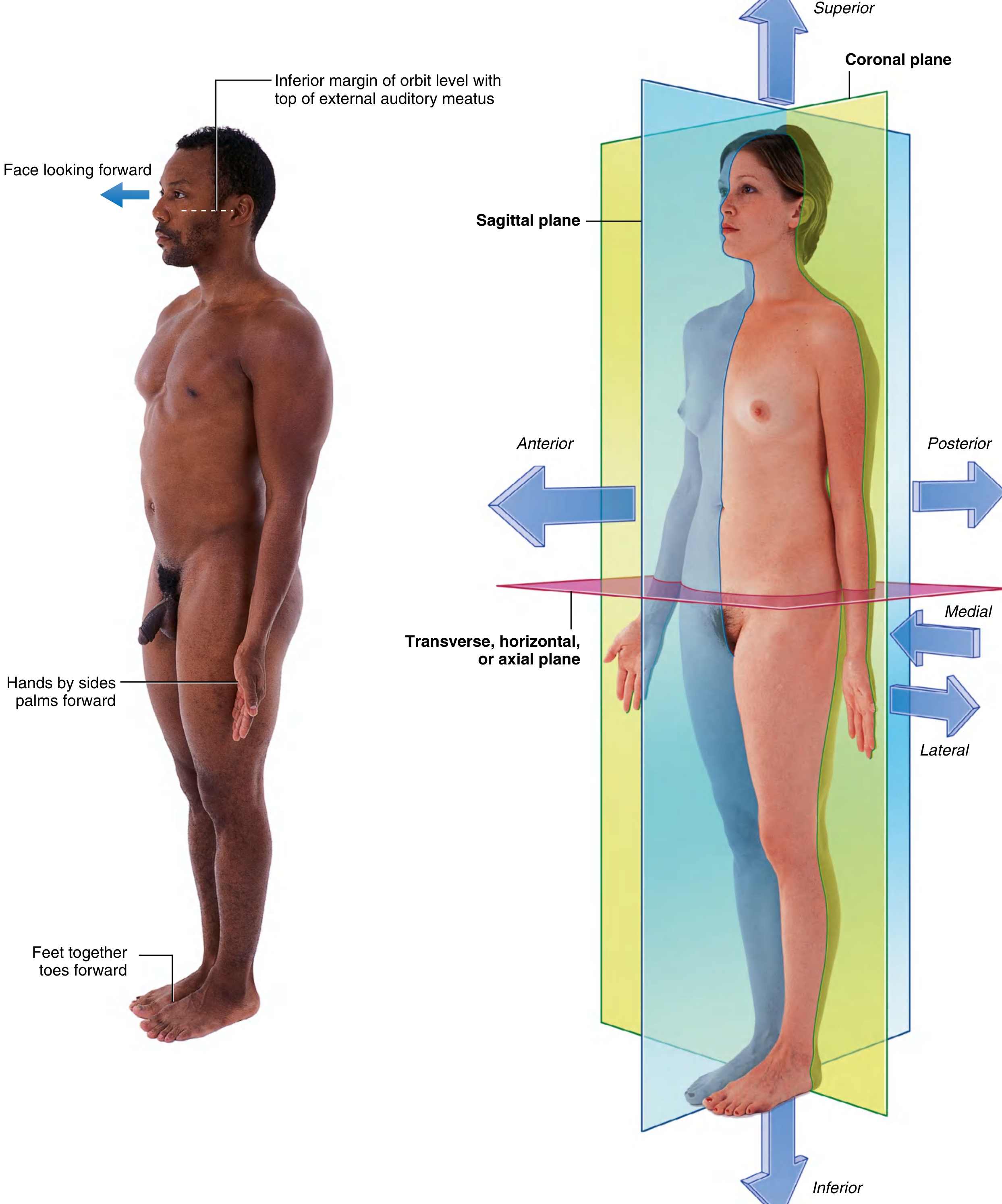
The 3 Anatomical Planes
| Plane | Orientation | Divides body into |
|---|---|---|
| Coronal (Frontal) | Vertical | Anterior (front) & Posterior (back) |
| Sagittal | Vertical, perpendicular to coronal | Right & Left; the midline version = median sagittal plane |
| Transverse (Axial/Horizontal) | Horizontal | Superior (top) & Inferior (bottom) |
Directional Terms - The Core Vocabulary
| Term | Opposite | Meaning |
|---|---|---|
| Anterior (ventral) | Posterior (dorsal) | Front / Back |
| Medial | Lateral | Toward midline / Away from midline |
| Superior | Inferior | Above / Below |
| Proximal | Distal | Closer to origin / Farther from origin |
| Superficial | Deep | Closer to surface / Farther from surface |
| Ipsilateral | Contralateral | Same side / Opposite side |
| Cranial | Caudal | Toward head / Toward tail |
Examples to cement these:
- The nose is anterior to the ears
- The thumb is lateral to the little finger
- The hand is distal to the elbow
- The heart is deep to the sternum
- The right hand and right foot are ipsilateral
MODULE 3 - Body Systems Overview
The human body has 11 major systems. In 1st year anatomy you focus heavily on skeletal, muscular, nervous, and cardiovascular systems.
| System | Main Components | Function |
|---|---|---|
| Skeletal | Bones, cartilage, joints | Support, protection, movement, blood cell production |
| Muscular | Skeletal, cardiac, smooth muscle | Movement, posture, heat production |
| Nervous | Brain, spinal cord, nerves | Control, communication, sensation |
| Cardiovascular | Heart, arteries, veins, capillaries | Circulation of blood |
| Lymphatic | Lymph nodes, vessels, spleen, thymus | Immunity, fluid balance |
| Respiratory | Lungs, airways | Gas exchange (O2/CO2) |
| Digestive | GI tract, liver, pancreas | Digestion, absorption |
| Urinary | Kidneys, ureters, bladder, urethra | Filtration, excretion |
| Reproductive | Gonads, ducts, accessory glands | Reproduction |
| Endocrine | Glands (pituitary, thyroid, adrenals, etc.) | Hormone secretion |
| Integumentary | Skin, hair, nails | Protection, sensation, thermoregulation |
MODULE 4 - The Skeletal System
Axial vs. Appendicular Skeleton
The skeleton has 206 bones in adults, divided into two groups:
- Axial skeleton (80 bones) - the central axis: skull, vertebral column, ribs, sternum
- Appendicular skeleton (126 bones) - the limbs + their girdles (shoulder + pelvis)
Cartilage - The Other Skeletal Tissue
Cartilage is avascular (no blood vessels), aneural (no nerves), and is nourished by diffusion.
| Type | Key Feature | Where Found |
|---|---|---|
| Hyaline | Most common; moderate collagen | Joint surfaces (articular cartilage), costal cartilage, trachea rings |
| Elastic | High elastic fiber content | External ear (pinna), epiglottis |
| Fibrocartilage | Dense collagen, very tough | Intervertebral discs, menisci of the knee, pubic symphysis |
Bone Types by Shape
| Type | Example |
|---|---|
| Long bones | Femur (thigh), humerus (upper arm) |
| Short bones | Carpals (wrist), tarsals (ankle) |
| Flat bones | Skull, scapula, sternum |
| Irregular bones | Vertebrae, facial bones |
| Sesamoid bones | Patella (kneecap) |
Bone Structure
Bone has two layers:
- Cortical (compact) bone - dense outer shell, provides strength
- Cancellous (spongy/trabecular) bone - honeycomb inner structure, houses red bone marrow (makes blood cells)
Functions of bone:
- Mechanical support (framework for the body)
- Protection of vital organs (skull protects brain, ribs protect heart/lungs)
- Movement (lever system with muscles)
- Mineral storage (calcium and phosphate reservoir)
- Haematopoiesis (blood cell production in red marrow)
Bone Development (Ossification)
- Intramembranous ossification - flat bones of skull form directly from mesenchymal tissue
- Endochondral ossification - long bones form by replacing a cartilage template
- Epiphyseal (growth) plates - areas of cartilage near the ends of long bones where length increase occurs; fuse in late adolescence, ending growth
Clinical note - Avascular Necrosis: When blood supply to bone is cut off (e.g. after a femoral neck fracture in elderly patients), the bone dies. The femoral head is a classic site. This often requires hip replacement surgery.
Clinical note - Epiphyseal Fractures: Growth plates are weaker than the surrounding bone in children. Fractures through growth plates must be treated carefully - damage here can cause uneven bone growth.
MODULE 5 - Joints (Articulations)
A joint is where two skeletal elements meet. There are two broad categories:
Solid Joints (No Cavity)
| Subtype | Joining Material | Example | Movement |
|---|---|---|---|
| Fibrous (Suture) | Dense fibrous tissue | Skull sutures | None (synarthrosis) |
| Fibrous (Syndesmosis) | Fibrous tissue | Inferior tibiofibular joint | Minimal |
| Cartilaginous (Synchondrosis) | Hyaline cartilage | Epiphyseal plates | None |
| Cartilaginous (Symphysis) | Fibrocartilage | Pubic symphysis, intervertebral discs | Slight (amphiarthrosis) |
Synovial Joints (Have a Cavity)
The most common and most mobile joints. Key features:
- Joint (articular) cavity filled with synovial fluid
- Articular cartilage covers bone surfaces (hyaline type)
- Synovial membrane lines the capsule and secretes synovial fluid
- Articular capsule - fibrous outer layer, synovial inner layer
6 Types of Synovial Joints
| Type | Movement | Example |
|---|---|---|
| Hinge | Flexion/Extension only (1 axis) | Elbow, knee, ankle, interphalangeal |
| Pivot | Rotation only (1 axis) | Atlantoaxial (C1-C2), proximal radioulnar |
| Condyloid (Ellipsoid) | Flexion/extension + abduction/adduction (2 axes) | Wrist, metacarpophalangeal joints |
| Saddle | Like condyloid + rotation | Thumb carpometacarpal joint |
| Ball and Socket | All planes + rotation (multiaxial) | Shoulder (glenohumeral), hip |
| Plane (Gliding) | Gliding movements | Facet joints of vertebrae, acromioclavicular |
Joint Movements Vocabulary
| Term | Meaning |
|---|---|
| Flexion | Decreasing the angle at a joint |
| Extension | Increasing the angle at a joint |
| Abduction | Moving away from the midline |
| Adduction | Moving toward the midline |
| Medial (Internal) Rotation | Rotating toward the midline |
| Lateral (External) Rotation | Rotating away from the midline |
| Circumduction | Circular movement combining all above |
| Pronation | Rotating forearm so palm faces down |
| Supination | Rotating forearm so palm faces up |
| Inversion | Sole turns inward (medially) |
| Eversion | Sole turns outward (laterally) |
| Dorsiflexion | Flexion at the ankle (foot up) |
| Plantarflexion | Extension at the ankle (foot down) |
MODULE 6 - Muscles
3 Types of Muscle
| Type | Control | Location | Appearance |
|---|---|---|---|
| Skeletal (Striated) | Voluntary | Attached to bones | Striped under microscope |
| Cardiac | Involuntary | Heart wall | Striped; has intercalated discs |
| Smooth | Involuntary | Hollow organs (gut, vessels, bladder) | No striations |
Skeletal Muscle Structure
- Origin - the more fixed, proximal attachment (usually)
- Insertion - the more mobile, distal attachment (usually)
- Action - what movement the muscle produces when it contracts
Muscle Roles
| Role | Definition | Example |
|---|---|---|
| Agonist (Prime mover) | Main muscle producing movement | Biceps brachii = elbow flexion |
| Antagonist | Opposes the agonist | Triceps brachii = elbow extension |
| Synergist | Helps/stabilizes the agonist | Brachialis assists biceps |
| Fixator | Stabilizes proximal joint | Rotator cuff stabilizes shoulder during arm movement |
Tendons and Ligaments
| Structure | Made of | Connects | Function |
|---|---|---|---|
| Tendon | Dense fibrous CT (collagen) | Muscle to bone | Transmits muscle force |
| Ligament | Dense fibrous CT (collagen) | Bone to bone | Stabilizes joints |
MODULE 7 - Nervous System
Central vs. Peripheral
| Division | Components |
|---|---|
| CNS | Brain + Spinal cord |
| PNS | All nerves outside brain and spinal cord |
Peripheral Nervous System Divisions
- Somatic PNS - voluntary control of skeletal muscle; conscious sensation from skin, muscles, joints
- Autonomic PNS - involuntary control of smooth muscle, cardiac muscle, glands
- Sympathetic ("fight or flight") - increases heart rate, dilates pupils, redirects blood to muscles
- Parasympathetic ("rest and digest") - slows heart rate, stimulates digestion
Nerve Types in the Body
- Afferent (sensory) - carry signals TO the CNS (from receptors)
- Efferent (motor) - carry signals FROM the CNS (to muscles/glands)
- Most peripheral nerves are mixed (contain both)
Spinal Cord and Dermatomes
The spinal cord has 31 segments: 8 cervical (C), 12 thoracic (T), 5 lumbar (L), 5 sacral (S), 1 coccygeal (Co)
A dermatome is the area of skin supplied by a single spinal nerve level.
Key ones to know:
- C5-6: shoulder and lateral arm
- T4: nipple line
- T10: umbilicus
- L1: inguinal region
- L4: medial leg + big toe
- S1: lateral foot + small toe
MODULE 8 - Cardiovascular System
The Heart
Located in the mediastinum (middle compartment of thorax), sits slightly left of midline, enclosed in the pericardium (fibroserous sac).
4 chambers:
- Right atrium - receives deoxygenated blood from body (via superior/inferior vena cava)
- Right ventricle - pumps to lungs (via pulmonary trunk)
- Left atrium - receives oxygenated blood from lungs (via pulmonary veins)
- Left ventricle - pumps to body (via aorta) - has thickest wall
4 valves:
| Valve | Location | Prevents backflow from |
|---|---|---|
| Tricuspid (right AV) | Between RA and RV | RV back into RA |
| Pulmonary | RV exit | Pulmonary trunk back into RV |
| Mitral/Bicuspid (left AV) | Between LA and LV | LV back into LA |
| Aortic | LV exit | Aorta back into LV |
Blood Vessel Types
| Vessel | Wall | Function |
|---|---|---|
| Arteries | Thick, elastic, muscular | Carry blood AWAY from heart (mostly oxygenated) |
| Arterioles | Thin muscular wall | Regulate blood flow to capillaries |
| Capillaries | Single cell layer | Site of gas, nutrient, waste exchange |
| Venules | Thin | Drain capillary beds |
| Veins | Thinner than arteries; have valves | Carry blood TOWARD heart (mostly deoxygenated) |
Exception: Pulmonary arteries carry deoxygenated blood; pulmonary veins carry oxygenated blood.
MODULE 9 - Skin (Integumentary System)
The skin is the largest organ in the body.
Two layers:
- Epidermis - outer layer; stratified squamous epithelium; avascular; varies in thickness
- Dermis - deeper layer; dense vascular connective tissue; contains hair follicles, sweat glands, sebaceous glands, sensory receptors
Fascia (deep to skin):
- Superficial fascia (subcutaneous tissue/hypodermis) - loose CT + fat; allows skin to move over deeper structures; conduit for vessels and nerves
- Deep fascia - dense organized CT; forms compartments for muscle groups; clinically important because it limits spread of infection/tumors
Clinical note - Langer's Lines (Cleavage Lines): Surgical incisions made parallel to these skin tension lines heal better with less scarring.
MODULE 10 - Body Regions (1st Year Regional Study)
The body is divided into these main regions, each forming a major study block:
| Region | Key Contents |
|---|---|
| Back | Vertebral column, spinal cord, deep back muscles, spinal nerves |
| Thorax | Heart, lungs, great vessels, esophagus, trachea; bounded by ribs + sternum + thoracic vertebrae |
| Abdomen | GI organs (stomach, intestines, liver, gallbladder, pancreas, spleen), kidneys, adrenals, aorta, IVC |
| Pelvis and Perineum | Bladder, rectum, reproductive organs, pelvic floor muscles |
| Upper Limb | Shoulder girdle, arm (humerus), forearm (radius + ulna), wrist + hand; brachial plexus |
| Lower Limb | Hip, thigh (femur), leg (tibia + fibula), ankle + foot; lumbosacral plexus |
| Head and Neck | Brain, cranial nerves, eyes, ears, nose, pharynx, larynx, thyroid, vessels |
MODULE 11 - Medical Imaging (Clinically Essential)
Anatomists and clinicians use imaging to "see" anatomy without cutting. You must understand these basics:
| Modality | Uses | Radiation? |
|---|---|---|
| Plain X-ray (Radiograph) | Bones, chest, abdomen; quick and cheap | Yes (low dose: ~0.02 mSv for chest) |
| Computed Tomography (CT) | Cross-sectional views; excellent for chest/abdomen/brain | Yes (higher: ~10 mSv for abdomen/pelvis) |
| MRI | Soft tissue detail (brain, spinal cord, ligaments, cartilage) | No radiation |
| Ultrasound | Soft tissue, vessels (with Doppler), abdominal organs, guided procedures | No radiation |
| Nuclear Medicine (PET/SPECT) | Functional imaging (metabolism, blood flow, cancer detection) | Yes (radioactive tracer) |
Reading a chest X-ray (basics):
- Lungs appear black (air-filled)
- Heart is a white shadow (mediastinum)
- Bones (ribs, vertebrae) appear white
- Soft tissues appear grey
MODULE 12 - How to Study Anatomy Effectively
The 5-Layer Approach for Each Structure
- Name it - learn the terminology
- Locate it - where is it in the body? What surrounds it?
- Describe it - shape, size, texture, layers
- Connect it - what blood supply, nerve supply, lymphatic drainage?
- Apply it - what happens clinically when this structure is damaged?
Study Techniques That Work
- Draw and label - sketching forces active recall far better than re-reading
- Use mnemonics - e.g. for carpal bones: "Some Lovers Try Positions That They Can't Handle" (Scaphoid, Lunate, Triquetrum, Pisiform, Trapezium, Trapezoid, Capitate, Hamate)
- 3D visualization - use apps like Complete Anatomy or BioDigital Human
- Cadaver/prosection and anatomical models when available
- Active recall - cover your notes and test yourself
- Spaced repetition - use Anki for terminology and landmarks
Recommended Resources
| Resource | Best for |
|---|---|
| Gray's Anatomy for Students | Comprehensive textbook; regional approach; excellent clinical cases |
| Netter's Atlas of Human Anatomy | The gold standard atlas; detailed colour illustrations |
| THIEME Atlas of Anatomy | Superb diagrams; system-based and regional |
| Moore's Clinically Oriented Anatomy | Strong clinical correlations throughout |
| Complete Anatomy (3D4Medical app) | Interactive 3D; dissection layers |
Quick-Reference: 1st Year Anatomy Topic Checklist
- Anatomical position, planes, and directional terms
- Body regions and cavities
- Skeletal system: bone types, cartilage, ossification, joints
- Muscular system: types, attachments, actions, nerve supply
- Nervous system: CNS/PNS, spinal cord, dermatomes
- Cardiovascular system: heart chambers/valves, vessels
- Respiratory system: lungs, airways, pleura
- Digestive system: GI tract, accessory organs
- Back: vertebral column, spinal cord anatomy
- Thorax: mediastinum, heart, lungs
- Abdomen: organs, peritoneum, vessels
- Pelvis and perineum: pelvic floor, organs
- Upper limb: bones, muscles, brachial plexus, vessels
- Lower limb: bones, muscles, lumbosacral plexus, vessels
- Head and neck: cranial nerves, major regions
- Neuroanatomy: brain regions, brainstem, cerebellum
- Imaging basics: X-ray, CT, MRI, ultrasound
Sources: Gray's Anatomy for Students (Elsevier), THIEME General Anatomy and Musculoskeletal System Atlas
This guide takes you from absolute zero - understanding what anatomy even is - through all the foundational language, systems, and body regions you'll cover in your first year. Each module above maps to a block of your curriculum. Work through them in order, and once you reach the regional modules (Back through Head and Neck), apply the 5-layer approach to every structure you study.
This is a shared conversation. Sign in to Orris to start your own chat.