
Describe Fertilization and gametogenesis OBG
Reading File
Finding Sources
Finding Sources
The best OBG sources are "The Developing Human" (embryology) and Langman's. Let me read both in parallel.
Reading File
Reading File
Good start. Now let me read more content — spermatogenesis, oogenesis, phases of fertilization sections.
Reading File
Reading File
Excellent. Now let me read the phases of fertilization section and the spermatogenesis/oogenesis details from The Developing Human.
Reading File
Reading File
Now let me get the spermatogenesis and oogenesis detailed content from "The Developing Human."
Reading File
Reading File
I now have comprehensive content. Let me also fetch the key diagrams to include visually.
Loading Image
Loading Image
Loading Image
I now have all the content needed for a comprehensive answer. Let me compose the full response.
Gametogenesis and Fertilization
Sources: The Developing Human: Clinically Oriented Embryology (Moore et al.) & Langman's Medical Embryology
GAMETOGENESIS
Gametogenesis is the process of formation and development of specialized sex cells (gametes — oocytes and spermatozoa) from bipotential primordial germ cells (PGCs). It prepares the gametes for fertilization by:
- Reducing the chromosome number from diploid (46) to haploid (23) via meiosis
- Altering cell morphology (cytodifferentiation)
Primordial Germ Cells (PGCs)
- Formed in the epiblast during the 2nd week
- Move through the primitive streak during gastrulation → migrate to the wall of the yolk sac
- During the 4th week, migrate toward the developing gonads (arriving by end of the 5th week)
- Mitotic divisions increase their number during migration
- Misplaced PGCs may give rise to teratomas (tumors containing derivatives of all three germ layers)
— The Developing Human, p. 75
MEIOSIS — Key Points
Meiosis involves two successive cell divisions:
| Division | What happens |
|---|---|
| Meiosis I (Reduction division) | Homologous chromosomes pair in prophase, then separate → two haploid (secondary) cells, each with 23 double-chromatid chromosomes |
| Meiosis II (Equational division) | Each double-chromatid chromosome splits; chromatids drawn to opposite poles → four haploid cells |
Key functions of meiosis:
- Maintains constant chromosome number across generations (46 → 23)
- Random assortment of maternal/paternal chromosomes
- Crossing over during prophase I → genetic recombination
SPERMATOGENESIS
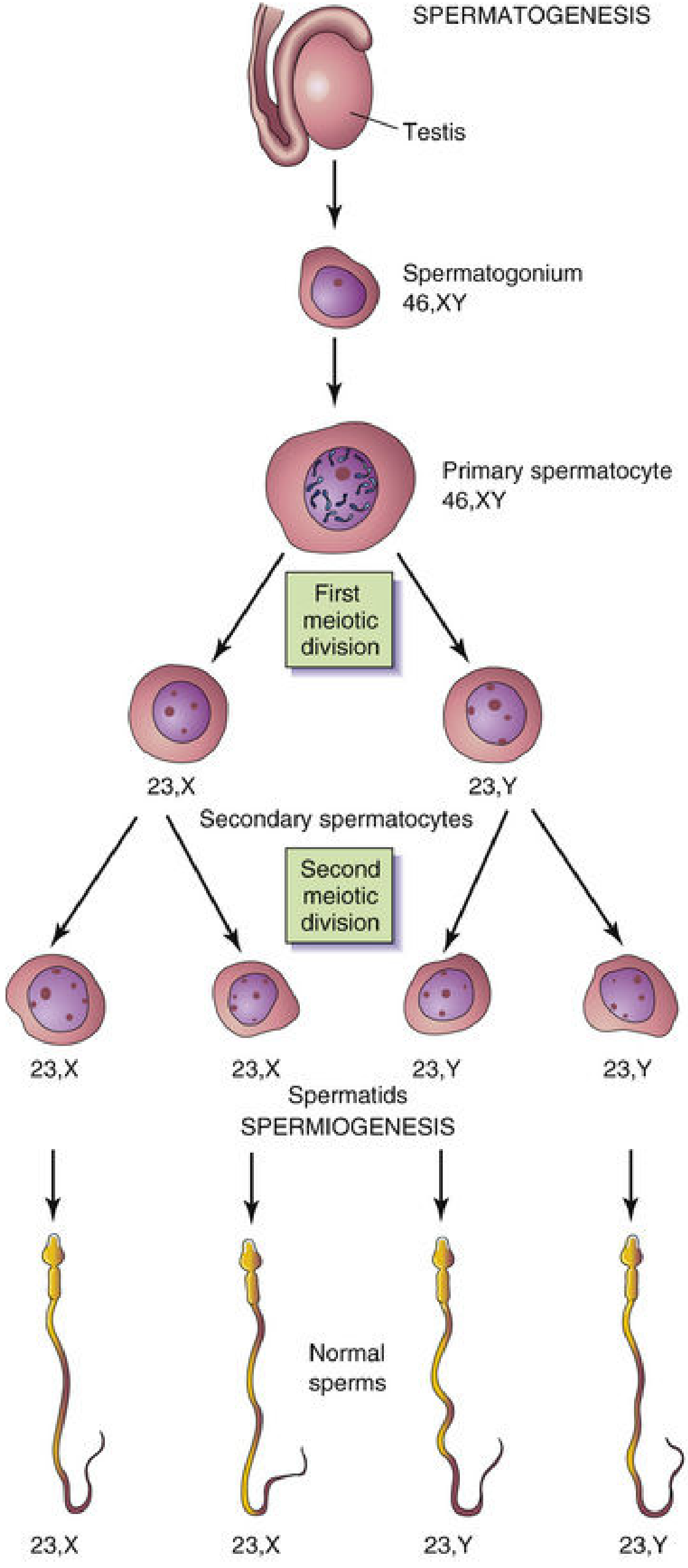
Fig: Normal Spermatogenesis — The Developing Human
Location: Seminiferous tubules of the testes
Onset: Puberty; continuous throughout adult life
Onset: Puberty; continuous throughout adult life
Stages:
- Spermatogonium (46,XY) — stem cell; undergoes mitosis to replenish itself and produce primary spermatocytes
- Primary spermatocyte (46,XY) — undergoes Meiosis I → 2 secondary spermatocytes (23,X and 23,Y)
- Secondary spermatocytes (23,X or 23,Y) — undergo Meiosis II → 4 spermatids
- Spermatids → mature spermatozoa via spermiogenesis (nuclear condensation, acrosome formation, flagellar development)
Net yield: 1 primary spermatocyte → 4 functional spermatozoa
Sperm structure: Head (contains acrosome with hydrolytic enzymes + nucleus), midpiece (mitochondria), and tail (flagellum for motility)
- Two types of sperm: 23,X and 23,Y — determines genetic sex of the embryo
- Up to 10% of ejaculated sperm are morphologically abnormal; those >20% abnormal may affect fertility
OOGENESIS
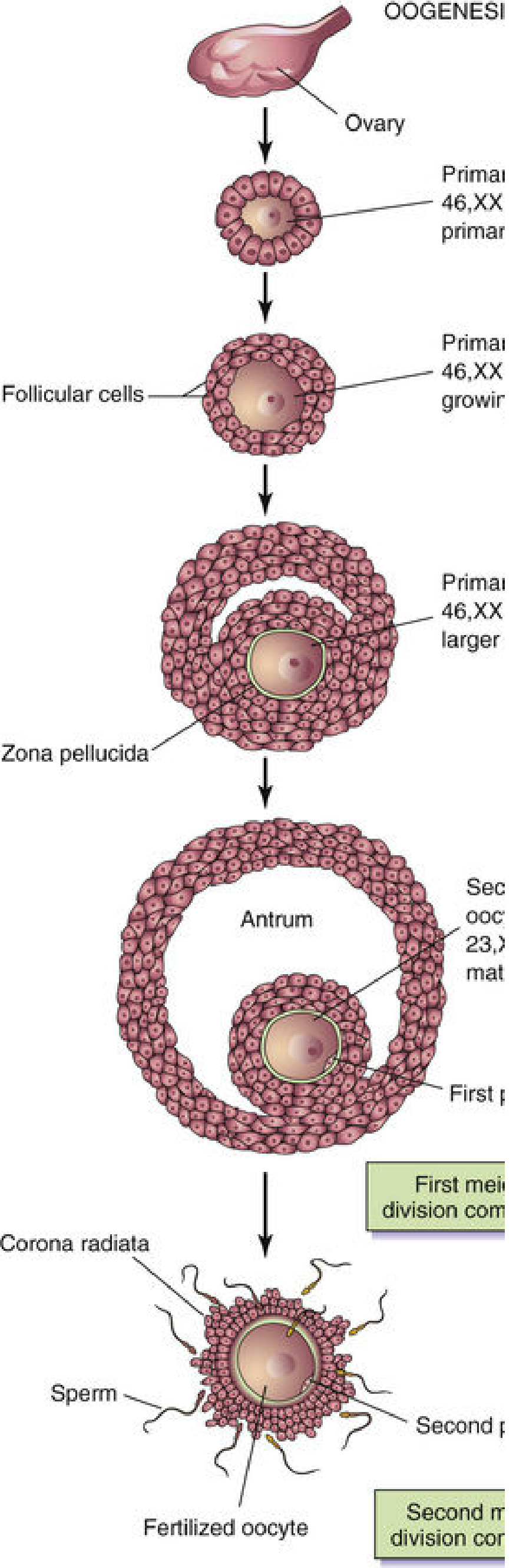
Fig: Normal Oogenesis — The Developing Human
Location: Ovary
Unique feature: Begins before birth; completed only after fertilization
Unique feature: Begins before birth; completed only after fertilization
Stages:
| Stage | Timing | Chromosome status |
|---|---|---|
| Oogonia proliferate by mitosis | Fetal life (2nd–5th month) | 46,XX |
| Primary oocytes (enter Meiosis I) | By birth (~2 million); arrested in prophase I | 46,XX |
| Meiosis I resumes → secondary oocyte + 1st polar body | Puberty onwards, just before ovulation (LH surge) | 23,XX |
| Secondary oocyte ovulated; arrested at metaphase II | Each menstrual cycle | 23,X |
| Meiosis II completed + 2nd polar body expelled | Only if fertilized by a sperm | 23,X |
| Mature oocyte (female pronucleus forms) | After fertilization | Haploid (23,X) |
Net yield: 1 primary oocyte → 1 mature oocyte + 3 polar bodies (polar bodies are non-functional and degenerate)
The asymmetric cytoplasm division conserves cytoplasm in the large oocyte — essential for supporting early embryonic development.
Follicular Development (associated with oogenesis):
- Primordial follicle: Primary oocyte + single layer of flat follicular cells
- Primary follicle: Columnar follicular (granulosa) cells + zona pellucida formation
- Secondary follicle: Multiple granulosa cell layers + theca interna/externa develop + antrum formation
- Mature (Graafian) follicle: Large antrum; oocyte surrounded by cumulus oophorus + corona radiata
- FSH drives growth of 5–12 primordial follicles; only one typically reaches maturity and ovulates
FERTILIZATION
Definition: The process by which sperm and secondary oocyte unite to form a zygote.
Site: Usually the ampulla of the uterine tube (the widest part)
Timing: Oocyte is viable for ~24 hours post-ovulation; sperm viable for ~48–72 hours in the female tract
Pre-Requisites Before Fertilization
Capacitation — occurs in the female reproductive tract (~7 hours):
- Sperm surface glycoproteins and seminal plasma proteins are removed
- Sperm plasma membrane altered → becomes capable of the acrosome reaction
- Sperm motility changes to a hypermotile "whiplash" pattern
Sperm Transport:
- Of 200–300 million sperms deposited in the vagina, only 300–500 reach the fertilization site
- Transported by muscular contractions of the uterine wall and flagellar movement
- Chemical signals (attractants) from the oocyte guide capacitated sperm (sperm chemotaxis)
Phases of Fertilization
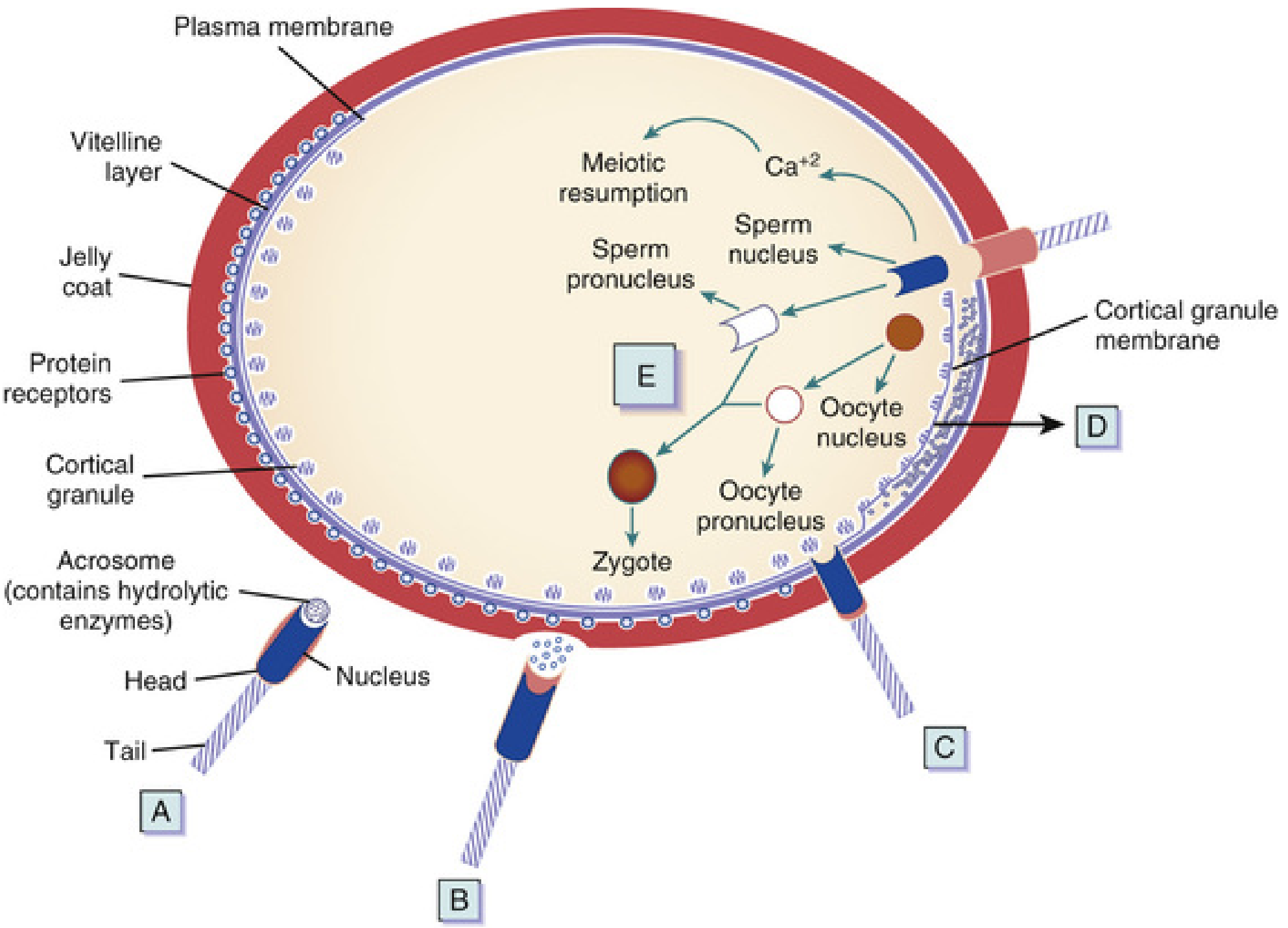
Fig: Molecular events in fertilization — The Developing Human
Phase 1 — Passage through the Corona Radiata
- Hyaluronidase released from the acrosome disperses the follicular cells of the corona radiata
- Tail movements of the sperm assist penetration
Phase 2 — Penetration of the Zona Pellucida
- The sperm binds to ZP3 (zona pellucida glycoprotein) via SED1 protein
- Acrosome reaction triggered: hydrolytic enzymes (esterase, acrosin, neuraminidase) are released
- Acrosin (proteolytic) is the most important enzyme; lysed a path through the zona
- Once one sperm penetrates → Zona reaction (block to polyspermy):
- Cortical granules release lysosomal enzymes into the perivitelline space
- These digest sperm receptors ZP2 and ZP3, making the zona impermeable to further sperm
Phase 3 — Fusion of Cell Membranes
- Plasma membranes of sperm and oocyte fuse
- Head and tail of sperm enter oocyte cytoplasm; sperm's plasma membrane and mitochondria remain behind (mitochondria are maternally inherited)
- Phospholipase C-zeta from the sperm causes a wave of Ca²⁺ release, reactivating cell cycling in the oocyte
Phase 4 — Completion of Meiosis II of the Oocyte
- Sperm penetration activates the secondary oocyte to complete Meiosis II
- Results in a mature oocyte + 2nd polar body
- Maternal chromosomes decondense → female pronucleus forms
Phase 5 — Formation of the Male Pronucleus
- Sperm nucleus enlarges within oocyte cytoplasm → male pronucleus
- Sperm tail degenerates
- Both pronuclei replicate their DNA (1n, 2c)
- The oocyte at this stage is called an ootid
Phase 6 — Syngamy (Fusion of Pronuclei) → Zygote
- Male and female pronuclei fuse → diploid chromosome complement (46)
- Chromosomes arrange on a cleavage spindle in preparation for first mitotic division
- The cell is now a zygote — the first cell of the new individual
Results of Fertilization
| Result | Significance |
|---|---|
| Restoration of diploid number (46) | Genetic continuity maintained |
| Determination of chromosomal sex | 23,X sperm → female (46,XX); 23,Y sperm → male (46,XY) |
| Initiation of cleavage | First mitotic division of zygote begins |
| Genetic uniqueness | New combination of maternal + paternal chromosomes |
| Completion of meiosis II | Oocyte matures only upon fertilization |
Abnormal Gametogenesis
Nondisjunction — failure of chromosome pairs to separate during meiosis:
- Results in gametes with 24 chromosomes (trisomy if fertilized) or 22 (monosomy)
- Trisomy 21 (Down syndrome) is the classic example; risk increases with maternal age
- Ideal maternal age for reproduction: 20–35 years
- Paternal age also matters — advanced age increases fresh gene mutations in offspring
— The Developing Human: Clinically Oriented Embryology, pp. 75–124; Langman's Medical Embryology, pp. 34–40
This is a shared conversation. Sign in to Orris to start your own chat.