
Community health nursing Defined and principles Quality of nurse in community scope of nu community Health nursing
community health nursing definition principles scope qualities of nurse
https://openstax.org/books/population-health/pages/3-2-publi…
Community Health Nursing: Definition, Principles, Qualities of a Nurse, and Scope
1. Definition of Community Health Nursing
-
American Nurses Association (ANA): "A synthesis of nursing practice and public health practice applied to promote and protect the health of populations... with the goal of preserving, protecting, and improving the health of all people through collective or social action."
-
American Public Health Association (APHA): Community health nursing is directed toward the health of the total community. It is not limited to any particular age group or diagnosis, and it includes all people regardless of race, class, or social standing.
-
Park's Preventive and Social Medicine describes the evolution: Public health nursing was "a direct offshoot" of the health promotional concept (1920-1960), when it was realized that personal health services - including maternal and child health, school health, and mental health - required nurses working beyond clinical walls and into communities.
-
The term community health nurse emerged in the 1960s to describe nurses working with individuals in community settings (home health care, case management). By the 21st century, the focus shifted back to "public health nursing" - emphasizing population-level work within communities, not just care setting.
2. Principles of Community Health Nursing
| # | Principle | Meaning |
|---|---|---|
| 1 | Population Focus | Primary focus is the health of the whole population, not just individuals. Assessment, policy development, and assurance are all population-centered. |
| 2 | Prevention Emphasis | Priority is on primary, secondary, and tertiary prevention - stopping illness before it occurs, catching it early, and reducing complications. |
| 3 | Community Collaboration | Partners with communities, interprofessional teams, government agencies, schools, and NGOs. Health is achieved through collective action. |
| 4 | Social Determinants of Health | Recognizes that income, education, housing, and environment drive health outcomes. Addresses root causes, not just symptoms. |
| 5 | Social Justice and Equity | Committed to fair distribution of resources and eliminating health disparities among all groups. |
| 6 | Ecological Model (Micro to Macro) | Understands health within the context of individual, family, community, and the larger social/environmental system. |
| 7 | Culturally Congruent Practice | Respectful, equitable, inclusive care that honors cultural beliefs, values, and languages of all community members. |
| 8 | Ethics | Ethical obligation to the public good; guided by ANA Code of Ethics and public health ethics frameworks. |
| 9 | Health Equity | Ensures every person has the opportunity to attain their highest level of health (ANA, 2022). |
- Continuity of care - providing ongoing rather than episodic care
- Evidence-based practice - grounding all decisions in research
- Empowerment - building the capacity of individuals, families, and communities for self-care
- Partnership - community participation in planning and evaluation of health services
3. Qualities (Characteristics) of a Community Health Nurse
Personal Qualities
- Cultural Sensitivity - Respects and understands diverse cultural backgrounds, beliefs, and practices
- Empathy - Genuine concern for patients' experiences and circumstances
- Patience - Works with complex, long-term community problems that require sustained effort
- Resilience - Withstands the emotional and practical challenges of working in underserved communities
- Adaptability - Works in constantly changing environments (homes, schools, clinics, disaster zones)
- Integrity and Ethics - Upholds honesty, confidentiality, and professional conduct
- Initiative and Leadership - Takes proactive steps to identify problems and mobilize resources
Professional/Technical Qualities
- Strong Communication Skills - Educates diverse populations using appropriate language and methods
- Critical Thinking & Problem-Solving - Analyzes community health data and designs appropriate interventions
- Teaching Skills - Delivers health education to individuals, families, and groups effectively
- Advocacy - Champions the needs of vulnerable populations before policymakers and health systems
- Teamwork - Works effectively with multidisciplinary teams (doctors, social workers, NGOs, government)
- Resourcefulness - Delivers quality care with limited resources in community settings
- Attention to Detail - Accurate record-keeping, surveillance reporting, and epidemiological data collection
Knowledge Competencies
- Epidemiology - Understands disease patterns, outbreak identification, and risk factors
- Health Promotion & Disease Prevention - Expert in all three levels of prevention
- Environmental Health - Knowledgeable about environmental factors affecting community health
- Research and Evidence-Based Practice - Applies current evidence to practice decisions
- Knowledge of Social Determinants - Understands how poverty, education, and housing affect health
4. Scope of Community Health Nursing
A. Settings of Practice
- Public health departments and government health agencies
- Schools (school health programs)
- Occupational/industrial settings
- Community health centers and primary health care centers (PHCs)
- Home health and home visits
- Maternal and child health programs
- Geriatric and rehabilitation centers
- Rural and remote areas
- Disaster and emergency response settings
B. Functions and Activities
- Systematic collection of community health data through surveys, interviews, epidemiological studies
- Community diagnosis - identifying health problems, at-risk populations, and available resources
- Vital statistics analysis and disease surveillance
- Teaching individuals, families, and communities about nutrition, hygiene, immunization, family planning, chronic disease management
- Health promotion campaigns (e.g., tobacco cessation, sanitation)
- Primary prevention: immunization, health education, maternal care
- Secondary prevention: screening programs (TB, cancer, hypertension, diabetes)
- Tertiary prevention: rehabilitation, reducing complications of chronic disease
- Providing nursing care to patients at home (post-surgical, elderly, disabled, mentally ill)
- Maternal and child care, postnatal visits, newborn care
- Influencing public health policy and legislation
- Advocating for resource allocation to underserved communities
- Coordinating referrals between primary, secondary, and tertiary health services
- Managing cases of communicable disease, malnutrition, and mental health
- Conducting community health research and needs assessments
- Generating evidence to improve public health programs
- Monitoring safe water, sanitation, waste disposal, and food safety
- Assessing environmental hazards (indoor air pollution, occupational hazards)
- Disease notification and outbreak investigation
- Contact tracing for communicable diseases
- Supporting people with disabilities to reintegrate into community life
- Coordinating community-based rehabilitation programs
Summary Table
| Dimension | Key Points |
|---|---|
| Definition | Synthesis of nursing + public health; population-level focus; health promotion and protection |
| Principles | Population focus, prevention, collaboration, social justice, equity, ethics, cultural competence |
| Qualities | Empathy, communication, cultural sensitivity, leadership, advocacy, critical thinking, adaptability |
| Scope | Assessment, health education, disease prevention, home care, policy, environmental health, epidemiology, research |
Make Mind map image
A detailed, colorful mind map about Community Health Nursing. Central node in the middle labeled "Community Health Nursing" in bold. Four main branches radiating outward: 1. DEFINITION branch (blue): "Synthesis of nursing + public health", "Population-level focus", "Health promotion & protection", "Beyond clinical settings", "Lillian Wald - founder" 2. PRINCIPLES branch (green): "Population Focus", "Prevention Emphasis", "Social Justice & Equity", "Community Collaboration", "Cultural Competence", "Ethics", "Health Equity", "Social Determinants of Health", "Evidence-Based Practice" 3. QUALITIES OF A NURSE branch (purple/violet): Personal - "Empathy", "Patience", "Resilience", "Adaptability", "Cultural Sensitivity"; Professional - "Communication", "Critical Thinking", "Advocacy", "Leadership", "Teaching Skills", "Teamwork", "Resourcefulness" 4. SCOPE OF PRACTICE branch (orange/red): Settings - "PHC Centers", "Schools", "Homes", "Workplaces"; Functions - "Assessment", "Health Education", "Disease Prevention (Primary/Secondary/Tertiary)", "Home Visits", "Epidemiology", "Rehabilitation", "Policy & Advocacy", "Research", "Environmental Health", "Case Management" Clean white background, professional medical education style, curved connecting lines, each branch in a distinct color with sub-nodes clearly labeled, icons or small symbols next to each node, modern infographic look
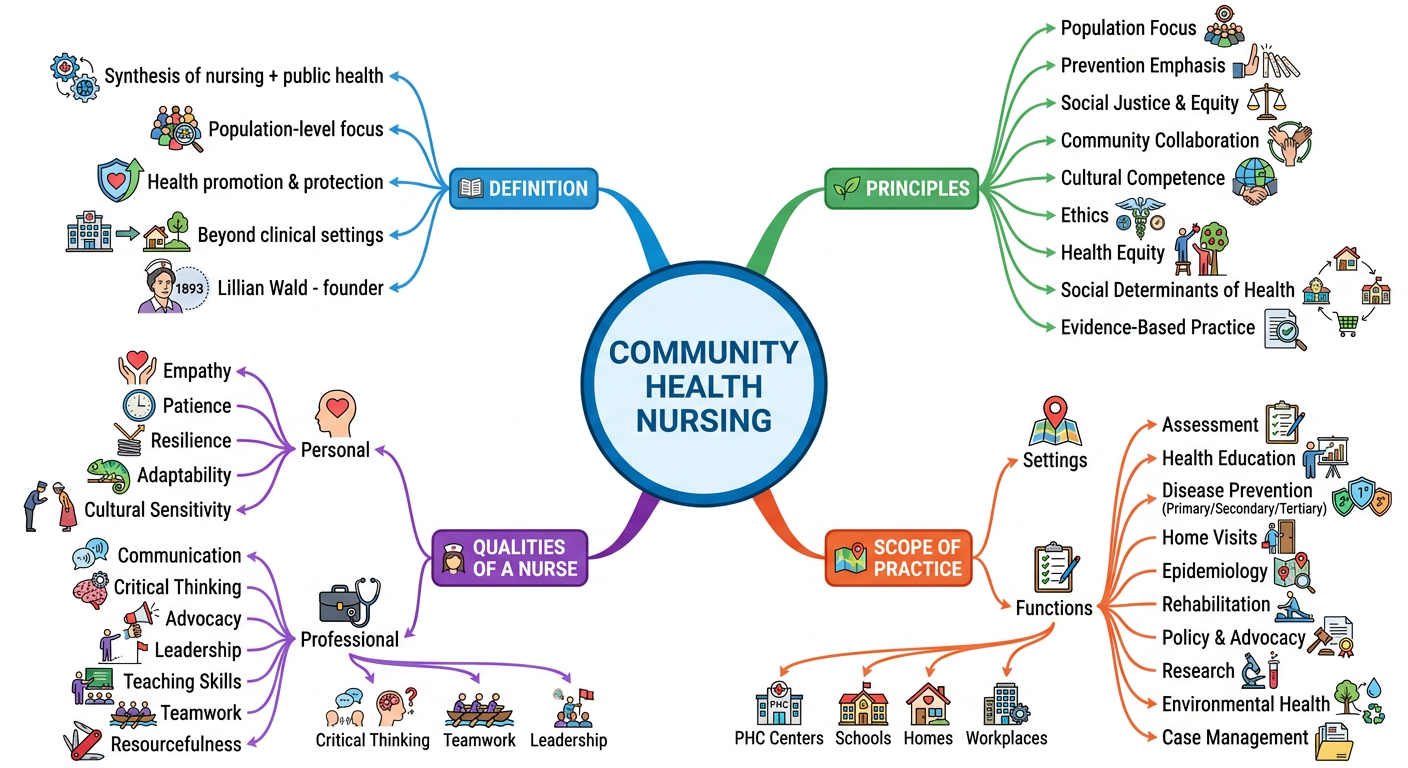
- Blue branch - Definition: Core concept, population focus, and historical roots
- Green branch - Principles: All 9 ANA principles including social justice, equity, and prevention
- Purple branch - Qualities of a Nurse: Both personal traits (empathy, resilience) and professional skills (advocacy, critical thinking)
- Orange branch - Scope of Practice: Settings, functions, and levels of prevention

Explain first Question answer In detail
Question 2(a) - Detailed Answer
Define Non-Communicable Disease. Explain Epidemiology of Cancer and National Tobacco Control Programme.
PART 1: Non-Communicable Diseases (NCDs) - Definition
WHO Classification of Major NCDs:
| Type | Examples |
|---|---|
| Cardiovascular diseases | Hypertension, Coronary artery disease, Stroke |
| Cancers | Lung, Breast, Cervical, Oral, Colorectal |
| Chronic respiratory diseases | COPD, Asthma |
| Diabetes | Type 2 Diabetes Mellitus |
| Mental disorders | Depression, Schizophrenia |
| Others | Accidents/injuries, Nutritional deficiencies |
Key Characteristics of NCDs:
- Non-infectious - not transmitted by contact, droplets, or vectors
- Chronic and long-lasting - persist for years or decades
- Multifactorial etiology - caused by multiple interacting risk factors
- Largely preventable - through lifestyle modifications and risk factor control
- Major risk factors: Tobacco use, Harmful alcohol use, Unhealthy diet, Physical inactivity, Air pollution
NCD Risk Factor Statistics (Global):
- Tobacco: Nearly 7 million deaths/year; causes 71% of lung cancer, 42% of chronic respiratory disease, 10% of CVD
- Physical inactivity: ~1.6 million deaths/year; 20-30% increased all-cause mortality
- Harmful alcohol: ~3.3 million deaths/year (5.9% of all deaths globally)
- Raised blood pressure: 9.4 million deaths/year (12.8% of all deaths) (Park's Preventive & Social Medicine, p. 413)
PART 2: Epidemiology of Cancer
Definition of Cancer
- Abnormal uncontrolled growth of cells
- Ability to invade adjacent tissues and distant organs (metastasis)
- Death of the patient if the tumour progresses beyond a treatable stage
Types/Categories of Cancer:
| Category | Origin | Examples |
|---|---|---|
| Carcinomas | Epithelial cells | Mouth, esophagus, uterus, skin |
| Sarcomas | Mesodermal/connective tissue | Fibrous tissue, fat, bone |
| Lymphomas/Leukemias | Bone marrow and immune system | Lymphoma, Multiple myeloma |
Global Burden of Cancer (2020)
- New cases: 19.29 million
- Deaths: 9.96 million
- Most common cancer diagnosed: Breast > Lung > Prostate > Colon > Stomach
- Leading cause of cancer death: Lung > Liver > Stomach > Breast
- Risk of developing cancer before age 75: 20.4% (Males 22.6%, Females 18.6%)
India - Cancer Statistics (2020)
- New cases: 13,24,413
- Deaths: 8,51,678
- 5-year prevalent cases: 27,20,251
- Top cancers in Males: Lip/oral cavity, Lung, Stomach, Colorectum, Oesophagus
- Top cancers in Females: Breast, Cervix uteri, Ovary, Lip/oral cavity, Colorectum
- Cancer in males is mostly tobacco-related; cervical cancer in females is linked to poor genital hygiene and HPV
Causes/Etiology of Cancer (Multifactorial)
1. Environmental Factors (responsible for 80-90% of cancers)
| Factor | Cancers Caused |
|---|---|
| Tobacco (smoking/chewing) | Lung, larynx, mouth, pharynx, esophagus, bladder, pancreas |
| Alcohol | Esophageal cancer, liver cancer |
| Dietary factors | Stomach (smoked fish), colon (low fibre, high fat), breast (high fat) |
| Occupational exposure | Benzene, arsenic, asbestos, chromium - responsible for 1-5% of cancers |
| Viruses | HBV/HCV → liver cancer; HPV → cervical cancer; EBV → Burkitt's lymphoma; HIV → Kaposi's sarcoma |
| Parasites | Schistosomiasis → bladder carcinoma |
| Radiation/Sunlight | Skin cancer, leukemia |
| Customs & habits | Betel/tobacco chewing → oral cancer |
2. Genetic Factors
- Retinoblastoma (hereditary), Down syndrome (leukemia risk elevated)
3. Host Factors
- Age, sex, race, immune status, nutritional state
Cancer Control Strategies (5 Components):
- Tobacco cessation programs
- Dietary modification
- Hepatitis B vaccination (prevents liver cancer)
- HPV vaccination (prevents cervical cancer)
- Limiting occupational exposures
- Sun protection
- Hospital-based registries - treat patients in that institution
- Population-based registries - cover entire geographic area (ideal size: 2-7 million people)
- India's National Cancer Registry Programme (NCRP) by ICMR - 28 population-based + 5 hospital-based registries
- Screening = "search for unrecognized malignancy by means of rapidly applied tests"
- Cervical cancer: Pap smear, VIA (Visual Inspection with Acetic acid)
- Breast cancer: Breast self-examination (BSE), mammography
- Oral cancer: Visual inspection
- Surgery, radiotherapy, chemotherapy (multi-modality approach)
- Pain management for advanced cases (WHO guidelines)
- Physical, psychological, and social rehabilitation of cancer survivors
PART 3: National Tobacco Control Programme (NTCP)
Background:
- Implement tobacco control laws
- Raise awareness about harmful effects of tobacco
- Fulfill obligations under WHO - Framework Convention on Tobacco Control (FCTC)
Coverage:
- Pilot phase started in 2007-08 in 16 districts across 9 states
- Now covers 108 districts in 31 states
Legal Framework - COTPA 2003:
- Prohibition of smoking in public places (effective 2nd October 2008)
- Prohibition of direct and indirect advertisement of tobacco products
- Prohibition of sale to persons below 18 years
- Prohibition of sale near educational institutions
- Mandatory statutory/pictorial health warnings on tobacco packs (85% of principal display area from April 2016)
- Mandatory display of tar and nicotine content on packs
9 Main Components of NTCP:
| # | Component |
|---|---|
| 1 | Public awareness / mass media campaigns for behavioral change |
| 2 | Tobacco product testing laboratories (to enforce COTPA regulations) |
| 3 | Mainstreaming program components under NRHM framework |
| 4 | Research and training on alternate crops and livelihood |
| 5 | Monitoring and evaluation including surveillance (Adult Tobacco Survey) |
| 6 | Dedicated tobacco control cells at state/district level |
| 7 | Training of health workers, social workers, NGOs, school teachers |
| 8 | School programme - tobacco awareness for children |
| 9 | Tobacco cessation facilities - quitlines, cessation clinics |
Role of CHC (Community Health Centre) Under NTCP:
- Health education and IEC activities on harmful effects of tobacco and secondhand smoke
- Promoting quitting of tobacco in the community
- Brief advice to all smokers and tobacco users
- Making CHC premises tobacco free and displaying mandatory signages
- Setting up a Tobacco Cessation Clinic by training counselors in cessation
Quick Summary Diagram
NON-COMMUNICABLE DISEASES
        |
   _____|___________
  |                 |
CANCER           TOBACCO (risk factor)
  |                      |
Epidemiology          NTCP
- Global burden       - COTPA 2003
- India statistics    - 9 components
- Etiology           - Tobacco-free CHC
- Control            - Cessation clinics
(5 strategies)
Make mindmap image
A detailed, colorful, professional mind map on a white background titled "Non-Communicable Diseases, Cancer Epidemiology & NTCP" at the center in bold dark text inside a large circle. Four main branches radiating from center: BRANCH 1 (Blue) - "NON-COMMUNICABLE DISEASES (NCDs)": Sub-nodes: "Not person-to-person", "Chronic & long-lasting", "Multifactorial", "Largely preventable" Risk Factors sub-branch: "Tobacco - 7M deaths/yr", "Alcohol - 3.3M deaths/yr", "Physical inactivity - 1.6M deaths/yr", "Unhealthy diet", "Raised BP - 9.4M deaths/yr" Types sub-branch: "Cardiovascular", "Cancer", "Diabetes", "Chronic respiratory", "Mental disorders" BRANCH 2 (Red/Orange) - "EPIDEMIOLOGY OF CANCER": Definition sub-node: "Abnormal cell growth + Invasion + Metastasis" Types: "Carcinomas", "Sarcomas", "Lymphomas/Leukemias" Global Burden: "19.29M new cases (2020)", "9.96M deaths", "Top: Breast, Lung, Prostate" India Statistics: "13.24L new cases", "8.51L deaths", "Males: Oral, Lung", "Females: Breast, Cervix" Causes: "Tobacco (80-90% env)", "Viruses (HPV, HBV)", "Diet", "Radiation", "Genetic", "Occupational" Cancer Control: "Primary Prevention", "Cancer Registration (NCRP-ICMR)", "Screening (Pap, Mammography)", "Treatment", "Rehabilitation" BRANCH 3 (Green) - "NATIONAL TOBACCO CONTROL PROGRAMME (NTCP)": Background: "11th Five Year Plan", "WHO-FCTC compliance", "108 districts, 31 states" COTPA 2003 sub-branch: "No smoking in public", "No ads for tobacco", "No sale below 18 yrs", "No sale near schools", "85% pictorial warning on packs", "Tar & nicotine content display" 9 Components: "Mass media campaigns", "Testing laboratories", "NRHM mainstreaming", "Research alternate crops", "Surveillance & monitoring", "Tobacco control cells", "Training workers & NGOs", "School programme", "Cessation facilities" BRANCH 4 (Purple) - "CHC ROLE UNDER NTCP": Essential: "Health education & IEC", "Promote quitting", "Brief advice to smokers", "Tobacco-free premises", "Mandatory signages" Desirable: "Tobacco Cessation Clinic", "Train cessation counselors" Clean white background, curved colorful lines, rounded node boxes, small medical icons, modern infographic style, clear readable fonts, well-spaced layout
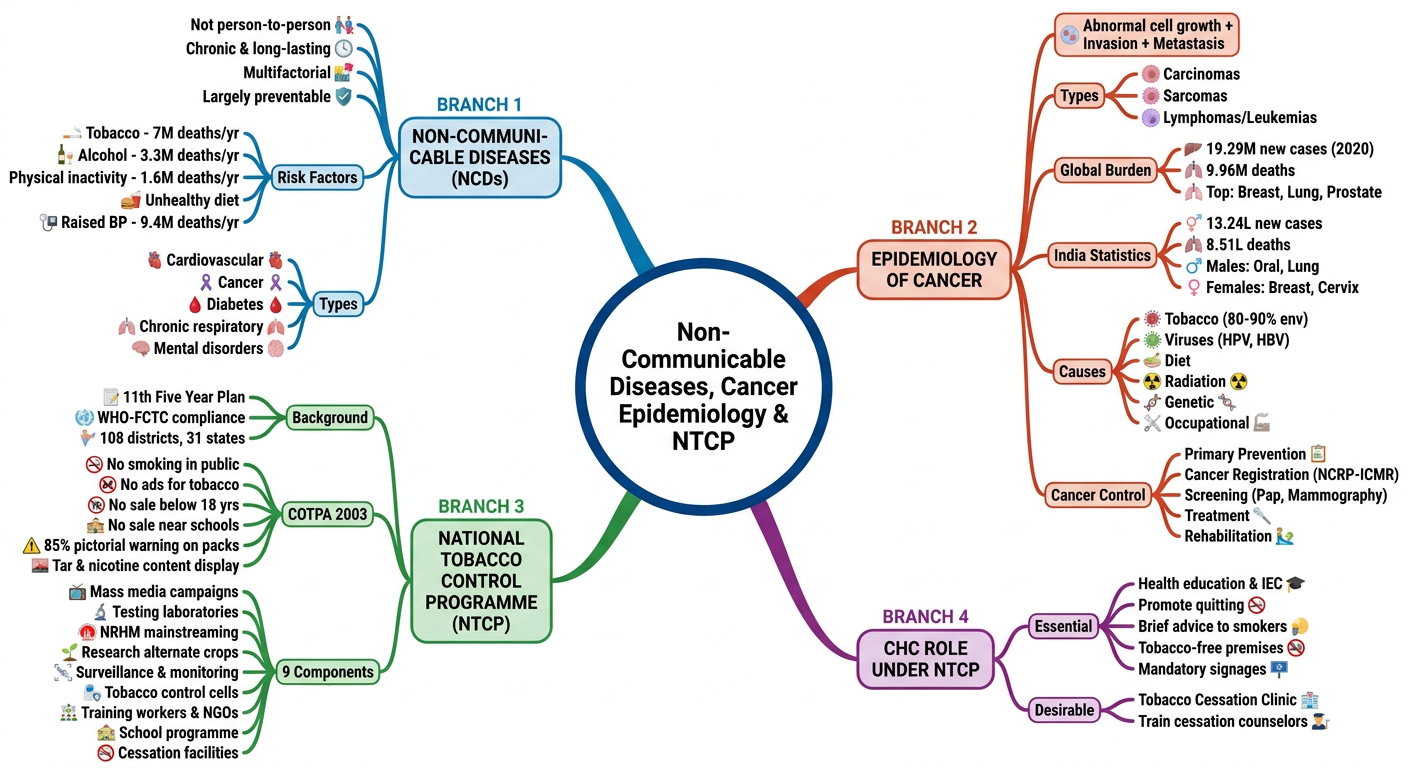
- Blue branch - Non-Communicable Diseases: definition, types, and risk factors with statistics
- Red/Orange branch - Epidemiology of Cancer: definition, global/India burden, causes, and 5 control strategies
- Green branch - NTCP: background, COTPA 2003 provisions, and all 9 components
- Purple branch - CHC Role under NTCP: essential and desirable activities