
Weils disease
Weil's disease is the severe (icteric) form of leptospirosis, caused by Leptospira interrogans. It presents with jaundice, acute kidney injury, bleeding, and can be fatal without prompt treatment. Antibiotics (penicillin or doxycycline) are the mainstay of treatment.
Searching sources...
Reading File
Now I'll search the medical library and PubMed in parallel.
Finding Sources
Searching PubMed
leptospirosis "Weil disease"
Searching Images
leptospirosis Weil disease jaundice clinical findings
Good results found. Now reading the most comprehensive textbook sources in parallel:
Reading File
Reading File
Reading File
Excellent data from all three sources. Let me also fetch the AKI pathogenesis diagram and get more clinical detail from Goldman-Cecil:
Loading Image
Reading File
Let me get more clinical manifestations and management data:
Reading File
There's a clinical photo of Weil disease. Let me fetch it and get more content including treatment and diagnosis:
Loading Image
Reading File
I now have comprehensive, well-sourced information. Let me compile a thorough answer.
Weil's Disease (Icteric Leptospirosis)
Weil's disease is the severe, icteric form of leptospirosis - a zoonotic infection caused by Leptospira interrogans, the most common pathogenic spirochete. It represents about 10% of all leptospirosis cases and is defined by the classic triad of jaundice, acute renal insufficiency, and bleeding.
Causative Organism
- Leptospira interrogans, serovar Icterohaemorrhagiae is the most common cause
- Thin spirochetes (0.1 µm × 6-20 µm) with characteristic hooked ends
- Over 250 serovars exist; genome has extensive horizontal gene transfer
- The name comes from Greek: leptos (thin) + speira (coil)
Epidemiology
- The world's most common zoonosis, causing ~1 million cases and 60,000 deaths annually (likely an underestimate)
- Transmitted via contact with urine-contaminated water or soil through broken skin or mucous membranes
- Reservoir: Urban brown rat (Rattus norvegicus) is the primary source; also dogs, pigs, cattle, horses
- Endemic in tropical countries with high rainfall: India, Malaysia, Brazil
- High-risk groups: sewer workers, farmers, slaughterhouse workers, veterinarians, rat catchers, flood victims, adventure travelers
- Outbreaks spike after flooding - Goldman-Cecil Medicine notes incidence will likely rise with climate change-driven extreme rainfall
Biphasic Disease Course
| Phase | Timing | Features |
|---|---|---|
| Leptospiremic phase | Days 1-7 | Bacteraemia; organism in blood and urine. Fever, myalgia, headache, conjunctival suffusion |
| Immune/Leptospiruric phase | Day 7 onward | Antibody formation, organism cleared from blood. Either resolves (mild) or progresses to Weil's |
Weil's Disease: Classic Triad
1. Jaundice
- Results from hepatocellular disruption in hepatic sinusoids by spirochetes causing bile leakage
- Serum bilirubin markedly elevated; liver enzymes are only moderately raised (unlike viral hepatitis)
- Hepatic failure per se is unusual - jaundice is mainly cholestatic
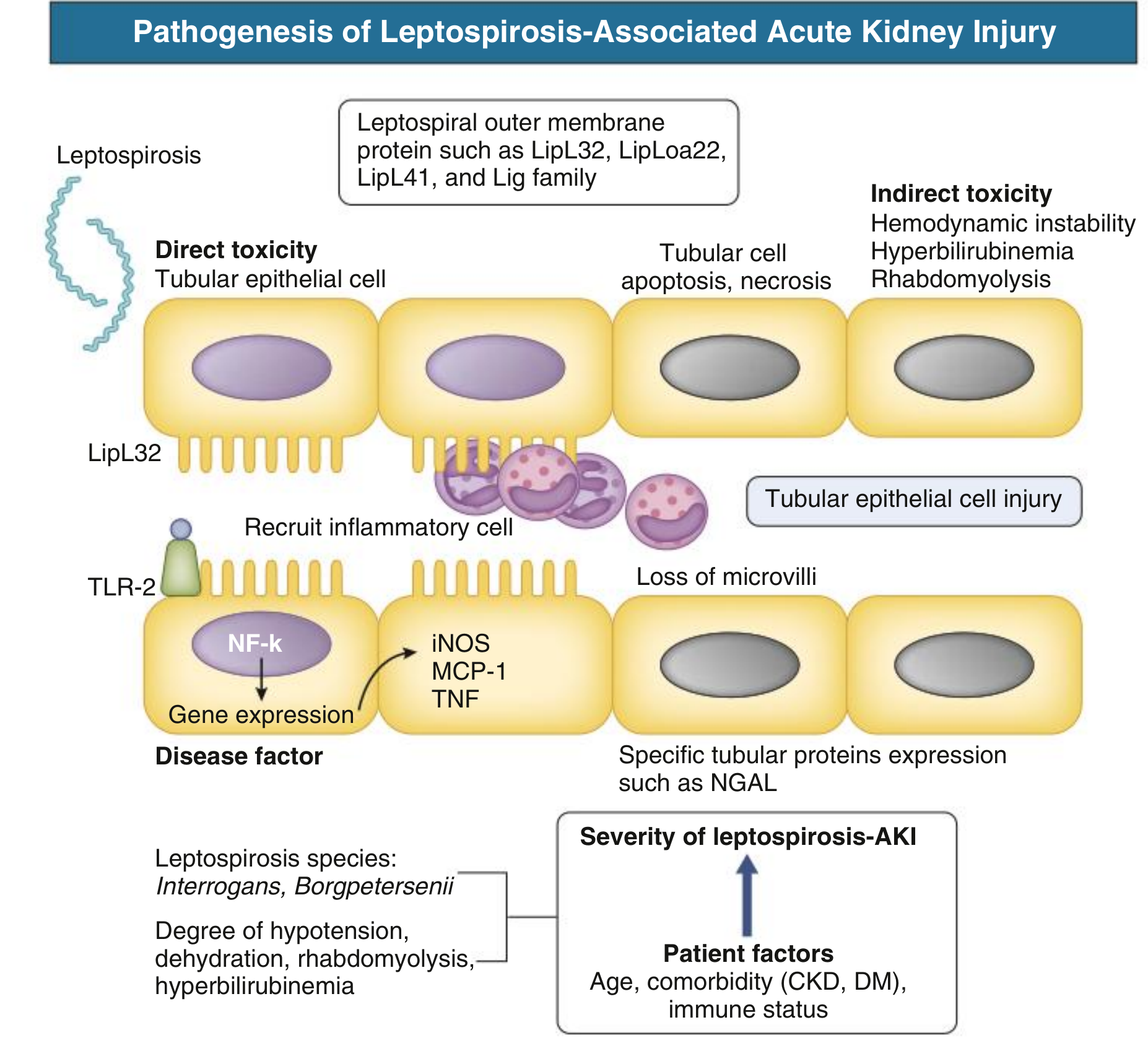
2. Acute Kidney Injury (AKI)
- Kidney involvement is almost universal; AKI incidence ranges from <10% to >80% in different series
- Typically non-oliguric and associated with hypokalemia (paradoxical, due to tubular wasting)
- Proximal tubular infection → reduced Na⁺/K⁺-ATPase activity → impaired sodium/water reabsorption → K⁺ wasting
- High urinary fractional excretion of Na⁺ and K⁺ precedes GFR reduction
- Histology: tubulointerstitial nephritis with cellular infiltration and interstitial oedema
- Long-term: CKD can develop after severe AKI
3. Bleeding
- Thrombocytopenia + coagulation disorders disrupt haemostasis
- Usually mild: petechiae, ecchymoses
- Severe: GI haemorrhage or pulmonary haemorrhage (diffuse alveolar haemorrhage/ARDS) - carries high mortality
Clinical Features of Weil's Disease
Incubation period: 6-29 days (median ~15 days)
| System | Manifestations |
|---|---|
| General | Abrupt-onset high fever, rigors, severe prostration |
| Musculoskeletal | Severe myalgia (especially calves and lower back), calf tenderness |
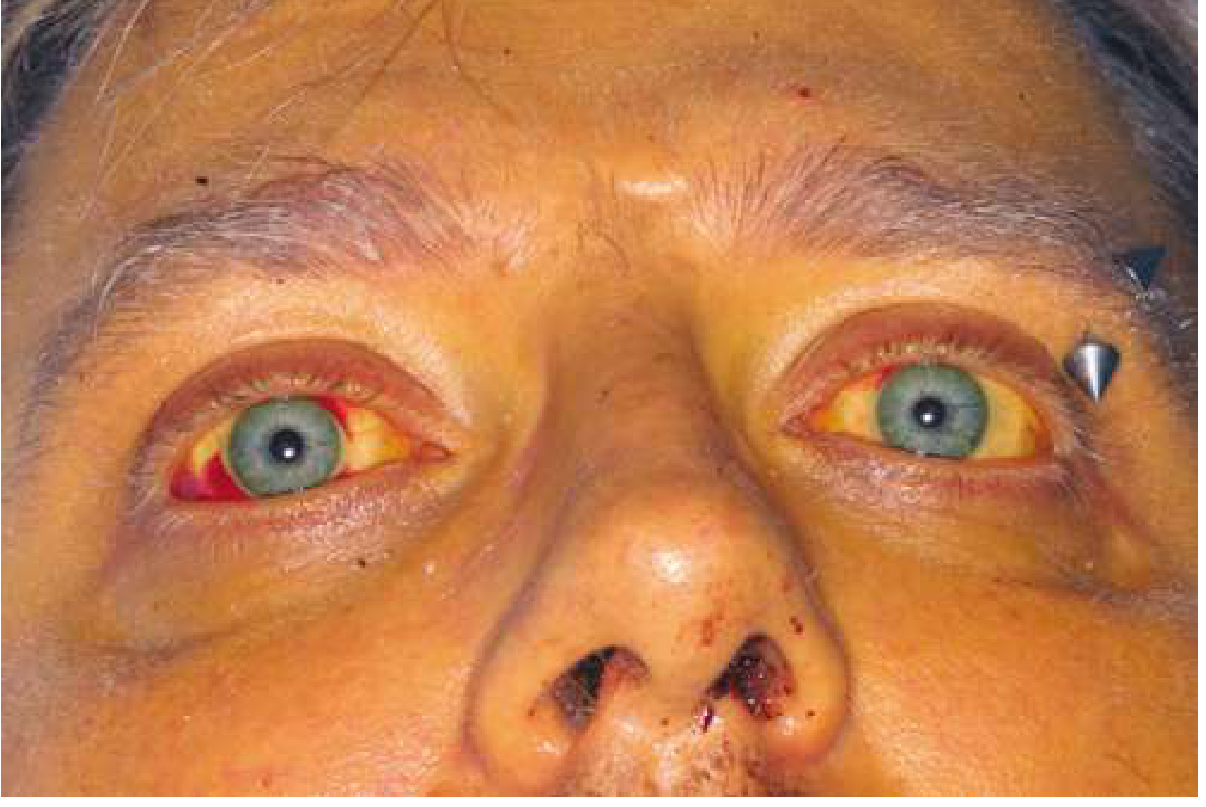
| Eyes | Conjunctival suffusion (pathognomonic - injection without exudate), subconjunctival haemorrhage, scleral icterus |
| Skin | Jaundice, petechiae, purpura, pretibial maculopapular rash |
| Renal | Proteinuria, haematuria, oliguria/anuria, non-oliguric AKI with hypokalemia |
| Hepatic | Deep jaundice, moderate transaminase elevation |
| Pulmonary | Cough (up to 50%), haemoptysis, ARDS |
| Neurological | Severe bitemporal/frontal headache, photophobia, meningism |
| Cardiac | Arrhythmias |
| GI | Nausea, vomiting, diarrhoea, abdominal pain, pancreatitis |
The photograph below shows the characteristic appearance in Weil's disease - conjunctival suffusion (red injection) combined with deep scleral icterus in a patient with confirmed Weil's disease:
Diagnosis
Case Definitions (WHO framework)
- Suspect: Acute fever (≥38.5°C) + headache + myalgia/prostration/conjunctival suffusion + history of exposure
- Probable (clinical): Suspect case + any 2 of: calf tenderness, cough ± haemoptysis, dyspnoea, skin rash, jaundice, haemorrhage, meningism, oliguria/proteinuria, arrhythmia
- Confirmed: Suspect/probable + any one of: organism isolation, positive PCR, seroconversion, MAT titer ≥400
Diagnostic Tests by Phase
| Timing | Best Test |
|---|---|
| Week 1 (leptospiremic) | Blood PCR (high sensitivity), blood cultures, dark-field microscopy |
| Week 2+ (immune) | Urine PCR, urine cultures, serology (MAT, IgM ELISA) |
- MAT (Microscopic Agglutination Test) is the gold standard serological test
- IgM ELISA and rapid tests are useful bedside adjuncts
- Labs: leukocytosis (15,000-30,000 cells/mm³), thrombocytopenia, elevated bilirubin (predominantly direct), mildly raised transaminases, raised creatinine, hypokalemia
Treatment
| Severity | Antibiotic | Regimen |
|---|---|---|
| Mild | Doxycycline | 100 mg BD × 7 days |
| Mild alternative | Azithromycin | Effective alternative |
| Severe (Weil's) | IV Penicillin G | 1.5 MU 6-hourly |
| Severe alternatives | IV Ampicillin or IV Ceftriaxone | Either effective |
Supportive care is equally important:
- Non-oliguric AKI with hypokalemia: aggressive fluid repletion + potassium supplementation
- Oliguric renal failure: early haemodialysis or peritoneal dialysis
- Pulmonary haemorrhage/ARDS: mechanical ventilation
- Thrombocytopenia: platelet support if bleeding
Prevention
- Limit contact with rodents and contaminated water/soil
- Protective footwear and clothing for occupational exposure
- Prophylaxis: Doxycycline 200 mg once weekly during high-risk exposure (e.g., flood relief work, travel to hyperendemic areas) - supported by a 2024 Cochrane meta-analysis on antibiotic prophylaxis for leptospirosis
- Vaccines are available for animals; human vaccines exist in some countries (Cuba, China, Japan)
Mortality
- Uncomplicated leptospirosis: very low
- Weil's disease: 5-10% mortality (from renal failure, vascular collapse, or haemorrhage)
- With pulmonary haemorrhage/ARDS: mortality can exceed 50%
- A 2023 meta-analysis of clinical predictors identified oliguria, jaundice, arrhythmias, thrombocytopenia, and elevated creatinine as predictors of severe AKI and death
Sources: Goldman-Cecil Medicine (26th Ed.) | Comprehensive Clinical Nephrology, 7th Ed. | Andrews' Diseases of the Skin
LDL Guidelines
LDL cholesterol targets vary by cardiovascular risk: very high risk patients (prior ASCVD, diabetes with organ damage) aim for <55 mg/dL (ESC 2019) or <70 mg/dL (ACC/AHA 2018), while lower-risk patients have less aggressive targets. Statins are first-line, with ezetimibe and PCSK9 inhibitors added for those not at goal.
Searching sources...
Reading File
Finding Sources
Searching PubMed
"LDL cholesterol" AND "cardiovascular risk" AND guidelines
Searching the Web
LDL cholesterol guidelines 2024 2025 ACC AHA ESC targets
Excellent - there are TWO major new guidelines: the 2026 ACC/AHA Dyslipidemia Guideline (March 13, 2026) and the 2025 ESC/EAS update. Let me get full details from both:
Reading Web Page
https://www.acc.org/latest-in-cardiology/journal-scans/2026/…
Finding Sources
Reading Article
PMID: 41366604
Now let me get the textbook content on dyslipidemia management and the full ACC/AHA 2026 details:
Finding Sources
Reading Web Page
https://www.patientcareonline.com/view/new-acc-aha-dyslipide…
I now have comprehensive data from both the 2026 ACC/AHA and 2025 ESC/EAS guidelines. Let me compile the full answer.
LDL Cholesterol Guidelines (2025-2026 Updates)
Two major guideline updates have just been released:
- 2026 ACC/AHA Dyslipidemia Guideline (March 13, 2026) - replaces the 2018 guideline, reintroduces specific LDL targets
- 2025 ESC/EAS Focused Update (August 29, 2025) - updates the 2019 ESC/EAS guideline
1. Risk Stratification
2026 ACC/AHA (Primary Prevention)
Uses the new PREVENT (Predicting Risk of CVD EVENTs) equations - replacing the old 2013 Pooled Cohort Equations, which overestimated 10-year ASCVD risk by ~40-50%. PREVENT is validated for adults aged 30-79 without existing ASCVD, with LDL 70-189 mg/dL, and provides both 10-year and 30-year risk estimates.
| 10-Year ASCVD Risk | Category |
|---|---|
| < 3% | Low |
| 3% to <5% | Borderline |
| 5% to <10% | Intermediate |
| ≥ 10% | High |
2025 ESC/EAS
Uses SCORE2 and SCORE2-OP (Older Persons) for risk assessment, with additional risk modifiers including family history, ethnicity, comorbidities, elevated hs-CRP, and Lp(a).
2. LDL-C Treatment Targets
2026 ACC/AHA Guideline (NEW - the return of specific LDL targets)
| Risk Category | LDL-C Goal |
|---|---|
| Borderline or Intermediate risk (primary prevention) | < 100 mg/dL |
| High risk (primary prevention) | < 70 mg/dL |
| Very High Risk ASCVD (secondary prevention) | < 55 mg/dL |
Very High Risk ASCVD = prior MI/stroke + additional high-risk features (multiple ASCVD events, ASCVD + diabetes/CKD/FH, or very high LDL despite therapy)
Note: A key shift - the 2026 guidelines move AWAY from the 2018 guideline's percent-reduction approach BACK to specific numeric LDL targets.
2025 ESC/EAS Guideline (maintained from 2019)
| Risk Category | LDL-C Goal |
|---|---|
| Moderate risk | < 100 mg/dL (<2.6 mmol/L) |
| High risk (incl. FH without other major risk factors) | < 70 mg/dL (<1.8 mmol/L) |
| Very High risk (incl. FH + ASCVD or another major risk factor) | < 55 mg/dL (<1.4 mmol/L) |
| Extreme risk (recurrent ASCVD events within 2 years on max therapy) | < 40 mg/dL (<1.0 mmol/L) |
3. Treatment: Step-Up Approach
First-line: Lifestyle Modification
- Heart-healthy diet (reduce saturated fat, increase fibre, plant sterols)
- Regular aerobic exercise
- Weight management, smoking cessation
Second-line: Statin Therapy (First Drug)
| Intensity | LDL-C Reduction | Examples |
|---|---|---|
| High-intensity | ≥ 50% | Atorvastatin 40-80 mg, Rosuvastatin 20-40 mg |
| Moderate-intensity | 30-50% | Atorvastatin 10-20 mg, Rosuvastatin 5-10 mg, Simvastatin 20-40 mg |
| Low-intensity | < 30% | Simvastatin 10 mg, Pravastatin 10-20 mg |
- High-intensity statin is recommended in high/very high risk patients
- For ACS: immediate high-intensity statin ± ezetimibe (per 2025 ESC/EAS)
Third-line: Add-on Nonstatin Therapies (if not at goal)
| Drug | Mechanism | Additional LDL Reduction | Notes |
|---|---|---|---|
| Ezetimibe | Inhibits NPC1L1 (intestinal cholesterol absorption) | ~20% | First add-on; oral, well tolerated |
| Bempedoic acid | Inhibits ATP-citrate lyase (upstream of HMG-CoA reductase) | ~18-25% | Newly endorsed in both ESC/EAS 2025 and ACC/AHA 2026; good for statin-intolerant patients |
| PCSK9 monoclonal antibodies (evolocumab, alirocumab) | Block PCSK9 - increase LDL-receptor expression | ~60% on top of statin | For high/very high risk not at goal; injectable (2-weekly or monthly) |
| Inclisiran | siRNA - silences PCSK9 production | ~50% | Still under study for outcomes (2026 ACC/AHA: not yet recommended pending outcome trials) |
| Evinacumab | Anti-ANGPTL3 antibody | Significant | For homozygous FH ≥5 years old failing max therapy (ESC/EAS 2025) |
Combination therapy can achieve up to 86% LDL reduction according to the 2025 ESC/EAS guidelines.
Important 2026 ACC/AHA note on supplements: The guidelines explicitly advise against supplements and vitamins (e.g. red yeast rice, fish oil, plant sterols alone) as substitutes for evidence-based lipid-lowering therapy.
4. Special Populations
| Population | Recommendation |
|---|---|
| Familial Hypercholesterolaemia (FH), heterozygous | LDL < 70 mg/dL; if FH + clinical ASCVD, aim < 55 mg/dL |
| Homozygous FH | Evinacumab considered if not at goal on max therapy |
| Diabetes (high-risk features) | LDL < 70 mg/dL; future guidelines may push toward < 55 |
| HIV patients | ESC/EAS 2025: statin from age 40 regardless of LDL |
| On anthracycline chemotherapy (high risk) | Statin recommended per ESC/EAS 2025 |
| CKD | Treat as high/very high risk depending on GFR and proteinuria |
| Older adults (SCORE2-OP) | Risk-adapted targets; 10-20% SCORE2-OP = high risk → LDL < 100 |
| Statin intolerant | Bempedoic acid or ezetimibe monotherapy; PCSK9i as alternative |
5. Lp(a) - New Emphasis in 2025 ESC/EAS
- Lp(a) should be measured at least once in every adult's lifetime
- Lp(a) > 50 mg/dL (105 nmol/L) is a CV risk-enhancing factor
- Higher Lp(a) = greater CV risk (independent of LDL)
- New Lp(a)-lowering agents (e.g. pelacarsen, olpasiran) are in late-stage trials; not yet in routine recommendations
6. Side-by-Side Comparison: ACC/AHA vs ESC/EAS
| Feature | 2026 ACC/AHA | 2025 ESC/EAS |
|---|---|---|
| Risk tool | PREVENT equations | SCORE2 / SCORE2-OP |
| Lowest LDL target | < 55 mg/dL (very high risk) | < 40 mg/dL (extreme risk) |
| Returns to LDL targets? | Yes (key change from 2018) | Yes (maintained from 2019) |
| Bempedoic acid | Recommended as add-on | Recommended for statin-intolerant |
| Inclisiran | Awaiting outcomes data | Mentioned |
| Evinacumab | Not specified | For HoFH ≥5 years |
| Supplements | Explicitly discouraged | Explicitly discouraged |
| Lp(a) | Risk enhancer | Full dedicated section |
Key takeaway: Both 2025-2026 guidelines align on the principle of "lower is better, longer is better." The 2026 ACC/AHA marks a significant return to specific numeric LDL goals after years of a percent-reduction framework, and introduces the more accurate PREVENT risk calculator. The ESC/EAS adds an extreme risk (<40 mg/dL) category not present in the ACC/AHA, and has gone further with novel agents like evinacumab for refractory FH.
Sources: 2026 ACC/AHA Dyslipidemia Guideline | 2025 ESC/EAS Focused Update | ESC guidelines on dyslipidemia update 2025 review [PMID: 41366604]
This is a shared conversation. Sign in to Orris to start your own chat.