
Write down Brief Answer on Rpileptogenesis
epileptogenesis
epileptogenesis definition mechanisms review
Epileptogenesis
- Head injury
- Stroke
- CNS infection
- Prolonged seizures
- Brain tumor
- Neurodegeneration
- Developmental or genetic abnormalities
Explain the stages of epileptogenesis in simple terms
epileptogenesis mechanisms
epileptogenesis stages latent period injury epileptic seizures review
Stages of Epileptogenesis
-
Initial brain insult
- Something damages or disturbs the brain, such as head injury, stroke, CNS infection, prolonged seizure, lack of oxygen, or a developmental brain abnormality.
- This may injure neurons and disrupt the normal balance between brain excitation and inhibition.
-
Latent period
- This is the “silent” period after the injury and before recurrent seizures become obvious.
- The person may have no visible seizures during this time.
- Inside the brain, however, changes are occurring: inflammation, loss of some neurons, scar formation (gliosis), altered chemical signals, and rewiring of nerve connections.
- These changes gradually make the brain more excitable.
-
Chronic epilepsy stage
- The brain network has become permanently prone to abnormal electrical discharges.
- Recurrent, unprovoked seizures begin to occur.
- Over time, repeated seizures may further strengthen the abnormal network in some people.
Brain injury or predisposition → hidden brain rewiring period → recurrent seizures/epilepsy.
Explain the molecular mechanisms in each stage
epileptogenesis molecular mechanisms
molecular mechanisms stages epileptogenesis inflammation BBB mTOR GABA glutamate review
https://pmc.ncbi.nlm.nih.gov/articles/PMC11127907
Molecular mechanisms in each stage of epileptogenesis
1. Initial insult phase: the trigger
- Excess glutamate release: Injured neurons release excess glutamate, the main excitatory neurotransmitter.
- Calcium overload: Glutamate overstimulates NMDA and AMPA receptors, allowing excessive Ca²⁺ to enter neurons.
- Excitotoxicity: High intracellular Ca²⁺ activates destructive enzymes, damages mitochondria, produces reactive oxygen species, and may lead to neuronal death.
- Inflammatory activation: Microglia and astrocytes become activated and release inflammatory mediators such as IL-1β, TNF-α, IL-6, HMGB1, and prostaglandins.
- Blood-brain barrier disruption: Injury can damage the blood-brain barrier. Proteins from blood, including albumin, then enter brain tissue and activate astrocytes, adding to inflammation and neuronal excitability.
- Immediate gene activation: Activity-dependent genes such as FOS, EGR1, and ARC are activated. They begin changing synaptic function and neuronal structure.
2. Latent phase: silent rewiring of the brain
-
Loss of inhibition
- Loss or dysfunction of GABA-producing interneurons reduces inhibitory control.
- Changes in GABA-A receptors and chloride handling can make GABA inhibition less effective.
- In some settings, altered chloride transporters can raise intracellular chloride, so GABA becomes less inhibitory or even depolarizing.
-
Increased excitation
- Increased glutamate release and reduced uptake by astrocytes, especially through the glutamate transporter GLT-1/EAAT2, leave more glutamate at synapses.
- Altered AMPA and NMDA receptor number or function can strengthen excitatory synapses.
-
Ion-channel changes
- Increased activity of sodium and calcium channels can make neurons fire more readily.
- Reduced potassium-channel function weakens the cell’s ability to return to its resting state after firing.
- Thus, neurons develop a lower threshold for abnormal repetitive firing.
-
Persistent inflammation
- Cytokines such as IL-1β and TNF-α alter synaptic transmission and ion-channel activity.
- HMGB1 can signal through TLR4 and promote excitability and inflammatory responses.
- Inflammation can also activate matrix metalloproteinases, which further impair the blood-brain barrier.
-
Synaptic and circuit reorganization
- Surviving neurons form new, sometimes abnormal, synaptic connections.
- In temporal lobe epilepsy, mossy-fiber sprouting in the dentate gyrus may create recurrent excitatory circuits.
- Neuronal loss, gliosis, and new synapse formation together create a hyperexcitable local network.
-
Gene and epigenetic changes
- Signaling pathways including BDNF-TrkB and mTOR promote neuronal growth, synaptic plasticity, and circuit remodeling.
- DNA methylation, histone modifications, and microRNAs can maintain long-term changes in gene expression.
3. Chronic epilepsy phase: established recurrent seizures
- Stable excitation-inhibition imbalance: Excitatory glutamate signaling remains too strong, while GABA-mediated inhibition remains inadequate.
- Permanent network changes: Gliosis, neuronal loss, abnormal axonal sprouting, and reorganized synapses sustain a seizure-prone circuit.
- Altered receptors and channels: Long-term changes in glutamate receptors, GABA receptors, sodium channels, potassium channels, and calcium channels keep neurons hyperexcitable.
- Ongoing neuroinflammation and blood-brain barrier dysfunction: These may persist and maintain the cycle of excitability.
- Seizures worsen the network: Each seizure can cause further calcium entry, oxidative stress, inflammation, and synaptic remodeling. This is why epilepsy can sometimes progress over time.
One-line summary
Create a flowchart of the molecular stages
A clear educational flowchart showing the molecular stages of epileptogenesis. Top-to-bottom sequence: Stage 1 Initial brain insult (trauma, stroke, infection, prolonged seizure) leads to excess glutamate and calcium influx, oxidative stress and mitochondrial injury, blood-brain barrier breakdown, and activation of microglia and astrocytes with IL-1β, TNF-α, and HMGB1. Arrow to Stage 2 Latent period / molecular remodeling showing loss of inhibitory GABA interneurons, reduced GABA signaling, increased glutamate and impaired astrocyte GLT-1 uptake, ion-channel changes, persistent neuroinflammation, mTOR and BDNF-TrkB signaling, gliosis and abnormal synaptic rewiring. Arrow to Stage 3 Chronic epilepsy showing hyperexcitable epileptogenic network, reduced seizure threshold, spontaneous recurrent seizures. Add a feedback arrow from recurrent seizures back to inflammation and remodeling labeled seizure-driven progression. Include a simple final summary at bottom: injury -> molecular remodeling -> recurrent seizures. Ensure labels are medically accurate, easy to read, and suitable for students.
Molecular stages of epileptogenesis
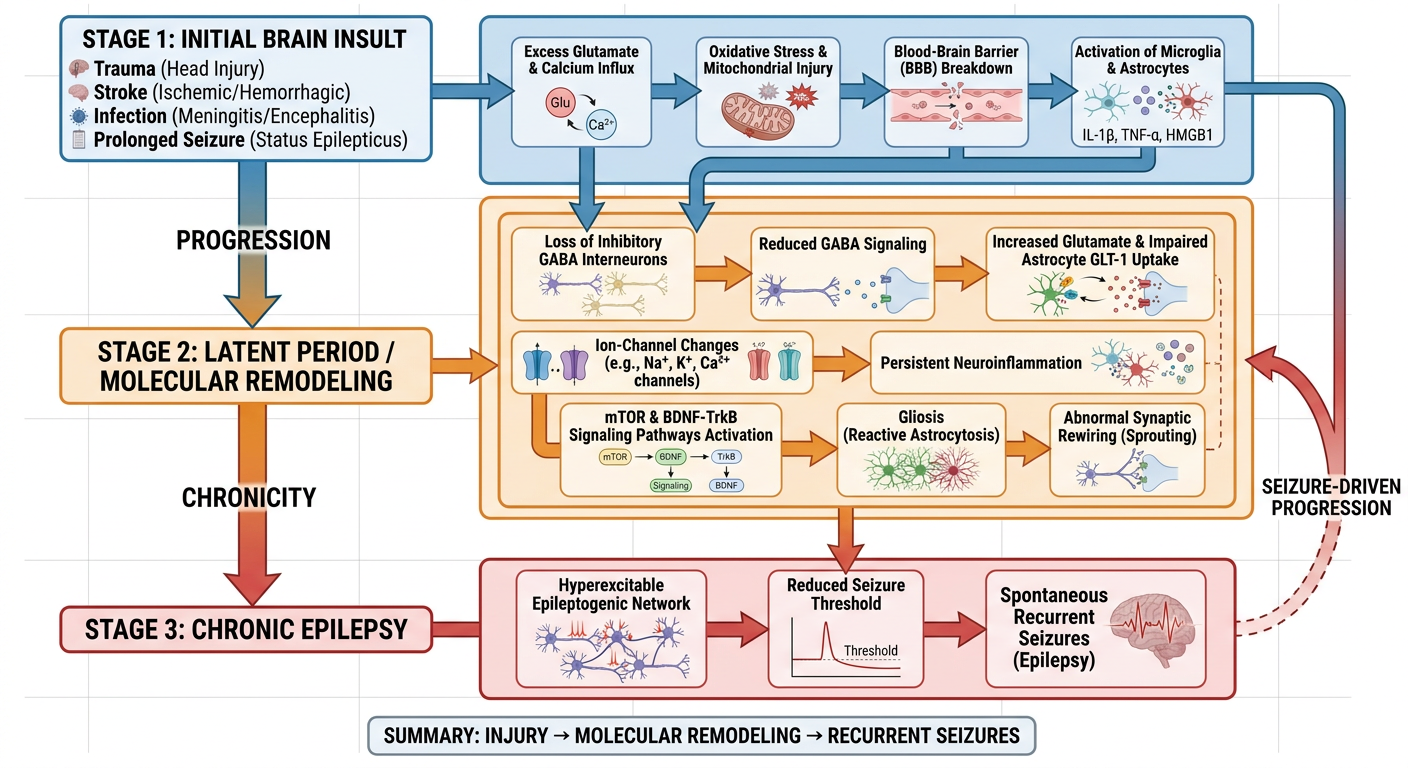
Brain insult → excitotoxicity and inflammation → latent molecular rewiring → hyperexcitable neural network → recurrent spontaneous seizures