
What is Little's area of nose
Reading File
Little's area is a highly vascular region on the anterior nasal septum (anteroinferior part) where several arteries anastomose, making it the most common site for nosebleeds (epistaxis).
Searching sources...
Finding Sources
Finding Sources
The Scott-Brown's reference looks very relevant. Let me read that section fully.
Reading File
Finding Sources
Excellent detail. Let me now read the KJ Lee's section on Kiesselbach plexus / Little's area for a complete description, and grab the Cummings endoscopy image.
Reading File
Reading File
Now let me get the endoscopy image of Kiesselbach plexus from Cummings and read the relevant epistaxis section from Scott-Brown's Vol 2.
Finding Sources
Reading File
I now have comprehensive information. Let me fetch the endoscopic image of Little's area / prominent septal vessels for a visual aid.
Loading Image
I now have all the information needed for a complete, well-sourced answer.
Little's Area of the Nose
Definition
Little's area (also called Kiesselbach's plexus) is a highly vascular region located on the anteroinferior part of the nasal septum. It is an arterial plexus sitting just beneath the thin overlying nasal mucosa, making it extremely prone to bleeding with minimal trauma.
Historical Note
- First identified as a frequent site of haemorrhage by James Little in 1879
- Described independently one year later by Wilhelm Kiesselbach
- Hence the dual name: Little's area = Kiesselbach's plexus
(Scott-Brown's Otorhinolaryngology Head & Neck Surgery, Vol 1, p. 1218)
Arterial Supply - The Four/Five Arteries
Little's area receives blood from both the external and internal carotid systems, making it a true anastomotic zone. The contributing arteries are:
| Artery | Origin | System |
|---|---|---|
| Posterior septal branch of sphenopalatine artery | Maxillary artery (via ECA) | External carotid |
| Greater palatine artery | Maxillary artery (via ECA) | External carotid |
| Superior labial artery (alar/nasal septal branch) | Facial artery (via ECA) | External carotid |
| Anterior ethmoidal artery | Ophthalmic artery (via ICA) | Internal carotid |
| Posterior ethmoidal artery | Ophthalmic artery (via ICA) | Internal carotid |
The terminal branches of the posterior septal artery of the sphenopalatine artery run anteroinferiorly in the muco-perichondrium and anastomose in this area.
(KJ Lee's Essential Otolaryngology, p. 517; Scott-Brown's Vol 1, p. 1218; Scott-Brown's Vol 2, p. 285)
Clinical Significance
- Most common site of epistaxis (nosebleed) - responsible for the vast majority of anterior bleeds
- Anterior bleeds in children account for >90% of all epistaxis, almost always from this area
- Common causes of bleeding here include:
- Nose picking (digital trauma)
- Dry/crusted mucosa (local dryness)
- Nasal blowing
- In the elderly: hypertension and anticoagulants
- The vessels lie just under thin mucosa, so even mild trauma easily ruptures them
(Bailey & Love's Short Practice of Surgery, 28th ed.; Scott-Brown's Vol 2, p. 285)
Endoscopic Appearance
Below is an endoscopic view showing prominent septal vessels in a child with recurrent epistaxis from Little's area:
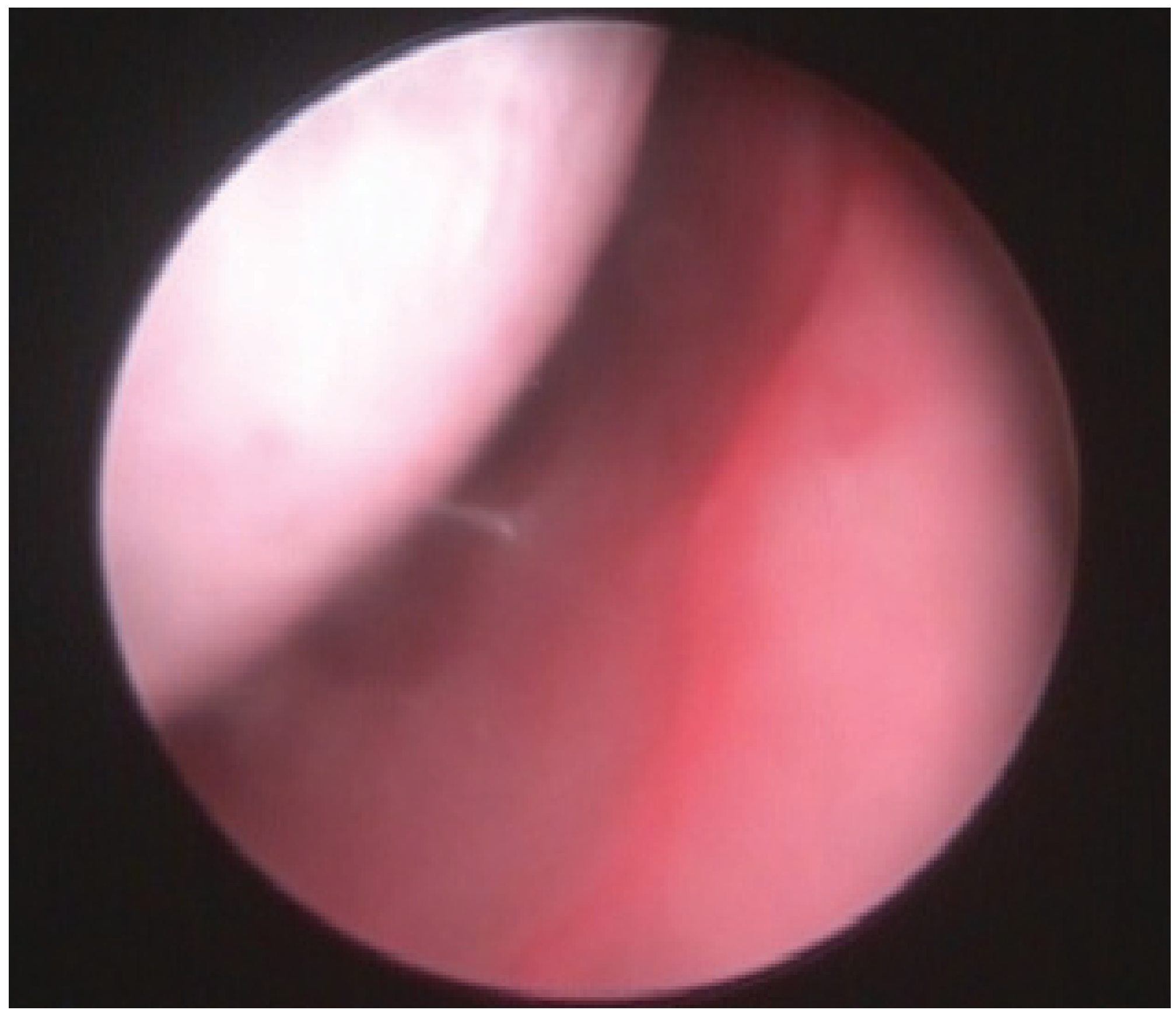
Endoscopic view of prominent vessels in Little's area - Scott-Brown's Otorhinolaryngology, Vol 2
Comparison: Little's Area vs. Woodruff's Plexus
| Feature | Little's Area (Kiesselbach's) | Woodruff's Plexus |
|---|---|---|
| Location | Anterior nasal septum | Posterior inferior meatus |
| Nature | Arterial plexus | Venous (previously thought arterial) |
| Common bleed type | Anterior epistaxis | Posterior epistaxis |
| Age group | Children, young adults | Elderly, hypertensives |
Treatment of Epistaxis from Little's Area
- Cauterization (chemical with silver nitrate or electrocautery) - first-line for recurrent anterior bleeding
- Topical moisturizers/nasal humidification to prevent dryness and crusting
- Anterior nasal packing if cauterization fails
(Cummings Otolaryngology Head and Neck Surgery; Gray's Anatomy for Students)
This is a shared conversation. Sign in to Orris to start your own chat.