Young syndrome
Young syndrome azoospermia sinusitis
Young syndrome clinical features pathophysiology management 2024
Young Syndrome
Definition
- Chronic sinusitis
- Bronchiectasis
- Obstructive azoospermia (with normal spermatogenesis)
Etiology and Pathophysiology
- Mercury poisoning - The incidence of Young syndrome has declined dramatically since the 1970s, coinciding with the ban on mercurous chloride (calomel), which was used in teething powders and anthelmintics. This temporal relationship strongly supports mercury exposure as a key etiologic factor.
- Abnormal ciliary function or mucus quality - Ciliary beat frequency and ultrastructural anatomy are generally normal (unlike primary ciliary dyskinesia/Kartagener syndrome), but mucociliary clearance is prolonged nearly threefold compared to controls. In at least one case, ~13% of epididymal cilia showed microtubular disarrangement (malformation of radial spokes and dynein arms). Abnormally thick, viscous secretions are produced.
Comparison with Similar Conditions
| Feature | Young Syndrome | Cystic Fibrosis | Kartagener / PCD |
|---|---|---|---|
| Bronchiectasis | Yes | Yes | Yes |
| Sinusitis | Yes | Yes | Yes |
| Azoospermia | Obstructive (epididymal) | Obstructive (absent vas deferens) | Yes (immotile sperm) |
| Site of obstruction | Distal epididymis | Congenital absence of vas deferens | Sperm flagellar dysfunction |
| Spermatogenesis | Normal | Normal | Normal |
| Sweat chloride | Normal | Elevated | Normal |
| GI symptoms | Absent | Present (pancreatic insufficiency) | Absent |
| Cilia ultrastructure | Normal (mostly) | Normal | Abnormal (absent dynein arms) |
| Situs inversus | No | No | ~50% |
| Genetics | Unknown | CFTR mutations | Autosomal recessive |
Clinical Presentation
- Recurrent sinopulmonary infections beginning in childhood or early adulthood
- Chronic productive cough
- Bronchiectasis on imaging
- Male infertility (presenting complaint in many cases)
- Normal testicular size and normal serum FSH (indicating intact spermatogenesis)
- Palpable vas deferens and epididymides bilaterally (unlike CF/CBAVD)
- Mild respiratory symptoms compared to CF; no GI involvement
Diagnosis
- Recurrent sinopulmonary infections (sinusitis, bronchiectasis)
- Persistent azoospermia with normal spermatogenesis (confirmed by testicular biopsy or normal FSH/testicular size)
- Obstruction at the epididymis on examination
- Exclusion of CF (normal sweat chloride, no CFTR mutations)
- Exclusion of immotile cilia syndrome / PCD (normal ciliary ultrastructure on EM, normal sperm motility in other contexts)
Classification
Management
- Antibiotics for acute bacterial sinopulmonary infections
- Inhaled bronchodilators (e.g., albuterol) and hypertonic saline to loosen airway secretions
- Airway clearance physiotherapy
- Surgical reconstruction (vasoepididymostomy) for fertility - however, success rates are lower than for other obstructive conditions
- Assisted reproduction - surgical sperm retrieval (e.g., MESA, TESE) combined with ICSI can achieve fatherhood
Key Points to Remember
- Triad: sinusitis + bronchiectasis + obstructive azoospermia
- Normal sweat test and pancreatic function (unlike CF)
- Normal ciliary ultrastructure (unlike Kartagener syndrome)
- Obstruction is at the epididymis, not the vas deferens
- Declining incidence since mercury-containing teething powders were banned
- Men with this triad should be tested for CFTR mutations before a definitive Young syndrome label is applied
Give me the list of ciliary dyskinesia syndrome where you will have situs inversus asplenia
ciliary dyskinesia situs inversus asplenia heterotaxy right isomerism syndrome list
Ciliary Dyskinesia Syndromes with Situs Inversus / Asplenia
The Underlying Mechanism
- The L-R signal is randomized → producing situs inversus (mirror image) in ~50% of cases
- The L-R signal is absent or chaotic → producing situs ambiguus / heterotaxy, which is when asplenia appears
The Syndromes
1. Kartagener Syndrome (Classic)
- Part of Primary Ciliary Dyskinesia (PCD)
- Triad: Situs inversus totalis + bronchiectasis + chronic sinusitis
- Spleen is present and normal (just on the wrong side, mirrored)
- ~50% of PCD patients develop situs inversus totalis (random chance from dysfunctional nodal cilia)
- Absent dynein arms on electron microscopy
- No asplenia
2. Heterotaxy Syndrome (Situs Ambiguus) - Right Isomerism = Asplenia Syndrome
- Also known as Ivemark syndrome (Ivemark sequence)
- Results from failure to establish the L-R axis (bilateral right-sidedness)
- Features:
- Asplenia (or hypoplastic spleen) - because the spleen is a left-sided organ; bilateral right-sidedness means no spleen develops
- Bilateral right-sided (trilobed) lungs and eparterial bronchi
- Complex congenital heart defects (single ventricle, AV canal, anomalous pulmonary venous return, transposition)
- Liver midline or right-sided
- Intestinal malrotation
- Dextrocardia (but NOT situs inversus totalis - incomplete/ambiguous)
- ~9-12% of PCD patients develop heterotaxy/situs ambiguus
- The spleen absence predisposes to fulminant infections by encapsulated bacteria (Streptococcus pneumoniae, Haemophilus, Neisseria)
3. Heterotaxy Syndrome - Left Isomerism = Polysplenia Syndrome
- Bilateral left-sidedness
- Polysplenia (multiple small spleens, may be functionally inadequate)
- Bilateral bilobed lungs
- IVC interruption with azygos continuation
- Complex heart defects (less severe than right isomerism)
- No asplenia
Summary Table
| Syndrome | Laterality | Spleen | Lungs | Key Cilia Defect |
|---|---|---|---|---|
| Kartagener syndrome (PCD) | Situs inversus totalis | Normal, mirrored | Mirrored | Absent dynein arms; randomized L-R axis |
| Right isomerism / Ivemark / Asplenia syndrome | Situs ambiguus | Absent (asplenia) | Bilateral trilobed | Nodal cilia fail to establish L-R axis |
| Left isomerism / Polysplenia syndrome | Situs ambiguus | Multiple small spleens | Bilateral bilobed | Nodal cilia fail to establish L-R axis |
| Young syndrome | Normal | Normal | Bronchiectasis only | Radial spoke + dynein arm malformation (no laterality defect) |
Key Takeaway
Ivemark syndrome (Right Isomerism / Asplenia Heterotaxy) - a form of PCD/heterotaxy where nodal cilia fail to generate directional flow, resulting in bilateral right-sidedness, absence of the spleen, complex heart defects, and ambiguous organ positioning.
Give me treatment of Kawasaki disease
"Kawasaki disease" treatment IVIG aspirin
Kawasaki disease treatment guidelines 2024 IVIG aspirin corticosteroids
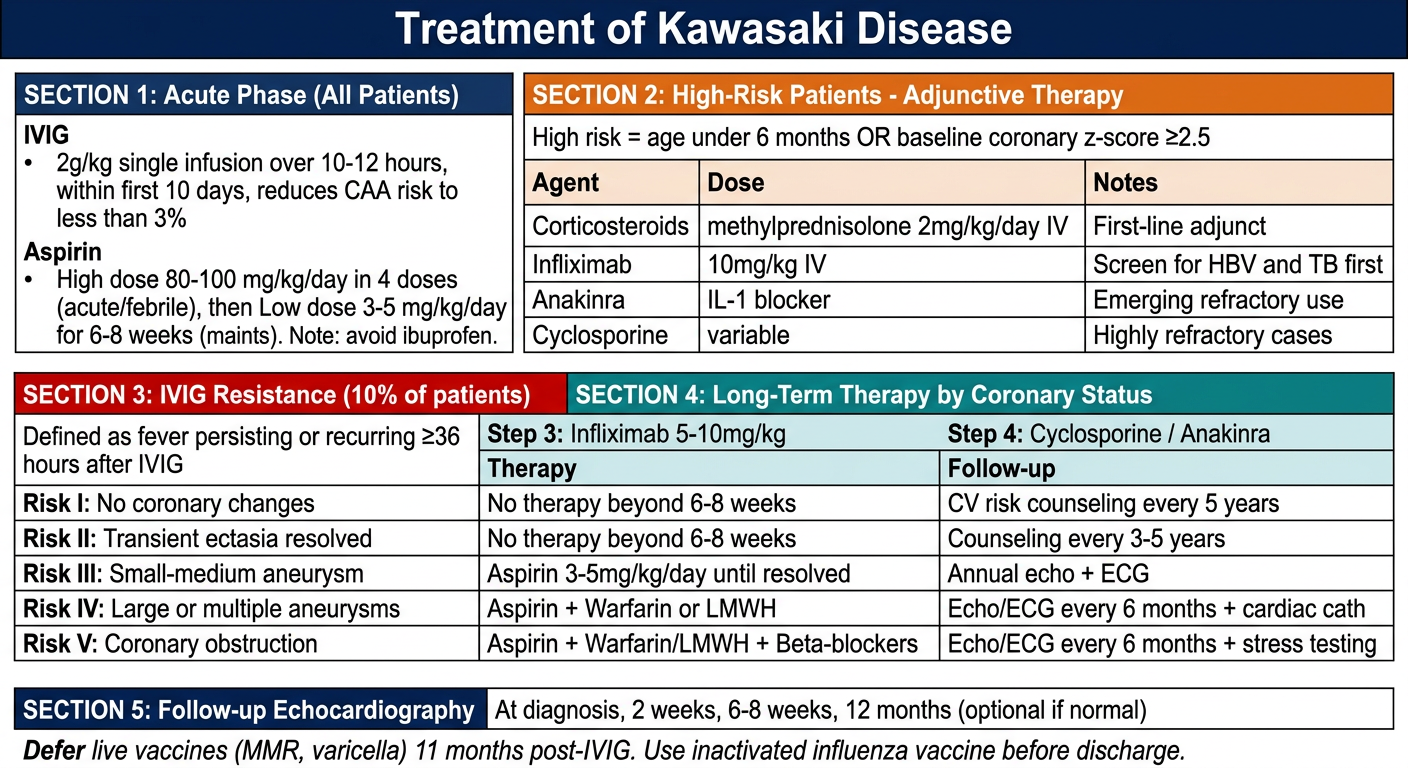
Treatment of Kawasaki Disease
1. Acute Phase Treatment (All Patients)
A. IVIG (Intravenous Immunoglobulin) - FIRST-LINE
- Dose: 2 g/kg as a single infusion over 10-12 hours
- Timing: Must be given within the first 10 days of illness (ideally days 5-9)
- Reduces coronary artery dilation risk from ~20-25% down to <3%
- Reduces incidence of coronary artery aneurysms fivefold vs aspirin alone
- Can still be given after day 10 if ESR/CRP remain elevated with persistent fever
- Treatment with IVIG + aspirin reduces CAA prevalence from ~25% (aspirin alone) to ~5%
B. Aspirin - GIVEN ALONGSIDE IVIG
| Phase | US Standard Dose | Alternative (Many Centers) |
|---|---|---|
| Acute (febrile) | High dose: 80-100 mg/kg/day in 4 divided doses | Moderate dose: 30-50 mg/kg/day |
| Duration of high/moderate dose | Until 48-72 hours after defervescence | Until afebrile |
| Maintenance (subacute/convalescent) | Low dose: 3-5 mg/kg/day as single daily dose | Same |
| Duration of low dose | 6-8 weeks, or until platelet count and ESR normalize (if no CAA) | Indefinitely if CAA persists |
Note: Ibuprofen antagonizes the antiplatelet effect of aspirin and should be avoided. Use acetaminophen for fever instead.
2. High-Risk Patients - Adjunctive Therapy (2024 AHA Update)
- Age ≤ 6 months
- Baseline coronary artery z-score ≥ 2.5 on echocardiogram
Adjunctive Options:
| Agent | Dose | Notes |
|---|---|---|
| Corticosteroids (methylprednisolone/prednisolone) | IV methylprednisolone 2 mg/kg/day | First-line adjunct for high-risk; reduces CAA z-score significantly; shown to suppress monocyte-mediated inflammation more than IVIG alone |
| Infliximab (anti-TNF-α) | 10 mg/kg IV over 2 hours | Alternative to steroids; screen for Hepatitis B and TB first; evidence from KIDCARE trial |
| Anakinra (IL-1 receptor antagonist) | Limited data | Emerging option; recent 2026 systematic review supports use in selected refractory cases |
| Cyclosporine | Limited data | Option for highly refractory cases |
3. IVIG Resistance (Refractory Kawasaki Disease)
- Second dose of IVIG - 2 g/kg (first-line re-treatment)
- Corticosteroids - IV methylprednisolone if second IVIG fails
- Infliximab - 5-10 mg/kg IV (from KIDCARE trial data)
- Non-glucocorticoid immunosuppressives (cyclosporine, anakinra) - for persistent fever despite above
4. Antithrombotic / Long-Term Therapy by Coronary Artery Status
| Risk Level | Coronary Status | Long-Term Therapy | Follow-Up |
|---|---|---|---|
| I | No coronary changes | None beyond 6-8 weeks | Cardiovascular risk counseling every 5 years |
| II | Transient ectasia, resolved by 8 weeks | None beyond 6-8 weeks | Cardiovascular risk counseling every 3-5 years |
| III | Small-medium solitary aneurysm | Aspirin 3-5 mg/kg/day until aneurysm resolves | Annual echo + ECG |
| IV | Large (>6 mm) or multiple aneurysms, no obstruction | Aspirin 3-5 mg/kg/day + warfarin or LMWH for giant aneurysms | Echo/ECG every 6 months; cardiac cath at 6-12 months |
| V | Coronary artery obstruction | Aspirin + warfarin/LMWH + beta-blockers (reduce myocardial work) | Echo/ECG every 6 months; cardiac cath; guided stress testing |
5. Echocardiographic Follow-Up (All Patients)
- At diagnosis (baseline)
- At 2 weeks
- At 6-8 weeks
- At 12 months (optional if normal)
- More frequent if CAA or elevated z-scores present
6. Other Considerations
- Influenza vaccine: All children ≥6 months should receive inactivated (not live) influenza vaccine before discharge (and family members) - mandatory while on aspirin therapy to reduce Reye syndrome risk
- Live vaccines (MMR, varicella): Defer for 11 months after IVIG (may blunt immune response)
- Incomplete Kawasaki disease: Treat with IVIG promptly at diagnosis - do NOT delay until day 10
Generate this in form of image
A detailed medical reference chart titled "Treatment of Kawasaki Disease" in a clean clinical style with a dark navy blue header. The chart is organized into clearly labeled sections: SECTION 1 - "Acute Phase (All Patients)" with two subsections: - IVIG 2g/kg single infusion over 10-12 hours, within first 10 days, reduces CAA risk to less than 3% - Aspirin: High dose 80-100 mg/kg/day in 4 doses (acute/febrile), then Low dose 3-5 mg/kg/day for 6-8 weeks (maintenance). Note: avoid ibuprofen. SECTION 2 - "High-Risk Patients - Adjunctive Therapy" (orange header): High risk = age under 6 months OR baseline coronary z-score ≥2.5 Table with columns Agent / Dose / Notes: - Corticosteroids / methylprednisolone 2mg/kg/day IV / First-line adjunct - Infliximab / 10mg/kg IV / Screen for HBV and TB first - Anakinra / IL-1 blocker / Emerging refractory use - Cyclosporine / variable / Highly refractory cases SECTION 3 - "IVIG Resistance (10% of patients)" (red header): Defined as fever persisting or recurring ≥36 hours after IVIG Step 1: Second IVIG dose 2g/kg Step 2: Corticosteroids IV methylprednisolone Step 3: Infliximab 5-10mg/kg Step 4: Cyclosporine / Anakinra SECTION 4 - "Long-Term Therapy by Coronary Status" (teal header): A 5-row table: Risk I: No coronary changes → No therapy beyond 6-8 weeks → CV risk counseling every 5 years Risk II: Transient ectasia resolved → No therapy beyond 6-8 weeks → Counseling every 3-5 years Risk III: Small-medium aneurysm → Aspirin 3-5mg/kg/day until resolved → Annual echo + ECG Risk IV: Large or multiple aneurysms → Aspirin + Warfarin or LMWH → Echo/ECG every 6 months + cardiac cath Risk V: Coronary obstruction → Aspirin + Warfarin/LMWH + Beta-blockers → Echo/ECG every 6 months + stress testing SECTION 5 - "Follow-up Echocardiography": At diagnosis, 2 weeks, 6-8 weeks, 12 months (optional if normal) Footer note: "Defer live vaccines (MMR, varicella) 11 months post-IVIG. Use inactivated influenza vaccine before discharge." Clean, professional medical infographic style with color-coded sections, white background, clear fonts, organized layout suitable for clinical reference.