
Post mortem changes
Reading File
Post mortem changes (also called thanatological changes) refer to the sequence of physical and biochemical changes that occur in a body after death. They are used in forensic medicine to estimate time of death (PMI - post mortem interval) and include primary changes (algor mortis, livor mortis, rigor mortis) and secondary changes (decomposition).
Searching sources...
Finding Sources
Finding Sources
Finding Sources
Finding Sources
Good - found the key textbooks. Now let me read the relevant sections in parallel.
Reading File
Reading File
Reading File
Reading File
Finding Sources
Finding Sources
Reading File
Reading File
Reading File
Reading File
Reading File
Reading File
Reading File
Finding Sources
Reading File
I now have comprehensive material. Let me fetch a few key images to include in the answer.
Reading File
I now have all the information needed to write a thorough, well-structured answer. Let me compile it.
Post Mortem Changes
Post mortem changes are the physical, chemical and biological changes that occur in a body after death. They are used in forensic medicine to estimate the post mortem interval (PMI) and to determine circumstances of death. They are divided into early (primary) and late (secondary) changes.
Classification
| Category | Changes |
|---|---|
| Early / Primary | Algor mortis, Livor mortis (PM hypostasis), Rigor mortis, Autolysis |
| Late / Secondary | Putrefaction, Adipocere, Mummification, Maceration, Skeletonization |
I. ALGOR MORTIS (Cooling of the Body)
After death, metabolic heat production ceases. The body loses heat by conduction, convection, radiation, and evaporation until it reaches ambient temperature. This is also called dead body chill.
Cooling Pattern
- For the first ~30 min to 1 hour, temperature falls little or not at all - this is the isothermic phase (postmortem temperature plateau)
- Then falls in a sigmoid (S-shaped) curve - initial slow fall, rapid fall, then slow approach to ambient
- Rule of thumb (temperate): ~1°C per hour in the rectum; in tropical climates 0.4-0.6°C per hour
- Rectal temperature is the most reliable site for measurement
Factors Affecting Rate of Cooling
| Factor | Faster Cooling | Slower Cooling |
|---|---|---|
| Body build | Thin, children, elderly | Fat, obese |
| Clothing | Absent | Heavy clothing |
| Environment | Well-ventilated, humid, cold | Enclosed, dry, warm |
| Medium | Flowing water (~3x air) | Still air |
| Cause of death | Blood loss, dehydration | Septicemia, convulsions (higher temp at death) |
Henssge Nomogram
A nomogram using body weight and ambient temperature is used to calculate PMI from the rectal temperature.
- The Essentials of Forensic Medicine and Toxicology, 36th edition (2026), p. 159-160
II. LIVOR MORTIS (Postmortem Hypostasis / Hypostasis)
After circulation stops, blood settles by gravity into the dependent vessels and capillaries, producing a purplish-red discoloration of the skin in the dependent areas of the body.
Time Course
| Phase | Time | Feature |
|---|---|---|
| Onset | 30 min - 2 hours | Faint pink patches |
| Becomes obvious | 3-4 hours | Well-defined staining |
| Fully established | 6-12 hours | Complete staining |
| Fixation (non-blanchable) | 6-12 hours | Vessel walls become permeable; blood diffuses into tissues |
Distribution
- Supine position: Neck, back, flanks - sparing bony prominences (shoulder blades, buttocks, heels - contact pallor/blanching)
- Prone position: Face, chest, anterior abdomen - Tardieu spots common, more intense
- Hanging: Hands, feet, lower legs (glove-and-stocking distribution)
- Areas under pressure (belt, waistband, tight clothing) remain pale - called vibices
Color Variations (Forensically Important)
| Color | Cause |
|---|---|
| Bluish-purple | Normal |
| Cherry-red / bright red | CO poisoning, cyanide, refrigeration |
| Chocolate brown | Methaemoglobinaemia (nitrites, chlorates) |
| Pink | CN poisoning |
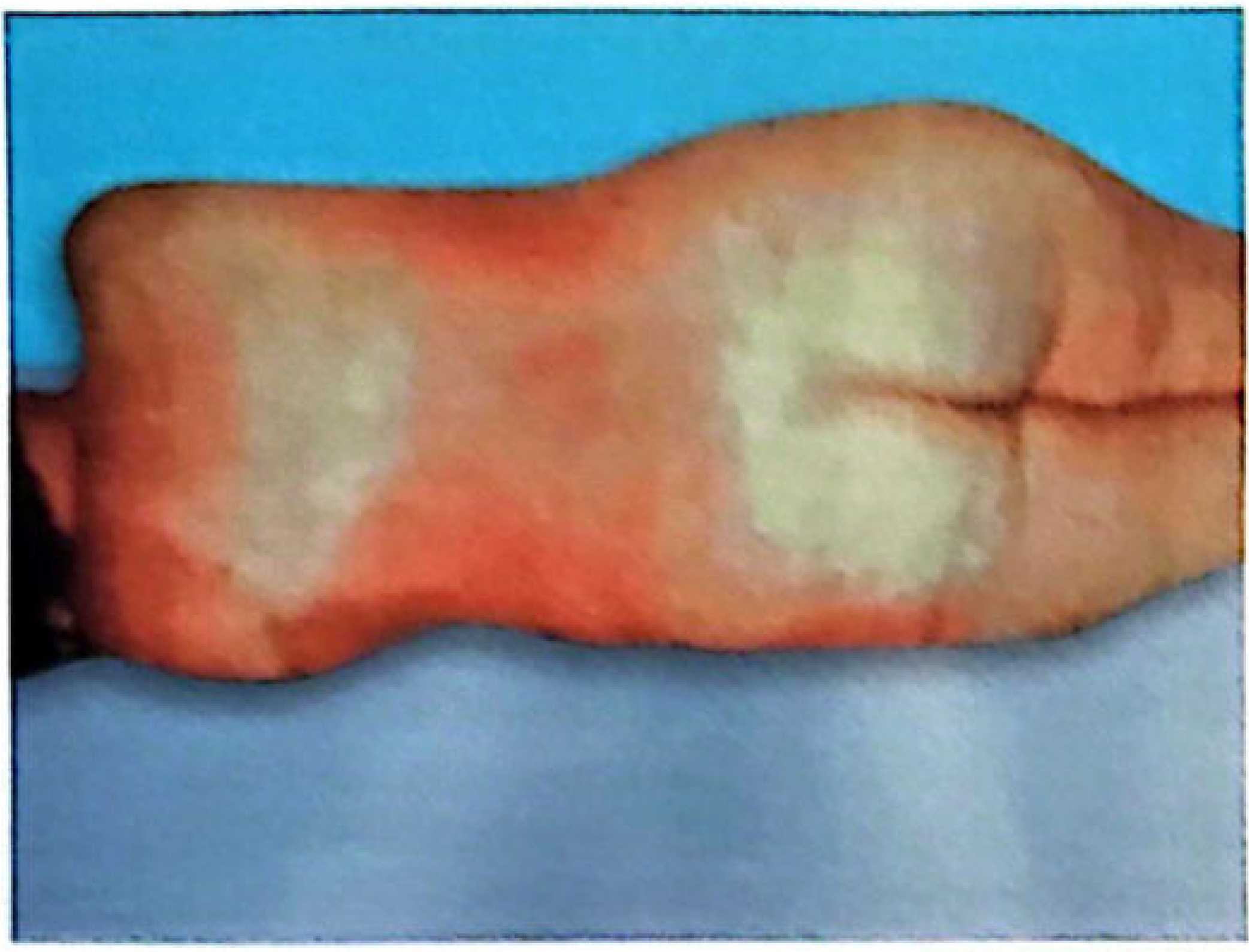
Fig: Cherry-red PM hypostasis in CO poisoning
Medicolegal Significance
- Confirms death
- Helps estimate time of death (unreliable due to variability)
- Indicates posture at time of death
- Indicates if the body was moved after death (double lividity / redistribution)
- Color may indicate cause of death
- Distribution pattern may suggest manner of death
- The Essentials of Forensic Medicine and Toxicology, 36th edition (2026), p. 160-162
- DiMaio's Forensic Pathology, 3rd Edition, p. 33
III. RIGOR MORTIS (Cadaveric Rigidity)
Stiffening of muscles after death, due to depletion of ATP. Without ATP, actin-myosin cross-bridges cannot be broken, becoming permanently linked - forming actomyosin, causing stiffness.
Three Stages of Muscular Changes
- Primary flaccidity (lasts 1-2 hours) - all muscles relax, joints flexible, body flattens
- Rigor mortis - progressive stiffening
- Secondary flaccidity - caused by putrefactive alkaline liquids dissolving actomyosin
Time Course (at moderate temperature, ~21°C)
| Event | Approximate Time |
|---|---|
| Onset | 1-2 hours |
| Well-marked | 6-12 hours |
| Complete (all muscles) | 12-24 hours |
| Starts to pass off | 24-36 hours |
| Complete resolution | 48-72 hours |
Important Features
- Affects all muscles simultaneously but first evident in smaller muscles (face, jaw, hands)
- Nysten's Law: Classically described as progressing downward (jaw → neck → trunk → limbs), but this is disputed; modern view is all muscles stiffen at the same rate - small muscles become apparent first
- Can be broken by passive stretching, but will not return once broken
- Can be fixed in a new posture if moved before fixation
Factors Affecting Rigor Mortis
| Factor | Effect |
|---|---|
| High temperature | Speeds onset, shorter duration |
| Cold temperature | Delays onset, prolongs duration |
| Physical exertion before death | Accelerates onset (depletes ATP) |
| Emaciation | Weak or no rigor |
| Drowning | May develop within 2-3 hours |
| Excited delirium, convulsant poisons | Accelerate onset |
Variants of Rigor
1. Heat Stiffening
- Caused by coagulation of muscle proteins when body temperature >65°C (burns, lightning)
- Produces pugilistic (boxer's) posture - flexion of arms and legs
- Cannot be broken by extending limbs (unlike rigor)
- Normal rigor does not occur afterward
2. Cold Stiffening
- Freezing of body fluids and solidification of subcutaneous fat
- At -5°C or below
- When joints forcibly flexed, ice breaks in synovial fluid with a sharp sound
- Normal rigor occurs after thawing, but passes off quickly
3. Cadaveric Spasm (Instantaneous Rigor)
-
Rare condition; group of muscles actively working at the moment of death immediately stiffen - no primary relaxation
-
Usually involves hands (e.g., victim grips weapon, weeds, etc.)
-
Mechanism: possibly neurogenic, failure of muscular relaxation due to adrenocortical exhaustion impairing ATP resynthesis
-
Predisposing factors: intense physical/emotional activity, cerebral hemorrhage, strychnine poisoning, drowning, firearm wound to head
-
Cannot be produced after death - hence great medicolegal significance (proves item was held at moment of death)
-
The Essentials of Forensic Medicine and Toxicology, 36th edition (2026), p. 162-178
-
DiMaio's Forensic Pathology, 3rd Edition, p. 34-38
IV. DECOMPOSITION
Decomposition involves two processes: autolysis and putrefaction.
A. Autolysis
Self-digestion of tissues by the body's own enzymes after cell membranes break down.
- Lysosomal hydrolases cause autodigestion without bacterial involvement
- Earliest in: intestinal lining, adrenal medulla, pancreas (within hours of death)
- Brain of newborns/infants undergoes early softening and liquefaction
- Increased by heat; stopped by freezing
B. Putrefaction
Decomposition by bacteria (mainly from the gut - Clostridium, Proteus, Bacteroides, etc.), producing gases and liquefaction of soft tissues.
Putrefactive Gases
Hydrogen sulphide (H2S), methane (CH4), ammonia, CO2, phosphine (PH3) - causing foul odor.
External Sequence of Changes
| Timeframe (summer) | Changes |
|---|---|
| 12-24 hours | Greenish discoloration of right iliac fossa (overlying cecum - greatest bacterial load); first external sign |
| 24-48 hours | Discoloration spreads over abdomen, foul odor begins |
| 2-3 days | Skin blisters (bullae) form, marbling (arborescent pattern over skin due to haemolysis in vessels), bloating begins |
| 4-7 days | Face bloated, tongue protruding, eyes bulging, gaseous distension of abdomen |
| 2-3 weeks | Epidermis separates, body cavities rupture |
| Months | Tissues liquefy, skeleton exposed |
- Marbling: Green-black branching/arborescent discoloration due to hemolysis in superficial veins - a distinctive sign
- Postmortem purge: Bloodstained frothy fluid from mouth/nose due to gas pressure (not injury)
Internal Organ Order of Putrefaction
- Larynx and trachea
- Stomach, intestines, pancreas, spleen
- Liver, lungs
- Brain
- Heart
- Kidneys, bladder
- Prostate, uterus
- Skin, muscle, tendon
- Bones
Conditions Affecting Rate of Putrefaction
| Factor | Accelerates | Retards |
|---|---|---|
| Temperature | 21-38°C optimal | <0°C, >48°C arrests it |
| Moisture | Moist environment | Dry environment |
| Air | Free air access | Closed/anaerobic environment |
| Clothing | Initially hastens | Later retards |
| Burial | Shallow, sandy soil | Deep burial (>2 m) |
Casper's Dictum: A body decomposes in air twice as rapidly as in water, and eight times as rapidly as in earth.
- The Essentials of Forensic Medicine and Toxicology, 36th edition (2026), p. 171-175
V. LATE CHANGES / SPECIAL FORMS OF DECOMPOSITION
1. Adipocere (Saponification)
Conversion of body fat into a waxy, soap-like substance (saponification) when the body is in a warm, moist, anaerobic environment.
- Mechanism: Intrinsic lipases + bacterial enzymes (mainly Cl. perfringens lecithinase) hydrogenate and hydrolyze body fat into higher fatty acids (palmitic, stearic, hydroxystearic acids)
- Onset: As early as 3-5 weeks in warm conditions; months in cold
- Conditions favoring: Warm, moist, anaerobic environment; obesity; immersion in water; burial in wet soil
- More common in: Females, obese individuals, well-nourished neonates
- Odor: Distinctive offensive/sweetish smell; ammoniacal in early stages
- Color: White/grey-white, later yellowish-brown; greasy texture
- Medicolegal value: Preserves body contours and injury evidence for long periods (years); allows identification; may preserve poisons
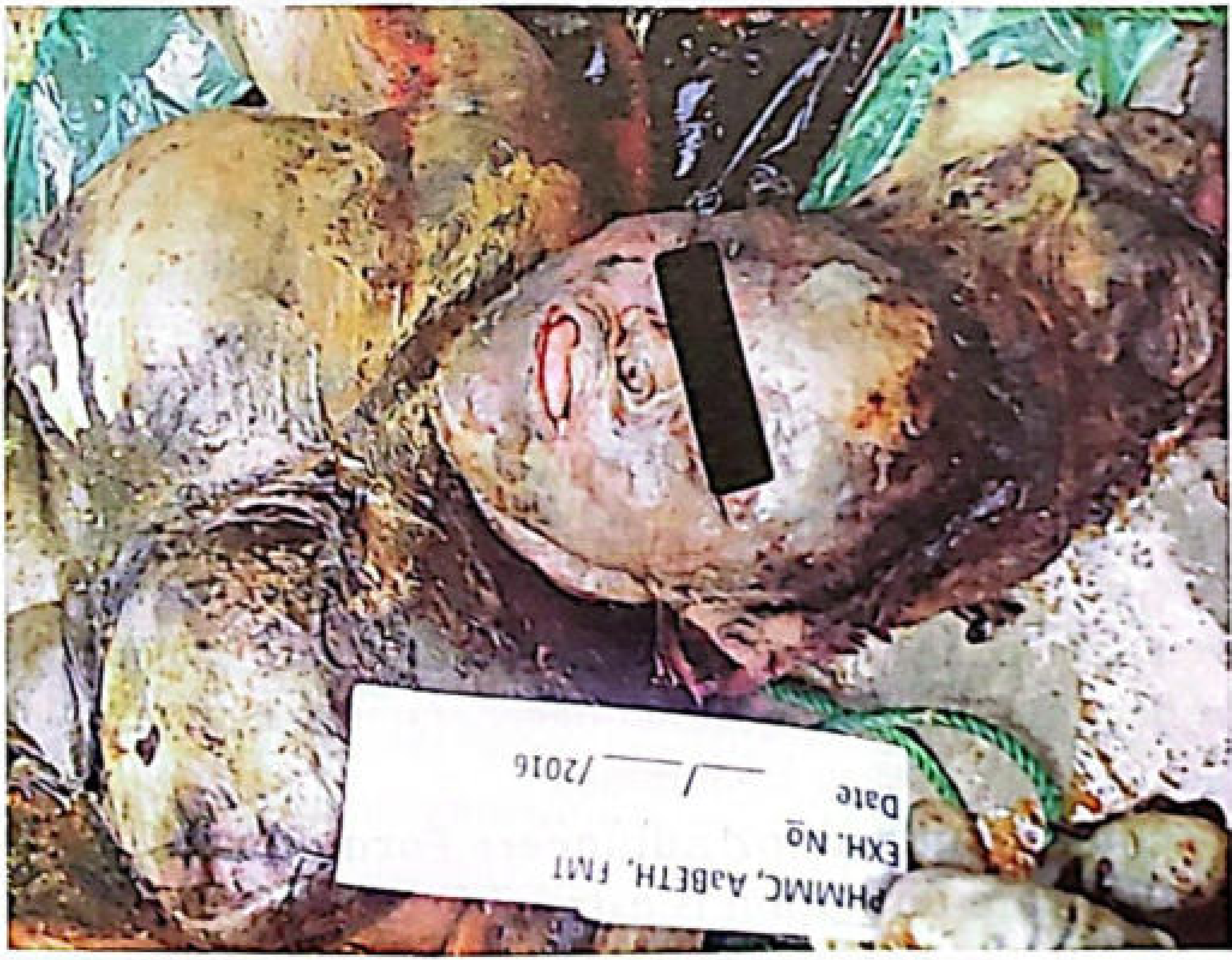
Fig: Adipocere
2. Mummification
Desiccation and drying of the body, preventing putrefaction.
- Conditions favoring: Hot, dry, well-ventilated environment; desert conditions; dry sandy soil
- Time: Several months (complete mummification)
- Features: Skin becomes brown, leathery, hard, and brittle; body weight greatly reduced; no putrefactive smell
- Medicolegal value: Preserves features and injuries for identification; may survive for centuries
3. Maceration
Softening and disintegration of tissues in a sterile fluid environment without putrefaction.
- Occurs mainly in a dead fetus in utero (amniotic fluid is sterile)
- Features: Skin becomes red/brown, wrinkled, peels off; bones become soft; no offensive odor
- Types by timing after fetal death:
- Early (<12 hours): Skin peeling, bullae formation
- Late (>48 hours): Brownish discoloration, overlapping skull bones, wrinkled skin
4. Skeletonization
Complete removal of soft tissues leaving only the skeleton.
- In tropical, humid conditions with heavy insect/scavenger activity: days to weeks
- In buried bodies: months to years
- In water: Attacked by fish, crustaceans
Summary: Medicolegal Importance of PM Changes
| Change | Use |
|---|---|
| Algor mortis | Estimate PMI (Henssge nomogram) |
| Livor mortis | Position at death, body movement, cause of death (color) |
| Rigor mortis | PMI estimation; cadaveric spasm = item held at moment of death |
| Putrefaction | PMI (broad estimate), conditions of death |
| Adipocere/mummification | Preserves evidence; long-term PMI estimate |
Sources: The Essentials of Forensic Medicine and Toxicology, 36th edition (2026); DiMaio's Forensic Pathology, 3rd Edition; Parikh's Textbook of Medical Jurisprudence, Forensic Medicine and Toxicology.
This is a shared conversation. Sign in to Orris to start your own chat.