
Grades of clubbing
Reading File
Clubbing grades are classically divided into 4 grades (Schamroth's or the Cyanosis/Lovibond grading system). Grade 1 involves loss of the nail bed angle, progressing to Grade 4 with severe hypertrophic changes.
Searching sources...
Finding Sources
Finding Sources
Reading File
Reading File
Reading File
Finding Sources
Searching the Web
grades of clubbing fingers Schamroth Lovibond clinical classification
Loading Image
Here is a complete overview of the grades of clubbing:
Grades of Digital Clubbing
Clubbing is graded using a 4-grade system based on progressive structural changes at the nail and distal phalanx:
| Grade | Feature | Description |
|---|---|---|
| Grade 1 | Nail bed fluctuation | Increased ballotability and softening of the nail bed. No visible change in the nail profile. This is the earliest and most subtle sign. |
| Grade 2 | Obliteration of the Lovibond angle | Loss of the normal <165° angle between the nail plate and the proximal nail fold. The Schamroth window (diamond-shaped gap when opposing fingers are placed back-to-back) is obliterated. Clubbing is not obvious at a glance. |
| Grade 3 | Parrot-beaking / increased nail curvature | Increased convexity of the nail in both longitudinal and transverse planes. The distal segment of the finger begins to bulge ("drumstick" appearance). Clubbing is apparent at a glance. |
| Grade 4 | Hypertrophic osteoarthropathy (HOA) | Periosteal new bone formation at distal long bones (radius, ulna, tibia, fibula). The nail and skin have a shiny, striated appearance. Painful swelling of joints may accompany. |
Key Clinical Signs Used in Assessment
Lovibond angle (Profile sign)
- Normally <165° (some sources say <180°)
- In clubbing, this angle is obliterated and becomes ≥180°
- Most sensitive measurement for early clubbing
Schamroth sign
- Place dorsal surfaces of corresponding fingers of both hands back-to-back
- Normally, a small diamond-shaped window is visible at the nail bases
- In clubbing, this window is obliterated (positive Schamroth sign)
- Sensitivity 77-87%, specificity 90% (Pallares-Sanmartin et al., JAMA 2010)
Phalangeal depth ratio
- Ratio of finger depth at nail vs. at distal interphalangeal joint
- Normally, DIP depth > nail depth
- In clubbing, nail depth > DIP depth (ratio >1)
Hyponychial angle
- Normally <192°; values above this support clubbing
Clinical Image
Below is a photograph of a clubbed finger showing the characteristic bulbous enlargement of the distal segment with increased nail curvature:
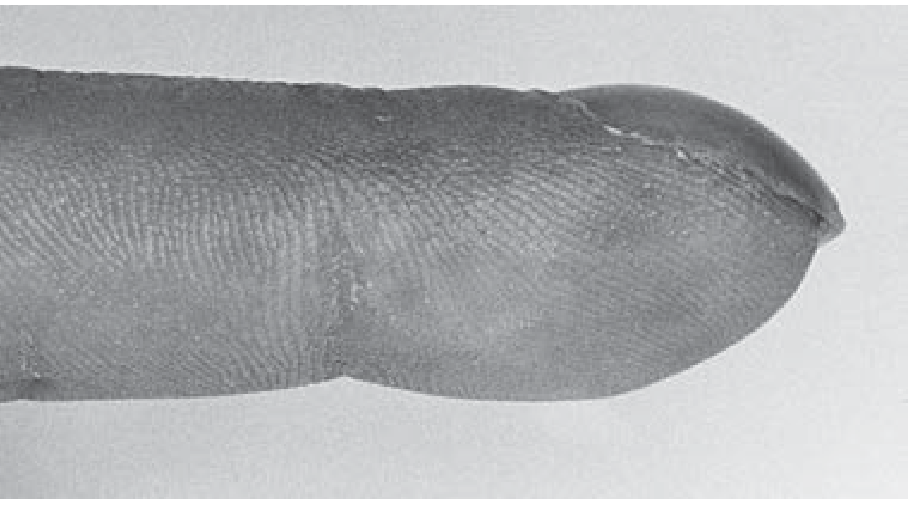
Fishman's Pulmonary Diseases and Disorders
Wikipedia's 5-Stage Variant
Some sources (including Wikipedia/older literature) describe a 5-stage system:
- No visible clubbing - nail bed fluctuation only
- Mild - loss of Lovibond angle, Schamroth window obliterated
- Moderate - increased convexity of nail fold, apparent at a glance
- Gross - drumstick thickening of entire distal finger
- Hypertrophic osteoarthropathy - shiny, striated nail and skin
Pathophysiology (brief)
Clubbing results from increased capillary density in the nail bed stroma, driven by hypoxia-inducible factors (HIF-1α, HIF-2α) and vascular growth factors (VEGF, PDGF). Blood shunting past pulmonary or hepatic capillary beds allows unmetabolized angiogenic factors to reach the digits. This explains the association with lung disease, hepatic cirrhosis, and cyanotic heart disease.
- Murray & Nadel's Textbook of Respiratory Medicine
- Fishman's Pulmonary Diseases and Disorders, p. 447
- Andrews' Diseases of the Skin: Clinical Dermatology
- IJCDW - Grading of Clubbing
This is a shared conversation. Sign in to Orris to start your own chat.