
Give a diagram of blood supply of stomach
Reading File
Searching sources...
The stomach receives blood from branches of the celiac trunk. The lesser curvature is supplied by the left and right gastric arteries, and the greater curvature by the left and right gastroepiploic arteries. The fundus receives blood from short gastric arteries, and the posterior wall from the posterior gastric artery.
Now let me search the medical library for a proper diagram and detailed description.
Finding Sources
Searching the Web
blood supply of stomach diagram anatomy
Reading File
Loading Image
Loading Image
Here is a complete overview of the blood supply of the stomach, with diagrams:
Blood Supply of the Stomach
Diagram 1 - Arterial Supply (labeled anatomy view)

Diagram 2 - Full Blood Supply & Venous Drainage (schematic)
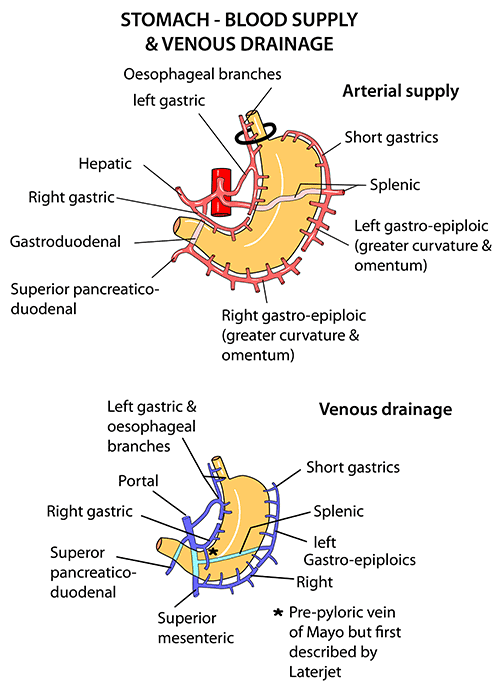
Arterial Supply
All arteries supplying the stomach are ultimately derived from the celiac trunk (the first major visceral branch of the abdominal aorta).
Lesser Curvature
| Artery | Origin | Course |
|---|---|---|
| Left gastric artery | Celiac trunk (directly) | Runs along the lesser curvature; gives esophageal branches |
| Right gastric artery | Common hepatic artery | Runs along the lesser curvature toward the left |
These two anastomose to form the lesser curvature arcade.
Greater Curvature
| Artery | Origin | Course |
|---|---|---|
| Left gastro-omental (gastroepiploic) artery | Splenic artery | Runs along the greater curvature toward the right |
| Right gastro-omental (gastroepiploic) artery | Gastroduodenal artery (branch of common hepatic) | Runs along the greater curvature toward the left |
These two anastomose to form the greater curvature arcade.
Fundus & Upper Body
- Short gastric arteries (4-5 branches) - arise from the splenic artery and supply the fundus and proximal stomach via the gastrosplenic ligament
- Posterior gastric artery - a branch of the splenic artery supplying the posterior wall
Venous Drainage
Venous drainage mirrors the arterial supply and drains into the portal venous system:
| Vein | Drains Into |
|---|---|
| Left gastric vein (coronary vein) | Portal vein |
| Right gastric vein | Portal vein |
| Right gastro-epiploic vein | Superior mesenteric vein |
| Left gastro-epiploic vein | Splenic vein |
| Short gastric veins | Splenic vein |
Clinical note: In portal hypertension, retrograde flow through the left gastric (coronary) vein leads to gastro-esophageal varices. In splenic vein thrombosis (e.g., from pancreatitis), isolated gastric varices can form via back-pressure through the gastroepiploic vessels.
Key Points
- The stomach is one of the best-vascularized organs in the abdomen due to its dual arcade system along both curvatures - this makes it resistant to ischemia
- This rich supply is why the stomach is commonly used as a conduit (gastric pull-up) in esophageal surgery
- The pre-pyloric vein of Mayo (also called the vein of Laterjet) is a surgical landmark marking the pylorus
Sources: Yamada's Textbook of Gastroenterology, 7th ed.; TeachMeAnatomy; InstantAnatomy
This is a shared conversation. Sign in to Orris to start your own chat.