
Patient has swelling in jaw and small cyst like hardness in jaw what it's cause?
Reading File
Jaw swelling with a cyst-like hardness can arise from several causes including dental infections (periapical abscess), odontogenic cysts (dentigerous, radicular), benign tumors (ameloblastoma), or lymph node enlargement. Let me search the medical library for detailed, authoritative information.
Searching sources...
Finding Sources
Finding Sources
Searching PubMed
jaw swelling odontogenic cyst diagnosis
Good results found. Let me read the detailed content from the most relevant sources.
Reading File
Reading File
Reading File
I now have comprehensive information. Here is a detailed, well-organized answer:
Jaw Swelling with Cyst-Like Hardness: Causes
Jaw swelling with a firm, cyst-like mass can result from a range of conditions - from simple dental infections to benign tumors and cysts of the jaw. Below are the most common and important causes, organized by category.
1. Odontogenic Cysts (Arising from Tooth-Related Structures)
These are the most common cause of cyst-like jaw swelling.
Dental (Radicular / Periapical) Cyst
- Most common jaw cyst
- Develops at the apex of a tooth with necrotic pulp, usually from untreated tooth decay
- Enlarges slowly by resorbing adjacent bone
- More common in the upper jaw (maxilla); if untreated in the lower jaw, can involve large portions of the mandible
- On palpation: may produce "egg-shell crackling" if bone is thinned, or fluctuation if bone is fully destroyed
- Fluid inside the cyst is clear and may contain cholesterol crystals
- Confirmed by X-ray
- (S Das Manual on Clinical Surgery, p. 341)
Dentigerous (Follicular) Cyst
- Associated with an unerupted permanent tooth (commonly lower/upper third molar)
- Develops from enamel epithelium around the crown of the unerupted tooth
- Fluid inside is viscid; the unerupted tooth is displaced deeper
- Also causes egg-shell crackling on palpation
- Confirmed by X-ray
- (S Das, p. 341)
Glandular Odontogenic Cyst
- Arises in the anterior mandible
- Presents as a slow-growing, painless swelling
- Radiology shows unilocular or multilocular radiolucency
- Histologically lined by cuboidal or columnar cells
- (Scott-Brown's Otorhinolaryngology, p. 8124)
Keratocystic Odontogenic Tumor (OKC/KCOT)
- Most common in the mandibular third molar area, but any part of the jaw can be involved
- Patients often present with swelling, pain, trismus (limited mouth opening), or sensory deficits
- Known for high recurrence rate if not fully removed
- (Cummings Otolaryngology, p. 3895)
2. Benign Jaw Tumors
Ameloblastoma (Adamantinoma)
- A multilocular cystic swelling most commonly in the lower jaw (mandible)
- Appears as a "honeycomb" pattern on X-ray
- Slow-growing but locally aggressive/malignant behavior
- Typical age: 20-30 years
- Expands at the cost of the outer table of bone
- (S Das, p. 341)
Aneurysmal Bone Cyst
- Affects the mandible more than the maxilla
- Can cause rapid jaw swelling
- Aspiration with an 18G needle yields blood
- Appears radiolucent on X-ray
- (KJ Lee's Essential Otolaryngology)
Giant-Cell Granuloma
- Occurs centrally in the mandible or maxilla
- Presents as a lobulated tumor, may erode through the cortex
- Benign but must be differentiated from osteoclastoma and brown tumor of hyperparathyroidism
- (S Das, p. 341)
3. Infectious / Dental Abscess Causes
- Periapical abscess: Acute bacterial infection at the tooth root tip - causes painful swelling, often with fever and redness
- Mandibular osteomyelitis: Bone infection, usually following dental infection or trauma
- Parotid/submandibular gland infection (sialadenitis): Salivary gland infection causing swelling near or in the jaw region
4. Syndrome-Associated Jaw Cysts
- Nevoid Basal Cell Carcinoma Syndrome (NBCCS / Gorlin Syndrome): Jaw cysts occur in ~90% of patients, often as early as age 5; both mandible and maxilla may be affected; cysts are usually keratocysts; mandibular involvement is twice as common as maxillary
- (Andrews' Diseases of the Skin, p. 752)
5. Other Causes to Consider
| Cause | Key Feature |
|---|---|
| Solitary bone cyst | Premolar/molar region, lobulated, aspirate may clot |
| Lymph node enlargement (reactive or malignant) | Soft-to-firm mass, may not be bony |
| Fibrous dysplasia | Painless bony expansion, young patients |
| Ranula | Mucus retention cyst, sublingual area |
| Osteosarcoma (rare) | Rapidly growing, painful, destructive on X-ray |
When to Seek Immediate Evaluation
The patient should be assessed promptly if any of these are present:
- Rapid growth of the swelling
- Pain, fever, redness (suggests infection/abscess)
- Difficulty opening the mouth (trismus)
- Numbness of the lip or chin (nerve involvement - suspicious for malignancy)
- Loose teeth in the area
Recommended Workup
- Dental X-ray (periapical/panoramic OPG) - first and most useful step
- CT scan of jaw - for extent and nature of lesion
- Aspiration of cyst fluid - color/consistency helps narrow diagnosis
- Biopsy - definitive diagnosis for any solid or complex lesion
- Dental/oral surgeon or ENT referral
A cyst-like hardness in the jaw most commonly turns out to be a dental (radicular) cyst from a non-vital tooth, or a dentigerous cyst from an impacted tooth. However, because ameloblastoma and other locally aggressive lesions can look similar clinically, a proper X-ray and specialist evaluation is always necessary before assuming it is benign.
Can I define in image
Yes, absolutely! You can upload an image of the jaw swelling and I will analyze it for you.
How to share:
- Take a clear photo of the affected jaw area
- Attach/upload it directly in this chat
Once you share the image, I will:
- Analyze the swelling, size, shape, and any visible features
- Compare findings with known jaw conditions
- Give you a more specific assessment based on what is visible
Tips for a better photo:
- Good lighting
- Include both sides of the face for comparison
- If possible, an intraoral (inside mouth) photo showing the gum/tooth area near the swelling
Go ahead and upload the image!
Give some images
Let me fetch clinical images of jaw cysts and swellings from the medical textbooks.
Searching sources...
Finding Sources
Finding Sources
Finding Sources
Reading File
Reading File
I found textbook images. Let me now fetch them and also look for more clinical images.
Loading Image
Reading File
Finding Sources
Reading File
Reading File
I found a great diagram image. Let me fetch it along with the ameloblastoma fibro-odontoma image found earlier.
Loading Image
Loading Image
Here are medical textbook images of jaw cysts and related conditions:
Image 1: Anatomy Diagram - Types of Jaw Cysts by Location
(Robbins Pathologic Basis of Disease)
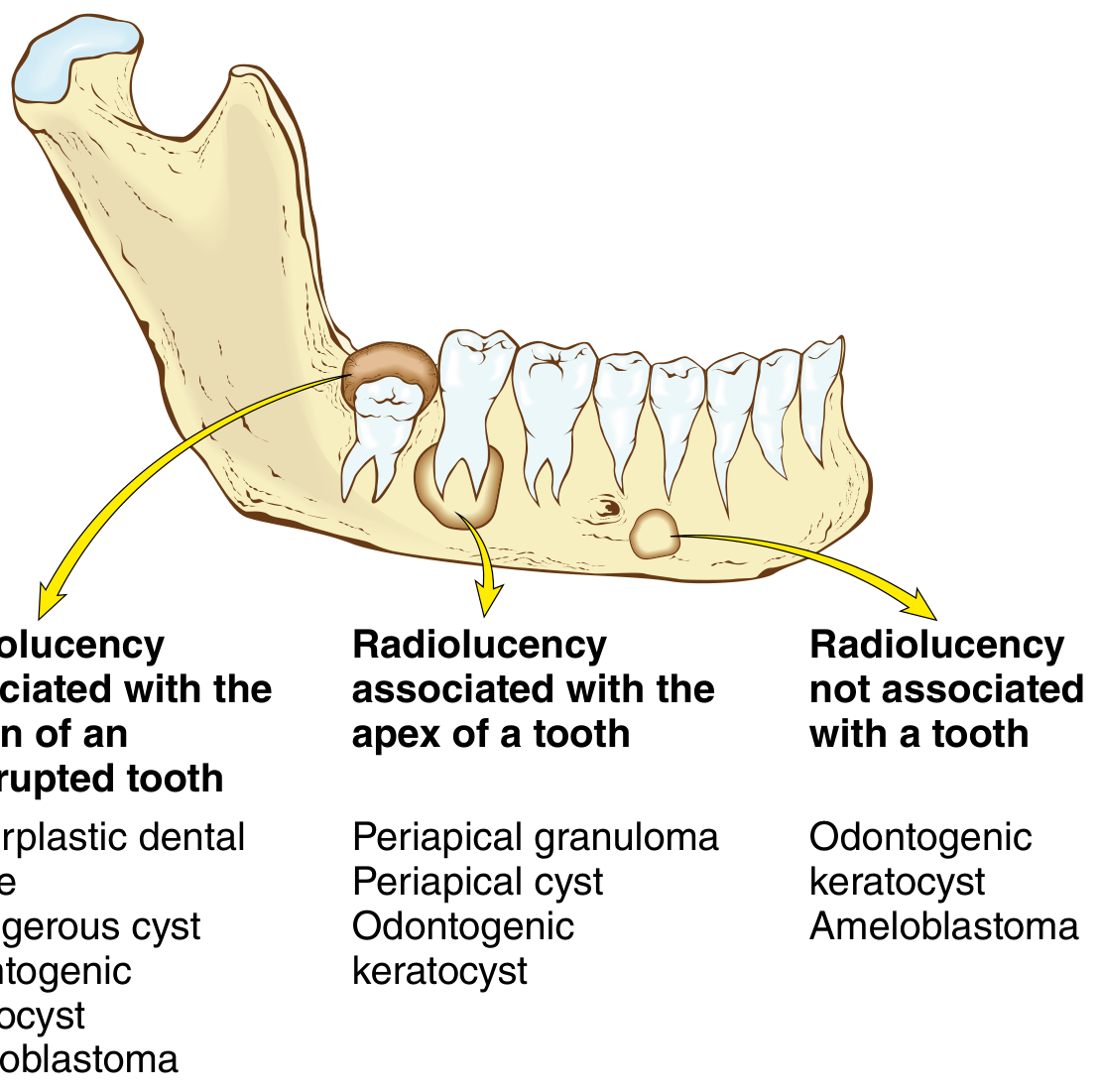
This diagram shows the three key patterns of jaw lesions on X-ray:
- Left (around crown of unerupted tooth): Dentigerous cyst, Odontogenic keratocyst, Ameloblastoma
- Middle (at tooth apex): Periapical granuloma, Periapical/Radicular cyst, Odontogenic keratocyst
- Right (not associated with a tooth): Odontogenic keratocyst, Ameloblastoma
Image 2: X-Ray - Keratocystic Odontogenic Tumor (OKC/KCOT)
(Cummings Otolaryngology)
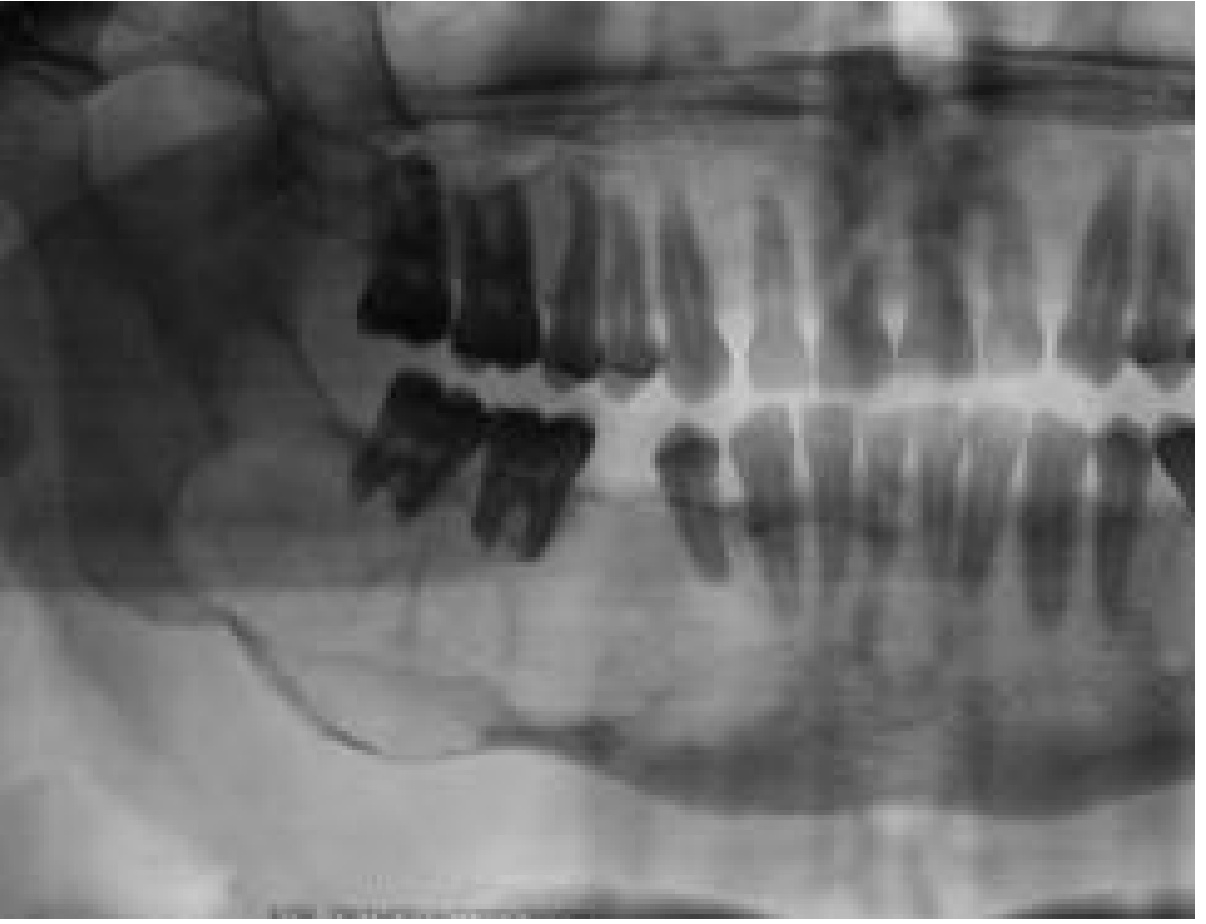
This is a panoramic (OPG) X-ray showing a keratocystic odontogenic tumor. Key features visible:
- A large dark (radiolucent) area in the jaw representing the cyst cavity
- Bowing (outward bulging) of the inferior border of the mandible
- Scalloping edges - typical of this type of cyst
- Displacement of teeth in the area
Image 3: Histology - Ameloblastic Fibro-Odontoma (Microscopy)
(Cummings Otolaryngology)
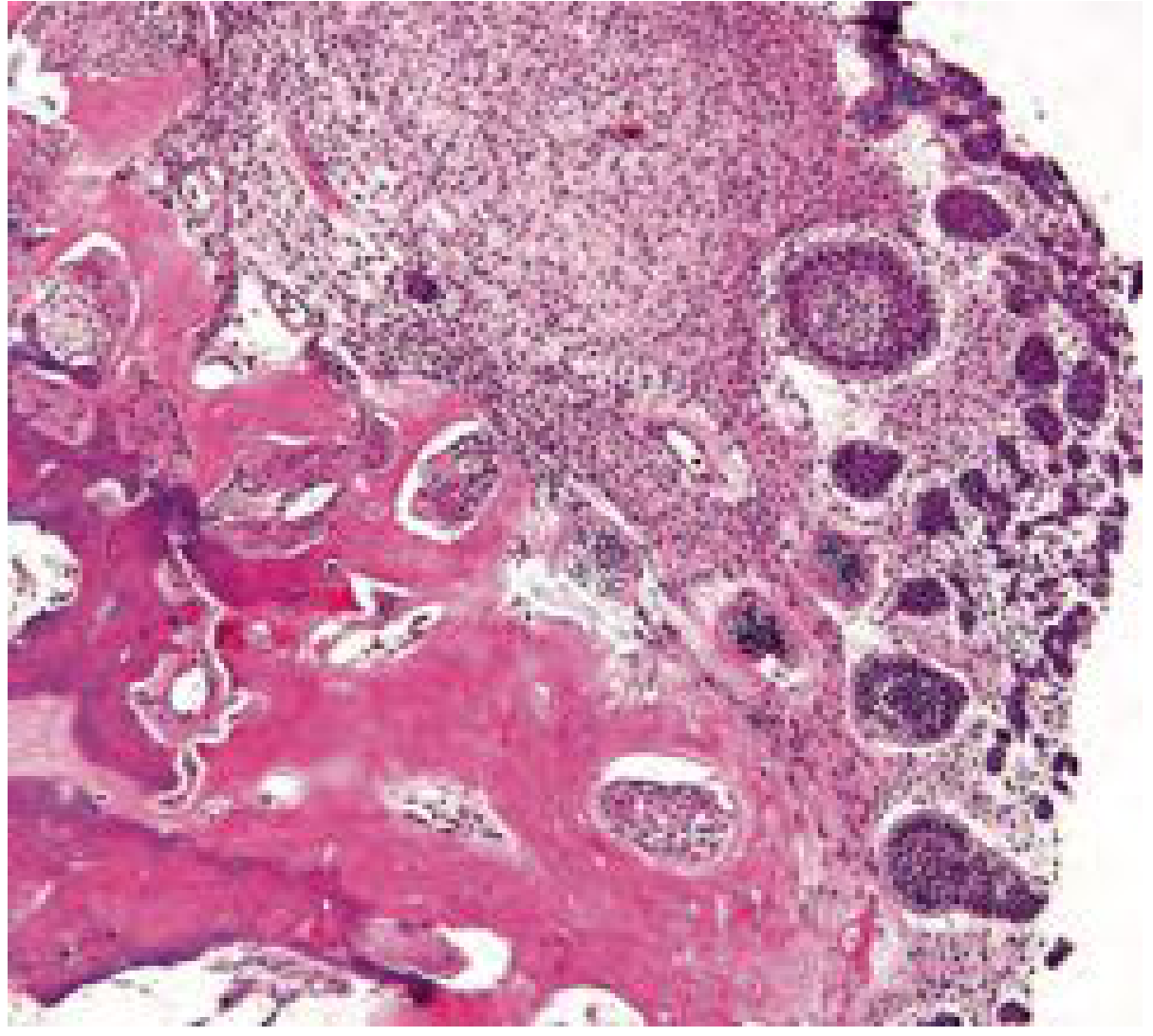
This is a microscopic (histology) image of a jaw tumor. On the right side: odontogenic epithelial islands (dark purple circular structures). On the left: mineralized products (enamel, dentin) confirming the diagnosis of ameloblastic fibro-odontoma.
Summary: How to Tell Them Apart on X-Ray
| Appearance on X-Ray | Most Likely Diagnosis |
|---|---|
| Dark area at tooth root tip | Radicular (periapical) cyst |
| Dark area around unerupted tooth crown | Dentigerous cyst |
| Multilocular "soap bubble" or "honeycomb" | Ameloblastoma |
| Unilocular cyst, scalloped borders, bowing of jaw border | Keratocystic odontogenic tumor |
| No tooth association, anterior jaw | Odontogenic keratocyst or giant cell lesion |
A panoramic X-ray (OPG) is the best first step to visualize the type and extent of any jaw cyst or swelling.
This is a shared conversation. Sign in to Orris to start your own chat.