
from Guyton and Hall Textbook of Medical Physiology (4th South Asia Edition) write a proper 3-mark reasoning answer on why A person cannot see in the dark immediately after coming from bright light.
Reading File
Finding Sources
Finding Sources
Reading File
Loading Image
I have all the source material needed. Here is the complete 3-mark reasoning answer directly from Guyton and Hall:
Why a Person Cannot See in the Dark Immediately After Coming from Bright Light
(Based on Guyton and Hall Textbook of Medical Physiology, 4th South Asia Edition)
Point 1 - Depletion of Photochemicals (Light Adaptation)
When a person is exposed to bright light for a prolonged period, large portions of the photochemicals in both the rods and cones are broken down. Specifically:
- The light-sensitive pigment rhodopsin (in rods) is continuously decomposed into retinal + opsin.
- Much of this retinal is then further converted into vitamin A, removing it from the visual cycle entirely.
As a result, by the time the person enters a dark environment, the concentrations of photosensitive chemicals remaining in the rods and cones are considerably reduced. Since vision depends on these photochemicals absorbing light and generating nerve signals, the eye's sensitivity to light is correspondingly low - making it nearly impossible to see in dim or dark conditions immediately. This state is called light adaptation.
(Guyton & Hall, p. 637 - "AUTOMATIC REGULATION OF RETINAL SENSITIVITY")
Point 2 - Dark Adaptation Requires Time (Regeneration of Rhodopsin)
Dark adaptation (the recovery of sensitivity in darkness) depends on the regeneration of rhodopsin and cone pigments, which is a time-dependent biochemical process:
- In the dark, retinal and opsins are reconverted back into light-sensitive pigments.
- Vitamin A is converted back into retinal, and retinal recombines with opsin to reform rhodopsin.
- The final limit of regeneration is set by the amount of opsin available in the rods and cones.
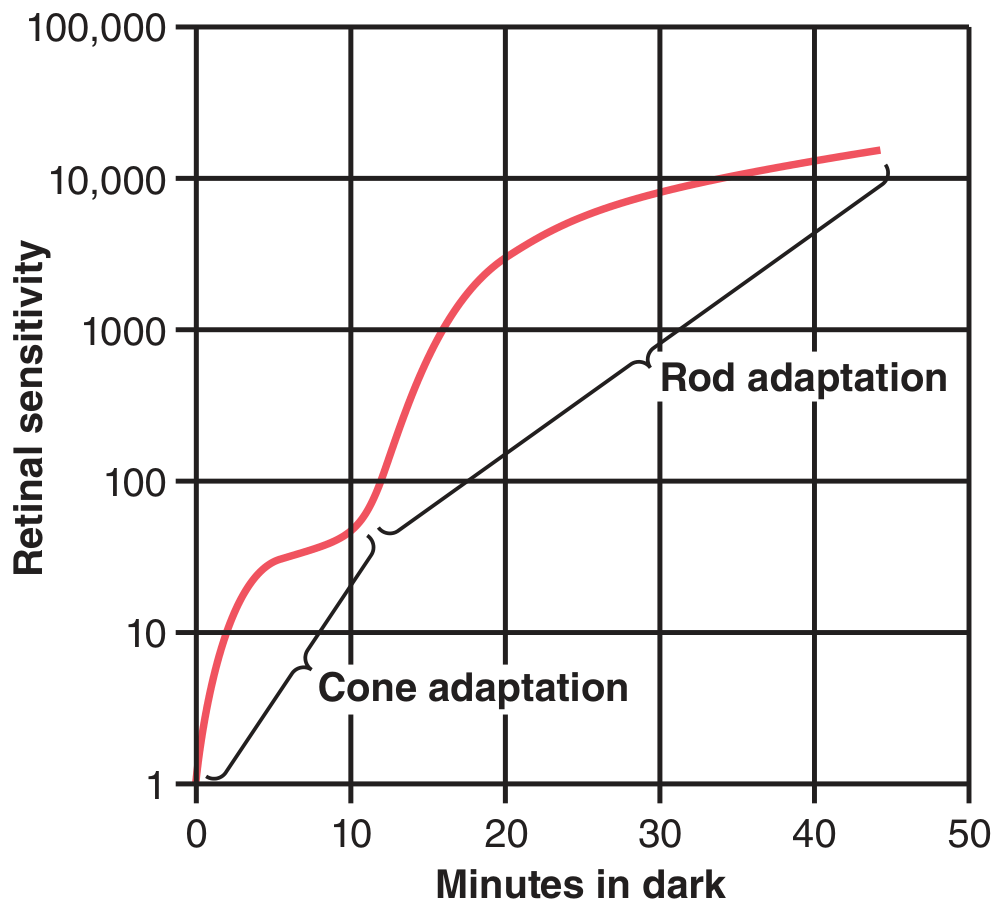
As shown in the dark adaptation curve (Fig. 51.9), retinal sensitivity is very low immediately on entering darkness. After ~1 minute, sensitivity increases 10-fold; after ~20 minutes, ~6,000-fold; and after ~40 minutes, ~25,000-fold. This gradual recovery takes time, explaining why vision is absent immediately after entering the dark.
Point 3 - Differential Recovery of Cones vs. Rods
The dark adaptation curve has a characteristic inflection, reflecting two separate phases:
- Cones adapt faster (chemical events in cones occur ~4 times more rapidly than in rods), reaching their sensitivity ceiling within a few minutes. However, cones achieve only a limited degree of sensitivity and are not suited for scotopic (dim light) vision.
- Rods adapt slowly but continue for many minutes to hours, ultimately achieving a tremendously greater sensitivity than cones. Additional rod sensitivity comes from neural convergence - signals from 100 or more rods summate onto a single ganglion cell.
Since rods are the primary receptors for night/dim-light vision, and their rhodopsin takes up to 40 minutes to fully regenerate after bright-light exposure, a person entering the dark immediately from bright light has virtually non-functional rod vision during the initial period. Until sufficient rhodopsin is regenerated and neural summation is restored, the person cannot see in the dark.
(Guyton & Hall, p. 637-638)
Summary: Bright light causes depletion of rhodopsin and conversion of retinal to vitamin A (light adaptation). On entering the dark, vision is absent because photosensitive pigments must be regenerated - a process requiring up to 40 minutes. Rods (the primary dark-vision receptors) are the slowest to recover, and until rhodopsin is sufficiently rebuilt, retinal sensitivity remains too low to detect dim light.
This is a shared conversation. Sign in to Orris to start your own chat.