

IMG-20260503-WA0013.jpg
Identify the specimen and answer
analyse_media
Reading File
Finding Sources
Reading File
Reading File
Loading Image
Specimen Identification: Transverse Sections of the Spinal Cord
The specimen in the glass jar (labeled 17) consists of two transverse (cross-sectional) slices of the spinal cord, preserved in formalin and mounted on a supporting pin/thread for display.
Identification
Specimen: Transverse sections of the spinal cord (likely human or large mammal)
This matches the classic gross anatomy museum preparation used in medical teaching. The two slices are mounted side by side, allowing bilateral comparison.
What You Can See in the Specimen
| Structure | Appearance | Significance |
|---|---|---|
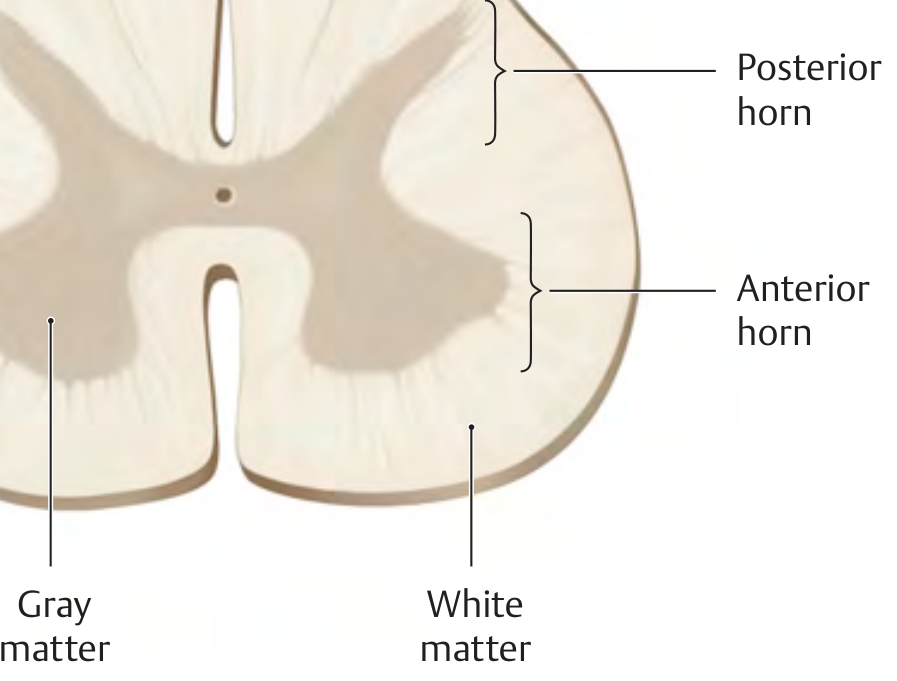
| Gray matter | Central butterfly / "H"-shaped darker region | Contains neuronal cell bodies |
| Anterior horns | Broader, rounded projections of gray matter (ventrally) | House lower motor neuron (LMN) cell bodies - efferent |
| Posterior horns | Narrower projections of gray matter (dorsally) | House sensory relay neuron cell bodies - afferent |
| White matter | Lighter surrounding ring | Myelinated ascending and descending fiber tracts |
| Central canal | Tiny dot at the center | Remnant of neural tube lumen, contains CSF |
| Anterior median fissure | Deep ventral groove | Landmark dividing left and right |
| Posterior median sulcus | Shallow dorsal groove | Divides posterior white columns |
Here is the textbook diagram for comparison:
Key Anatomical Points (for viva/exam)
- Gray matter is central; white matter is peripheral - opposite to the brain, where gray matter is the outer cortex.
- Functional arrangement:
- Anterior horn = Motor (efferent) - lower motor neurons (alpha and gamma motor neurons)
- Posterior horn = Sensory (afferent)
- Lateral horn (present at T1-L2 and S2-S4) = Autonomic neurons
- White matter tracts are organized into three funiculi on each side:
- Posterior funiculus: dorsal columns (fine touch, proprioception, vibration)
- Lateral funiculus: corticospinal tract (motor, descending), spinothalamic tract (pain/temp, ascending)
- Anterior funiculus: anterior corticospinal tract and other tracts
- The spinal cord has 31 segments: 8 cervical, 12 thoracic, 5 lumbar, 5 sacral, 1 coccygeal.
- The conus medullaris (tip of spinal cord) ends at L1-L2 in adults.
- Central canal is lined by ependymal cells and is continuous with the fourth ventricle superiorly.
Clinical Relevance
- Brown-Sequard syndrome (hemisection): ipsilateral motor loss + contralateral pain/temp loss
- Anterior cord syndrome: loss of motor + pain/temp bilaterally below lesion; dorsal columns preserved
- Syringomyelia: cavity in central cord destroys anterior white commissure - "cape-like" bilateral loss of pain and temperature
- Subacute combined degeneration (Vit B12 deficiency): degeneration of posterior and lateral funiculi
Source: General Anatomy and Musculoskeletal System, THIEME Atlas of Anatomy, p. 102
This is a shared conversation. Sign in to Orris to start your own chat.