
Hypothalamus short answer
Reading File
Searching sources...
Finding Sources
Finding Sources
Reading File
Now let me pull content from the best sources - Guyton (physiology), Histology textbook, and the psychiatry textbook for a comprehensive short answer.
Reading File
Reading File
Finding Sources
Reading File
Finding Sources
Reading File
I now have sufficient material. Let me compile a thorough short-answer response on the hypothalamus.
Loading Image
Here is a complete short-answer on the Hypothalamus:
Hypothalamus
Location and Relations
The hypothalamus is a small but functionally mighty part of the diencephalon. It sits at the base of the brain, encapsulating the ventral portion of the third ventricle. It is bounded above by the thalamus (hypothalamic sulcus), anteriorly by the lamina terminalis, posteriorly by the midbrain tegmentum, and inferiorly it connects to the pituitary gland via the infundibular stalk. - Neuroanatomy through Clinical Cases, 3rd ed.
Structural Organization
The hypothalamus is organized into three zones medial to lateral and four regions anterior to posterior.
Mediolateral zones:
- Periventricular zone - thin layer immediately adjacent to the third ventricle; rich in peptide-secreting neurons
- Medial zone - contains most named nuclei; functionally dominant
- Lateral zone - contains the lateral hypothalamic nucleus and the medial forebrain bundle (MFB), a diffuse fiber tract carrying connections to/from the hypothalamus
Anteroposterior regions (see figure below):
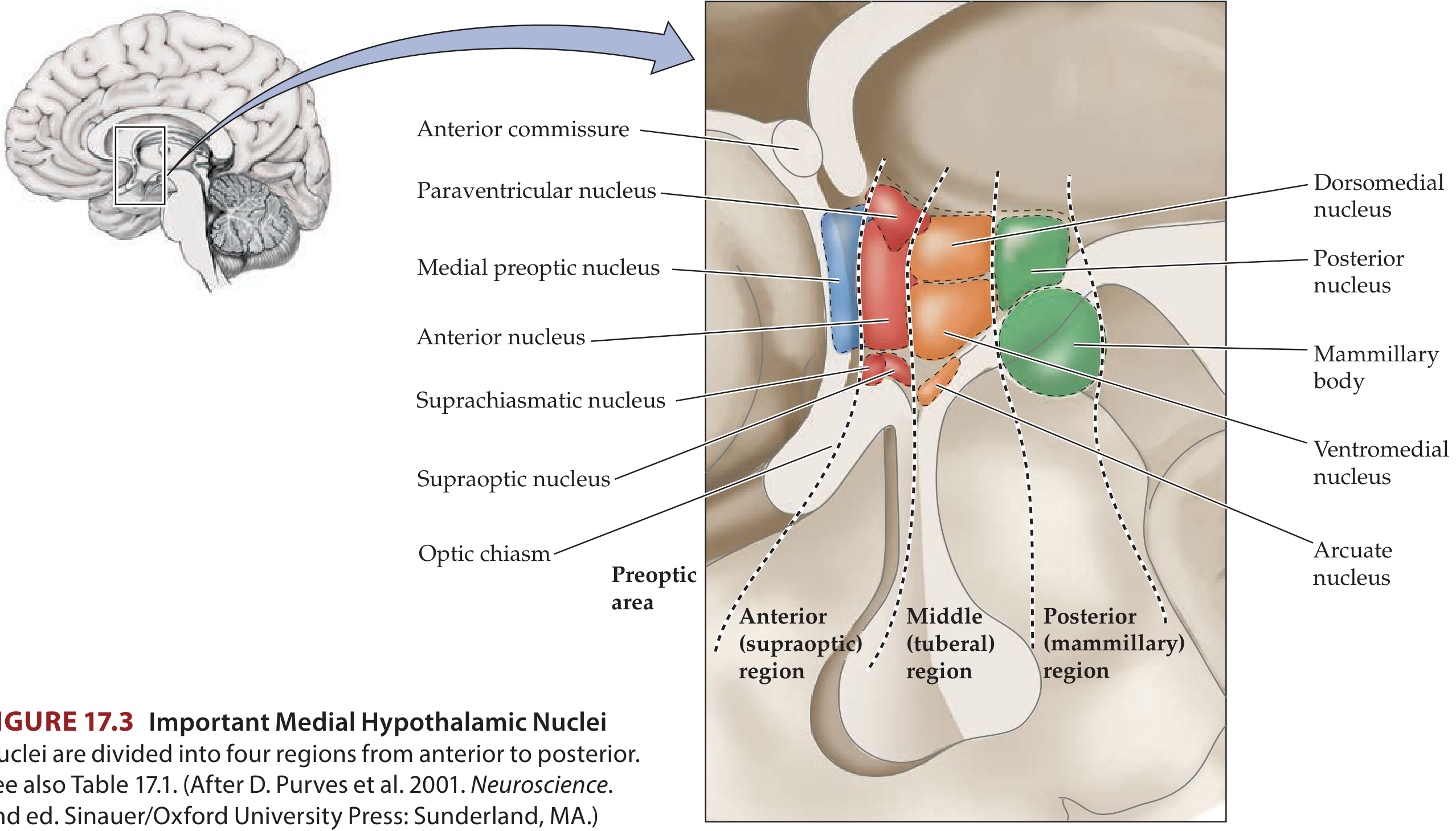
| Region | Key Nuclei |
|---|---|
| Preoptic area (telencephalic in origin) | Medial and lateral preoptic nuclei |
| Anterior (supraoptic) region | Anterior hypothalamic nucleus, supraoptic nucleus, paraventricular nucleus, suprachiasmatic nucleus |
| Middle (tuberal) region | Dorsomedial nucleus, ventromedial nucleus, arcuate nucleus |
| Posterior (mammillary) region | Posterior nucleus, mammillary bodies |
Key Nuclei and Their Functions (Memory Aid: TAN HOPS)
| Nucleus | Function |
|---|---|
| Supraoptic nucleus | Produces vasopressin (ADH) - projects to posterior pituitary |
| Paraventricular nucleus | Produces oxytocin (also some ADH); also contains CRH-secreting neurons |
| Suprachiasmatic nucleus | Master circadian clock - receives direct retinal input |
| Arcuate nucleus | Produces GHRH and dopamine (prolactin inhibitor); site of GnRH neurons |
| Ventromedial nucleus | Satiety center - lesion causes hyperphagia and obesity |
| Lateral hypothalamic area | Hunger/feeding center - lesion causes anorexia and weight loss |
| Anterior hypothalamic nucleus | Heat dissipation (cooling center) - lesion causes hyperthermia |
| Posterior hypothalamic nucleus | Heat conservation - lesion causes hypothermia; also mediates rage/aggression |
| Mammillary bodies | Memory (part of Papez circuit); lesion in Wernicke-Korsakoff syndrome |
| Dorsomedial nucleus | Feeding behavior, heart rate, GI motility |
Functions
1. Neuroendocrine Control
The hypothalamus is the "master regulator" of the pituitary. It secretes releasing and inhibiting hormones that act on the anterior pituitary via the hypothalamo-hypophyseal portal system (hypophyseal portal veins carry hormones from the median eminence to the anterior pituitary). - Histology: A Text and Atlas, Wolters Kluwer
| Hypothalamic Hormone | Effect on Anterior Pituitary |
|---|---|
| GHRH | Stimulates GH release |
| Somatostatin | Inhibits GH (and TSH) |
| CRH | Stimulates ACTH release |
| TRH | Stimulates TSH (and PRL) release |
| GnRH | Stimulates LH and FSH release |
| Dopamine (PIF) | Inhibits prolactin release |
Oxytocin and ADH are produced in the hypothalamus (supraoptic and paraventricular nuclei) and released from the posterior pituitary (neurohypophysis) via axonal transport.
2. Autonomic Nervous System Integration
- Anterior hypothalamus: Parasympathetic outflow (heart rate decrease, increased secretion)
- Posterior hypothalamus: Sympathetic outflow (fight-or-flight: tachycardia, vasoconstriction, pupillary dilation)
3. Temperature Regulation ("Thermostat")
- Anterior hypothalamus (preoptic area): Activated by heat - initiates cooling responses: vasodilation, sweating, decreased thermogenesis
- Posterior hypothalamus: Integrates temperature signals and initiates heat conservation: vasoconstriction, shivering, piloerection, increased thyroxine - Guyton & Hall, Medical Physiology
4. Feeding and Body Weight
- Ventromedial nucleus = satiety; Lateral area = hunger
- Integrates signals from leptin (inhibits hunger), ghrelin (stimulates hunger), and insulin
5. Sleep-Wake and Circadian Rhythm
- Suprachiasmatic nucleus - master pacemaker; driven by light input via retinohypothalamic tract
- Posterior hypothalamus promotes wakefulness; anterior promotes sleep (VLPO)
6. Emotional Behavior and Limbic Integration
- The posterior hypothalamus plays a key role in anger and aggression (Cannon-Bard theory). Removing the cerebral hemispheres while leaving the posterior hypothalamus intact produces "sham rage" in animals
- Connects to limbic system via the medial forebrain bundle and fornix-mammillary pathway - Neuroscience: Exploring the Brain, 5th ed.
7. Reproduction and Gonadal Function
- GnRH is released in a pulsatile fashion from the arcuate nucleus; pulsatile GnRH is required for LH/FSH release and normal reproductive function
- Suprachiasmatic nucleus regulates the LH surge driving ovulation
8. Water Balance
- ADH (vasopressin) - released in response to raised plasma osmolality detected by hypothalamic osmoreceptors; increases water reabsorption in the renal collecting duct
- Thirst center - in the lateral hypothalamus/preoptic area
Hypothalamo-Hypophyseal Connections (Summary)
| System | Pathway | Hormones |
|---|---|---|
| Tuberoinfundibular | Axons from arcuate/periventricular nuclei → median eminence → portal blood | Releasing/inhibiting hormones |
| Supraopticohypophyseal | Axons from supraoptic/paraventricular nuclei → posterior pituitary | ADH, Oxytocin |
Clinically Important Lesions
| Lesion | Result |
|---|---|
| Posterior hypothalamus | Hypothermia, somnolence, loss of sympathetic drive |
| Anterior hypothalamus | Hyperthermia, insomnia |
| Ventromedial nucleus | Hyperphagia, obesity |
| Lateral area | Anorexia, weight loss |
| Supraoptic/paraventricular nuclei | Diabetes insipidus (cranial) |
| Mammillary bodies | Wernicke-Korsakoff syndrome (memory loss, confabulation) |
| Craniopharyngioma | Compresses hypothalamus and pituitary stalk - causes panhypopituitarism, DI, visual field defects |
Sources: - Neuroanatomy through Clinical Cases, 3rd ed. - Guyton and Hall Textbook of Medical Physiology - Histology: A Text and Atlas with Correlated Cell and Molecular Biology - Neuroscience: Exploring the Brain, 5th ed.
This is a shared conversation. Sign in to Orris to start your own chat.