


IMG-20260505-WA0008.jpg
IMG-20260505-WA0009.jpg
Explain scaitic nerve and all the content in the given pages
Reading File
Finding Sources
Searching the Web
sciatic nerve anatomy origin course branches clinical
Reading File
Searching Images
sciatic nerve anatomy gluteal region thigh branches
Reading File
Loading Image
Now I have enough information from the textbooks and the attached images. Let me compile a comprehensive explanation.
The Sciatic Nerve — Complete Notes
Overview
The sciatic nerve is the thickest (largest) nerve in the body. In its upper part it forms a band about 2 cm wide. It begins in the pelvis and terminates at the superior angle of the popliteal fossa by dividing into the tibial and common peroneal nerves.
Origin & Root Value
- Largest branch of the sacral plexus
- Root value: L4, L5, S1, S2, S3
- It is actually two nerves wrapped in a common sheath:
| Component | Formed by | Divisions |
|---|---|---|
| Tibial part | L4, L5, S1, S2, S3 | Ventral (anterior) divisions |
| Common peroneal part | L4, L5, S1, S2 | Dorsal (posterior) divisions |
Course
In the Pelvis
- Lies in front of the piriformis, under cover of its fascia
- It is part of the network of nerves of the posterior pelvis (sometimes noted as the network of the "Posterior Pelvis")
In the Gluteal Region
- Enters through the greater sciatic foramen, below the piriformis
- Runs downwards with a slight lateral convexity
- Passes between the ischial tuberosity and the greater trochanter
Relations in the Gluteal Region:
| Position | Structure |
|---|---|
| Superficial (posterior) | Gluteus maximus |
| Deep (anterior): | |
| a. | Body of the ischium |
| b. | Tendon of obturator internus + gemelli |
| c. | Quadratus femoris, obturator externus |
| d. | Capsule of hip joint |
| e. | Upper, transverse fibres of adductor magnus |
| Medial | Inferior gluteal nerve and vessels |
In the Thigh
- Enters the back of the thigh at the lower border of gluteus maximus
- Runs vertically downwards up to the superior angle of the popliteal fossa
- Terminates at the junction of the upper 2/3 and lower 1/3 of the thigh by dividing into:
- Tibial nerve
- Common peroneal nerve
Relations in the Thigh:
| Position | Structure |
|---|---|
| Superficial (posterior) | Long head of biceps femoris |
| Deep (anterior) | Adductor magnus |
Branches
1. Articular Branches
- To the hip joint — arise in the gluteal region
2. Muscular Branches
Tibial part supplies:
- Semitendinosus
- Semimembranosus
- Long head of biceps femoris
- Ischial head of adductor magnus (medial side)
Common peroneal part supplies:
- Short head of biceps femoris only
Memory Aid: Medial = Semimembranosus & Semitendinosus | Lateral = Biceps femoris
3. Terminal Branches
- Tibial nerve (L4, L5, S1, S2, S3)
- Common peroneal nerve (L4, L5, S1, S2)
Accompanying Artery
The sciatic nerve is accompanied by a small artery — arteria nervi ischiadici — a branch of the inferior gluteal artery, which runs along the nerve for some distance before sinking into its substance.
What the Sciatic Nerve Ultimately Innervates
Motor:
- All muscles in the posterior compartment of the thigh (hamstrings + ischial head of adductor magnus)
- All muscles of the leg and foot (via its terminal branches)
Sensory:
- Lateral side of the leg
- Lateral side and sole of the foot
Clinical Anatomy
1. Sleeping Foot
When a person sits on the edge of a hard table/chair, the nerve gets compressed between the table edge and the femur → numbness of the lower limb. Sensations return when the foot is placed on the ground a few times. This is called sleeping foot.
2. Sciatica
- Shooting pain along the cutaneous distribution of the sciatic nerve and its terminal branches, chiefly the common peroneal
- Pain begins in the gluteal region and radiates along the back of the thigh → lateral side of the leg → dorsum of the foot
- Cause: compression of one or more nerve roots forming the sciatic nerve
- Disc prolapse (most common — nucleus pulposus herniates through annulus fibrosus, compressing the spinal nerve root)
- Neuritis, etc.
3. Sciatic Nerve Injury
Can result from penetrating wounds or dislocation of the hip.
Effects:
| Type | Loss |
|---|---|
| Motor | All movements below the knee — loss of hamstrings, dorsiflexors, plantar flexors, evertors, muscles of the sole → foot drop |
| Sensory | Back of thigh, whole leg, and foot — except the area innervated by the saphenous nerve (medial side of leg/foot) |
Muscle wasting occurs in:
- Hamstrings
- Calf muscles
- Peroneal muscles
- Dorsiflexors
- Muscles of the sole
Key Diagrams from Your Pages
| Figure | Content |
|---|---|
| Fig. 7.4 | Formation of the sciatic nerve from L4–S3 (anterior + posterior divisions) |
| Fig. 7.5 | Branches of sciatic nerve — tibial part (medial) vs common peroneal part (lateral) |
| Fig. 7.6 | Testing the hamstrings (resistance against action of muscles) |
| Fig. 7.7 | Relations of sciatic nerve in the gluteal region and back of thigh |
| Fig. 7.8 | Disc prolapse causing sciatica — herniation of nucleus pulposus compressing spinal nerve |
| Fig. 7.9 | Wasting of various muscle groups after sciatic nerve injury (hamstrings, calf, peroneal, dorsiflexors, sole, foot drop) |
| Fig. 7.10 | Sensory loss over most of the leg due to sciatic nerve injury |
Cadaveric Image — Sciatic Nerve in Posterior Thigh
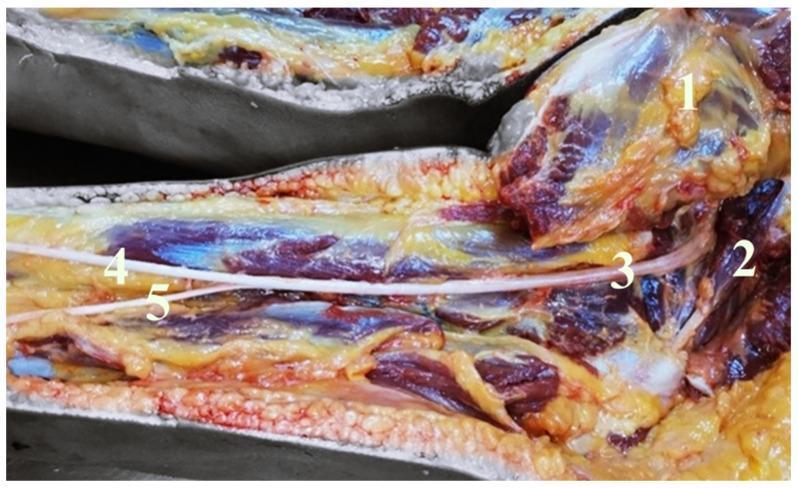
Cadaveric dissection: (1) Gluteus maximus, (2) Piriformis, (3) Sciatic nerve emerging below piriformis, (4) Tibial nerve, (5) Common peroneal nerve
Quick Summary Table
| Feature | Detail |
|---|---|
| Largest nerve | In the body |
| Root value | L4, L5, S1, S2, S3 |
| Exits pelvis via | Greater sciatic foramen, below piriformis |
| Terminates | Upper 2/3 / lower 1/3 junction of thigh |
| Terminal branches | Tibial nerve + Common peroneal nerve |
| Motor supply | Posterior thigh, all leg & foot muscles |
| Injury results in | Foot drop, loss of movements below knee, sensory loss over back of thigh, leg, foot |
Sources: Gray's Anatomy for Students, 4th ed.; BD Chaurasia's Human Anatomy (pages shown in your images)
Give relation
Here are the complete Relations of the Sciatic Nerve in each region:
Relations of the Sciatic Nerve
1. In the Pelvis
| Position | Structure |
|---|---|
| Anterior (deep) | Piriformis muscle (nerve lies in front of it) |
The nerve lies under cover of the fascia of piriformis.
2. In the Gluteal Region
Superficial (Posterior) Relations
| Structure |
|---|
| Gluteus maximus — covers the nerve completely |
Deep (Anterior) Relations
| Structure |
|---|
| a. Body of the ischium |
| b. Tendon of obturator internus with superior and inferior gemelli |
| c. Quadratus femoris (with obturator externus deep to it) |
| d. Capsule of the hip joint |
| e. Upper, transverse fibres of adductor magnus |
Medial Relations
| Structure |
|---|
| Inferior gluteal nerve and vessels |
Lateral Relations
| Structure |
|---|
| Posterior cutaneous nerve of the thigh runs just medial to it (some texts describe it as lateral context) |
Key point: At the midpoint between the ischial tuberosity and the greater trochanter, the nerve lies just deep to gluteus maximus — this is the surface marking used clinically.
3. In the Thigh (Back of Thigh)
Superficial (Posterior) Relations
| Structure |
|---|
| Long head of biceps femoris crosses over the nerve |
Deep (Anterior) Relations
| Structure |
|---|
| Adductor magnus |
Medial Relations
| Structure |
|---|
| Posterior cutaneous nerve of the thigh |
| Perforating arteries (pass close by) |
Summary Diagram (Text Format)
GLUTEAL REGION — Cross-sectional view (posterior → anterior)

POSTERIOR (Superficial)
        ↓
  Gluteus maximus
        ↓
  SCIATIC NERVE  ←── Inferior gluteal nerve & vessels (medial)
        ↓
  Obturator internus + Gemelli
        ↓
  Quadratus femoris
        ↓
  Hip joint capsule / Adductor magnus
        ↓
ANTERIOR (Deep)
THIGH — Cross-sectional view (posterior → anterior)

POSTERIOR (Superficial)
        ↓
  Long head of Biceps femoris
        ↓
  SCIATIC NERVE
        ↓
  Adductor magnus
        ↓
ANTERIOR (Deep)
Quick Reference Table
| Region | Superficial/Posterior | Deep/Anterior | Medial |
|---|---|---|---|
| Pelvis | — | Piriformis | — |
| Gluteal | Gluteus maximus | Ischium, Obturator internus + Gemelli, Quadratus femoris, Hip capsule, Adductor magnus | Inferior gluteal nerve & vessels |
| Thigh | Long head of Biceps femoris | Adductor magnus | Posterior cutaneous nerve of thigh |
Clinical Relevance of Relations
- The sciatic nerve's deep relation to the hip joint capsule explains why hip dislocation can injure it.
- Its relation to quadratus femoris and obturator internus means deep gluteal injections can damage it if given incorrectly — injections must be given in the upper outer quadrant of the buttock.
- The long head of biceps femoris crossing it in the thigh acts as a surgical landmark during posterior thigh dissections.
This is a shared conversation. Sign in to Orris to start your own chat.