
Detailed notes on central nervous system physiology
Central Nervous System Physiology - Detailed Notes
1. Overview and Organization of the Nervous System
- Somatic nervous system - voluntary skeletal muscle control
- Autonomic nervous system (ANS) - involuntary control of viscera, glands, smooth muscle; subdivided into sympathetic and parasympathetic
- Enteric nervous system - intrinsic neural plexuses of the gut
2. The Neuron - Basic Structural and Functional Unit
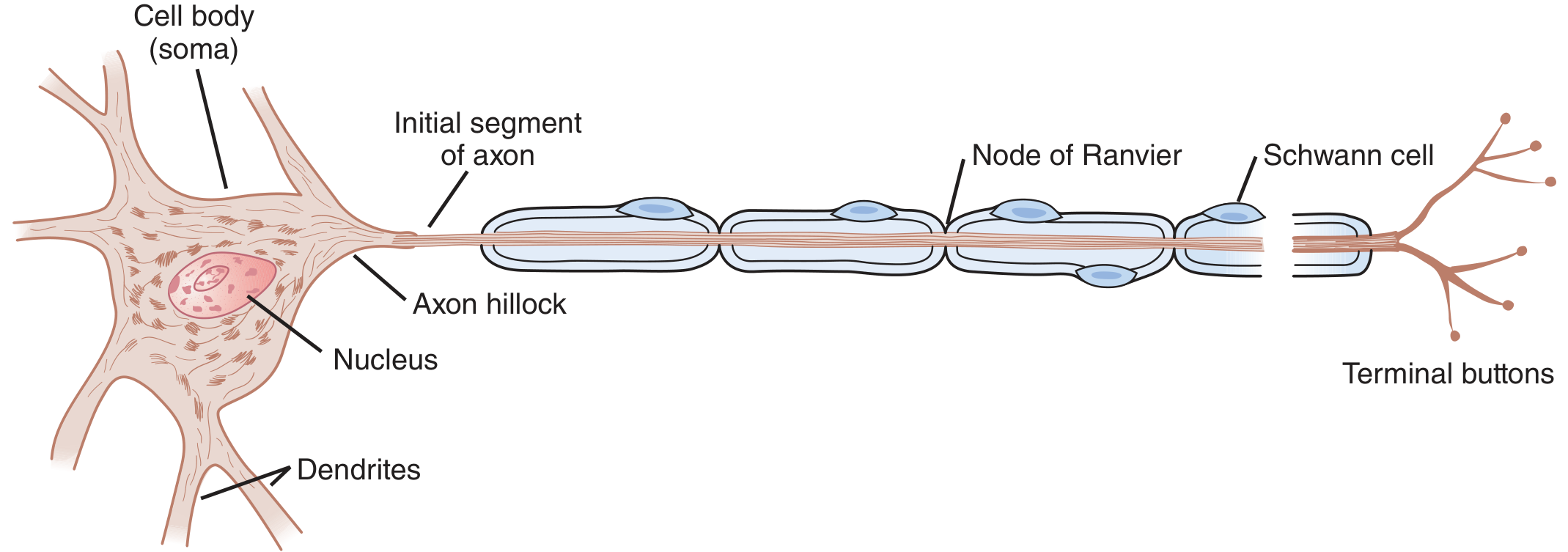
2.1 Structural Components
| Component | Structure | Function |
|---|---|---|
| Soma (cell body) | Contains nucleus, Nissl substance (RER), mitochondria | Metabolic center; protein synthesis |
| Dendrites | Multiple branching processes | Receive and integrate incoming signals; processed via dendritic spines |
| Axon hillock | Thickened base of axon | Site of action potential initiation (lowest threshold) |
| Initial segment | First portion of axon | Integrates inputs; determines firing |
| Axon | Long fibrous process, may be myelinated | Conducts impulses to presynaptic terminals |
| Terminal boutons (buttons) | Synaptic knobs at axon endings | Store and release neurotransmitters |
2.2 Neuron Classification by Number of Processes
- Unipolar - one process (e.g., invertebrate neurons)
- Bipolar - two processes: one dendrite + one axon (e.g., retinal neurons, olfactory epithelium)
- Pseudounipolar - single process splits into two (both function as axons); one to periphery, one to spinal cord. Classic example: dorsal root ganglion cells
- Multipolar - one axon + many dendrites. Most CNS neurons; includes spinal motor neurons, hippocampal pyramidal cells, cerebellar Purkinje cells
2.3 Neuroglial Cells
- Astrocytes - structural support, BBB maintenance, ion buffering (K+), neurotransmitter uptake, synaptic modulation
- Oligodendrocytes - myelinate CNS axons (one cell can myelinate multiple axons; contrast with Schwann cells in PNS, which myelinate one segment each)
- Microglia - CNS immune cells; phagocytosis of debris and pathogens
- Ependymal cells - line ventricles and central canal; involved in CSF production and circulation
3. Resting Membrane Potential
3.1 Ionic Basis
- Pumps 3 Na⁺ out for every 2 K⁺ in (electrogenic - net positive charge moves out)
- Creates the following concentration gradients:
| Ion | Outside (mEq/L) | Inside (mEq/L) | Ratio (in/out) |
|---|---|---|---|
| Na⁺ | 142 | 14 | 0.1 |
| K⁺ | 4 | 140 | 35.0 |
| Cl⁻ | 103 | 4 | low inside |
| A⁻ (proteins) | - | high | impermeant |
Nernst equilibrium potential for Na⁺: approximately +61 mV
RMP (-70 mV) lies between these values, reflecting the combined influence of both ions weighted by relative permeability (Goldman-Hodgkin-Katz equation).
Key point: Only 1/3,000,000 to 1/100,000,000 of the total positive charges inside the fiber need to be transferred to establish the -70 mV potential. This incredibly small ion movement allows the potential to reverse from -70 mV to +35 mV in as little as 1/10,000 of a second.
4. The Action Potential (AP)
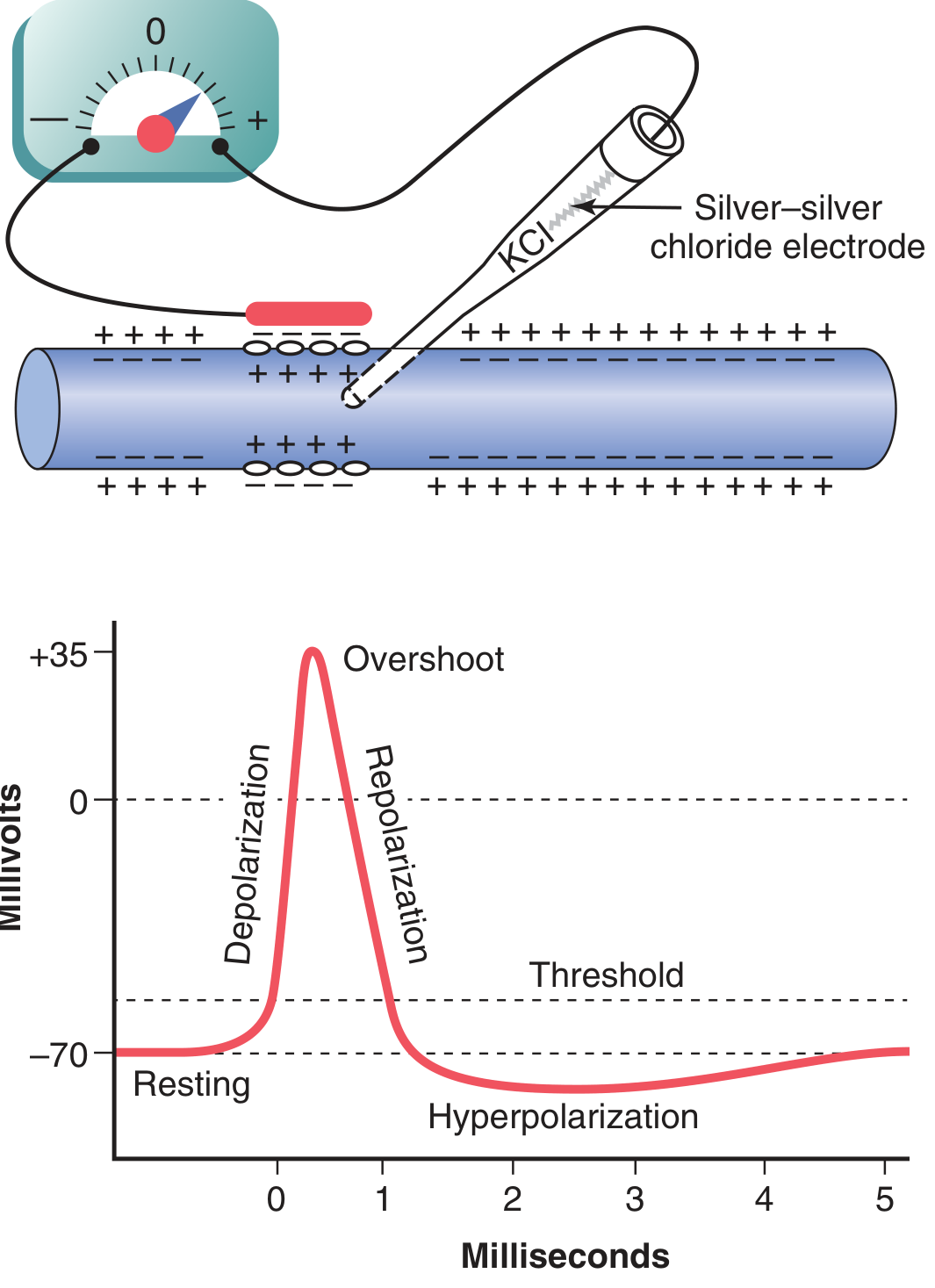
4.1 Stages of the Action Potential
- Membrane is "polarized"
- Voltage-gated Na⁺ channels closed but capable of opening
- K⁺ leak channels open
- Threshold reached at approximately -55 mV
- Massive opening of voltage-gated Na⁺ channels
- Rapid Na⁺ influx drives membrane potential from -70 mV to approximately +35 mV (overshoot) in large fibers
- Some CNS neurons only approach 0 mV without overshooting
- Within <1 ms, Na⁺ channels begin to close (inactivation gate closes)
- Voltage-gated K⁺ channels open (delayed)
- K⁺ rapidly exits, restoring negative potential
- K⁺ channels remain open slightly longer than needed
- Membrane potential briefly dips below -70 mV
- Returns to resting level once K⁺ channels close
4.2 Voltage-Gated Channels
- Activation gate (m gate) - opens rapidly when membrane depolarizes to threshold
- Inactivation gate (h gate) - closes within a millisecond after activation, stopping Na⁺ influx (responsible for the absolute refractory period)
- Delayed rectifier channels - open ~0.1-0.5 ms after depolarization
- Their delayed opening underlies the repolarization phase and undershoot
4.3 Refractory Periods
- Absolute refractory period - Na⁺ inactivation gates are closed; no stimulus can generate another AP regardless of strength. Lasts ~1-2 ms.
- Relative refractory period - After-hyperpolarization phase; a stronger-than-normal stimulus can generate an AP. This limits the maximum firing frequency of a neuron.
4.4 All-or-Nothing Principle
4.5 Ionic Fluxes During an AP (Ganong's)
- During depolarization: Na⁺ rushes in through voltage-gated Na⁺ channels
- Peak of AP: Na⁺ permeability at maximum; approaches Na⁺ equilibrium potential (+61 mV)
- Repolarization: K⁺ efflux via delayed rectifier K⁺ channels dominates
5. Conduction of Nerve Impulses
5.1 Unmyelinated Fibers - Continuous Conduction
5.2 Myelinated Fibers - Saltatory Conduction
- The AP "jumps" from node to node
- Much faster conduction velocity (up to 120 m/s in large myelinated fibers vs 0.5-2 m/s in unmyelinated C fibers)
- More energy efficient - fewer ions cross the membrane; less ATP needed by Na⁺-K⁺ pump to restore gradients
| Fiber Type | Diameter (μm) | Conduction (m/s) | Function |
|---|---|---|---|
| Aα | 12-20 | 70-120 | Motor, proprioception |
| Aβ | 5-12 | 30-70 | Touch, pressure |
| Aδ | 2-5 | 12-30 | Fast pain, cold |
| B | 1-3 | 3-15 | Preganglionic ANS |
| C | 0.3-1 | 0.5-2 | Slow pain, warmth |
5.3 Re-Establishing Ionic Gradients After APs
6. Synaptic Transmission
6.1 Types of Synapses
- Pre- and postsynaptic membrane separated by synaptic cleft (~20-40 nm wide)
- One-way transmission (presynaptic → postsynaptic)
- Subject to fatigue, pharmacological modulation, plasticity
- Direct cytoplasmic connections via connexins
- Very fast, bidirectional transmission
- Common in cardiac muscle, smooth muscle, some CNS neurons (e.g., inferior olive)
6.2 Synaptic Anatomy
- Axodendritic - most common; axon terminal contacts dendrite or dendritic spine
- Axosomatic - axon contacts cell body (soma)
- Axoaxonal - axon contacts another axon (mediates presynaptic inhibition/facilitation)
- Mitochondria (energy supply for neurotransmitter synthesis and vesicle recycling)
- Synaptic vesicles - three types:
- Small clear vesicles: contain acetylcholine, glycine, GABA, or glutamate
- Small dense-core vesicles: contain catecholamines (dopamine, norepinephrine)
- Large dense-core vesicles: contain neuropeptides (synthesized in soma, transported by fast axoplasmic transport)
6.3 Steps in Chemical Synaptic Transmission
- AP arrives at presynaptic terminal
- Depolarization opens voltage-gated Ca²⁺ channels at active zones
- Ca²⁺ influx (transmitter release begins within 200 μs)
- Synaptic vesicles dock and fuse with presynaptic membrane via SNARE proteins (SNAP-25, synaptobrevin, syntaxin); neurexin-neuroligin interactions align pre- and postsynaptic elements
- Exocytosis releases neurotransmitter into synaptic cleft
- Neurotransmitter diffuses across cleft and binds to postsynaptic receptors
- Receptor activation produces postsynaptic potential (EPSP or IPSP)
- Neurotransmitter is removed by: reuptake (transporters), enzymatic degradation (e.g., AChE), or diffusion
6.4 Postsynaptic Potentials
- Caused by opening of Na⁺/K⁺ channels (or other cation channels)
- Net inward cation current → depolarization (more positive potential)
- If summated EPSPs bring the axon hillock to threshold (~-55 mV), an AP fires
- Caused by opening of Cl⁻ channels (e.g., GABA-A receptor) or K⁺ channels
- Cl⁻ influx (or K⁺ efflux) → hyperpolarization (more negative potential)
- Makes it harder to reach threshold - inhibits firing
6.5 Summation
| Type | Mechanism |
|---|---|
| Temporal summation | Multiple EPSPs from the same presynaptic neuron arriving in rapid succession; each builds on the residual depolarization of the previous one |
| Spatial summation | EPSPs from multiple presynaptic neurons arriving simultaneously; their depolarizations add at the axon hillock |
6.6 Inhibitory Mechanisms
- An inhibitory interneuron releases glycine or GABA onto the postsynaptic neuron
- Produces IPSP via Cl⁻ or K⁺ channel opening
- Example: reciprocal innervation - stretch receptor activation excites agonist motor neuron AND inhibits antagonist motor neuron via an inhibitory interneuron (direct/postsynaptic inhibition)
- An inhibitory neuron synapses on an excitatory axon terminal (axoaxonal synapse)
- GABA acting on GABA-A receptors increases Cl⁻ conductance in the excitatory terminal
- This reduces the size of the AP invading the terminal, reducing Ca²⁺ influx, and thus less neurotransmitter is released
- GABA-B receptors also open K⁺ channels and close Ca²⁺ channels at the terminal
7. Major Neurotransmitter Systems
| Neurotransmitter | Type | Receptor Types | Location | Effect |
|---|---|---|---|---|
| Glutamate | Amino acid | AMPA, NMDA, Kainate, mGluR | Widespread (main excitatory) | Excitation, LTP, memory |
| GABA | Amino acid | GABA-A (ionotropic, Cl⁻), GABA-B (metabotropic, K⁺/Ca²⁺) | Widespread (main inhibitory) | Inhibition |
| Glycine | Amino acid | GlyR (ionotropic, Cl⁻) | Spinal cord, brainstem | Inhibition (reciprocal innervation) |
| Acetylcholine (ACh) | Quaternary amine | Nicotinic (ionotropic), Muscarinic (metabotropic) | NMJ, basal forebrain, ANS | Excitation (NMJ), varied (muscarinic) |
| Dopamine | Catecholamine | D₁-D₅ (metabotropic) | Substantia nigra (→ striatum), VTA (→ limbic) | Reward, motor control, motivation |
| Norepinephrine | Catecholamine | α₁, α₂, β₁, β₂ (metabotropic) | Locus coeruleus (→ cortex) | Arousal, attention, stress |
| Serotonin (5-HT) | Indoleamine | 5-HT1-7 | Raphe nuclei (→ widespread) | Mood, sleep, pain modulation |
| Histamine | Imidazole | H₁-H₄ | Hypothalamus | Wakefulness |
| Endorphins/Enkephalins | Neuropeptides | μ, δ, κ opioid receptors | Throughout CNS | Pain modulation, reward |
8. Receptor Types and Signal Transduction
Ionotropic Receptors (Fast Synaptic Transmission)
- Ligand-gated ion channels
- Response in milliseconds
- Examples: AMPA, NMDA, GABA-A, nAChR, GlyR
Metabotropic Receptors (Slow Synaptic Transmission)
- G protein-coupled receptors (GPCRs)
- Activate intracellular second messengers (cAMP, IP₃, DAG)
- Response in seconds to minutes; longer-lasting effects
- Examples: GABA-B, mGluR, muscarinic, adrenergic, dopaminergic, serotonergic
9. Higher CNS Functions
9.1 Cerebral Cortex
- Primary motor cortex (M1) - precentral gyrus (area 4); voluntary movement; somatotopically organized as the motor homunculus
- Primary somatosensory cortex (S1) - postcentral gyrus (areas 3, 1, 2); body sensation; sensory homunculus
- Primary visual cortex (V1) - occipital lobe (area 17); retinotopic mapping
- Primary auditory cortex (A1) - superior temporal gyrus (area 41/42); tonotopic mapping
- Broca's area - left inferior frontal gyrus (areas 44, 45); speech production
- Wernicke's area - left posterior superior temporal gyrus (area 22); speech comprehension
- Prefrontal cortex - executive function, planning, working memory, personality
9.2 Basal Ganglia
- Direct pathway: cortex → striatum → GPi → thalamus → cortex (net facilitatory - promotes movement)
- Indirect pathway: cortex → striatum → GPe → STN → GPi → thalamus → cortex (net inhibitory - suppresses movement)
9.3 Cerebellum
- Vestibulocerebellum (flocculonodular lobe) - balance, eye movement (input from vestibular system)
- Spinocerebellum (vermis + intermediate hemispheres) - limb coordination, corrects ongoing movements (input from spinal cord)
- Cerebrocerebellum (lateral hemispheres) - motor planning and timing (input from cortex)
9.4 Thalamus
| Nucleus | Input | Cortical Projection |
|---|---|---|
| VPL | Spinal cord (body sensation) | Somatosensory cortex |
| VPM | Trigeminal (face sensation) | Somatosensory cortex |
| MGN | Inferior colliculus | Auditory cortex |
| LGN | Retina | Visual cortex |
| VL | Cerebellum, basal ganglia | Motor cortex |
| MD | Prefrontal cortex, limbic | Prefrontal cortex |
9.5 Hypothalamus
- Temperature regulation - anterior hypothalamus cools; posterior warms
- Feeding and satiety - lateral hypothalamus (hunger); ventromedial nucleus (satiety)
- Thirst and water balance - osmoreceptors trigger ADH release (posterior pituitary)
- Circadian rhythms - suprachiasmatic nucleus (SCN)
- Autonomic regulation - coordinates sympathetic and parasympathetic responses
- Hormone regulation - controls anterior pituitary via releasing/inhibiting hormones (TRH, CRH, GnRH, GHRH, somatostatin, dopamine)
9.6 Limbic System
- Hippocampus - formation of declarative (explicit) memory (consolidation from short to long-term)
- Amygdala - emotional processing (fear, aggression), emotional memory
- Cingulate gyrus - attention, emotion regulation, pain
10. Sensory Physiology
10.1 General Principles
- Receptor potential - graded potential generated by sensory stimulus; not all-or-nothing
- Adequate stimulus - the specific type of energy a receptor is specialized to detect
- Sensory coding: intensity is coded by AP frequency and number of recruited fibers; modality by labeled-line specificity; location by receptive field topography
10.2 Somatosensory Pathways
- Modalities: fine touch, vibration, proprioception, two-point discrimination
- First-order neurons: dorsal root ganglia → dorsal columns (ipsilateral) → decussates at medulla
- Second-order: medial lemniscus → contralateral thalamus (VPL)
- Third-order: VPL → somatosensory cortex
- Modalities: pain, temperature, crude touch
- First-order neurons: dorsal root ganglia → dorsal horn → decussates in spinal cord
- Second-order: contralateral spinothalamic tract → thalamus (VPL)
- Third-order: VPL → somatosensory cortex
10.3 Pain
- Fast (sharp) pain - Aδ fibers; spinothalamic tract; localized
- Slow (burning/aching) pain - C fibers; spinothalamic tract; diffuse
- Referred pain - visceral pain perceived at somatic location due to convergence of visceral and somatic afferents on same spinal neurons (e.g., cardiac ischemia → left arm/jaw)
- Gate control theory (Melzack and Wall) - Aβ (touch) fibers activate inhibitory interneurons in dorsal horn that suppress pain transmission by C/Aδ fibers
- Periaqueductal gray (PAG) → raphe nuclei → spinal cord
- Releases serotonin and enkephalins → inhibits pain transmission
- Opioids act at μ receptors throughout this system
11. Motor Control
11.1 Spinal Motor Circuits
Smaller motor units: fine control (extraocular, hand)
Larger motor units: powerful movements (limb, postural)
- Muscle spindle Ia afferents → monosynaptic EPSP on α-motor neuron → muscle contraction
- Simultaneously activates Renshaw cells for recurrent inhibition (limits overfiring)
- Inhibitory interneuron → IPSP on antagonist motor neuron = reciprocal innervation
- Ib afferents from GTO → inhibitory interneuron → IPSP on agonist motor neuron
- Prevents excessive tension; protects muscle from damage
11.2 Descending Motor Pathways
| Pathway | Origin | Decussation | Function |
|---|---|---|---|
| Corticospinal (pyramidal) | Motor cortex | Medullary pyramids (~85%) | Voluntary fine motor control, especially distal limbs |
| Rubrospinal | Red nucleus (midbrain) | Immediately | Distal limb control (less dominant in humans) |
| Reticulospinal | Reticular formation | Bilateral | Proximal limb and axial muscle control, posture |
| Vestibulospinal | Vestibular nuclei | Ipsilateral | Postural reflexes, extension tone |
| Tectospinal | Superior colliculus | Contralateral | Head and eye movements (orienting reflex) |
12. Autonomic Nervous System (ANS)
12.1 Anatomical Organization
| Feature | Sympathetic | Parasympathetic |
|---|---|---|
| Outflow | Thoracolumbar (T1-L2) | Craniosacral (CN III, VII, IX, X; S2-4) |
| Preganglionic fiber | Short | Long |
| Postganglionic fiber | Long | Short |
| Ganglion location | Paravertebral/prevertebral | Near/in target organ |
| Preganglionic NT | ACh (nAChR) | ACh (nAChR) |
| Postganglionic NT | NE (most); ACh (sweat glands, some vessels) | ACh (mAChR) |
12.2 Key Physiological Effects
| Target Organ | Sympathetic Effect | Parasympathetic Effect |
|---|---|---|
| Heart rate | ↑ (β₁) | ↓ (M₂) |
| Heart contractility | ↑ (β₁) | ↓ (M₂) |
| Bronchioles | Dilate (β₂) | Constrict (M₃) |
| Pupils | Dilate (α₁, mydriasis) | Constrict (M₃, miosis) |
| GI motility | ↓ (β₂, α₂) | ↑ (M₃) |
| Bladder detrusor | Relax (β₂) | Contract (M₃) |
| Bladder sphincter | Contract (α₁) | Relax (M₃) |
| Blood vessels (skin) | Constrict (α₁) | Dilate (M) |
| Adrenal medulla | Releases Epi/NE | - |
13. Sleep and the Reticular Activating System (RAS)
- The ascending reticular activating system (ARAS) projects from brainstem reticular formation to thalamus and cortex, maintaining wakefulness
- Key neurotransmitters for arousal: norepinephrine (locus coeruleus), serotonin (raphe), acetylcholine (pedunculopontine/LDT), histamine (TMN), orexin (hypothalamus)
- NREM (Non-REM) sleep:
- Stage 1 (N1): transition, theta waves (4-8 Hz)
- Stage 2 (N2): sleep spindles (12-14 Hz), K-complexes
- Stage 3 (N3): slow-wave sleep (SWS), delta waves (<4 Hz); growth hormone released
- REM sleep: low-voltage, fast EEG (desynchronized); dreaming, eye movements, muscle atonia (inhibition of spinal motor neurons); memory consolidation
14. Synaptic Plasticity and Memory
- Repeated high-frequency stimulation of a synapse → persistent increase in synaptic strength
- Key mechanism: NMDA receptor activation requires simultaneous presynaptic glutamate release AND postsynaptic depolarization (coincidence detection) to unblock the Mg²⁺ plug; Ca²⁺ enters → activates CaMKII → AMPA receptor phosphorylation and insertion into postsynaptic membrane
- Low-frequency stimulation → persistent decrease in synaptic strength
- Involves AMPA receptor endocytosis
- Declarative (explicit) - episodic (events) and semantic (facts); hippocampus-dependent
- Non-declarative (implicit) - procedural (motor skills, cerebellum), classical conditioning (amygdala/cerebellum), priming (neocortex)
15. Blood-Brain Barrier and Cerebrospinal Fluid
- Formed by tight junctions between cerebral capillary endothelial cells + astrocytic foot processes + pericytes
- Highly selective: allows lipid-soluble molecules (O₂, CO₂, alcohol, steroids) and small uncharged molecules (glucose via GLUT1, amino acids via specific transporters)
- Excludes: most drugs, large molecules, charged/hydrophilic substances, bacteria
- Absent in circumventricular organs (area postrema, median eminence, posterior pituitary, subfornical organ) - these sense blood-borne signals
- Produced by choroid plexus (~500 mL/day); total volume ~150 mL
- Composition: low protein, low cells, glucose ~2/3 of plasma glucose
- Circulation: lateral ventricles → interventricular foramina (of Monro) → 3rd ventricle → cerebral aqueduct (of Sylvius) → 4th ventricle → subarachnoid space via foramina of Luschka and Magendie → reabsorbed at arachnoid granulations into dural sinuses
- Functions: mechanical cushion, CNS homeostasis (ionic, metabolic), waste removal
- Guyton and Hall Textbook of Medical Physiology (Guyton and Hall, Ch. 5 - Membrane Potentials/Action Potentials)
- Ganong's Review of Medical Physiology, 26th Ed. (Ganong's, Ch. 4 - The Neuron; Ch. 6 - Synaptic & Junctional Transmission)
Convert these to pdf
pandoc to convert the markdown notes to PDF, which handles tables, headings, and images cleanly. Let me set that up:ls /home/daytona/workspace/
mkdir -p /home/daytona/workspace/cns-physiology && which pandoc && pandoc --version | head -1
~/cns-physiology/cns_physiology_notes.md
# Central Nervous System Physiology - Detailed Notes
*Sources: Guyton and Hall Textbook of Medical Physiology; Ganong's Review of Medical Physiology, 26th Ed.*
---
## 1. Overview and Organization of the Nervous System
The CNS processes, integrates, and transmits information from external and internal sources to initiate physiological behaviors. It consists of the brain and spinal cord, working together with the peripheral nervous system (PNS).
**Functional divisions:**
- **Somatic nervous system** - voluntary skeletal muscle control
- **Autonomic nervous system (ANS)** - involuntary control of viscera, glands, smooth muscle; subdivided into sympathetic and parasympathetic
- **Enteric nervous system** - intrinsic neural plexuses of the gut
The CNS is protected by the blood-brain barrier (BBB), cerebrospinal fluid (CSF), and the meninges.
---
## 2. The Neuron - Basic Structural and Functional Unit

*Figure: Motor neuron with myelinated axon showing soma, dendrites, axon hillock, nodes of Ranvier, Schwann cells, and terminal buttons. (Ganong's Review of Medical Physiology, 26th Ed.)*
### 2.1 Structural Components
| Component | Structure | Function |
|---|---|---|
| **Soma (cell body)** | Contains nucleus, Nissl substance (RER), mitochondria | Metabolic center; protein synthesis |
| **Dendrites** | Multiple branching processes | Receive and integrate incoming signals; processed via dendritic spines |
| **Axon hillock** | Thickened base of axon | Site of action potential initiation (lowest threshold) |
| **Initial segment** | First portion of axon | Integrates inputs; determines firing |
| **Axon** | Long fibrous process, may be myelinated | Conducts impulses to presynaptic terminals |
| **Terminal boutons** | Synaptic knobs at axon endings | Store and release neurotransmitters |
### 2.2 Neuron Classification by Number of Processes
- **Unipolar** - one process (e.g., invertebrate neurons)
- **Bipolar** - two processes: one dendrite + one axon (e.g., retinal neurons, olfactory epithelium)
- **Pseudounipolar** - single process splits into two (both function as axons); one to periphery, one to spinal cord. Classic example: dorsal root ganglion cells
- **Multipolar** - one axon + many dendrites. Most CNS neurons; includes spinal motor neurons, hippocampal pyramidal cells, cerebellar Purkinje cells
### 2.3 Neuroglial Cells
Glia outnumber neurons ~10:1 and are not electrically excitable, but play essential supporting roles:
- **Astrocytes** - structural support, BBB maintenance, ion buffering (K+), neurotransmitter uptake, synaptic modulation
- **Oligodendrocytes** - myelinate CNS axons (one cell can myelinate multiple axons; contrast with Schwann cells in PNS, which myelinate one segment each)
- **Microglia** - CNS immune cells; phagocytosis of debris and pathogens
- **Ependymal cells** - line ventricles and central canal; involved in CSF production and circulation
---
## 3. Resting Membrane Potential
The **resting membrane potential (RMP)** of large nerve fibers is approximately **-70 mV** (inside negative relative to outside).
### 3.1 Ionic Basis
The Na+/K+ ATPase pump is central to establishing RMP:
- Pumps **3 Na+ out** for every **2 K+ in** (electrogenic - net positive charge moves out)
- Creates the following concentration gradients:
| Ion | Outside (mEq/L) | Inside (mEq/L) | Ratio (in/out) |
|---|---|---|---|
| Na+ | 142 | 14 | 0.1 |
| K+ | 4 | 140 | 35.0 |
| Cl- | 103 | 4 | low inside |
| A- (proteins) | -- | high | impermeant |
**Leak channels:** K+ leak channels allow continuous outward K+ diffusion down its concentration gradient, carrying positive charge out and contributing further to the negative interior. The membrane is about 100x more permeable to K+ than to Na+ at rest.
**Nernst equilibrium potential for K+:** approximately -94 mV
**Nernst equilibrium potential for Na+:** approximately +61 mV
**RMP (-70 mV)** lies between these values, reflecting the combined influence of both ions weighted by relative permeability (Goldman-Hodgkin-Katz equation).
> Key point: Only 1/3,000,000 to 1/100,000,000 of the total positive charges inside the fiber need to be transferred to establish the -70 mV potential. This incredibly small ion movement allows the potential to reverse from -70 mV to +35 mV in as little as 1/10,000 of a second.
---
## 4. The Action Potential

*Figure: Typical action potential. Resting at -70 mV, depolarization overshoot to +35 mV, repolarization, and hyperpolarization (undershoot). (Guyton and Hall, Ch. 5)*
### 4.1 Stages of the Action Potential
**1. Resting Stage (-70 mV)**
- Membrane is "polarized"
- Voltage-gated Na+ channels closed but capable of opening
- K+ leak channels open
**2. Depolarization Stage**
- Threshold reached at approximately **-55 mV**
- Massive opening of voltage-gated Na+ channels
- Rapid Na+ influx drives membrane potential from -70 mV to approximately **+35 mV** (overshoot) in large fibers
- Some CNS neurons only approach 0 mV without overshooting
**3. Repolarization Stage**
- Within <1 ms, Na+ channels begin to close (inactivation gate closes)
- Voltage-gated K+ channels open (delayed)
- K+ rapidly exits, restoring negative potential
**4. Hyperpolarization (Undershoot)**
- K+ channels remain open slightly longer than needed
- Membrane potential briefly dips below -70 mV
- Returns to resting level once K+ channels close
### 4.2 Voltage-Gated Channels
**Voltage-gated Na+ channels** have two gating components:
- **Activation gate (m gate)** - opens rapidly when membrane depolarizes to threshold
- **Inactivation gate (h gate)** - closes within a millisecond after activation, stopping Na+ influx (responsible for the absolute refractory period)
**Voltage-gated K+ channels (delayed rectifier):**
- Open ~0.1-0.5 ms after depolarization
- Their delayed opening underlies the repolarization phase and undershoot
### 4.3 Refractory Periods
- **Absolute refractory period** - Na+ inactivation gates are closed; no stimulus can generate another AP regardless of strength. Lasts ~1-2 ms.
- **Relative refractory period** - After-hyperpolarization phase; a stronger-than-normal stimulus can generate an AP. This limits the maximum firing frequency of a neuron.
### 4.4 All-or-Nothing Principle
Once an AP is elicited at any point on the membrane, depolarization travels over the entire membrane provided conditions are right. The "safety factor" - the ratio of AP amplitude to threshold - must be >1 for continued propagation.
### 4.5 Ionic Fluxes During an AP
- **During depolarization:** Na+ rushes in through voltage-gated Na+ channels
- **Peak of AP:** Na+ permeability at maximum; approaches Na+ equilibrium potential (+61 mV)
- **Repolarization:** K+ efflux via delayed rectifier K+ channels dominates
---
## 5. Conduction of Nerve Impulses
### 5.1 Unmyelinated Fibers - Continuous Conduction
Depolarization spreads by local circuit currents: inward Na+ current at a depolarized zone flows longitudinally inside the axon, then outward through adjacent resting membrane, depolarizing it to threshold. This proceeds continuously in both directions from the stimulus point.
### 5.2 Myelinated Fibers - Saltatory Conduction
In myelinated fibers, the myelin sheath acts as an electrical insulator. Ion exchange can only occur at **nodes of Ranvier** - the unmyelinated gaps between myelin segments (~1 mm apart).
**Key features of saltatory conduction:**
- The AP "jumps" from node to node
- Much faster conduction velocity (up to 120 m/s in large myelinated fibers vs 0.5-2 m/s in unmyelinated C fibers)
- More energy efficient - fewer ions cross the membrane; less ATP needed by Na+/K+ pump to restore gradients
**Nerve fiber classification and conduction velocity:**
| Fiber Type | Diameter (um) | Conduction (m/s) | Function |
|---|---|---|---|
| A-alpha | 12-20 | 70-120 | Motor, proprioception |
| A-beta | 5-12 | 30-70 | Touch, pressure |
| A-delta | 2-5 | 12-30 | Fast pain, cold |
| B | 1-3 | 3-15 | Preganglionic ANS |
| C | 0.3-1 | 0.5-2 | Slow pain, warmth |
### 5.3 Re-Establishing Ionic Gradients After APs
Transmission of each AP slightly reduces the Na+/K+ gradients. However, the change is so minute per impulse that 100,000 to 50 million impulses can be transmitted before gradients fail. The **Na+/K+ ATPase** continuously restores gradients using ATP. Pump activity increases approximately as the **cube** of intracellular Na+ concentration - a powerful feedback mechanism.
---
## 6. Synaptic Transmission
### 6.1 Types of Synapses
**Chemical synapses** (most common in CNS):
- Pre- and postsynaptic membrane separated by **synaptic cleft** (~20-40 nm wide)
- One-way transmission (presynaptic to postsynaptic)
- Subject to fatigue, pharmacological modulation, plasticity
**Electrical synapses (gap junctions):**
- Direct cytoplasmic connections via connexins
- Very fast, bidirectional transmission
- Common in cardiac muscle, smooth muscle, some CNS neurons (e.g., inferior olive)
### 6.2 Synaptic Anatomy
Types of chemical synaptic contacts:
- **Axodendritic** - most common; axon terminal contacts dendrite or dendritic spine
- **Axosomatic** - axon contacts cell body (soma)
- **Axoaxonal** - axon contacts another axon (mediates presynaptic inhibition/facilitation)
Presynaptic terminal contains:
- **Mitochondria** (energy supply for neurotransmitter synthesis and vesicle recycling)
- **Synaptic vesicles** - three types:
- *Small clear vesicles*: contain acetylcholine, glycine, GABA, or glutamate
- *Small dense-core vesicles*: contain catecholamines (dopamine, norepinephrine)
- *Large dense-core vesicles*: contain neuropeptides (synthesized in soma, transported by fast axoplasmic transport)
### 6.3 Steps in Chemical Synaptic Transmission
1. **AP arrives** at presynaptic terminal
2. **Depolarization** opens voltage-gated **Ca2+ channels** at active zones
3. **Ca2+ influx** (transmitter release begins within 200 us)
4. Synaptic vesicles dock and fuse with presynaptic membrane via **SNARE proteins** (SNAP-25, synaptobrevin, syntaxin); neurexin-neuroligin interactions align pre- and postsynaptic elements
5. **Exocytosis** releases neurotransmitter into synaptic cleft
6. Neurotransmitter diffuses across cleft and binds to **postsynaptic receptors**
7. Receptor activation produces postsynaptic potential (EPSP or IPSP)
8. Neurotransmitter is removed by: *reuptake* (transporters), *enzymatic degradation* (e.g., AChE), or *diffusion*
**Vesicle recycling:** Small vesicles are recovered by endocytosis and refilled locally ("kiss-and-run" discharge is most common - vesicle briefly fuses, discharges contents, then reseals without full endocytosis).
### 6.4 Postsynaptic Potentials
**Excitatory Postsynaptic Potential (EPSP):**
- Caused by opening of **Na+/K+ channels** (or other cation channels)
- Net inward cation current leads to depolarization (more positive potential)
- If summated EPSPs bring the axon hillock to threshold (~-55 mV), an AP fires
**Inhibitory Postsynaptic Potential (IPSP):**
- Caused by opening of **Cl- channels** (e.g., GABA-A receptor) or **K+ channels**
- Cl- influx (or K+ efflux) leads to hyperpolarization (more negative potential)
- Makes it harder to reach threshold - inhibits firing
### 6.5 Summation
| Type | Mechanism |
|---|---|
| **Temporal summation** | Multiple EPSPs from the *same* presynaptic neuron arriving in rapid succession; each builds on the residual depolarization of the previous one |
| **Spatial summation** | EPSPs from *multiple* presynaptic neurons arriving simultaneously; their depolarizations add at the axon hillock |
On average, each neuron forms over **2,000 synaptic endings**. The axon hillock integrates all inputs (summation of EPSPs and IPSPs) to determine whether an AP will be generated.
### 6.6 Inhibitory Mechanisms
**Postsynaptic inhibition:**
- An inhibitory interneuron releases glycine or GABA onto the postsynaptic neuron
- Produces IPSP via Cl- or K+ channel opening
- Example: reciprocal innervation - stretch receptor activation excites agonist motor neuron AND inhibits antagonist motor neuron via an inhibitory interneuron
**Presynaptic inhibition:**
- An inhibitory neuron synapses on an excitatory axon terminal (axoaxonal synapse)
- GABA acting on GABA-A receptors increases Cl- conductance in the excitatory terminal
- This reduces the size of the AP invading the terminal, reducing Ca2+ influx, and thus less neurotransmitter is released
- GABA-B receptors also open K+ channels and close Ca2+ channels at the terminal
**Presynaptic facilitation:** The opposite - activity at an axoaxonal synapse increases transmitter release from the excitatory ending.
---
## 7. Major Neurotransmitter Systems
| Neurotransmitter | Type | Receptor Types | Location | Effect |
|---|---|---|---|---|
| **Glutamate** | Amino acid | AMPA, NMDA, Kainate, mGluR | Widespread (main excitatory) | Excitation, LTP, memory |
| **GABA** | Amino acid | GABA-A (Cl-), GABA-B (K+/Ca2+) | Widespread (main inhibitory) | Inhibition |
| **Glycine** | Amino acid | GlyR (Cl-) | Spinal cord, brainstem | Inhibition |
| **Acetylcholine** | Quaternary amine | Nicotinic, Muscarinic | NMJ, basal forebrain, ANS | Excitation (NMJ), varied |
| **Dopamine** | Catecholamine | D1-D5 (metabotropic) | Substantia nigra, VTA | Reward, motor control |
| **Norepinephrine** | Catecholamine | Alpha-1, Alpha-2, Beta-1, Beta-2 | Locus coeruleus | Arousal, attention, stress |
| **Serotonin (5-HT)** | Indoleamine | 5-HT1-7 | Raphe nuclei | Mood, sleep, pain modulation |
| **Histamine** | Imidazole | H1-H4 | Hypothalamus | Wakefulness |
| **Endorphins/Enkephalins** | Neuropeptides | Opioid (mu, delta, kappa) | Throughout CNS | Pain modulation, reward |
---
## 8. Receptor Types and Signal Transduction
### Ionotropic Receptors (Fast Synaptic Transmission)
- Ligand-gated ion channels
- Response in milliseconds
- Examples: AMPA, NMDA, GABA-A, nAChR, GlyR
### Metabotropic Receptors (Slow Synaptic Transmission)
- G protein-coupled receptors (GPCRs)
- Activate intracellular second messengers (cAMP, IP3, DAG)
- Response in seconds to minutes; longer-lasting effects
- Examples: GABA-B, mGluR, muscarinic, adrenergic, dopaminergic, serotonergic
---
## 9. Higher CNS Functions
### 9.1 Cerebral Cortex
The cortex is organized into 6 layers and divided into functional areas (Brodmann areas):
- **Primary motor cortex (M1)** - precentral gyrus (area 4); voluntary movement; somatotopically organized as the motor homunculus
- **Primary somatosensory cortex (S1)** - postcentral gyrus (areas 3, 1, 2); body sensation; sensory homunculus
- **Primary visual cortex (V1)** - occipital lobe (area 17); retinotopic mapping
- **Primary auditory cortex (A1)** - superior temporal gyrus (area 41/42); tonotopic mapping
- **Broca's area** - left inferior frontal gyrus (areas 44, 45); speech production
- **Wernicke's area** - left posterior superior temporal gyrus (area 22); speech comprehension
- **Prefrontal cortex** - executive function, planning, working memory, personality
### 9.2 Basal Ganglia
Components: striatum (caudate + putamen), globus pallidus (GP), subthalamic nucleus (STN), substantia nigra (SN)
**Function:** modulation of voluntary movement initiation and suppression; habit formation; reward
**Two pathways:**
- *Direct pathway:* cortex -> striatum -> GPi -> thalamus -> cortex (net facilitatory - promotes movement)
- *Indirect pathway:* cortex -> striatum -> GPe -> STN -> GPi -> thalamus -> cortex (net inhibitory - suppresses movement)
Dopamine from the substantia nigra pars compacta facilitates direct and inhibits indirect pathway - net movement facilitation.
**Dopamine loss (Parkinson's disease):** reduced direct, increased indirect pathway activity leads to thalamic suppression and bradykinesia, rigidity, tremor.
### 9.3 Cerebellum
Three functional divisions:
- **Vestibulocerebellum (flocculonodular lobe)** - balance, eye movement (input from vestibular system)
- **Spinocerebellum (vermis + intermediate hemispheres)** - limb coordination, corrects ongoing movements (input from spinal cord)
- **Cerebrocerebellum (lateral hemispheres)** - motor planning and timing (input from cortex)
Cerebellar output is always via Purkinje cells -> deep cerebellar nuclei -> thalamus -> cortex.
### 9.4 Thalamus
The thalamus is the principal relay station for sensory and motor information to the cortex:
| Nucleus | Input | Cortical Projection |
|---|---|---|
| VPL | Spinal cord (body sensation) | Somatosensory cortex |
| VPM | Trigeminal (face sensation) | Somatosensory cortex |
| MGN | Inferior colliculus | Auditory cortex |
| LGN | Retina | Visual cortex |
| VL | Cerebellum, basal ganglia | Motor cortex |
| MD | Prefrontal cortex, limbic | Prefrontal cortex |
The thalamus also regulates sleep-wake transitions via thalamocortical oscillations.
### 9.5 Hypothalamus
Controls homeostasis via the ANS and endocrine system:
- **Temperature regulation** - anterior hypothalamus cools; posterior warms
- **Feeding and satiety** - lateral hypothalamus (hunger); ventromedial nucleus (satiety)
- **Thirst and water balance** - osmoreceptors trigger ADH release (posterior pituitary)
- **Circadian rhythms** - suprachiasmatic nucleus (SCN)
- **Autonomic regulation** - coordinates sympathetic and parasympathetic responses
- **Hormone regulation** - controls anterior pituitary via releasing/inhibiting hormones (TRH, CRH, GnRH, GHRH, somatostatin, dopamine)
### 9.6 Limbic System
Structures: hippocampus, amygdala, cingulate gyrus, parahippocampal gyrus, mammillary bodies, fornix
Functions:
- **Hippocampus** - formation of declarative (explicit) memory (consolidation from short to long-term)
- **Amygdala** - emotional processing (fear, aggression), emotional memory
- **Cingulate gyrus** - attention, emotion regulation, pain
---
## 10. Sensory Physiology
### 10.1 General Principles
- **Receptor potential** - graded potential generated by sensory stimulus; not all-or-nothing
- **Adequate stimulus** - the specific type of energy a receptor is specialized to detect
- **Sensory coding:** intensity is coded by AP frequency and number of recruited fibers; modality by labeled-line specificity; location by receptive field topography
### 10.2 Somatosensory Pathways
**Dorsal column-medial lemniscal pathway:**
- Modalities: fine touch, vibration, proprioception, two-point discrimination
- First-order neurons: dorsal root ganglia -> dorsal columns (ipsilateral) -> decussates at medulla
- Second-order: medial lemniscus -> contralateral thalamus (VPL)
- Third-order: VPL -> somatosensory cortex
**Spinothalamic (anterolateral) pathway:**
- Modalities: pain, temperature, crude touch
- First-order neurons: dorsal root ganglia -> dorsal horn -> decussates in **spinal cord**
- Second-order: contralateral spinothalamic tract -> thalamus (VPL)
- Third-order: VPL -> somatosensory cortex
### 10.3 Pain
- **Fast (sharp) pain** - A-delta fibers; spinothalamic tract; localized
- **Slow (burning/aching) pain** - C fibers; spinothalamic tract; diffuse
- **Referred pain** - visceral pain perceived at somatic location due to convergence of visceral and somatic afferents on same spinal neurons (e.g., cardiac ischemia -> left arm/jaw)
- **Gate control theory** (Melzack and Wall) - A-beta (touch) fibers activate inhibitory interneurons in dorsal horn that suppress pain transmission by C/A-delta fibers
**Endogenous analgesia system:**
- Periaqueductal gray (PAG) -> raphe nuclei -> spinal cord
- Releases serotonin and enkephalins -> inhibits pain transmission
- Opioids act at mu receptors throughout this system
---
## 11. Motor Control
### 11.1 Spinal Motor Circuits
**Motor unit** = one alpha-motor neuron + all muscle fibers it innervates
Smaller motor units: fine control (extraocular, hand)
Larger motor units: powerful movements (limb, postural)
**Stretch reflex (myotatic reflex):**
- Muscle spindle Ia afferents -> monosynaptic EPSP on alpha-motor neuron -> muscle contraction
- Simultaneously activates Renshaw cells for recurrent inhibition (limits overfiring)
- Inhibitory interneuron -> IPSP on antagonist motor neuron = reciprocal innervation
**Golgi tendon organ (GTO) - inverse myotatic reflex:**
- Ib afferents from GTO -> inhibitory interneuron -> IPSP on agonist motor neuron
- Prevents excessive tension; protects muscle from damage
### 11.2 Descending Motor Pathways
| Pathway | Origin | Decussation | Function |
|---|---|---|---|
| Corticospinal (pyramidal) | Motor cortex | Medullary pyramids (~85%) | Voluntary fine motor control, especially distal limbs |
| Rubrospinal | Red nucleus (midbrain) | Immediately | Distal limb control |
| Reticulospinal | Reticular formation | Bilateral | Proximal limb and axial muscle control, posture |
| Vestibulospinal | Vestibular nuclei | Ipsilateral | Postural reflexes, extension tone |
| Tectospinal | Superior colliculus | Contralateral | Head and eye movements (orienting reflex) |
---
## 12. Autonomic Nervous System (ANS)
### 12.1 Anatomical Organization
| Feature | Sympathetic | Parasympathetic |
|---|---|---|
| Outflow | Thoracolumbar (T1-L2) | Craniosacral (CN III, VII, IX, X; S2-4) |
| Preganglionic fiber | Short | Long |
| Postganglionic fiber | Long | Short |
| Ganglion location | Paravertebral/prevertebral | Near/in target organ |
| Preganglionic NT | ACh (nAChR) | ACh (nAChR) |
| Postganglionic NT | NE (most); ACh (sweat glands) | ACh (mAChR) |
### 12.2 Key Physiological Effects
| Target Organ | Sympathetic Effect | Parasympathetic Effect |
|---|---|---|
| Heart rate | Increases (beta-1) | Decreases (M2) |
| Heart contractility | Increases (beta-1) | Decreases (M2) |
| Bronchioles | Dilate (beta-2) | Constrict (M3) |
| Pupils | Dilate (alpha-1, mydriasis) | Constrict (M3, miosis) |
| GI motility | Decreases (beta-2, alpha-2) | Increases (M3) |
| Bladder detrusor | Relaxes (beta-2) | Contracts (M3) |
| Bladder sphincter | Contracts (alpha-1) | Relaxes (M3) |
| Blood vessels (skin) | Constricts (alpha-1) | Dilates |
| Adrenal medulla | Releases Epi/NE | -- |
---
## 13. Sleep and the Reticular Activating System
- The **ascending reticular activating system (ARAS)** projects from brainstem reticular formation to thalamus and cortex, maintaining wakefulness
- Key neurotransmitters for arousal: norepinephrine (locus coeruleus), serotonin (raphe), acetylcholine (pedunculopontine/LDT), histamine (TMN), orexin (hypothalamus)
**Sleep stages:**
- **NREM (Non-REM) sleep:**
- Stage 1 (N1): transition, theta waves (4-8 Hz)
- Stage 2 (N2): sleep spindles (12-14 Hz), K-complexes
- Stage 3 (N3): slow-wave sleep (SWS), delta waves (<4 Hz); growth hormone released
- **REM sleep:** low-voltage, fast EEG (desynchronized); dreaming, eye movements, muscle atonia (inhibition of spinal motor neurons); memory consolidation
---
## 14. Synaptic Plasticity and Memory
**Long-Term Potentiation (LTP):**
- Repeated high-frequency stimulation of a synapse leads to persistent increase in synaptic strength
- Key mechanism: NMDA receptor activation requires simultaneous presynaptic glutamate release AND postsynaptic depolarization (coincidence detection) to unblock the Mg2+ plug; Ca2+ enters -> activates CaMKII -> AMPA receptor phosphorylation and insertion into postsynaptic membrane
**Long-Term Depression (LTD):**
- Low-frequency stimulation leads to persistent decrease in synaptic strength
- Involves AMPA receptor endocytosis
**Types of memory:**
- **Declarative (explicit)** - episodic (events) and semantic (facts); hippocampus-dependent
- **Non-declarative (implicit)** - procedural (motor skills, cerebellum), classical conditioning (amygdala/cerebellum), priming (neocortex)
---
## 15. Blood-Brain Barrier and Cerebrospinal Fluid
**Blood-Brain Barrier (BBB):**
- Formed by tight junctions between cerebral capillary endothelial cells + astrocytic foot processes + pericytes
- Highly selective: allows lipid-soluble molecules (O2, CO2, alcohol, steroids) and small uncharged molecules (glucose via GLUT1, amino acids via specific transporters)
- Excludes: most drugs, large molecules, charged/hydrophilic substances, bacteria
- Absent in circumventricular organs (area postrema, median eminence, posterior pituitary, subfornical organ) - these sense blood-borne signals
**Cerebrospinal Fluid (CSF):**
- Produced by **choroid plexus** (~500 mL/day); total volume ~150 mL
- Composition: low protein, low cells, glucose ~2/3 of plasma glucose
- Circulation: lateral ventricles -> interventricular foramina (of Monro) -> 3rd ventricle -> cerebral aqueduct (of Sylvius) -> 4th ventricle -> subarachnoid space via foramina of Luschka and Magendie -> reabsorbed at **arachnoid granulations** into dural sinuses
- Functions: mechanical cushion, CNS homeostasis (ionic, metabolic), waste removal
---
**Key References:**
- Guyton and Hall Textbook of Medical Physiology (Ch. 5 - Membrane Potentials and Action Potentials)
- Ganong's Review of Medical Physiology, 26th Ed. (Ch. 4 - The Neuron; Ch. 6 - Synaptic and Junctional Transmission)
cd /home/daytona/workspace/cns-physiology && pandoc cns_physiology_notes.md \ -o CNS_Physiology_Notes.pdf \ --pdf-engine=xelatex \ -V geometry:margin=2.5cm \ -V fontsize=11pt \ -V mainfont="DejaVu Serif" \ -V sansfont="DejaVu Sans" \ -V monofont="DejaVu Sans Mono" \ -V colorlinks=true \ -V linkcolor=blue \ -V urlcolor=blue \ --highlight-style=tango \ --toc \ --toc-depth=3 \ -M title="Central Nervous System Physiology" \ -M subtitle="Detailed Study Notes" \ -M date="June 2026" \ --from markdown+pipe_tables+table_captions \ 2>&1 && echo "SUCCESS" || echo "FAILED"
which pdflatex; which lualatex; which wkhtmltopdf; which weasyprint; which chromium; which google-chrome 2>/dev/null; python3 -c "import weasyprint; print('weasyprint ok')" 2>/dev/null; python3 -c "import reportlab; print('reportlab ok')" 2>/dev/null
cd /home/daytona/workspace/cns-physiology && pandoc cns_physiology_notes.md \ -o cns_notes.html \ --standalone \ --toc \ --toc-depth=3 \ -M title="Central Nervous System Physiology" \ --from markdown+pipe_tables \ --css="" \ -V "pagetitle=CNS Physiology Notes" \ 2>&1 && echo "HTML OK"
cd /home/daytona/workspace/cns-physiology && cat > style.css << 'EOF' body { font-family: 'Georgia', serif; font-size: 11pt; line-height: 1.6; color: #1a1a1a; max-width: 900px; margin: 0 auto; padding: 20px 40px; } h1 { font-size: 22pt; color: #1a3a5c; border-bottom: 3px solid #1a3a5c; padding-bottom: 8px; margin-top: 30px; } h2 { font-size: 16pt; color: #1a3a5c; border-bottom: 2px solid #4a7cac; padding-bottom: 4px; margin-top: 28px; } h3 { font-size: 13pt; color: #2c5f8a; margin-top: 20px; } h4 { font-size: 11.5pt; color: #3a3a3a; margin-top: 16px; } table { border-collapse: collapse; width: 100%; margin: 14px 0; font-size: 10pt; } th { background: #1a3a5c; color: white; padding: 7px 10px; text-align: left; } td { padding: 6px 10px; border: 1px solid #c0c8d0; } tr:nth-child(even) td { background: #f0f4f8; } tr:nth-child(odd) td { background: #ffffff; } code { background: #f4f4f4; padding: 2px 5px; border-radius: 3px; font-size: 9.5pt; } pre { background: #f4f4f4; padding: 12px; border-radius: 5px; overflow-x: auto; } blockquote { border-left: 4px solid #4a7cac; padding: 8px 16px; background: #eef4fb; margin: 12px 0; color: #2a4a6a; } img { max-width: 100%; height: auto; display: block; margin: 16px auto; } ul, ol { padding-left: 22px; } li { margin-bottom: 4px; } hr { border: none; border-top: 2px solid #dde3ea; margin: 28px 0; } strong { color: #1a3a5c; } #TOC { background: #f0f6ff; border: 1px solid #b0c8e8; border-radius: 6px; padding: 16px 22px; margin: 20px 0 30px 0; } #TOC a { color: #1a3a5c; text-decoration: none; } #TOC ul { list-style: none; padding-left: 14px; } #TOC > ul > li > a { font-weight: bold; } p { margin: 8px 0; } .title { text-align: center; font-size: 26pt; color: #1a3a5c; margin-top: 20px; } .subtitle { text-align: center; font-size: 15pt; color: #4a7cac; } .date { text-align: center; color: #888; font-size: 10pt; margin-bottom: 30px; } @media print { body { max-width: 100%; padding: 10px 20px; } h1 { page-break-before: avoid; } h2 { page-break-before: auto; } table { page-break-inside: avoid; } img { page-break-inside: avoid; max-height: 400px; } } EOF echo "CSS written"
cd /home/daytona/workspace/cns-physiology && pandoc cns_physiology_notes.md \ -o cns_notes_styled.html \ --standalone \ --toc \ --toc-depth=3 \ -M title="Central Nervous System Physiology" \ -M subtitle="Detailed Study Notes" \ -M date="June 2026" \ --from markdown+pipe_tables \ --css=style.css \ --self-contained \ 2>&1 && echo "HTML OK" && wc -l cns_notes_styled.html
cd /home/daytona/workspace/cns-physiology && chromium \ --headless \ --no-sandbox \ --disable-gpu \ --disable-software-rasterizer \ --run-all-compositor-stages-before-draw \ --print-to-pdf="CNS_Physiology_Notes.pdf" \ --print-to-pdf-no-header \ --no-pdf-header-footer \ "file:///home/daytona/workspace/cns-physiology/cns_notes_styled.html" \ 2>&1 | tail -5 && ls -lh CNS_Physiology_Notes.pdf && echo "PDF DONE"
CNS Physiology Notes
PDF Document · PDF
- Styled with a clean navy/blue academic theme
- Table of contents with all 15 sections linked
- All tables formatted with alternating row colors
- Both neuron diagram and action potential graph images embedded
- Covers: neuron anatomy, resting membrane potential, action potentials, saltatory conduction, synaptic transmission, neurotransmitter systems, cerebral cortex/basal ganglia/cerebellum/thalamus/hypothalamus, sensory pathways, motor control, ANS, sleep, memory/LTP, and the BBB/CSF