
Shock and there pathophysiology condition symptoms diagnosis and treatment
Reading File
Finding Sources
Finding Sources
Good, I have multiple high-quality sources. Let me now read the most comprehensive sections in parallel — Rosen's Emergency Medicine (clinical), Robbins Pathology (pathophysiology), Schwartz's Surgery (comprehensive overview), and Guyton (physiology).
Reading File
Reading File
Reading File
Reading File
Excellent content. Let me now read more from Rosen's (clinical types, diagnosis, treatment) and Schwartz's Surgery (detailed shock forms and management), and also get the Robbins content on stages of shock.
Reading File
Reading File
Reading File
Now let me read the Schwartz's Surgery section on forms of shock and management, plus Robbins' stages of shock, and the Rosen's treatment sections:
Reading File
Reading File
Reading File
I have excellent content from multiple authoritative textbooks. Let me also fetch the key physiology diagram and search for a shock classification image, while reading the Schwartz's treatment sections:
Loading Image
Searching Images
types of shock classification pathophysiology diagram
Reading File
I now have comprehensive content from multiple authoritative textbooks. Let me also get the Robbins stages of shock content and the treatment details:
Reading File
I now have all the content needed. Let me compile the comprehensive answer.# Shock — Comprehensive Clinical Review
Definition
Shock is a state of circulatory failure that impairs tissue perfusion and leads to cellular hypoxia. At its most fundamental level, shock is the failure to meet the metabolic needs of the cell. Whether caused by hemorrhage, sepsis, or cardiac failure, mortality rates exceed 20%.
"Shock is the manifestation of the rude unhinging of the machinery of life." — Samuel V. Gross, 1872
— Schwartz's Principles of Surgery, p. 131
Classification of Shock
Shock is traditionally divided into four to six major categories:
| Type | Key Mechanism | Clinical Examples |
|---|---|---|
| Hypovolemic | Inadequate blood/plasma volume | Hemorrhage, severe burns, vomiting, diarrhea |
| Cardiogenic | Pump failure → low cardiac output | MI, ventricular arrhythmia, cardiac tamponade, PE |
| Distributive (Septic) | Peripheral vasodilation + endothelial injury | Gram+ bacteria, gram− bacteria, fungi, SARS-CoV-2 |
| Obstructive | Mechanical obstruction of flow | Massive PE, tension pneumothorax, cardiac tamponade |
| Neurogenic | Acute loss of vasomotor tone | Spinal cord injury |
| Anaphylactic | IgE-mediated acute vasodilation | Drug/food/venom hypersensitivity |
— Robbins, Cotran & Kumar Pathologic Basis of Disease, p. 134
Pathophysiology
1. Cellular & Mitochondrial Level
Mitochondria function at the lowest oxygen tension in the body and are affected first in inadequate tissue perfusion. When oxygen falls:
- Aerobic → anaerobic metabolism: Glycolysis produces only 2 mol ATP/mol glucose (vs. 38 mol in aerobic metabolism)
- Lactate accumulation: Pyruvate is converted to lactate → metabolic lactic acidosis
- ATP depletion disrupts: membrane ion pumps, cellular signaling, enzyme activity, DNA repair
- Oxygen debt: a cumulative deficit in tissue oxygenation correlated with severity and duration of hypoperfusion
— Schwartz's Principles of Surgery, p. 164
2. Neuroendocrine Compensatory Response
The body responds to falling blood pressure via:
- Baroreceptor reflexes → intense sympathetic stimulation
- CNS ischemic response (activated when MAP <50 mmHg) → maximal sympathetic output
- Renin-angiotensin-aldosterone activation → vasoconstriction + Na/water retention
- ADH (vasopressin) release → peripheral vasoconstriction + renal water retention
- Catecholamines (epinephrine, norepinephrine) → ↑ HR, vasoconstriction
- Reverse stress-relaxation → blood vessels contract around diminished volume
- Interstitial fluid absorption into capillaries to replenish volume
The net effect: tachycardia, peripheral vasoconstriction, renal fluid conservation, and shunting of blood to heart and brain.
— Guyton and Hall Textbook of Medical Physiology, p. 301
3. Stages of Shock (Progressive Deterioration)
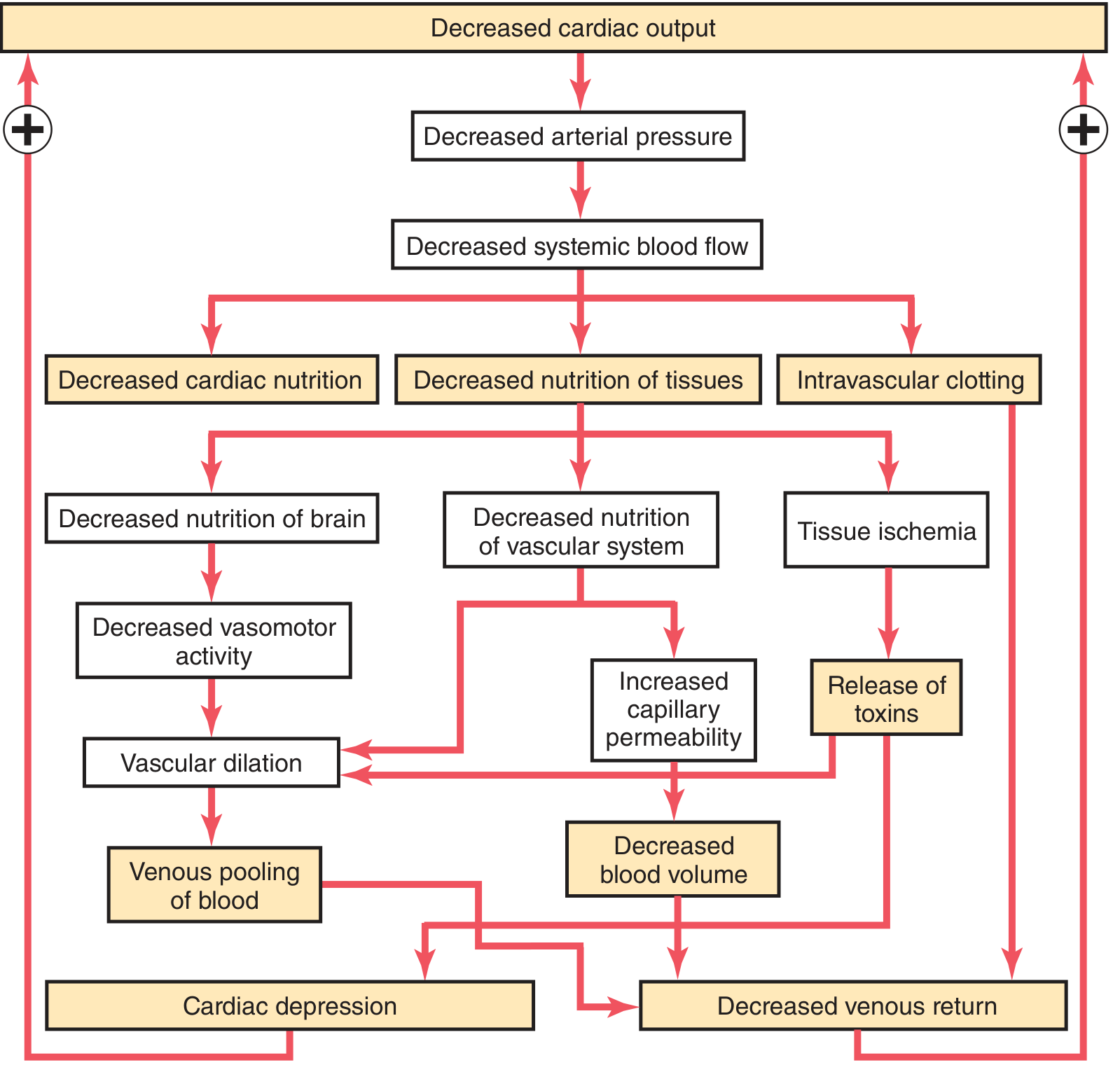
Figure: Positive feedback cycles leading to progressive shock (Guyton & Hall)
| Stage | Characteristics |
|---|---|
| Stage 1 — Nonprogressive (Compensated) | Neurohumoral mechanisms maintain perfusion. Tachycardia, peripheral vasoconstriction, cool pale skin. Vital signs may be near normal. |
| Stage 2 — Progressive | Tissue hypoxia overrides compensation. Anaerobic metabolism → lactic acidosis → arteriolar dilation → microvascular pooling → worsening cardiac output. Widespread organ hypoperfusion begins. |
| Stage 3 — Irreversible | Lysosomal enzyme leakage, myocardial depression (via ↑NO), intestinal bacterial translocation, renal failure. Even if hemodynamics are corrected, survival is not possible. |
— Robbins, Cotran & Kumar Pathologic Basis of Disease, p. 134–136
4. Pathophysiology of Septic Shock (Special Case)
Septic shock involves a uniquely complex mechanism:
- PAMPs (LPS, endotoxin, M protein, fungal antigens) activate TLRs on macrophages, neutrophils, dendritic cells
- NF-κB activation → massive cytokine release (TNF, IL-1, IL-6, IL-12, IFN-γ, HMGB1)
- Complement activation → C3a/C5a anaphylatoxins
- Endothelial activation → ↑ adhesion molecules, vascular permeability, edema
- Coagulation activation → Disseminated Intravascular Coagulation (DIC)
- Counter-regulatory immunosuppression → Th1→Th2 shift, lymphocyte apoptosis, anergy (patients oscillate between hyperinflammatory and immunosuppressed states)
Note: Septic shock initially causes peripheral vasodilation → warm, flushed skin (unlike other forms of shock that cause cold, clammy skin).
— Robbins, Cotran & Kumar, p. 135–136
Symptoms & Clinical Features
General (All Types)
| Finding | Notes |
|---|---|
| Tachycardia (>100 bpm) | May be absent in neurogenic shock or β-blocker use |
| Hypotension | May be absent early (compensated shock) |
| Tachypnea (>20/min) | Compensatory respiratory alkalosis |
| Altered mental status / agitation | Decreased cerebral perfusion |
| Cool, pale, clammy skin | Peripheral vasoconstriction (except septic shock → warm, flushed) |
| Oliguria (<0.5 mL/kg/h) | Renal hypoperfusion |
| Weak, thready pulse | Low stroke volume |
Hemorrhagic Shock — Classification by Blood Loss
| Class | Blood Loss (mL) | Blood Loss (%) | HR | BP | CNS Symptoms |
|---|---|---|---|---|---|
| I | <750 | <15% | <100 | Normal | Normal |
| II | 750–1500 | 15–30% | >100 | Orthostatic changes | Anxiety |
| III | 1500–2000 | 30–40% | >120 | Hypotension | Confusion |
| IV | >2000 | >40% | >140 | Severe hypotension | Lethargy/unconscious |
— Schwartz's Principles of Surgery, p. 169
Septic vs. Other Shock — Key Distinction
| Feature | Hypovolemic/Cardiogenic | Septic (early) |
|---|---|---|
| Skin | Cool, clammy, pale | Warm, flushed |
| Peripheral resistance | ↑ | ↓ |
| Cardiac output | ↓ | Initially ↑ ("hyperdynamic") |
Diagnosis
Empirical Criteria for Shock (Rosen's Emergency Medicine)
- Ill appearance or altered mental status
- Heart rate >100 bpm
- Respiratory rate >20/min or PaCO₂ <32 mmHg
- Arterial base deficit < −4 mEq/L OR lactate >4 mmol/L
- Urine output <0.5 mL/kg/h
- Arterial hypotension >30 minutes
Important: Shock can occur with normal blood pressure (compensated). BP and HR alone correlate poorly with cardiac index and underestimate hypoperfusion severity.
Key Diagnostic Tests
| Test | Significance |
|---|---|
| Serum lactate >4 mmol/L | Best early marker of global hypoperfusion; predicts multiorgan failure |
| Base deficit < −4 mEq/L | Reflects metabolic acidosis from anaerobic metabolism |
| Blood cultures × 2 | Before antibiotics in suspected septic shock |
| CBC, BMP, LFTs, coagulation (PT/PTT) | Organ injury assessment; DIC screen |
| Troponin, ECG, Echo | Cardiogenic shock workup |
| Bedside ultrasound (FAST/echo) | IVC collapsibility (volume status), pericardial effusion, cardiac function |
| Central venous pressure (CVP) | Limited utility but guides fluid responsiveness |
| Urine output (Foley catheter) | Reliable index of vital organ perfusion |
A downward trend in lactate + upward trend in base deficit + improving vital signs + improving urine output = adequate resuscitation.
— ROSEN's Emergency Medicine, p. 61–62
Treatment
General Principles (All Shock)
- Airway: Secure airway; ensure adequate ventilation and oxygenation
- Vascular access: Large-bore IV × 2, or central line, or intraosseous if IV unavailable
- Continuous monitoring: HR, BP, SpO₂, urine output, serial lactate/base deficit
- Identify and treat the cause — treatment is cause-specific
Hypovolemic/Hemorrhagic Shock
| Priority | Action |
|---|---|
| 1. Control hemorrhage | Direct pressure, tourniquet, surgery, or REBOA (Resuscitative Endovascular Balloon Occlusion of the Aorta) |
| 2. Balanced resuscitation | Packed RBCs + Fresh Frozen Plasma + Platelets in 1:1:1 ratio |
| 3. Limit crystalloid | Excessive crystalloid worsens outcomes (dilutional coagulopathy, abdominal compartment syndrome) |
| 4. Permissive hypotension | Target MAP 50–65 mmHg until hemorrhage controlled (uncontrolled resuscitation is harmful) |
| 5. Hemoglobin target | Transfuse PRBCs for Hgb <7 g/dL (non-hemorrhagic) |
— Schwartz's Principles of Surgery, p. 169; ROSEN's Emergency Medicine, p. 62
Septic Shock
The Surviving Sepsis Campaign core principles:
| Priority | Intervention |
|---|---|
| 1. Early antibiotics | Broad-spectrum within 1 hour of diagnosis |
| 2. Source control | Identify and drain/debride infection source ASAP |
| 3. Fluid resuscitation | At least 30 mL/kg IV crystalloid in first 3 hours |
| 4. Vasopressors | Norepinephrine as first-line if MAP remains <65 mmHg after fluids |
| 5. Reassess frequently | Dynamic indices (stroke volume variation), lactate clearance |
— Schwartz's Principles of Surgery, p. 160; ROSEN's Emergency Medicine, p. 62
Cardiogenic Shock
| Intervention | Details |
|---|---|
| Treat underlying cause | PCI for STEMI, cardioversion for arrhythmia, pericardiocentesis for tamponade |
| Inotropes | Dobutamine (↑ contractility), dopamine |
| Vasopressors | Norepinephrine if severely hypotensive |
| Mechanical support | Intra-aortic balloon pump (IABP), Impella device, ECMO |
| Avoid excess fluids | Risk of pulmonary edema |
Obstructive Shock
| Cause | Treatment |
|---|---|
| Cardiac tamponade | Emergency pericardiocentesis |
| Tension pneumothorax | Immediate needle decompression → chest tube |
| Massive PE | Anticoagulation, thrombolytics, or catheter-directed therapy |
Anaphylactic Shock
| Drug | Route/Dose |
|---|---|
| Epinephrine 1:1000 | IM 0.3–0.5 mg (first-line) |
| Diphenhydramine | IV/IM |
| Corticosteroids | IV (e.g., methylprednisolone) |
| IV fluids | Aggressive crystalloid |
Neurogenic Shock
- IV fluids + vasopressors (phenylephrine, norepinephrine)
- Treat spinal cord injury
- Maintain MAP ≥85 mmHg to preserve spinal cord perfusion
Complications / Organ Morphology in Shock
| Organ | Injury |
|---|---|
| Brain | Ischemic encephalopathy, neuronal loss (irreversible) |
| Heart | Subendocardial infarction/necrosis |
| Kidneys | Acute tubular necrosis (ATN) → acute renal failure |
| Lungs | Diffuse alveolar damage → ARDS ("shock lung") |
| Adrenals | Cortical lipid depletion (↑ steroid synthesis) |
| GI tract | Ischemic colitis, mucosal erosions; bacterial translocation |
| Liver | Centrilobular necrosis |
Fibrin thrombi (from DIC) are most readily seen in kidney glomeruli. Except for neurons and cardiomyocytes, affected tissues can recover completely if the patient survives.
— Robbins, Cotran & Kumar, p. 136
Key Summary Points
- Shock = inadequate tissue perfusion → cellular hypoxia → lactate production → metabolic acidosis → multiorgan failure
- Four classical types: hypovolemic, cardiogenic, distributive (septic), obstructive
- Lactate >4 mmol/L or base deficit < −4 mEq/L = presumptive diagnosis regardless of BP
- Norepinephrine is the preferred vasopressor in most shock states
- Hemorrhagic shock → balanced blood product transfusion (1:1:1), not crystalloid alone
- Septic shock → antibiotics within 1 hour, source control, crystalloid 30 mL/kg, norepinephrine
- Progressive stages: Compensated → Progressive → Irreversible
- Early recognition and treatment prevent the downward spiral to irreversible multiorgan failure
*Sources: ROSEN's Emergency Medicine (9780323757898) · Robbins, Cotran & Kumar Pathologic Basis of Disease (9780443264528) · Robbins & Kumar Basic Pathology (9780323790185) · Schwartz's Principles of Surgery 11th ed. (9781259835346) · Guyton and Hall Textbook of Medical Physiology (9780443111013)*This is a comprehensive review of shock synthesized from five major medical textbooks. Here's a quick navigation guide to the content above:
What's covered:
-
Definition — failure of circulation to meet cellular metabolic needs; mortality >20%
-
Classification (6 types)
- Hypovolemic, Cardiogenic, Distributive/Septic, Obstructive, Neurogenic, Anaphylactic
-
Pathophysiology (4 levels)
- Cellular/mitochondrial: aerobic → anaerobic → lactate → ATP depletion
- Neuroendocrine compensation: baroreceptors, RAAS, catecholamines, ADH
- Three progressive stages: Compensated → Progressive → Irreversible
- Septic shock: TLR/NF-κB activation → cytokine storm → DIC → organ failure
-
The vicious cycle diagram from Guyton & Hall showing how decreased cardiac output feeds back on itself
-
Symptoms — including the ATLS hemorrhagic shock classification (Class I–IV)
-
Diagnosis — Rosen's empirical criteria; lactate and base deficit as key biomarkers
-
Treatment — type-specific protocols including balanced resuscitation for hemorrhage, 1-hour antibiotics for sepsis, emergency procedures for obstructive shock
-
Organ complications — ATN, ARDS, DIC, centrilobular necrosis, bacterial translocation
Hirsutism, virilization and endometriosis according to bereks and Novak gyncelogy book
Reading File
Finding Sources
Found it. Now search for all three topics in that book simultaneously:
Finding Sources
Finding Sources
Now read the hirsutism/virilization section and the main endometriosis chapter in parallel:
Reading File
Reading File
The hirsutism section I found is towards the end (treatment section). I need the full dedicated chapter on hirsutism/virilization with pathophysiology. Let me search for the dedicated chapter start and read deeper into the endometriosis chapter:
Finding Sources
Reading File
Good content. Now I need the dedicated hirsutism/virilization chapter with pathophysiology. Let me search specifically for it:
Finding Sources
Reading File
Now let me read the dedicated hirsutism/virilization chapter (block9) from the beginning, and also read the deep endometriosis and the full endometriosis chapter (block3):
Reading File
Reading File
I need the dedicated hirsutism/virilization chapter. Let me search the TOC for the specific chapter:
Finding Sources
Reading File
Your credits are exhausted. Your daily credits reset tomorrow, or you can purchase a top-up for more.
This is a shared conversation. Sign in to Orris to start your own chat.