
recruitment of motor unit 1st mbbs physiology
I'll read the medical library skill first, then search for motor unit recruitment content.
Reading File
Now let me search the library for motor unit recruitment content in parallel:
Finding Sources
Finding Sources
The Eric Kandel Principles of Neural Science has the most relevant section. Let me read it along with the Neuroscience Exploring the Brain content:
Reading File
Reading File
Excellent content found. Let me read the key recruitment section from Kandel and the Neuroscience textbook further:
Reading File
Reading File
Now let me read the critical recruitment section from Kandel (around lines 675-760) for full details, and also fetch a key diagram:
Reading File
I now have comprehensive content. Let me fetch the key diagram image for the size principle:
Loading Image
Reading File
I now have all the material needed for a thorough 1st MBBS-level answer. Let me also fetch the recruitment diagram and twitch summation image:
Loading Image
Loading Image
I have all the content I need. Here is a thorough, 1st MBBS-level explanation of motor unit recruitment:
Recruitment of Motor Units
1. What is a Motor Unit?
A motor unit is the basic functional unit of motor control. It consists of:
- One alpha (α) motor neuron (cell body in the ventral horn of the spinal cord or brain stem)
- All the skeletal muscle fibers it innervates
When the alpha motor neuron fires an action potential, all the muscle fibers in that unit contract simultaneously - this is the "all-or-none" principle at the motor unit level. A typical muscle is controlled by a few hundred motor neurons clustered in a motor nucleus.
2. How is Muscle Force Graded? (Two Mechanisms)
The nervous system grades (controls) the force of muscle contraction in two ways:
| Mechanism | Description |
|---|---|
| Rate coding (temporal summation) | Increasing the firing frequency of already active motor neurons - leading to summation of twitches and tetanus |
| Motor unit recruitment | Activating additional motor units progressively |
3. Motor Unit Recruitment - The Core Concept
Recruitment means the progressive activation of more and more motor units as greater muscle force is required.
"Force is increased during a muscle contraction by the activation of additional motor units, which are recruited progressively from the weakest to the strongest."
- Kandel, Principles of Neural Science, 6th Ed.
- As you gradually increase effort, new motor units are "switched on" one by one
- Muscle force decreases by de-recruiting units in the reverse order (strongest de-recruited first)
- The force level at which a given motor unit first becomes active is called its recruitment threshold
4. Henneman's Size Principle (1957) - THE KEY RULE
Proposed by Elwood Henneman at Harvard in 1957, the Size Principle states:
Motor units are recruited in an orderly sequence from smallest to largest.
| Recruited FIRST (low force) | Recruited LAST (high force) |
|---|---|
| Small motor neurons | Large motor neurons |
| Small axon diameter, slow conduction velocity | Large axon diameter, fast conduction velocity |
| Few muscle fibers (small innervation ratio) | Many muscle fibers (large innervation ratio) |
| Type I (slow-twitch) fibers - fatigue resistant | Type II (fast-twitch) fibers - fatigue easily |
| Low force output | High force output |
Why does the Size Principle work? (Mechanism)
The key is input resistance (Rin):
- All motor neurons in a nucleus receive the same broadly distributed excitatory synaptic input
- The brain does NOT selectively target specific motor neurons
- Small neurons have a smaller surface area → fewer parallel membrane channels → higher input resistance (Rin)
- By Ohm's law: ΔVm = Isyn × Rin
- The same synaptic current (Isyn) produces a larger EPSP in small neurons
- Therefore small neurons reach threshold first, large neurons need more total input to fire
This means orderly recruitment is determined by the intrinsic properties of the spinal neurons themselves, not by supraspinal commands.
5. Innervation Ratio and Precision of Control
The number of muscle fibers per motor neuron is the innervation ratio, and it varies by muscle function:
| Muscle | Innervation Ratio | Purpose |
|---|---|---|
| Quadriceps (antigravity) | >1,000 fibers per neuron | Power generation |
| Hand intrinsics / finger muscles | ~100 fibers per neuron | Moderate precision |
| Extraocular muscles | ~3 fibers per neuron | Very fine control |
Rule: Muscles with many small motor units allow finer CNS control.
6. Recruitment Thresholds and the Operating Range
- In hand muscles: all motor units are recruited by ~60% of maximum voluntary contraction (MVC)
- In biceps, deltoid, tibialis anterior: recruitment continues up to ~85% MVC
- Beyond the upper limit of recruitment, only rate coding (increased firing frequency) can further increase force
Over most of a muscle's operating range, both recruitment and rate coding occur simultaneously - as shown in the graph below:
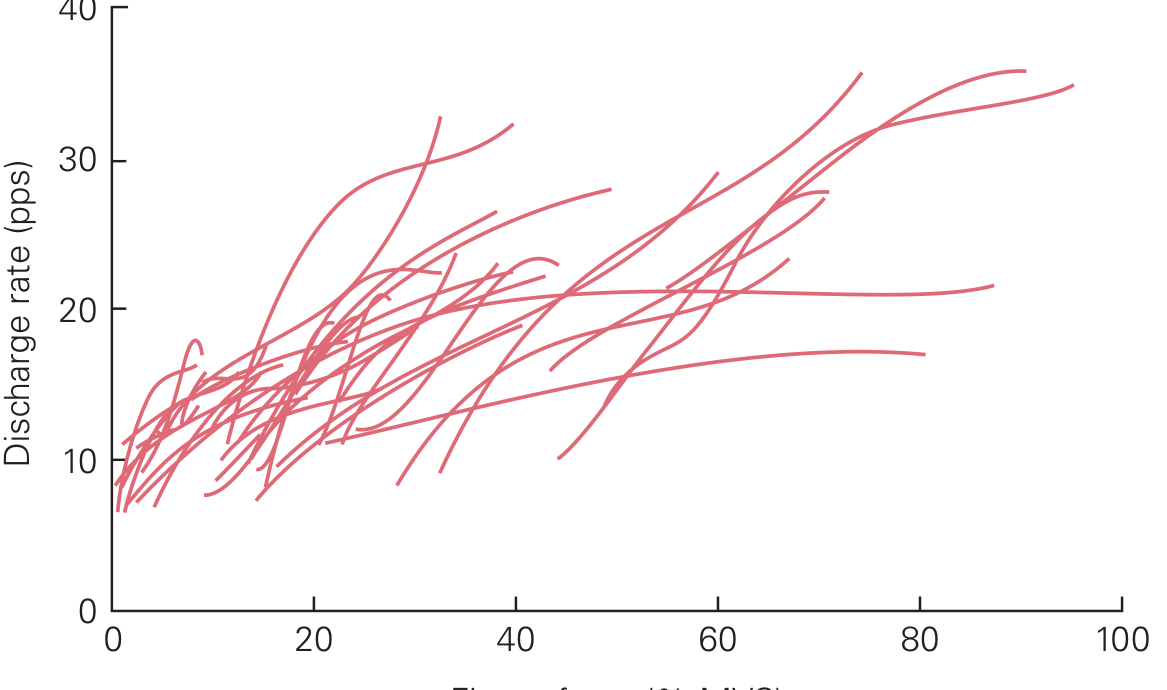
Each line = one motor unit. The leftmost point = recruitment threshold. As finger force increases, both more units are recruited AND existing units fire faster. (Kandel, Principles of Neural Science)
7. Effect of Contraction Speed on Recruitment
- The order of recruitment does NOT change with contraction speed
- Faster contractions shift recruitment earlier - the upper limit of recruitment during fast contractions is ~40% MVC (compared to 60-85% during slow contractions)
- This means fast powerful movements use rate coding more than slow precise ones
8. Recruitment and Fatigue Resistance
Because slow-twitch, fatigue-resistant Type I units are recruited first and fast-twitch Type II units are recruited last:
- Sustained low-intensity tasks (e.g., standing, posture) use primarily Type I units - which are aerobic and fatigue-resistant
- Explosive/high-intensity tasks (e.g., sprinting, lifting heavy weights) additionally recruit Type II units - which fatigue quickly
This arrangement is highly energy efficient - the expensive, fatigable fast units are held in reserve.
9. Summary Table
| Feature | Small Motor Unit | Large Motor Unit |
|---|---|---|
| Motor neuron size | Small | Large |
| Input resistance | High | Low |
| EPSP amplitude (same Isyn) | Large - reaches threshold easily | Small - needs more input |
| Recruited | First (low force) | Last (high force) |
| Fiber type | Type I (slow oxidative) | Type II (fast glycolytic) |
| Fatigue | Resistant | Easily fatigued |
| Innervation ratio | Low | High |
| Conduction velocity | Slow | Fast |
Quick Memory Aid for Exams
"Small before Large" = Henneman's Size Principle
- Small neuron → High Rin → Big EPSP → Fires first
- Weak units first, strong units last
- De-recruitment is the exact reverse
Sources: Kandel - Principles of Neural Science, 6th Ed., pp. 785-792; Neuroscience: Exploring the Brain, 5th Ed., pp. 1255-1259
This is a shared conversation. Sign in to Orris to start your own chat.