
Human development stages all from gemete to adult and activities happenes in that stages es
Reading File
Now let me search the medical library for human development stages.
Finding Sources
Finding Sources
Finding Sources
Finding Sources
Excellent - found "The Developing Human" textbook. Let me read from that and also search for more development stages.
Reading File
Finding Sources
Reading File
Finding Sources
Finding Sources
Finding Sources
Finding Sources
Finding Sources
I have enough information from the textbook and my knowledge. Let me now fetch the key development images and compose the full answer.
Loading Image
Loading Image
I now have excellent textbook images and content. Let me compose the complete, detailed answer covering all human development stages from gamete to adult.
Human Development: From Gamete to Adult
Based on The Developing Human: Clinically Oriented Embryology (Moore et al.) and supporting medical library sources
Overview
Human development is a continuous process divided into two broad phases:
- Prenatal (before birth): Zygote → Embryo → Fetus
- Postnatal (after birth): Neonate → Infant → Child → Adolescent → Adult
PHASE 1 - GAMETOGENESIS (Formation of Sex Cells)
Before fertilization can occur, mature gametes must be produced.
Spermatogenesis (in males)
- Occurs in the seminiferous tubules of the testes, starting at puberty
- Spermatogonia (diploid, 2n) undergo mitosis to produce primary spermatocytes
- Meiosis I produces secondary spermatocytes (haploid, n)
- Meiosis II produces spermatids
- Spermiogenesis transforms spermatids into mature spermatozoa
- Each spermatogonium yields 4 functional sperm
Oogenesis (in females)
- Begins before birth; oogonia multiply in the fetal ovary
- Primary oocytes arrest in prophase I at birth; resume at puberty
- Each month, one primary oocyte completes meiosis I → secondary oocyte + first polar body
- Meiosis II completes only after fertilization
- Each oogonium yields 1 functional egg + polar bodies
PHASE 2 - FERTILIZATION (Day 0)
- Occurs in the ampulla of the uterine tube, approximately 14 days after the last menstrual period
- One sperm penetrates the secondary oocyte's zona pellucida
- The oocyte completes meiosis II → mature ovum
- The two pronuclei (male + female) fuse → zygote (diploid, 2n, 46 chromosomes)
- The zygote is the first cell of a new human being
Key events: acrosomal reaction, cortical reaction (zona reaction prevents polyspermy), restoration of diploid number, sex determination
PHASE 3 - CLEAVAGE & TRANSPORT (Days 1-4)
The zygote undergoes cleavage (rapid mitotic divisions) while traveling along the uterine tube toward the uterus.
| Day | Stage | Activity |
|---|---|---|
| Day 1-2 | 2-cell → 4-cell | First cleavage divisions; cells called blastomeres |
| Day 3 | Morula (16-32 cells) | Solid ball of cells; enters uterine cavity |
| Day 4 | Early blastocyst | Fluid cavity (blastocoele) forms; zona pellucida begins to thin |
PHASE 4 - BLASTOCYST & IMPLANTATION (Days 5-10)
- Blastocyst has two cell populations:
- Inner cell mass (embryoblast) - will become the embryo
- Outer cell layer (trophoblast) - will become the placenta and fetal membranes
- Hatching: blastocyst escapes the zona pellucida
- Implantation (Days 6-10): trophoblast invades the endometrium of the uterine wall
- Syncytiotrophoblast (invasive outer layer) penetrates the decidua
- Cytotrophoblast (inner proliferating layer) supports growth
- Human chorionic gonadotropin (hCG) is secreted - basis of pregnancy tests
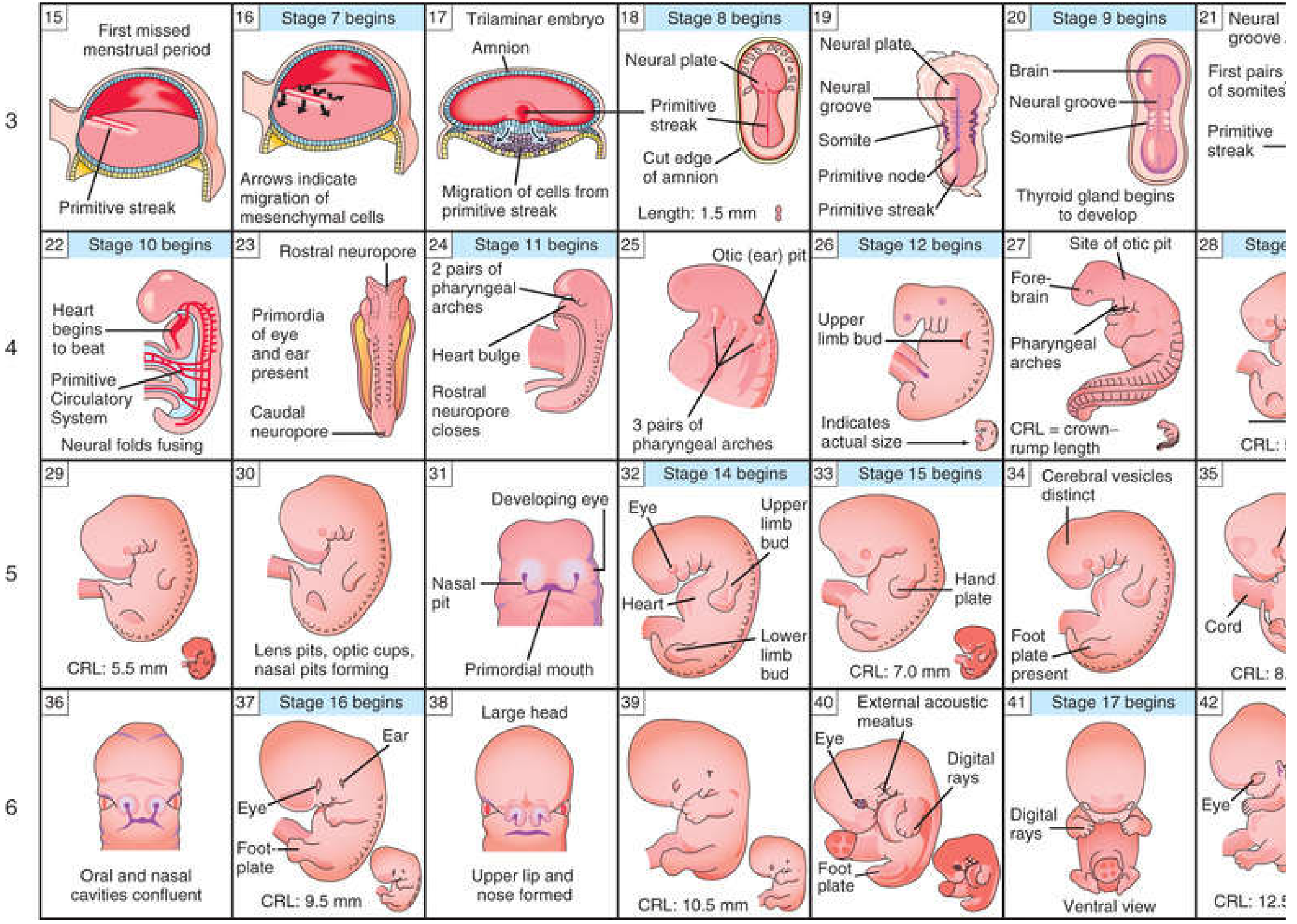
PHASE 5 - EMBRYONIC PERIOD (Weeks 3-8)
This is the most critical period of development. Stages 1-23 (Carnegie stages) span this time. All major organ systems are laid down. The embryo is most vulnerable to teratogens during this period.
Week 3 - Gastrulation
- Primitive streak forms on the epiblast
- Three primary germ layers established via gastrulation:
- Ectoderm - skin, nervous system
- Mesoderm - muscles, bones, heart, kidneys, blood
- Endoderm - gut, lungs, liver, pancreas
- Notochord forms → induces neural plate formation
- Neurulation begins: neural plate → neural folds → neural groove
Week 4 - Folding & Organogenesis Begins
- Embryo folds (head, tail, and lateral folds) - converts flat disc to cylindrical shape
- Heart begins to beat (day 22-23) - this is the first organ to function
- Neural tube closes (rostral neuropore closes day 25; caudal neuropore day 28)
- Pharyngeal arches form (jaw, neck structures)
- Upper limb buds appear (day 26-27)
- Primitive circulatory system forms
- Somites (blocks of paraxial mesoderm) form rapidly - 25-30 pairs by end of week 4
Week 5
- Rapid brain growth; large head
- Lens pits and optic cups form (eye development)
- Nasal pits forming
- Lower limb buds appear
- Crown-rump length (CRL): ~5-8 mm
Week 6
- Hand plates develop; digital rays visible
- Upper lip and nose formed
- Oral and nasal cavities become confluent
- Retinal pigment visible
- CRL: ~9-13 mm
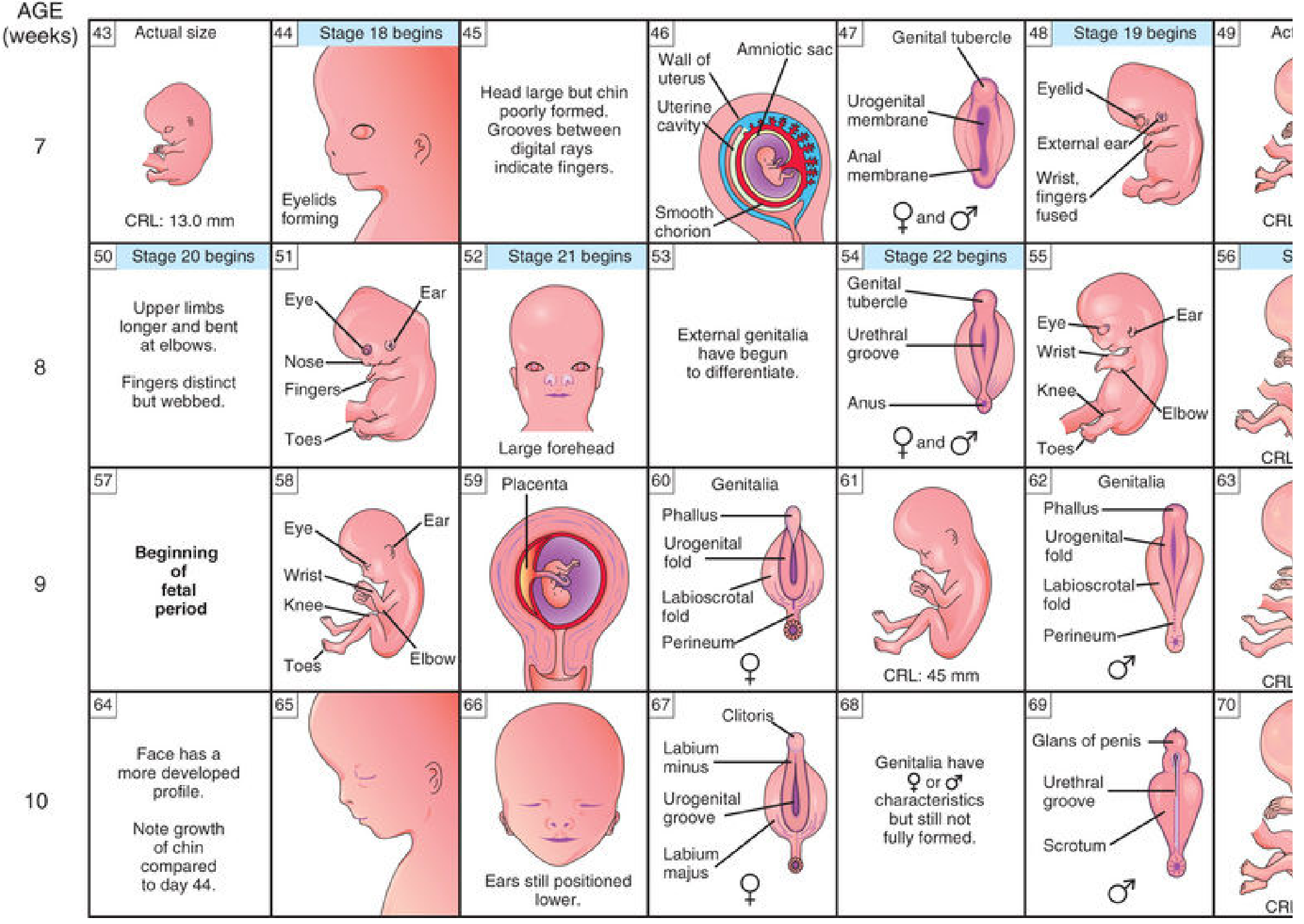
Week 7
- Eyelids begin forming
- Fingers evident; toes developing
- Intestines herniate into the umbilical cord (physiological herniation)
- Wrist and fingers still fused
- CRL: ~13 mm
Week 8 - End of Embryonic Period
- All major structures established
- Fingers distinct but webbed; toes present
- External genitalia begin to differentiate (still indifferent)
- Face has distinctly human features
- CRL: ~30 mm
PHASE 6 - FETAL PERIOD (Weeks 9-38/Birth)
The fetal period is characterized by rapid growth and differentiation of tissues and organs formed in the embryonic period. The fetus goes from ~30 mm to ~500 mm crown-heel length.
| Weeks | Key Events |
|---|---|
| 9-12 | Face gains a more developed profile; intestines return to abdominal cavity; sex distinguishable by external genitalia; urine production begins; fetal movements start (not felt by mother yet); CRL ~50-87 mm |
| 13-16 | Rapid growth; ossification accelerates; eyes face anteriorly; external ears move to normal position; scalp hair pattern determined; 110-140 mm CRL |
| 17-20 | Fetal movements felt by mother (quickening); skin covered by vernix caseosa; eyebrows and lashes appear; brown fat (thermogenesis) forms; CRL ~160-190 mm |
| 21-25 | Substantial weight gain; lungs begin producing surfactant (viability threshold ~24 weeks); fingernails present; eyelids partially open; CRL ~200 mm |
| 26-29 | Eyes open fully; eyelashes well developed; more subcutaneous fat; lungs capable of breathing; CNS can regulate some body functions; CRL ~250 mm |
| 30-34 | Pupillary light reflex present; skin pink and smooth; limbs well developed; toenails present; CRL ~280 mm |
| 35-38 (full term) | Firm grasp; chest prominent; testes descended (males); skin pale pink and smooth; limbs chubby; CRL ~360 mm, weight ~3,400 g |
POSTNATAL STAGES
Neonatal Period (0-4 weeks / first month)
- Key events: adaptation to extrauterine life
- Critical cardiovascular changes: foramen ovale closes, ductus arteriosus closes
- Respiratory system must start functioning independently
- Thermoregulation begins
- Weight may drop initially (physiological), then regained by ~2 weeks
- By 1 month: reflexes (rooting, sucking, Moro, grasp) present
Infancy (1 month - 1 year)
- Fastest period of postnatal growth
- Length increases by ~50%; weight triples by age 1
- 6-8 deciduous teeth erupt by age 1
- Motor development: head control → rolling → sitting → standing → first steps
- Neurological: smiling (6 weeks), tracking, reaching, pincer grasp develop
- Language: cooing → babbling → first words (~12 months)
Early Childhood (1-6 years)
- Growth continues but slows compared to infancy
- All 20 primary (deciduous) teeth emerge by age 2-3
- Fine and gross motor skills mature
- Language rapidly expands
- Cognitive: egocentric thinking, symbolic play (Piaget's preoperational stage)
- Social: attachment, parallel then cooperative play
Late Childhood (6-12 years)
- Slow, steady growth; ~6 cm/year
- Primary teeth replaced by permanent teeth
- Active ossification; skeletal growth
- Logical thinking develops (Piaget's concrete operational)
- Fine motor skills refined (writing, drawing)
- Peer relationships become central
Puberty / Adolescence (females ~8-16 yrs; males ~9-18 yrs)
- Prepubertal growth spurt precedes puberty
- Triggered by hypothalamic-pituitary-gonadal axis activation
- Females: breast development (thelarche), pubic hair (adrenarche), menarche (first menstruation), ovulation
- Males: testicular enlargement, pubic hair, voice deepening, spermarche (first ejaculation), facial hair
- Bone density increases; epiphyseal growth plates eventually fuse
- Psychological: identity formation (Erikson's identity vs. role confusion)
Adulthood (18-21+ years)
- Full physical growth and maturity attained between ages 18-21
- Ossification and growth virtually complete by 21-25 years
- Brain development (prefrontal cortex maturation) continues into the mid-20s
- Peak physical performance in early adulthood
- Reproductive capacity established and maintained through middle adulthood
- Aging processes begin gradually (decreased bone density, reduced cellular repair, organ changes)
Summary Table: Development at a Glance
| Stage | Timing | Key Marker |
|---|---|---|
| Gametes | Before fertilization | Haploid cells (n=23) |
| Zygote | Day 0 | Fertilization; diploid restored |
| Cleavage/Morula | Days 1-3 | Rapid mitosis; no size increase |
| Blastocyst | Days 4-5 | Fluid cavity; inner cell mass |
| Implantation | Days 6-10 | Trophoblast invades endometrium |
| Embryo (gastrulation) | Week 3 | 3 germ layers; primitive streak |
| Embryo (organogenesis) | Weeks 4-8 | All organs initiated; heart beats |
| Fetus (early) | Weeks 9-20 | Growth; sex identifiable; quickening |
| Fetus (late) | Weeks 21-38 | Lung maturation; surfactant; fat |
| Neonate | 0-4 weeks | Cardiovascular + respiratory adaptation |
| Infant | 1 month-1 year | Rapid growth; motor/language milestones |
| Child | 1-12 years | Steady growth; cognitive/social skills |
| Adolescent | ~8-18 years | Puberty; sexual maturity; identity |
| Adult | 18+ years | Full maturity; brain complete ~25 |
Sources: The Developing Human: Clinically Oriented Embryology (Moore, Persaud, Torchia) - a primary embryology reference; Histology: A Text and Atlas (Ross & Pawlina)
This is a shared conversation. Sign in to Orris to start your own chat.