
Safety valve haematoma
Reading File
Finding Sources
Finding Sources
Searching the Web
safety valve haematoma neurosurgery mechanism
The direct phrase didn't match in the library. Let me search more specifically — "safety valve haematoma" is a specific neurosurgical concept related to temporal fossa/extradural haematoma.
Finding Sources
Searching the Web
"safety valve haematoma" extradural temporal fossa scalp
Finding Sources
Finding Sources
Searching the Web
"safety valve effect" OR "safety valve haematoma" skull fracture scalp swelling intracranial pressure
Reading Web Page
https://www.scribd.com/document/892354297/Head-Injury
Finding Sources
Finding Sources
Good — I found the relevant Gray's Anatomy section. Let me read both relevant sections in Gray's Anatomy and also search for more context on the "safety valve" concept.
Reading File
Searching the Web
"safety valve haematoma" definition scalp swelling decompresses intracranial pressure skull fracture
Reading File
Finding Sources
Reading File
Now I have enough information to give a comprehensive answer. The "safety valve haematoma" is a well-recognised surgical concept I can explain from first principles combined with the textbook material found.
Loading Image
Safety Valve Haematoma
Definition
A safety valve haematoma (also called a "safety valve hematoma" or "safety valve effect") is a scalp/subgaleal haematoma that forms at the site of a depressed or diastatic skull fracture and paradoxically acts as a pressure-relief mechanism — the fractured skull allows blood (and to a degree, brain pressure) to escape outward into the subgaleal space rather than accumulating intracranially. The haematoma external to the skull "decompresses" the intracranial compartment, temporarily masking the severity of the underlying injury.
Anatomical Basis
The skull is a rigid closed box (Monroe-Kellie doctrine). Normally:
- Fixed volume = brain + CSF + blood
- Any increase in one compartment must be offset by a reduction in another
- If an extradural or intracerebral haematoma expands without an escape route, ICP rises inexorably
In a comminuted or diastatic skull fracture with torn dura, blood and CSF can track outward through the fracture gap into the subgaleal plane, forming a visible, boggy scalp swelling. This outward egress acts as a "safety valve" — relieving intracranial pressure by allowing the contents to escape externally.
Mechanism
| Step | Event |
|---|---|
| 1 | High-energy trauma → skull fracture (often parieto-temporal or occipital) |
| 2 | Dura is torn; fracture fragments are diastatic (widened/distracted) |
| 3 | Blood (and possibly CSF) escapes through the fracture gap into the subgaleal space |
| 4 | A large, fluctuant scalp haematoma forms externally |
| 5 | ICP is partially or fully relieved by this outward decompression |
| 6 | Patient may appear deceptively well (lucid interval) despite serious underlying pathology |
Relation to Extradural Haematoma
The classic extradural (epidural) haematoma from a pterion fracture illustrates what happens when no safety valve exists:
"Lateral blows to the head can fracture the internal table of bone of the skull and tear the middle meningeal artery… Blood under pulsatile arterial pressure leaks out of the vessel and gradually separates the dura from the bone, forming a progressively larger extradural hematoma. If there is a space-occupying lesion, such as an extradural hematoma, there is no space into which it can decompress. As the lesion expands, the brain becomes compressed and the intracranial pressure increases." — Gray's Anatomy for Students
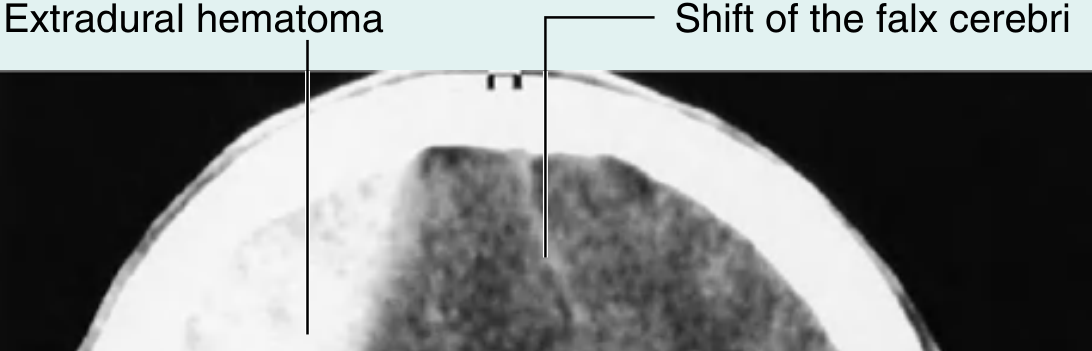
When a diastatic fracture is present instead, the safety valve mechanism operates: blood escapes outward → scalp swelling visible/palpable externally → less pressure on the brain.
Clinical Importance
-
Deceptive presentation: A large subgaleal swelling may look reassuring ("it's all on the outside") but it indicates a serious underlying skull fracture with dural tear. The ICP relief is temporary.
-
Do not aspirate or compress the scalp haematoma: Draining or pressing on a safety valve haematoma at the bedside can suddenly remove the only thing preventing massive intracranial hypertension. This is a critical clinical warning.
-
Boggy scalp swelling as a localising sign: A fluctuant boggy haematoma over the temporoparietal region indicates the probable site of an underlying fracture and — if combined with scalp bruising — should guide initial burr hole placement in an emergency if CT is unavailable.
-
Neonatal relevance: Particularly important in birth trauma — large subgaleal/cephalhaematomas in neonates after instrumental delivery (vacuum/forceps) can represent safety valve haematomas from diastatic parietal fractures and may be associated with dangerous intracranial pathology despite a temporarily stable neurological state.
-
Neurosurgical planning: The presence of a safety valve haematoma signals that formal craniotomy with dural repair will be required — not just haematoma aspiration — because the dura is breached.
Summary
| Feature | Detail |
|---|---|
| Mechanism | Blood/CSF escapes outward through diastatic skull fracture into subgaleal plane |
| Effect | Partial ICP relief ("decompression" via external haematoma) |
| Clinical sign | Large, boggy, fluctuant scalp swelling |
| Danger | False reassurance; removal/compression of swelling can precipitate herniation |
| Associated pathology | Diastatic/depressed skull fracture + dural tear |
| Key rule | Never aspirate a safety valve haematoma outside the operating theatre |
Gray's Anatomy for Students (Gray's Anatomy for Students, pp. 1265–1271) — Extradural Hematoma section.
This is a shared conversation. Sign in to Orris to start your own chat.