
new ballard score by nelson book of pediatrics
Reading File
The New Ballard Score (NBS) is a gestational age assessment tool used in neonates, evaluating neuromuscular and physical maturity criteria.
Searching sources...
Finding Sources
Finding Sources
Now let me search specifically for Nelson's textbook and also read the detailed content:
Finding Sources
Reading File
I have the content and the images. Let me read more of the table and also fetch the images:
Reading File
Loading Image
Loading Image
Loading Image
Here is a complete overview of the New Ballard Score (NBS) based on authoritative textbook sources (Textbook of Family Medicine 9e, citing Ballard JL et al., J Pediatr. 1991;119:417-423 - the same reference used in Nelson's Pediatrics):
New Ballard Score (NBS)
The NBS is used to assess gestational age in newborns, including extremely premature infants (as early as 20 weeks). It evaluates two domains - neuromuscular maturity and physical maturity - and sums the scores to estimate gestational age.
Key rule: If gestational age by dates vs. by exam differs by >1 week, use the earlier gestational age.
Part 1: Neuromuscular Maturity
Scores range from -1 to 5 for each criterion. Assign scores with the infant relaxed and quiet.
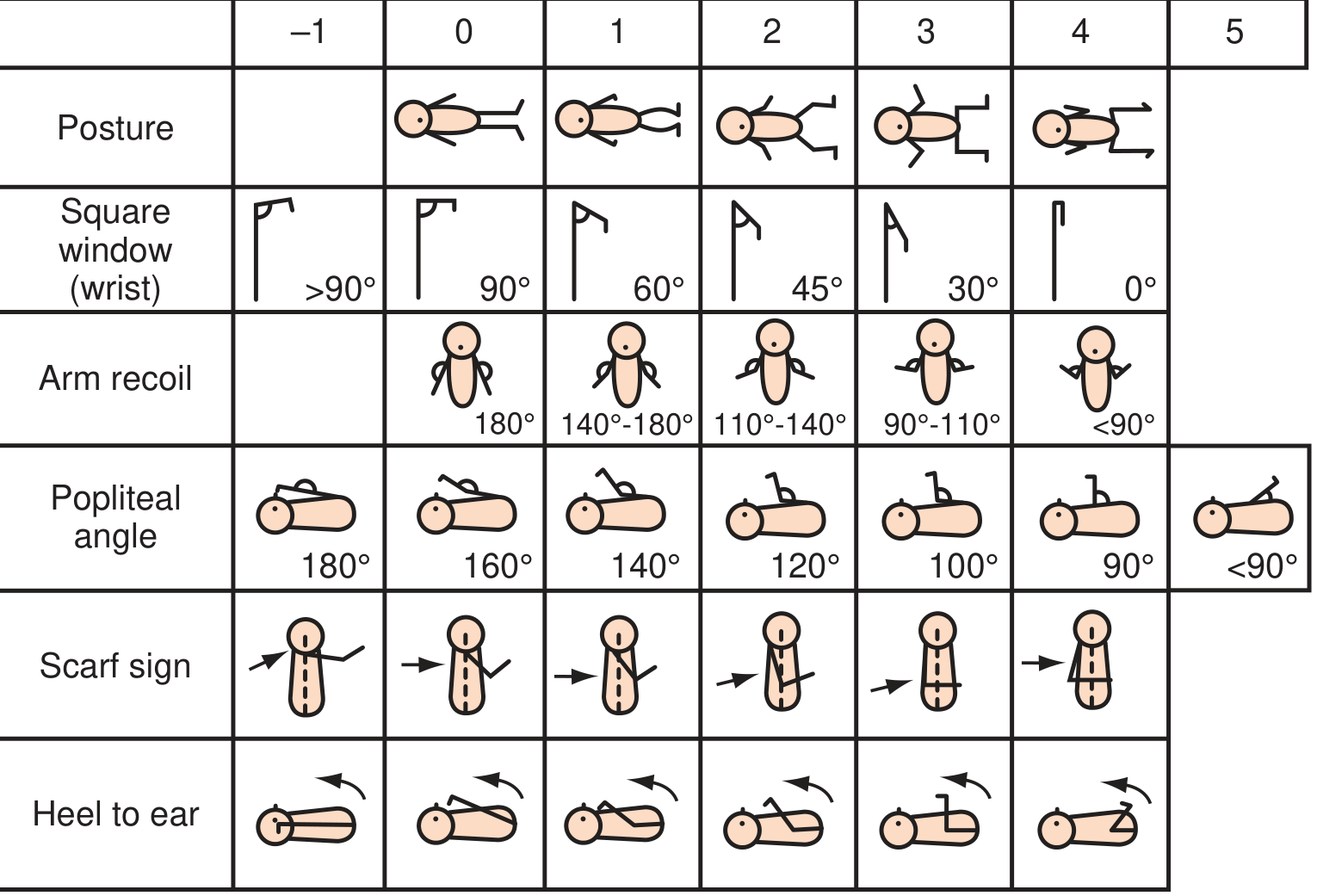
| Criterion | How to Examine | Score Progression |
|---|---|---|
| Posture | Observe infant when relaxed and quiet | Score 0 (fully extended) → 4 (fully flexed) |
| Square window (wrist) | Flex wrist between hypothenar eminence and forearm; measure angle | >90° = 0 → 90° → 60° → 45° → 30° → 0° = 4 |
| Arm recoil | Flex forearms for 5 sec, fully extend arms, release; score position | 180° = 0 → 140-180° → 110-140° → 90-110° → <90° = 4 |
| Popliteal angle | Hip fully flexed, extend knee with gentle pressure; measure popliteal angle | 180° = -1 → 160° → 140° → 120° → 100° → 90° → <90° = 5 |
| Scarf sign | Move arm over opposite shoulder; keep scapula on table | Arm crosses well past midline = -1 → arm reaches midline = 2 → cannot reach midline = 4 |
| Heel to ear | Move foot toward head; keep pelvis on table; do not force | Foot easily reaches ear = -1 → progressively more resistance with maturity |
Part 2: Physical Maturity
Scores range from -1 to 4 or 5 depending on criterion.
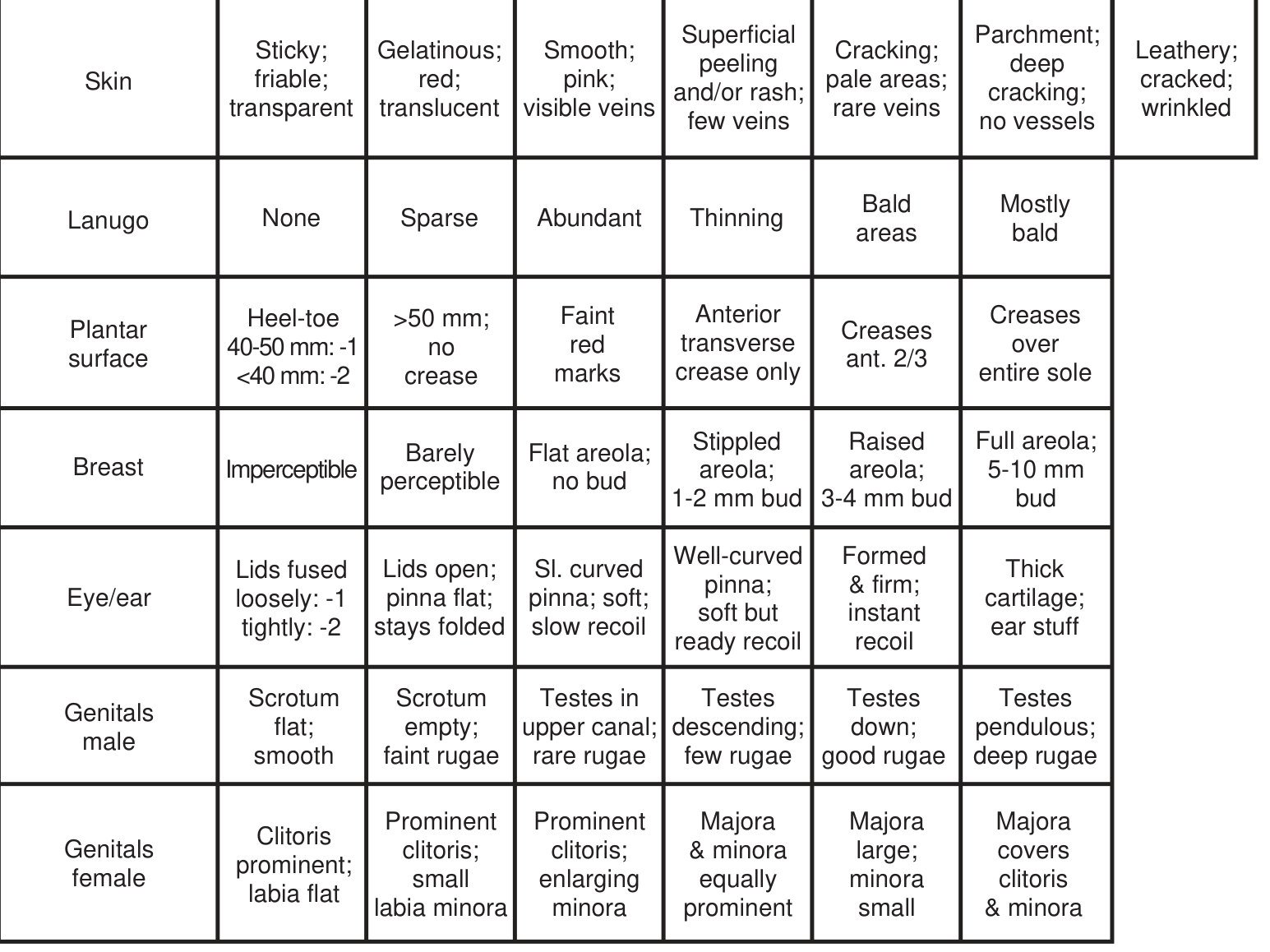
| Criterion | Immature → Mature |
|---|---|
| Skin | Sticky, friable, transparent → Gelatinous, red, translucent → Smooth, pink, visible veins → Superficial peeling/rash, few veins → Cracking, pale areas, rare veins → Parchment, deep cracking, no vessels → Leathery, cracked, wrinkled |
| Lanugo (over back/scapulae) | None → Sparse → Abundant → Thinning → Bald areas → Mostly bald |
| Plantar surface (tip of great toe to back of heel) | Heel-toe <40 mm = -2; 40-50 mm = -1 → >50 mm, no crease → Faint red marks → Anterior transverse crease only → Creases over anterior 2/3 → Creases over entire sole |
| Breast | Imperceptible → Barely perceptible → Flat areola, no bud → Stippled areola, 1-2 mm bud → Raised areola, 3-4 mm bud → Full areola, 5-10 mm bud |
| Eye/Ear | Lids fused tightly = -2; loosely = -1; Lids open, pinna flat, stays folded = 0 → Slightly curved pinna, soft, slow recoil → Well-curved, soft but ready recoil → Formed & firm, instant recoil → Thick cartilage, ear stiff |
| Genitals (Male) | Scrotum flat, smooth → Empty, faint rugae → Testes in upper canal, rare rugae → Testes descending, few rugae → Testes down, good rugae → Testes pendulous, deep rugae |
| Genitals (Female) | Clitoris prominent, labia flat → Prominent clitoris, small labia minora → Prominent clitoris, enlarging minora → Majora & minora equally prominent → Majora large, minora small → Majora covers clitoris & minora |
Part 3: Maturity Rating (Score → Gestational Age)
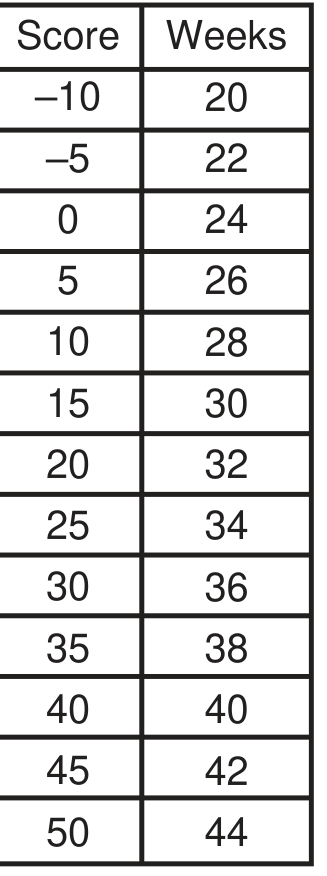
| Total Score | Gestational Age (weeks) |
|---|---|
| -10 | 20 |
| -5 | 22 |
| 0 | 24 |
| 5 | 26 |
| 10 | 28 |
| 15 | 30 |
| 20 | 32 |
| 25 | 34 |
| 30 | 36 |
| 35 | 38 |
| 40 | 40 |
| 45 | 42 |
| 50 | 44 |
Summary of Scoring
- Neuromuscular criteria: 6 items (Posture, Square window, Arm recoil, Popliteal angle, Scarf sign, Heel to ear)
- Physical criteria: 6 items (Skin, Lanugo, Plantar surface, Breast, Eye/Ear, Genitalia)
- Total possible score: -10 to +50
- Covers gestational age range: 20 to 44 weeks
The NBS was expanded from the original Ballard Score to include extremely premature infants (as young as 20 weeks / score -10), which is its key advantage over the older version.
Source: Textbook of Family Medicine 9e, p. 527, citing Ballard JL, Khoury JC, Wedig K et al. New Ballard Score, expanded to include extremely premature infants. J Pediatr. 1991;119:417-423.
APGAR TABLE FROM NELSON OR BATES
Searching sources...
Finding Sources
Finding Sources
Reading File
Reading File
Reading File
I have all the data. Here is the complete APGAR Score Table from both sources:
APGAR Score
Devised by Virginia Apgar in 1952, it provides a standardized method to assess the physical condition of newborns immediately after birth and their response to resuscitation.
The APGAR Table
Each of the 5 signs is scored 0, 1, or 2. Maximum possible score = 10.
| Sign | 0 | 1 | 2 |
|---|---|---|---|
| Heart Rate | Absent | <100 bpm | ≥100 bpm |
| Respiratory Effort | Absent | Irregular / slow | Strong, crying |
| Muscle Tone | Limp | Some flexion of extremities | Active motion / good flexion |
| Reflex Irritability (response to stimulation / nose suction) | No response | Grimace | Cough, sneeze, or cry |
| Color | Blue or pale (all cyanotic) | Acrocyanosis (blue extremities, pink body) | Completely pink |
Mnemonic - APGAR: Appearance (color), Pulse (heart rate), Grimace (reflex irritability), Activity (muscle tone), Respiration
When to Assess
| Timing | Action |
|---|---|
| 1 minute | First score - reflects intrauterine/intrapartum condition |
| 5 minutes | Second score - reflects response to resuscitation |
| Every 5 min up to 20 min | If score remains <7 at 5 min, repeat at 5-min intervals while resuscitation continues |
Score Interpretation
| Score | Interpretation | Action |
|---|---|---|
| 7 - 10 | Normal / reassuring | Routine newborn care |
| 4 - 6 | Moderately depressed | Stimulation + supplemental oxygen; reassess |
| 0 - 3 | Severely depressed | Immediate resuscitation required |
Important Clinical Notes
- Do not delay assessment of airway, breathing, and circulation to calculate the Apgar score - resuscitation always takes priority.
- The score can be affected by: gestational age, maternal medications, neurologic/cardiorespiratory conditions, trauma, infection, and ongoing resuscitation.
- A low score (0-3) does not predict neurologic outcome and cannot determine if a hypoxic event occurred in utero.
- A score of 0-3 at 5 minutes may correlate with increased neonatal death.
- It is considered negligence to omit Apgar scoring of a newborn, especially low birth weight infants.
Sources: Textbook of Family Medicine 9e, p. 526-527 (citing AAP/AHA Neonatal Resuscitation, 2011); The Harriet Lane Handbook 23e, Table 18.2 (citing Apgar V, Anesth Analg 1953;32:260); Park's Textbook of Preventive and Social Medicine, Table 3.
This is a shared conversation. Sign in to Orris to start your own chat.