
Cubital fossa
Reading File
Finding Sources
Finding Sources
Reading File
Reading File
Reading File
Reading File
Loading Image
Loading Image
Excellent - I have comprehensive textbook content and two great anatomy images. Here is the full answer:
Cubital Fossa
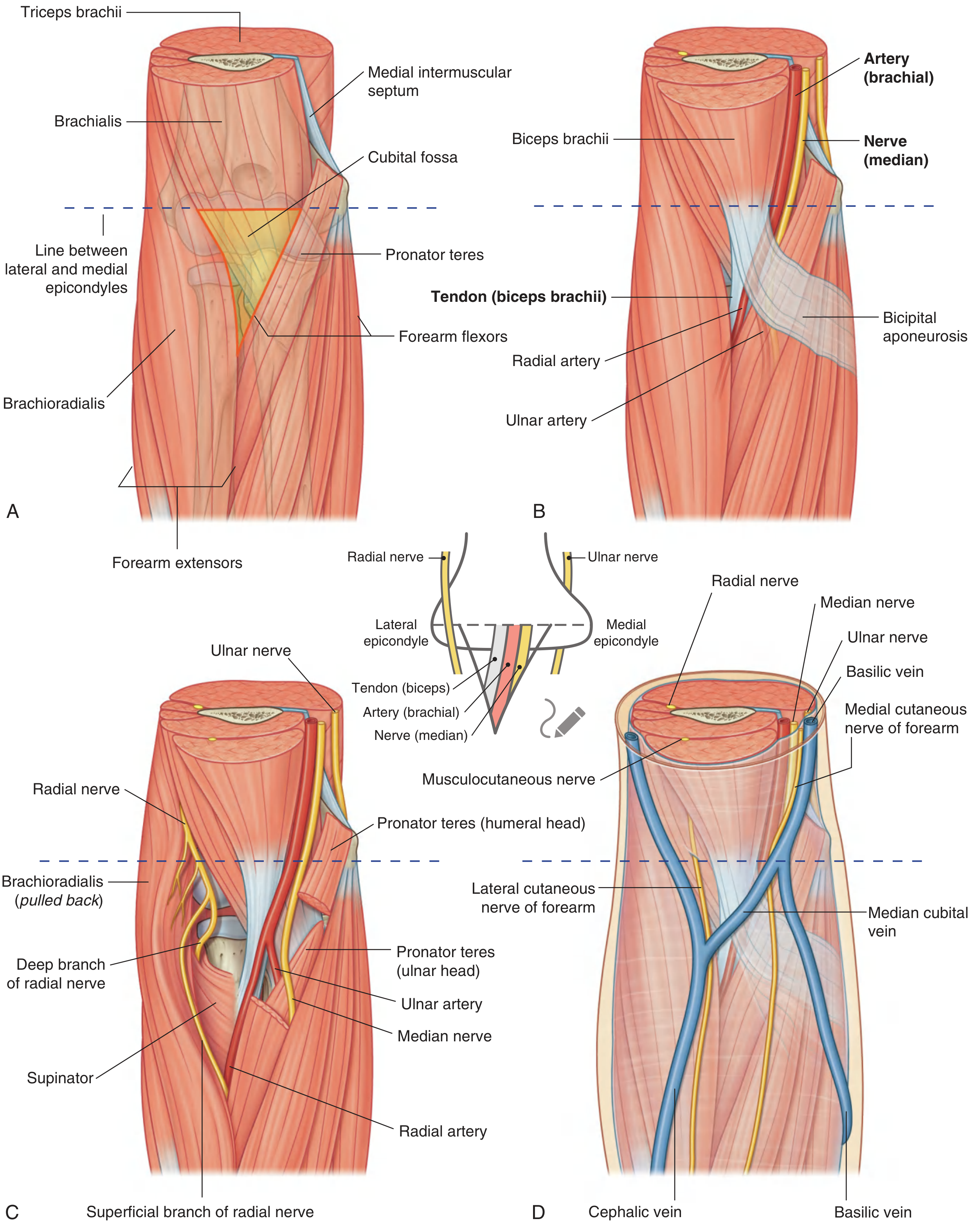
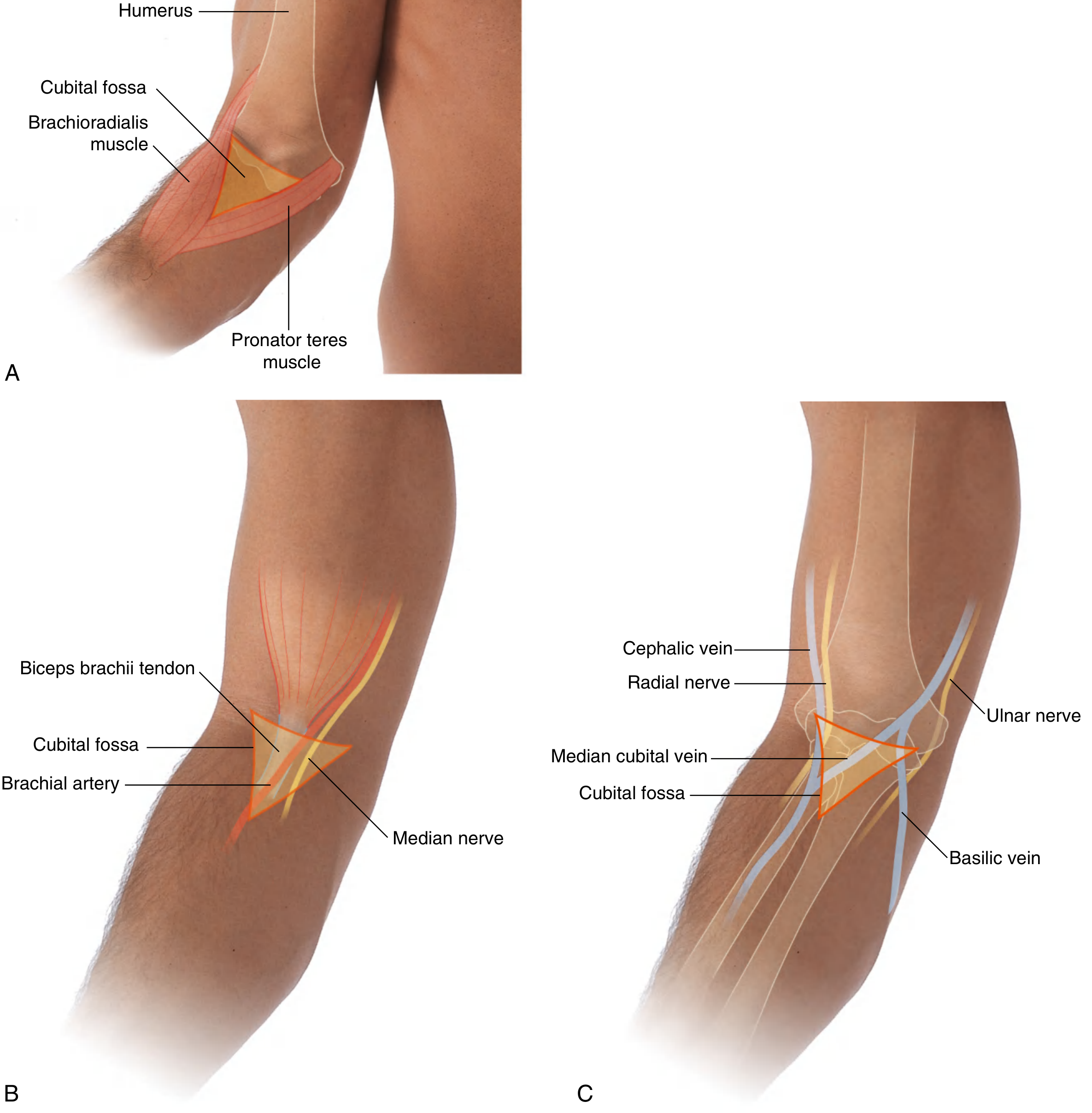
The cubital fossa is a triangular depression located anterior to the elbow joint, serving as the key transition zone between the arm and forearm through which most major neurovascular structures pass.
Boundaries
| Component | Structure |
|---|---|
| Base (superior) | Imaginary horizontal line between the medial and lateral epicondyles |
| Lateral border | Brachioradialis muscle (from lateral supraepicondylar ridge) |
| Medial border | Pronator teres muscle (from medial epicondyle) |
| Floor (bed) | Brachialis muscle (mainly); supinator laterally |
| Roof | Superficial fascia + skin; reinforced by the bicipital aponeurosis deep to it |
| Apex | Where brachioradialis and pronator teres meet inferiorly |
Contents (lateral to medial) - mnemonic: TAN
- T - Tendon of biceps brachii (most lateral, easily palpable)
- A - Artery (brachial artery - bifurcates here into radial and ulnar at the apex)
- N - Nerve (median nerve - most medial, exits between the two heads of pronator teres)
The Bicipital Aponeurosis
The bicipital aponeurosis (lacertus fibrosus) is a flat connective tissue sheet passing from the medial side of the biceps brachii tendon to the deep fascia of the forearm. It lies directly over the brachial artery and median nerve, protecting them anteriorly. Its sharp medial margin is often palpable.
The Radial Nerve - a special case
The radial nerve is NOT a content of the cubital fossa in the classic sense but lies just under the lateral lip of the brachioradialis muscle (forming the lateral margin). Here it divides into:
- Superficial branch - continues into forearm deep to brachioradialis (sensory)
- Deep branch (posterior interosseous nerve) - passes between the two heads of supinator to enter the posterior forearm compartment (motor)
The Ulnar Nerve - does NOT pass through
The ulnar nerve passes posterior to the medial epicondyle (in the cubital tunnel), not through the cubital fossa. It can be "rolled" against the medial epicondyle on examination.
Roof Structures (superficial)
The median cubital vein lies in the subcutaneous fascia over the roof, crossing diagonally from the cephalic vein (lateral) to the basilic vein (medial). Other structures in the roof include:
- Lateral cutaneous nerve of the forearm (terminal branch of musculocutaneous nerve)
- Medial cutaneous nerve of the forearm
The cephalic and basilic veins are often visible at the margins. Venous pattern in this region is highly variable (M-pattern, absence of median cubital vein, accessory cephalic vein are all common).
Clinical Relevance
| Clinical point | Details |
|---|---|
| Venepuncture / IV cannulation | Median cubital vein in the roof is the most common site - easy to access, supported by the bicipital aponeurosis beneath it |
| Brachial artery pulse | Palpated medial to the biceps tendon; used for BP measurement with a sphygmomanometer |
| Brachial artery bifurcation | Normally at the apex of the fossa - may occur anomalously higher up in the arm or even the axilla |
| Dialysis fistula | Brachial artery anastomosed to cephalic vein at the elbow (or radial artery to cephalic vein at wrist) to create high-flow access |
| Posterior interosseous nerve injury | Deep branch of radial nerve can be compressed at supinator arcade (arcade of Frohse) just below the cubital fossa |
| Intravenous drug use | Repeated injections in the cubital fossa lead to pigmented "railroad track" scars, thrombosed veins, abscess formation, risk of septicemia, HIV, and hepatitis |
| Pronator teres syndrome | Median nerve compression between the two heads of pronator teres as it exits the fossa |
Summary Table
| Feature | Structure |
|---|---|
| Lateral border | Brachioradialis |
| Medial border | Pronator teres |
| Floor | Brachialis (+ supinator laterally) |
| Roof | Fascia + skin; bicipital aponeurosis |
| Contents (L→M) | Biceps tendon, Brachial artery, Median nerve |
| Nerve NOT inside | Ulnar nerve (posterior to medial epicondyle) |
| Nerve at lateral margin | Radial nerve (divides into superficial + deep branches) |
| Key superficial vein | Median cubital vein |
Source: Gray's Anatomy for Students, pp. 889-891; 944-945
Ama vata
Finding Sources
Searching the Web
Ama vata Ayurveda rheumatoid arthritis pathophysiology treatment
Reading Web Page
https://www.easyayurveda.com/amavata-causes-treatment-medici…
Searching PubMed
amavata ayurveda rheumatoid arthritis
Searching the Web
Ama vata nidana samprapti purvarupa rupa lakshana sapta rupa chikitsa Ayurveda classical text
Searching PubMed
amavata ayurveda treatment clinical
I now have enough comprehensive information to give a thorough answer on Ama Vata.
Ama Vata (आमवात)
Ama Vata is one of the most significant disease entities in Ayurveda, first described as a separate disease by Acharya Madhavakara in Madhava Nidana (9th century AD). It is classically compared to Rheumatoid Arthritis (RA) in modern medicine, though the Ayurvedic concept is broader, encompassing pathophysiology rooted in digestive dysfunction and dosha imbalance.
Etymology
- Ama (आम) - Undigested, toxic metabolic waste product formed due to impaired Agni (digestive fire)
- Vata (वात) - The kinetic bio-principle governing movement, circulation, and neurological functions
- Ama Vata = Disease caused by the amalgamation of morbid Ama and vitiated Vata dosha
Concept of Ama
Ama is the immature, unprocessed nutritional essence formed in the stomach (Amashaya) due to sluggish digestion (Agnimandya). Key features of Ama:
- Sticky (Picchila), heavy (Guru), cold (Sheeta)
- Circulates through the Srotas (channels) in an unprocessed form
- Tissues cannot metabolize it - it accumulates and blocks channels (Srotorodha)
- Depletes nutrition to tissues and triggers a wide array of diseases
- Modern correlation: analogous to improperly processed antigens, immune complexes, and pro-inflammatory cytokines
Nidana (Causative Factors)
As per Madhava Nidana:
| Nidana | Meaning |
|---|---|
| Viruddha Ahara | Incompatible/unwholesome diet (e.g., fish + milk, hot + cold foods together) |
| Mandagni | Diminished digestive fire |
| Viruddha Chesta | Erroneous/incompatible activities |
| Nishchalata | Sedentary habits, lack of exercise |
| Snigdha bhuktavato vyayama | Physical exertion immediately after taking fatty/oily food |
Additional factors from other Acharyas: Guru Ahara (heavy food), Kand-shak sevan (root vegetables), Vyayama after Snigdha ahara
Samprapti (Pathogenesis)
Samprapti Ghatakas (key elements of pathogenesis):
| Component | Involved |
|---|---|
| Dosha | Vata (Pradhana), Kapha (Anubandhi), Pitta |
| Dushya (tissues affected) | Rasa, Rakta, Mamsa, Asthi, Sandhi |
| Srotas (channels) | Rasavaha, Raktavaha, Mamsavaha, Asthivaha |
| Srotodusti type | Sanga (obstruction) and Atipravritti |
| Agni | Jatharagni mandya (impaired digestive fire) |
| Udbhava sthana (origin) | Amashaya (stomach/GI tract) |
| Sanchara sthana | Sarva shareera (whole body) |
| Vyakta sthana (manifestation) | Sandhi (joints) - Shleshmasthana |
| Adhisthana | Sandhi (joints) |
Pathogenesis sequence:
- Nidana sevana → Agnimandya (impaired Agni)
- Agnimandya → Ama formation in Amashaya
- Ama enters Rasa Dhatu and circulates (Ama pradoshaja vikara)
- Simultaneously, Vata gets vitiated (Vataprakopa)
- Ama + vitiated Vata reach Shleshmasthana (joints - seat of Kapha)
- Srotorodha (channel blockage) in Sandhis
- Shotha (swelling) + Shula (pain) → Ama Vata
Purvarupa (Prodromal Symptoms)
Not distinctly mentioned in classics, but inferred (Madhava Nidana):
- Daurbalya - Generalized weakness
- Hridaya gaurava - Heaviness in the chest
- Gatra stambha - Body stiffness
- Apaka - Indigestion
- Angamarda - Body aching/malaise
- Gaurava - Heaviness of body
- Aruchi - Loss of taste/appetite
- Alasya - Lethargy, lack of enthusiasm
Rupa / Lakshana (Clinical Features)
1. Pratyatma Lakshana (Pathognomonic signs)
- Sandhi Shula - Joint pain
- Sandhi Shotha - Joint swelling
- Sandhi Stabdhata - Joint stiffness
2. Samanya Lakshana (General symptoms)
- Angamarda - Body ache/malaise
- Aruchi - Anorexia
- Trishna - Thirst
- Alasya - Lethargy
- Gaurava - Heaviness
- Jwara - Fever
- Apaka - Indigestion
- Anganshunata - Oedema of various body parts
3. Doshanubandha Lakshana (Based on dominant dosha)
| Dosha | Features |
|---|---|
| Vatanubandha | Severe pain, cracking sounds, tremors, dry swelling |
| Pittanubandha | Burning sensation, redness, fever, tenderness |
| Kaphanubandha | Cold, heavy, sticky swelling; heaviness; itching |
| Sannipataja | Mixed features; worst prognosis |
4. Pravriddhavastha Lakshana (In aggravated/advanced stage)
- Deformities of joints
- Restricted movement
- Generalised weakness
- Cardiac involvement (Hrit graha)
- Shoola throughout the body
Sapta Rupa - Classic Description (Madhava Nidana)
The disease is characterized by "Hastapadasandhishu sarvangeshva api cha vedana" - pain in all joints of hands, feet, and entire body, with Jwara (fever), Gaurava (heaviness), Aruchi, and Angamarda.
Upadrava (Complications)
- Anaha (flatulence/distension)
- Chardi (vomiting)
- Trishna (excessive thirst)
- Moha (delusion/confusion)
- Bhrama (vertigo)
- Hridroga (cardiac disease)
- Shosha (emaciation/wasting)
Sadhyasadhyata (Prognosis)
| Type | Prognosis |
|---|---|
| Ekadoshaja (single dosha) | Sadhya (curable) |
| Dwidoshaja | Yapya (manageable) |
| Sannipataja (all 3 doshas) | Kriccha Sadhya (difficult to cure) |
| Pravriddha (long-standing with deformities) | Asadhya (incurable) |
Chikitsa (Treatment)
Treatment principle: Ama Pachana (digesting Ama) + Vata Shamana (pacifying Vata) + Srotas Shuddhi (clearing channels)
Key principle: Langhana is the best treatment for Ama Vata (fasting/lightening therapy)
A. Shodhan Chikitsa (Detoxification/Panchakarma)
| Procedure | Details |
|---|---|
| Virechana | Purgation (after Ama digestion) |
| Basti (Vaitarana Basti) | Medicated enema - chief treatment for Vata; Niruha basti with tikta/katu drugs |
| Rooksha Sweda | Dry fomentation (not Snigdha/oily - contraindicated in Ama stage) |
| Upanaha | Medicated poultice application |
Note: Snehana (oleation) is contraindicated in the Ama stage as Snigdha (oily) substances worsen Ama. Rooksha (dry) Sweda is used instead.
B. Shaman Chikitsa (Palliative)
Key single drugs:
- Shunti (dry ginger, Zingiber officinale) - best Ama pachaka (Ama digestant)
- Guggulu (Commiphora mukul) - anti-inflammatory, Vata-Kapha shamaka
- Rasna (Pluchea lanceolata) - Vata shamaka
- Eranda (castor, Ricinus communis) - Vatanulomana
- Nirgundi (Vitex negundo) - anti-inflammatory
- Punarnava (Boerhavia diffusa)
- Devadaru (Cedrus deodara)
Classical formulations:
- Simhanada Guggulu - chief formulation for Ama Vata with Vata-Kapha dominance
- Amritadi Guggulu
- Rasna Saptaka Kwatha - decoction for pain and stiffness
- Kaishor Guggulu - with Pitta anubandha
- Mahavishgarbha Taila / Prasarini Taila - external application
- Yogaraja Guggulu
- Erandabhrishta Haritaki - constipation, Vata anulomana
C. Pathya-Apathya (Diet and Lifestyle)
Pathya (favourable):
- Ushna (warm/hot) food and water
- Laghu (light, easily digestible) food
- Takra (buttermilk)
- Old rice (Purana Shali), Mudga (green gram), Yava (barley)
- Saindhava lavana (rock salt)
- Lashuna (garlic), Shunti, Haridra (turmeric)
- Dry heat, light exercise after Ama digestion
Apathya (unfavourable):
- Snigdha, Guru, Viruddha Ahara
- Curd, milk with fish
- Cold water/cold exposure
- Sedentary lifestyle
- Day sleep
- Abhishyanda-causing (Kapha-aggravating) foods
Correlation with Modern Medicine
| Ama Vata | Rheumatoid Arthritis |
|---|---|
| Agnimandya | Gut dysbiosis, altered gut microbiome |
| Ama formation | Immune complex formation, autoantibodies (RF, anti-CCP) |
| Srotorodha | Synovial inflammation, pannus formation |
| Sandhi Shotha + Shula | Symmetric polyarthritis |
| Jwara | Systemic inflammation (raised ESR, CRP) |
| Hridgraha (complication) | Cardiac involvement in RA |
| Shosha | Cachexia, muscle wasting |
Recent metabolomics research (PMID 38972279) has explored biomarker changes in RA patients receiving Ayurvedic whole-system interventions, and a validated Ama assessment instrument (PMID 36822147) has been developed for measuring disease activity in Ama Vata, helping bridge Ayurvedic assessment with clinical outcomes.
Summary Mnemonic
"NSPRL-C" for Ama Vata:
- N - Nidana: Viruddha Ahara, Mandagni, Sedentary life
- S - Samprapti: Ama + Vata → Sandhi lodgement
- P - Purvarupa: Weakness, heaviness, stiffness
- R - Rupa: Sandhi shula, shotha, stabdhata + Jwara
- L - Langhana is the cornerstone of treatment
- C - Chikitsa: Ama pachana → Shodhan → Shaman (Guggulu, Shunti, Basti)
This is a shared conversation. Sign in to Orris to start your own chat.