
Teach me about ECG
Reading File
Now let me search the library for ECG content across multiple angles simultaneously.
Finding Sources
Finding Sources
Searching Images
ECG electrocardiogram normal waveform P QRS T waves
Reading File
Reading File
Finding Sources
Finding Sources
Reading File
Reading File
Finding Sources
Loading Image
Loading Image
Reading File
Finding Sources
Finding Sources
Reading File
Finding Sources
Reading File
Loading Image
I now have comprehensive material from multiple authoritative textbooks. Let me compile a thorough ECG teaching guide.
Electrocardiogram (ECG) — A Comprehensive Guide
1. What Is an ECG?
An ECG records the electrical activity of the heart as seen from the body surface. When a cardiac impulse passes through the heart, electrical current spreads into surrounding tissues and reaches the skin. Electrodes placed on the skin detect these potential differences, and the recording is the ECG.
"When a cardiac impulse passes through the heart, electrical current also spreads from the heart into the adjacent tissues. A small portion of the current spreads all the way to the surface of the body. If electrodes are placed on the skin on opposite sides of the heart, electrical potentials generated by the current can be recorded." — Guyton and Hall Textbook of Medical Physiology
2. The Cardiac Conduction System (The Source of the ECG)
Before reading an ECG, you must understand what generates it:
| Structure | Location | Role |
|---|---|---|
| SA node (sinoatrial) | Junction of SVC and right atrium (crista terminalis) | Primary pacemaker; initiates each beat |
| AV node | Near coronary sinus opening, atrioventricular septum | Slows conduction (~delay of 0.1 s) between atria and ventricles |
| Bundle of His | Membranous interventricular septum | Conducts impulse from AV node downward |
| Right & Left bundle branches | Interventricular septum | Distribute impulse to each ventricle |
| Purkinje fibers | Subendocardial network | Final rapid spread to ventricular myocardium |
The conduction system is insulated from the surrounding myocardium by connective tissue, ensuring a unidirectional wave that sweeps from apex to outflow tracts. — Gray's Anatomy for Students
3. The ECG Waveforms
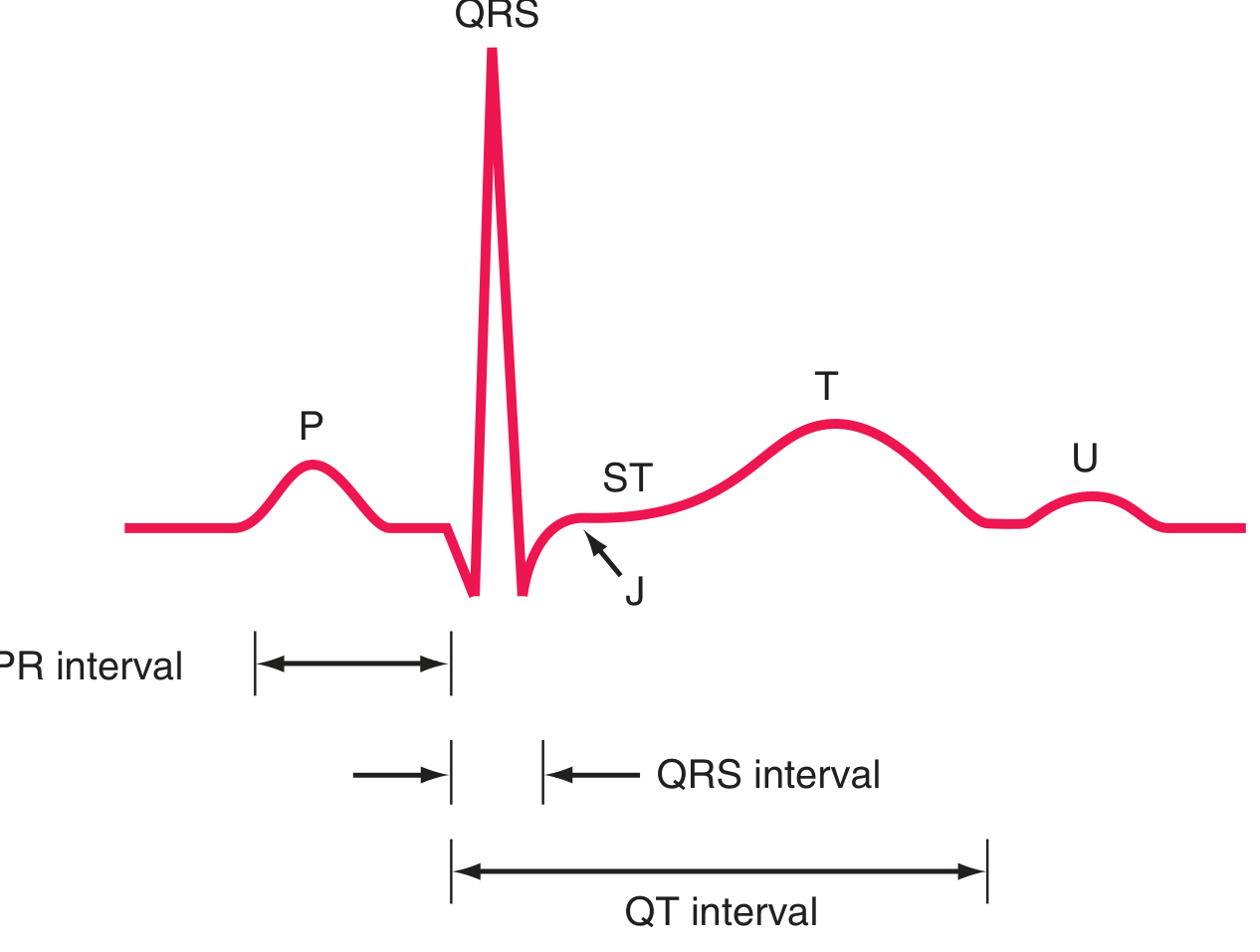
Each waveform directly corresponds to an electrical event:
P Wave
- Represents: Atrial depolarization
- SA node fires → impulse spreads across both atria → atria contract
- Small, rounded, upright in leads I, II, aVF; inverted in aVR
- Normally < 120 ms duration, < 2.5 mm in height
- In lead V1 it is normally biphasic (positive right atrial component, then small negative left atrial component)
PR Interval
- Represents: Time from atrial depolarization → onset of ventricular depolarization (includes the physiologic delay at the AV node)
- Normal: 120–200 ms (3–5 small boxes)
- Prolongation → AV block; shortening → pre-excitation (WPW)
QRS Complex
- Represents: Ventricular depolarization (spread through bundle branches → Purkinje → myocardium)
- Normal: ≤ 100–110 ms (≤ 2.5 small boxes)
- Q wave = first negative deflection; R wave = first positive deflection; S wave = negative deflection after R
- Widening → bundle branch block, hyperkalemia, Class IC drugs (block Na⁺ influx)
ST Segment
- Represents: Ventricular plateau phase (phase 2 of action potential) — isoelectric in normal hearts
- J point = junction between end of QRS and start of ST segment
- Elevation → STEMI, pericarditis, Brugada; Depression → NSTEMI/subendocardial ischemia, LVH
T Wave
- Represents: Ventricular repolarization (phase 3 of action potential)
- Normally upright in I, II, V3–V6; inverted in aVR
- "The T wave is caused by potentials generated as the ventricles recover from depolarization, normally occurring 0.25 to 0.35 second after depolarization." — Guyton & Hall
QT Interval
- Represents: Total ventricular depolarization + repolarization time
- Varies inversely with heart rate; must be rate-corrected (QTc)
- Normal QTc: < 460 ms (women), < 450 ms (men) — Harrison's Principles of Internal Medicine 22E
- Prolongation → amiodarone, hypocalcemia, congenital LQTS → risk of torsades de pointes
- Shortening → hypercalcemia, digoxin
U Wave
- Small deflection after T wave; represents late phases of ventricular repolarization
- Prominent U waves → hypokalemia
4. The ECG Grid & How to Measure
The ECG is printed on 1-mm² graph paper:
- Horizontal axis = time: 1 small box = 40 ms; 1 large box = 200 ms (at standard speed 25 mm/s)
- Vertical axis = voltage: 1 large box (10 mm) = 1 mV (standard calibration)
Heart Rate from the ECG:
- Count large boxes between two consecutive R waves (RR interval)
- Rate = 300 ÷ number of large boxes between R waves
- Or: 1500 ÷ number of small boxes
5. The 12 Leads
The 12-lead ECG views the heart from 12 different angles — like 12 cameras around a stage.
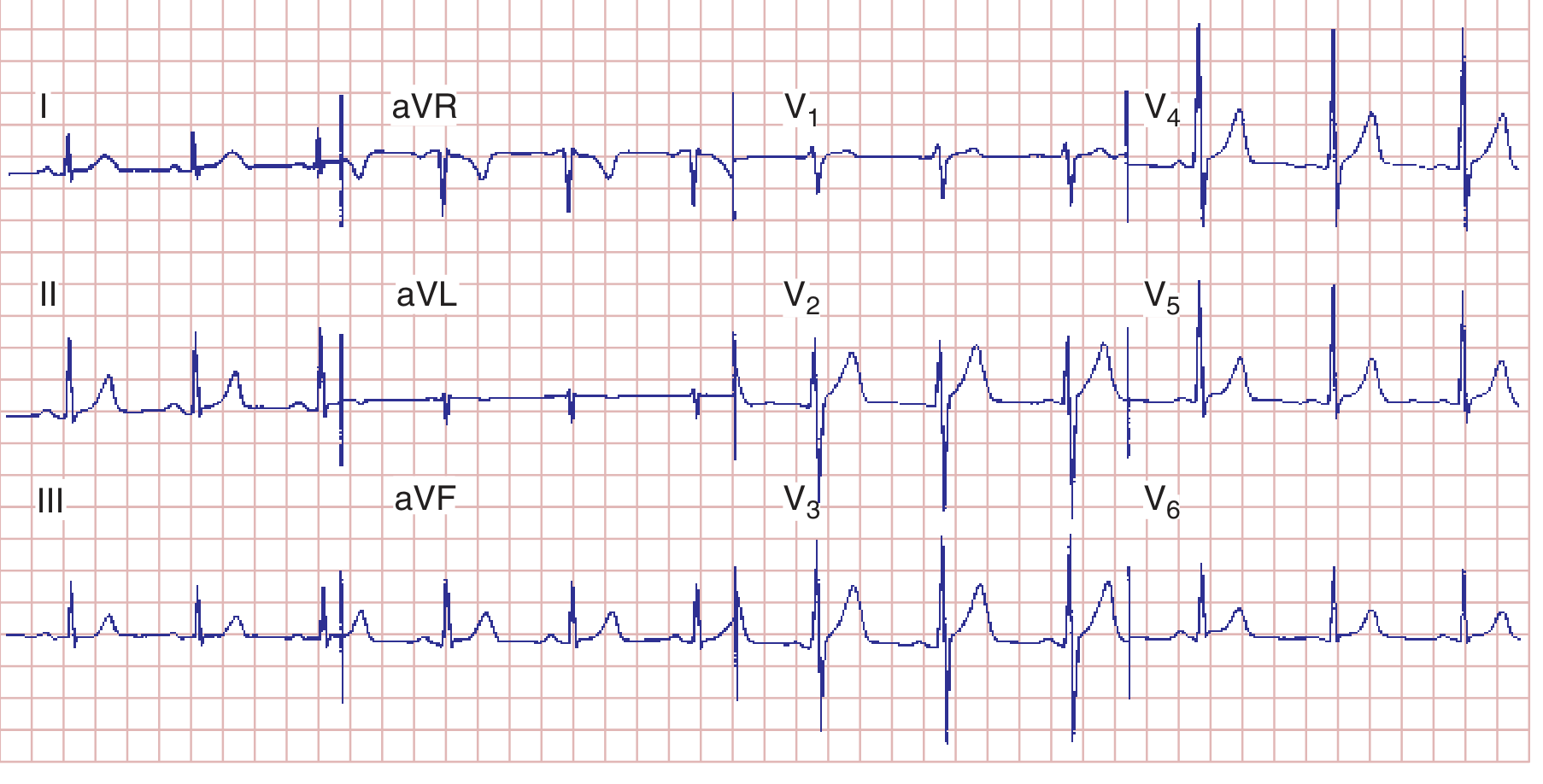
Limb Leads (Frontal Plane)
| Lead | View | Positive pole direction |
|---|---|---|
| I | Lateral | Left arm (+) vs right arm (−) |
| II | Inferior | Left leg (+) vs right arm (−) |
| III | Inferior | Left leg (+) vs left arm (−) |
| aVR | Augmented — right arm | Rightward, upward |
| aVL | Augmented — left arm | Leftward, upward |
| aVF | Augmented — left foot | Downward (inferior) |
Precordial Leads (Horizontal Plane)
Placed across the chest from right (V1) to left (V6):
- V1–V2: Right ventricular surface (septal view)
- V3–V4: Anterior wall
- V5–V6: Lateral wall
"Each lead is analogous to a different video camera angle 'looking' at the same events—atrial and ventricular depolarization and repolarization—from different spatial orientations." — Harrison's Principles of Internal Medicine 22E
Depolarization rule: A positive (upright) deflection appears in a lead if the wave of depolarization moves toward the positive pole of that lead; a negative deflection appears if it moves away.
Grouping Leads by Territory (Clinical Importance)
| Territory | Leads | Artery |
|---|---|---|
| Inferior | II, III, aVF | RCA |
| Anterior | V1–V4 | LAD |
| Lateral | I, aVL, V5–V6 | LCx |
| Septal | V1–V2 | Septal branches of LAD |
6. Normal ECG Sequence (The Cardiac Cycle)
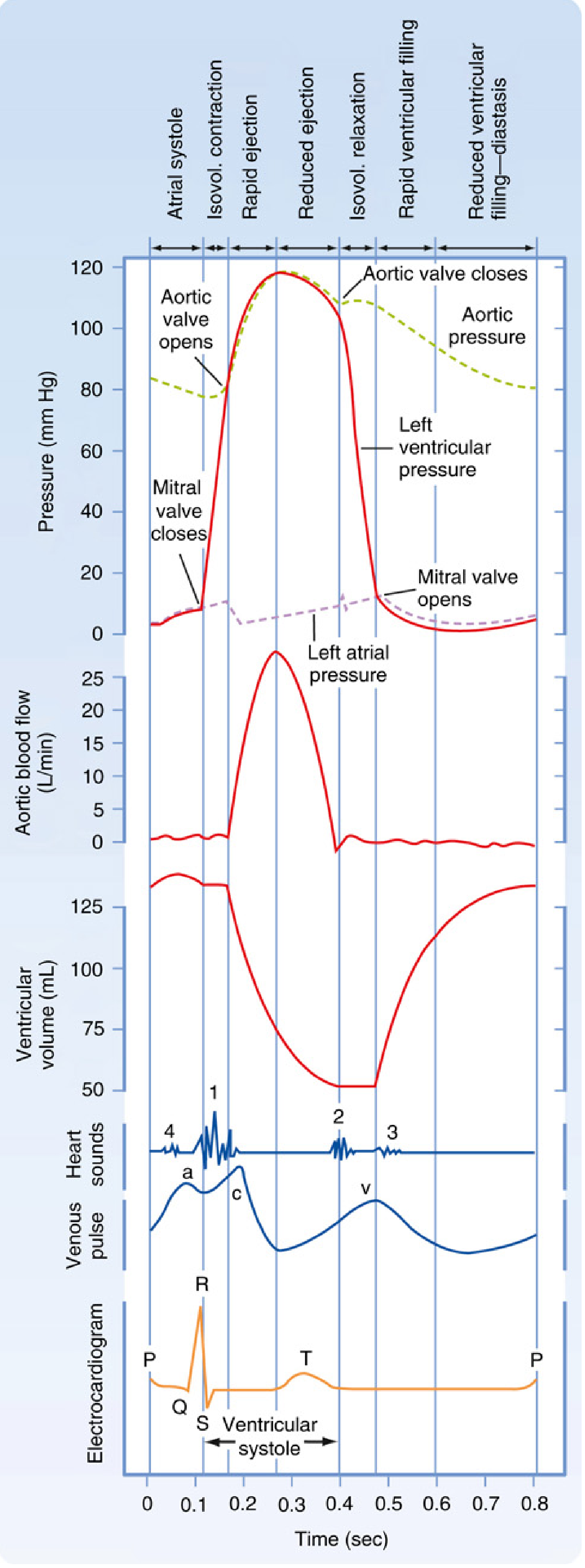
From the diagram above:
- P wave → atrial depolarization → atrial systole ("atrial kick")
- PR interval → AV node delay
- QRS complex → ventricular depolarization → ventricular systole begins; mitral valve closes at end of R wave
- ST segment → isovolumic contraction → aortic valve opens during QRS
- T wave → ventricular repolarization → during diastole
7. Systematic Approach to Reading an ECG
Use this stepwise approach every time:
| Step | What to assess | Key normals |
|---|---|---|
| 1. Rate | RR interval | 60–100 bpm |
| 2. Rhythm | Regular? P before every QRS? | Sinus rhythm |
| 3. Axis | Direction of mean QRS vector | −30° to +90° (normal) |
| 4. P wave | Shape, duration, axis | Upright in II; inverted in aVR |
| 5. PR interval | Duration | 120–200 ms |
| 6. QRS complex | Duration, morphology, R-wave progression | ≤ 110 ms; R grows V1→V5 |
| 7. ST segment | Elevation or depression | Isoelectric (< 1 mm deviation) |
| 8. T wave | Morphology, inversion | Upright in I, II, V3–V6 |
| 9. QT interval | Rate-corrected QTc | < 450 ms men; < 460 ms women |
| 10. Special features | U waves, delta waves, J waves | — |
8. Key Abnormalities to Recognize
Arrhythmias
| Pattern | ECG finding |
|---|---|
| Atrial fibrillation | No discrete P waves; irregularly irregular rhythm |
| Atrial flutter | "Sawtooth" flutter waves at 300 bpm, typically 2:1 or 3:1 block |
| 1st-degree AV block | PR > 200 ms, every P conducts |
| 2nd-degree AV block (Mobitz I) | Progressive PR lengthening until a P is dropped (Wenckebach) |
| 2nd-degree AV block (Mobitz II) | Constant PR, sudden non-conducted P waves |
| 3rd-degree (complete) AV block | No relationship between P waves and QRS |
| LBBB | Wide QRS ≥ 120 ms; broad notched R in I, aVL, V5–V6; no septal Q |
| RBBB | Wide QRS ≥ 120 ms; RSR' ("rabbit ears") in V1; wide S in I, V5–V6 |
Ischemia & Infarction
- ST elevation (STEMI): Acute transmural ischemia in the territory of the occluded artery; reciprocal ST depression in opposite leads
- ST depression / T-wave inversion: Subendocardial ischemia or NSTEMI
- Pathological Q waves: Irreversible myocardial necrosis (width > 40 ms, depth > 25% of R wave)
- Evolution of acute anterior MI: hyperacute T waves → ST elevation → Q wave formation → T-wave inversion
Hypertrophy
- LVH: Tall R in V5–V6 (Sokolow: SV1 + RV5 > 35 mm); ST depression + T inversion in lateral leads ("strain")
- RVH: Dominant R in V1, right axis deviation, T inversion V1–V3
Metabolic Effects
| Electrolyte | ECG Change |
|---|---|
| Hyperkalemia | Peaked T waves → PR prolongation → P wave loss → wide QRS → sine wave → VF |
| Hypokalemia | Flattened T, prominent U wave, ST depression |
| Hypercalcemia | Short QT |
| Hypocalcemia | Prolonged QT |
9. Action Potentials and the ECG
Each waveform corresponds to a phase of the ventricular action potential:
- Phase 0 (rapid Na⁺ influx, depolarization) → QRS onset
- Phase 2 (plateau, Ca²⁺/K⁺ balance) → isoelectric ST segment
- Phase 3 (repolarization, K⁺ efflux) → T wave
This is why drugs and electrolytes that affect ion channels directly alter ECG morphology. — Harrison's Principles of Internal Medicine 22E
10. Quick Clinical Pearls
- Atrial repolarization normally isn't seen because it occurs during the QRS complex (which masks it); it becomes visible in acute pericarditis and AV block
- In normal sinus rhythm: P wave is positive in II, negative in aVR — if not, consider ectopic atrial pacemaker
- R-wave progression: R wave grows from V1 → V5; the "transition zone" (where R = S) is normally at V3–V4. Poor R-wave progression suggests anterior infarction or LBBB
- Brugada pattern: Right bundle branch block-like morphology with coved ST elevation in V1–V2 → risk of sudden cardiac death
Sources: Guyton and Hall Textbook of Medical Physiology; Harrison's Principles of Internal Medicine, 22nd Edition; Fuster and Hurst's The Heart, 15th Edition; Miller's Anesthesia, 10th Edition; Gray's Anatomy for Students
This is a shared conversation. Sign in to Orris to start your own chat.