

inbound5384754309224663266.jpg
Explain
Reading File
Finding Sources
Searching Images
superior sagittal sinus anatomy dural venous sinuses
Reading File
Loading Image
Here is a thorough explanation of the Superior Sagittal Sinus as described in the textbook page:
Superior Sagittal Sinus
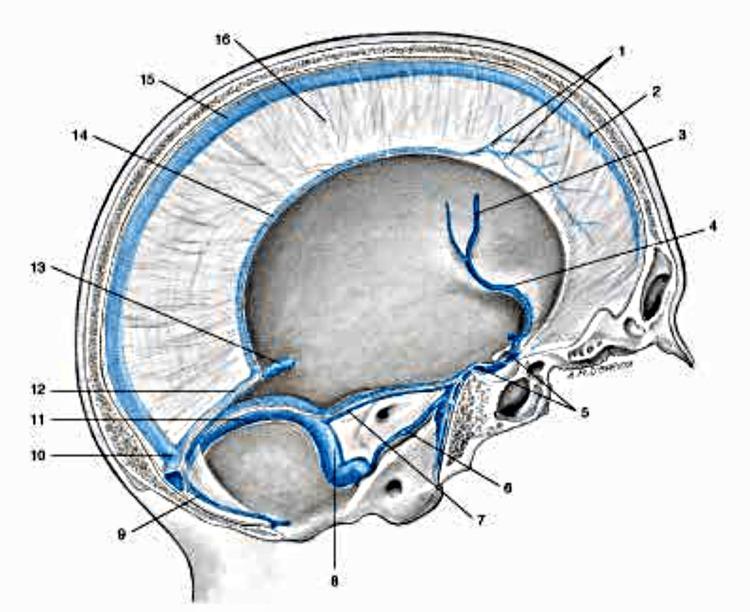
What is it?
The superior sagittal sinus (SSS) is one of the dural venous sinuses — channels formed between the two layers of the dura mater (the tough outer covering of the brain) that collect venous blood and cerebrospinal fluid (CSF) from the brain and drain it toward the heart.
It runs along the upper, convex (attached) margin of the falx cerebri — the midline fold of dura that separates the two cerebral hemispheres.
Course and Anatomy
| Feature | Detail |
|---|---|
| Begins | Anteriorly at the crista galli (a bony projection of the ethmoid bone), formed by union of tiny meningeal veins |
| Communication at origin | With veins of the frontal sinus and occasionally the nasal veins via the foramen caecum |
| Direction | Runs upward and backward along the midline |
| Shape on cross-section | Triangular |
| Size | Becomes progressively larger as it runs posteriorly |
| Ends | Near the internal occipital protuberance — usually bends to the right and becomes the right transverse sinus |
| Anastomosis | Communicates with the opposite (left) transverse sinus — the junction of all these sinuses is the confluence of sinuses (torcular Herophili) |
Interior of the Sinus
The inside of the SSS is not a simple hollow tube. It contains:
- Openings of superior cerebral veins — where cortical veins drain into the sinus
- Openings of venous lacunae — lateral expansions that flank the sinus on both sides
- Arachnoid villi and granulations — finger-like projections that protrude into the lacunae and directly into the sinus; these are the main sites where CSF is reabsorbed back into venous blood
- Fibrous bands crossing the angle of the sinus — these are structural trabeculae within the sinus lumen
Tributaries (What drains INTO it)
The SSS receives blood from:
| Tributary | Notes |
|---|---|
| Superior cerebral veins | Never open directly into the SSS — they first enter the venous lacunae beside the sinus |
| Parietal emissary veins | Connect the scalp veins to the SSS through the parietal bone (a potential route for scalp infection to reach intracranial sinuses) |
| Venous lacunae | Usually 3 on each side; they first receive diploic veins (from within the skull bones) and meningeal veins, then drain into the main sinus |
| Nasal vein (occasional) | A vein from the nose may open into the sinus when the foramen caecum is patent |
Why is the SSS clinically important?
- CSF reabsorption: The arachnoid granulations here are the primary route for draining CSF. Blockage can cause raised intracranial pressure (ICP) and hydrocephalus.
- Superior sagittal sinus thrombosis (SSST): Thrombosis of the SSS causes raised ICP, headache, seizures, and bilateral leg weakness. It is a neurological emergency.
- Infection pathway: Emissary veins and the foramen caecum create a direct connection between the scalp/nose and the intracranial sinuses, allowing infections to spread.
- Surgical landmark: The SSS must be carefully avoided during midline cranial surgeries.
The Confluence of Sinuses
When the SSS reaches the back of the skull (internal occipital protuberance), it meets:
- The straight sinus (formed by the inferior sagittal sinus + great cerebral vein of Galen)
- The occipital sinus
Together they form the confluence of sinuses, which then drains laterally into the transverse sinuses → sigmoid sinuses → internal jugular veins.
Sources: Gray's Anatomy for Students; BDC (BD Chaurasia) Head and Neck, as shown in the textbook image
Write a short note on superior saggital sinus acc to this photo
Superior Sagittal Sinus — Short Note
(Based on the textbook page shown)
Definition & Position
The superior sagittal sinus occupies the upper convex, attached margin of the falx cerebri.
Course
- Begins anteriorly at the crista galli, formed by the union of tiny meningeal veins
- At its origin, it communicates with:
- Veins of the frontal sinus
- Occasionally veins of the nose via the foramen caecum
- Runs upward and backward, becoming progressively larger
- Is triangular on cross-section
- Ends near the internal occipital protuberance by turning (usually to the right) to become the right transverse sinus
- Communicates with the opposite sinus — the meeting point of all sinuses is the confluence of sinuses
Interior of the Sinus
The interior shows:
| Feature | Significance |
|---|---|
| Openings of superior cerebral veins | Cortical venous drainage |
| Openings of venous lacunae | Lateral expansions of the sinus |
| Arachnoid villi & granulations | Project into lacunae AND sinus — site of CSF reabsorption |
| Fibrous bands crossing the angle | Structural trabeculae |
Tributaries
- Superior cerebral veins — open into the venous lacunae (never directly)
- Parietal emissary veins
- Venous lacunae (usually 3 on each side) — receive diploic and meningeal veins first, then drain into sinus
- Nasal vein — occasionally, when foramen caecum is patent
Clinical Importance
- CSF reabsorption via arachnoid granulations — blockage → raised ICP
- SSS thrombosis → headache, seizures, bilateral lower limb weakness
- Emissary veins provide a route for spread of infection from scalp to intracranial sinuses
This is a shared conversation. Sign in to Orris to start your own chat.