
Treatment for polycystic ovaries
"polycystic ovary syndrome" AND treatment
polycystic ovary syndrome PCOS ultrasound diagram
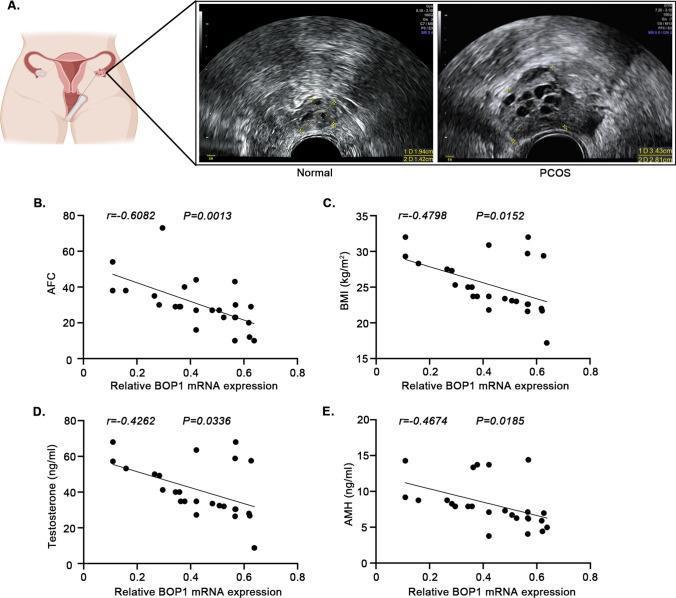
This composite educational graphic illustrates the relationship between BOP1 expression and polycystic ovary syndrome (PCOS). Panel A presents an anatomical diagram of a transvaginal ultrasound procedure alongside two actual ultrasound images comparing a 'Normal' ovary to a 'PCOS' ovary. The PCOS ovary demonstrates classic diagnostic features including enlargement and a 'string of pearls' appearance with multiple peripherally located, small, hypoechoic antral follicles. Panels B through E are scatter plots with linear regression lines showing clinical correlations in PCOS patients. These graphs demonstrate that relative BOP1 mRNA expression in granulosa cells is negatively correlated with four key clinical indicators: Antral Follicle Count (AFC) (r = -0.6082), Body Mass Index (BMI) (r = -0.4798), Serum Testosterone levels (r = -0.4262), and Anti-Müllerian Hormone (AMH) levels (r = -0.4674). All correlations are statistically significant (p < 0.05). This visual data suggests that downregulation of the BOP1 gene is associated with increased severity of PCOS phenotypic markers and hormonal imbalances.
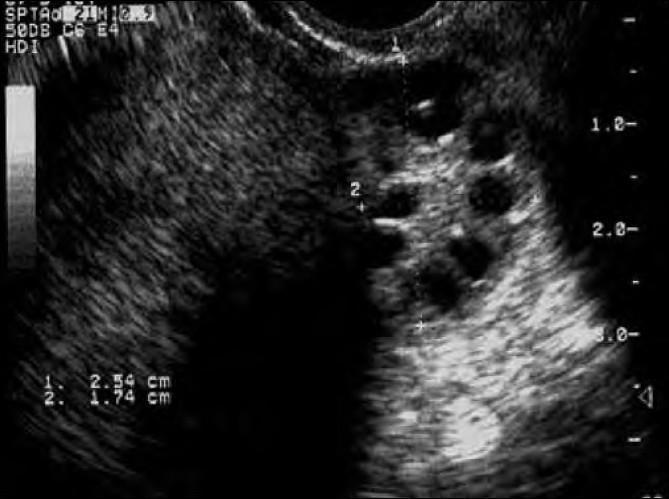
This diagnostic image is a transvaginal ultrasound (sonogram) of a human ovary, illustrating the classic morphological features of polycystic ovary syndrome (PCOS). The image shows an enlarged ovary containing numerous small, well-defined, hypoechoic (fluid-filled) cystic structures distributed primarily in the peripheral stroma, often referred to as the 'string of pearls' sign. There are at least eight visible follicles of varying diameters. Two linear calipers mark the dimensions of the ovary, with measurements recorded at 2.54 cm and 1.74 cm. The ovarian stroma appears relatively hyperechoic and prominent. The image also exhibits characteristic ultrasound speckle artifact throughout the tissue. This visual is used in medical education to demonstrate the 'polycystic' component of the Rotterdam criteria for diagnosing PCOS, emphasizing the specific distribution and quantity of follicles and the increase in overall ovarian volume.
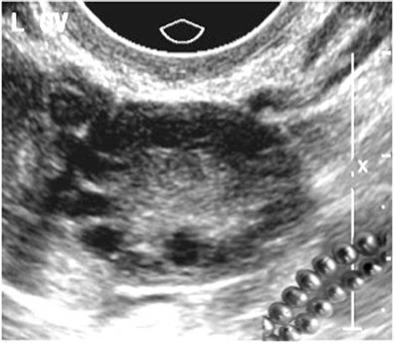
This diagnostic image is an endovaginal ultrasound of a human ovary, commonly associated with the diagnosis of polycystic ovary syndrome (PCOS). The ultrasound shows a transverse cross-section of the ovary characterized by an increased volume and specific follicular distribution. Numerous small, hypoechoic to anechoic cystic structures (follicles), typically measuring 2–8 mm in diameter, are visible. These follicles are arranged in a classic subcapsular distribution, lining up along the periphery of the organ to create the characteristic 'string-of-pearls' sign. The central portion of the ovary consists of a prominent, hyper-echodense ovarian stroma, which appears brighter relative to the dark peripheral cysts. This imaging pattern is a hallmark sonographic criterion for PCOS in the context of clinical signs like hirsutism or metabolic dysfunction. An inset image in the bottom right corner provides a visual analogy using a literal string of pearls to illustrate the diagnostic pattern.
Treatment of Polycystic Ovary Syndrome (PCOS)
1. Lifestyle Modification (All Women with PCOS)
- Caloric restriction and dietary changes (low glycaemic index diet preferred)
- Regular aerobic and resistance exercise
- Behavioural counselling for weight management
2. Menstrual Regulation and Endometrial Protection
- Suppressing LH and reducing ovarian androgen production
- Increasing sex hormone-binding globulin (SHBG), which lowers free androgens
- Protecting the endometrium from unopposed oestrogen (which risks hyperplasia/carcinoma)
- Medroxyprogesterone acetate 10 mg/day, or progesterone 200 mg/day for 10-14 days every 3 months
- Levonorgestrel intrauterine device (IUD)
3. Management of Hyperandrogenism (Hirsutism & Acne)
- COCPs reduce androgens within 2-3 months, but hirsutism/acne improvement may take 6+ months
- If COCP alone is inadequate after 6 months, add an antiandrogen:
- Spironolactone (50-200 mg/day) - aldosterone antagonist with antiandrogenic properties; most widely used
- Flutamide - non-steroidal antiandrogen; less commonly used due to hepatotoxicity risk
- Finasteride - 5-alpha reductase inhibitor; used for hirsutism
- Cosmetic measures (laser hair removal, electrolysis, waxing) are adjuncts, not substitutes
- All antiandrogens require effective contraception due to teratogenicity risk
4. Metabolic and Cardiometabolic Risk Reduction
- Obesity and BMI
- Hypertension
- Glycaemic control (fasting glucose, HbA1c, or OGTT)
- Fasting lipid profile (in overweight/obese women)
- Depression and anxiety
5. Fertility / Ovulation Induction (Women Seeking Pregnancy)
| Agent | Role |
|---|---|
| Letrozole (aromatase inhibitor) | First-line for ovulation induction |
| Clomiphene citrate (SERM) | Second-line; used with or without metformin |
| Metformin | Adjunct to diet/exercise; may improve clomiphene response |
| Injectable gonadotropins (FSH/LH) | Used by specialists when oral agents fail; risk of ovarian hyperstimulation syndrome (OHSS) is higher in PCOS |
| Ovarian drilling (laparoscopic) | Surgical option for clomiphene-resistant PCOS; reduces androgen output |
| IVF | For women who fail all of the above |
- Letrozole is now preferred over clomiphene as it carries a lower multiple pregnancy risk and higher live birth rate
- Metformin combined with clomiphene may improve ovulation rates compared to clomiphene alone
- PCOS increases the risk of OHSS, so gonadotropins must be used cautiously
6. Pregnancy-Related Considerations
- Early miscarriage
- Gestational diabetes
- Gestational hypertension and pre-eclampsia
- Preterm birth
7. Surgical Treatment
Summary Table
| Goal | First-line | Second-line / Add-on |
|---|---|---|
| Menstrual regulation | COCP | Cyclic progestins, LNG-IUD |
| Hyperandrogenism | COCP | Spironolactone, flutamide |
| Metabolic risk | Lifestyle + metformin | GLP-1 agonists (emerging) |
| Ovulation induction | Letrozole | Clomiphene ± metformin, gonadotropins |
| Surgical | - | Ovarian drilling (selected cases) |
- GLP-1 agonists meta-analysis in PCOS (2024) confirms weight loss and hormonal benefit in obese PCOS women
- Lifestyle interventions systematic review (2025) supports lifestyle change as cornerstone management