
Femur
Reading File
Finding Sources
Searching Images
femur anatomy bone
Reading File
Reading File
Finding Sources
Reading File
Loading Image
Loading Image
Reading File
Loading Image
Reading File
Loading Image
Here is a comprehensive overview of the femur — the longest bone in the body — based on Gray's Anatomy for Students and Imaging Anatomy: Bones, Joints, Vessels and Nerves.
The Femur
The femur is the single bone of the thigh, articulating with the acetabulum of the pelvis proximally and the tibia (and patella) distally. It descends from lateral to medial at an angle of approximately 7° from the vertical, so the distal end is closer to the midline than the proximal end.
Proximal End
Head
- Spherical, covered by hyaline cartilage (except for the fovea)
- Articulates with the acetabular lunate surface to form the hip joint
- The fovea capitis (fovea) is a non-articular pit on the medial surface — attachment point for the ligamentum teres (ligament of the head), which carries a branch of the obturator artery
Neck
- Cylindrical strut connecting the head to the shaft
- Projects superomedially at ~125° from the shaft (the neck-shaft angle) and slightly anteriorly (anteversion)
- The angulation increases the range of motion at the hip joint
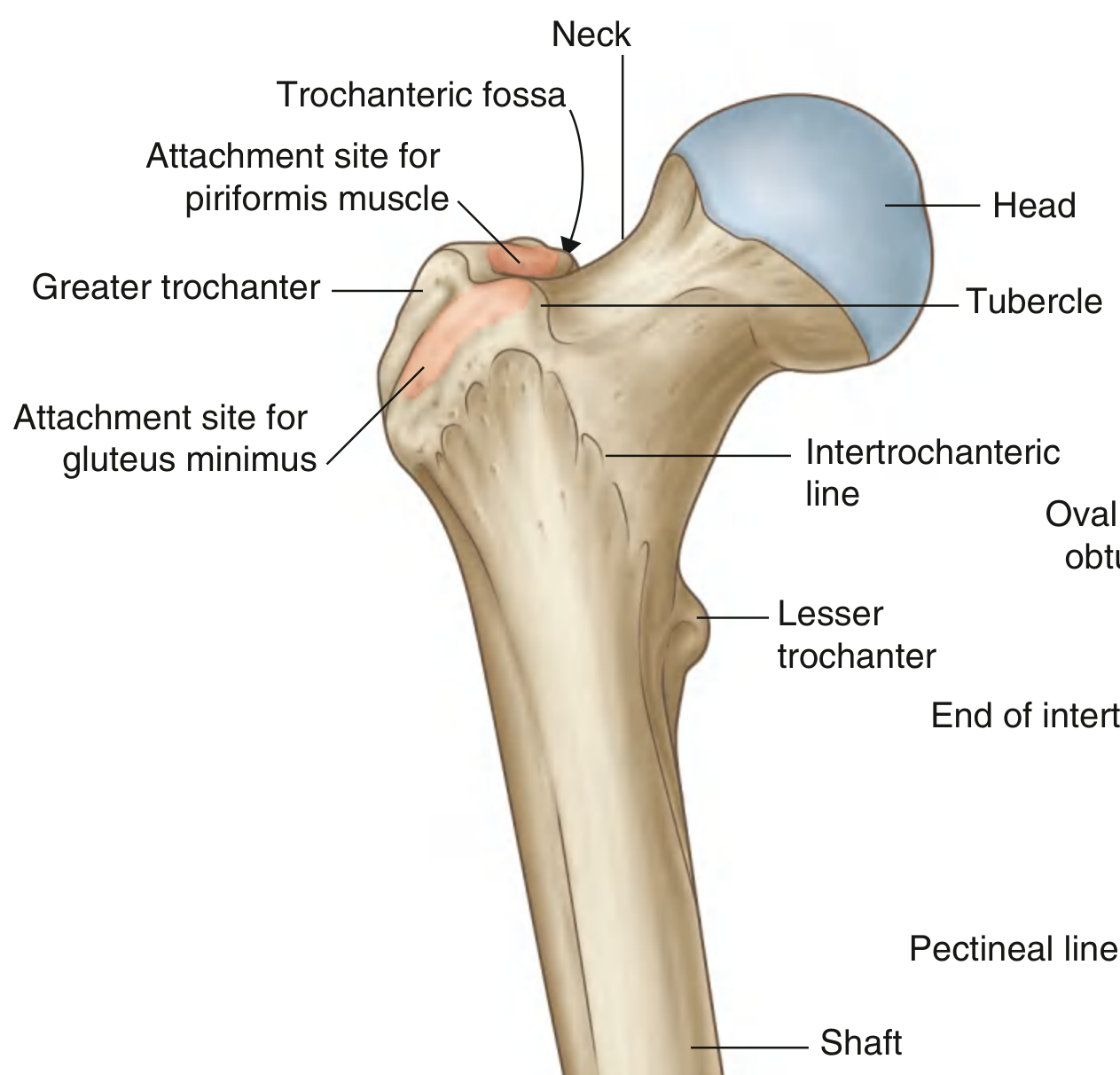
Greater trochanter
- Projects superolaterally from the shaft at the neck-shaft junction
- Contains the trochanteric fossa on its medial-posterior surface
- Attachment sites: gluteus medius (posterior lateral surface), gluteus minimus (anterolateral surface), piriformis (margin above trochanteric fossa), obturator internus + gemelli (medial superior surface), obturator externus (trochanteric fossa)
Lesser trochanter
- Blunt, conical projection on the posteromedial shaft just below the neck junction
- Attachment site for the combined iliopsoas tendon (primary hip flexor)
Intertrochanteric line — anterior surface; ridge running from the base of the greater trochanter to just anterior to the lesser trochanter; the joint capsule of the hip attaches here anteriorly
Intertrochanteric crest — posterior surface; broad smooth ridge from the posterior margin of the greater trochanter to the base of the lesser trochanter; carries the quadrate tubercle, attachment for quadratus femoris
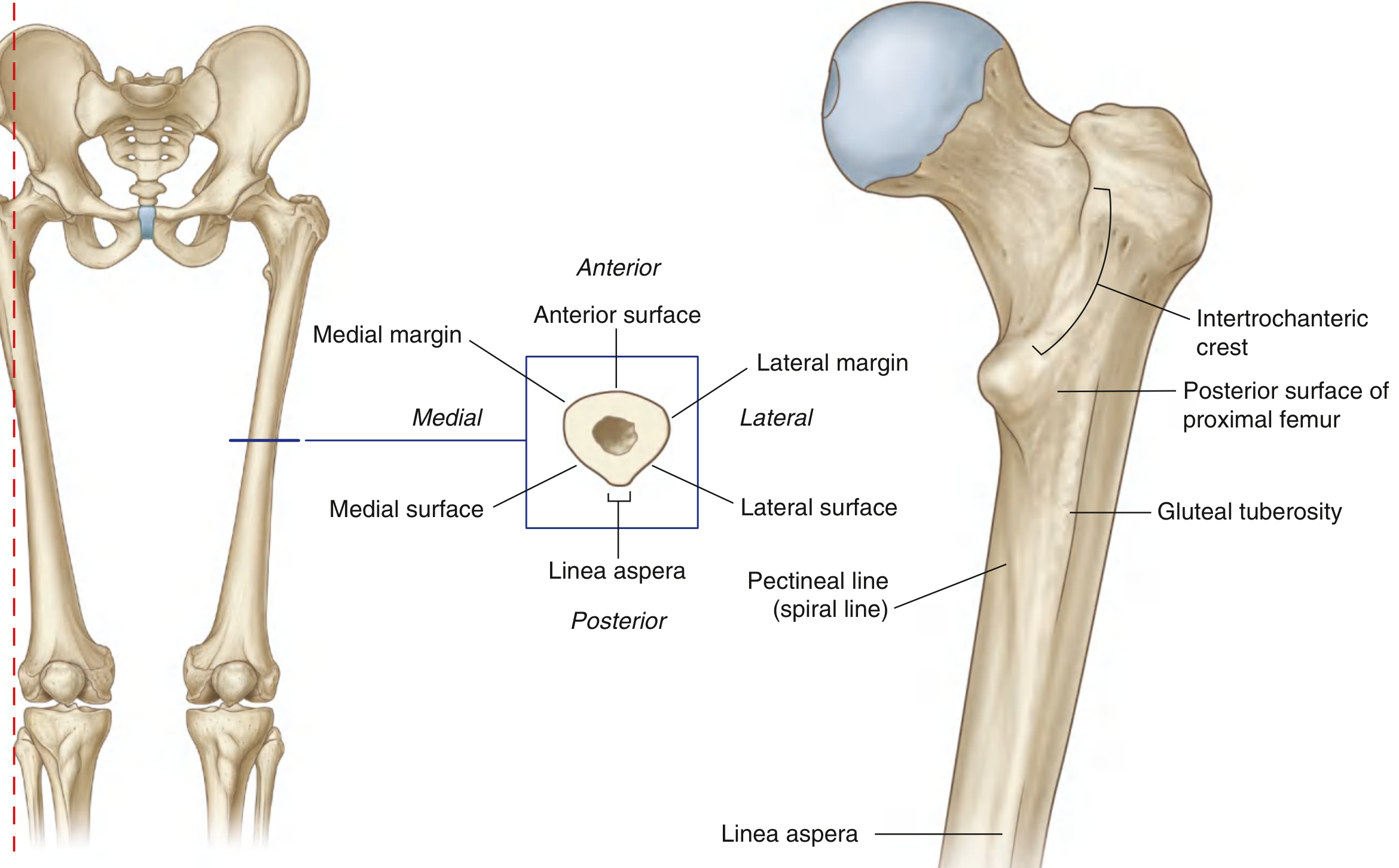
Shaft (Diaphysis)
- Triangular in cross-section in its middle third — anterior, lateral (posterolateral), and medial (posteromedial) surfaces
- Linea aspera — a prominent posterior longitudinal crest; major muscle attachment site in the thigh
- Proximally it diverges into:
- Pectineal (spiral) line — curves anteriorly under the lesser trochanter to join the intertrochanteric line
- Gluteal tuberosity — curves laterally to the base of the greater trochanter; attachment for gluteus maximus
- Proximally it diverges into:
- The nutrient artery (branch of the profunda femoris) is the primary blood supply to the femoral shaft
Distal End
- Expands into medial and lateral condyles that articulate with the tibial plateau
- The condyles are separated posteriorly by the intercondylar fossa (notch)
- Above the condyles are the medial and lateral epicondyles — attachment sites for collateral ligaments of the knee
- The adductor tubercle sits on the medial epicondyle — attachment for the adductor magnus
- The anterior surface of the distal femur bears the patellar (trochlear) surface, which articulates with the patella
Trabecular Architecture
The proximal femur contains four trabecular groups:
| Group | Orientation |
|---|---|
| Primary compressive | Perpendicular to femoral head |
| Secondary compressive | Perpendicular to intertrochanteric region |
| Primary tensile | Curved, parallel to femoral neck |
| Secondary tensile | Parallel to intertrochanteric region |
Ward's triangle — an area of relatively sparse trabeculae in the inferomedial femoral neck, between the primary compressive and tensile groups; a site of vulnerability in osteoporotic fractures.
Clinical Correlates
| Fracture Type | Key Feature |
|---|---|
| Femoral neck — subcapital | Highest risk of avascular necrosis (AVN) of femoral head; disrupts retinacular vessels |
| Femoral neck — transcervical | Intermediate risk of AVN |
| Femoral neck — basicervical | Lowest risk of AVN; more common after high-energy trauma in younger patients |
| Intertrochanteric | Does not involve the femoral neck; preserves the neck blood supply; common in the elderly after low-energy falls |
| Isolated lesser trochanter fracture in adults | Highly suspicious for pathological fracture due to malignant deposit |
| Femoral shaft fracture | Requires significant energy; associated with major soft tissue injury and significant blood loss |
Blood supply to the femoral head comes primarily from retinacular vessels derived from the medial and lateral circumflex femoral arteries (branches of the profunda femoris), which course along the neck, pierce the capsule, and supply the head. A minor contribution comes from the artery of the ligamentum teres (branch of the obturator artery).
Sources: Gray's Anatomy for Students, pp. 657–660; Imaging Anatomy: Bones, Joints, Vessels and Nerves, Vol. 3, pp. [proximal femur section]
Angles of femur
Finding Sources
Finding Sources
Reading File
Reading File
Reading File
Finding Sources
Loading Image
Reading File
Loading Image
Loading Image
Loading Image
Loading Image
This is a shared conversation. Sign in to Orris to start your own chat.