
Constipation Tests Types Management From slesinger and fordtrans
Reading File
Finding Sources
Finding Sources
Reading File
Reading File
Finding Sources
Reading File
Reading File
Reading File
Reading File
Reading File
Reading File
Loading Image
Reading File
I now have comprehensive content from Sleisenger & Fordtran. Let me compile the full, detailed answer.
Constipation - Sleisenger and Fordtran's Gastrointestinal and Liver Disease
Definition and Symptoms
Constipation is a patient's perception of altered bowel movements, encompassing:
- Hard stools
- Difficulty with defecation
- Sensation of incomplete evacuation
- Abdominal discomfort, bloating, excessive straining
- Sensation of anorectal blockage
The traditional medical definition is ≤3 bowel movements per week (based on the 95% lower confidence limit for healthy adults in the USA). However, stool frequency correlates poorly with constipation complaints. The most common terms used by patients to define constipation are straining (52%), hard stools (44%), and inability to defecate (34%).
Chronic constipation = symptoms present for at least 3 consecutive months.
Rome IV Criteria for Functional Constipation (Box 19.1)
1. Must include 2 or more of the following:
- (a) Straining during >25% of defecations
- (b) Lumpy or hard stools (Bristol Types 1-2) during >25% of defecations
- (c) Sensation of incomplete evacuation during >25% of defecations
- (d) Sensation of anorectal obstruction/blockage during >25% of defecations
- (e) Manual maneuvers to facilitate defecation (e.g., digital evacuation, pelvic floor support) during >25% of defecations
- (f) Fewer than 3 spontaneous bowel movements per week
2. Loose stools are rarely present without use of laxatives
3. Insufficient criteria for IBS-C
Symptoms must be present for the previous 3 months, with onset at least 6 months before diagnosis.
Bristol Stool Form Scale
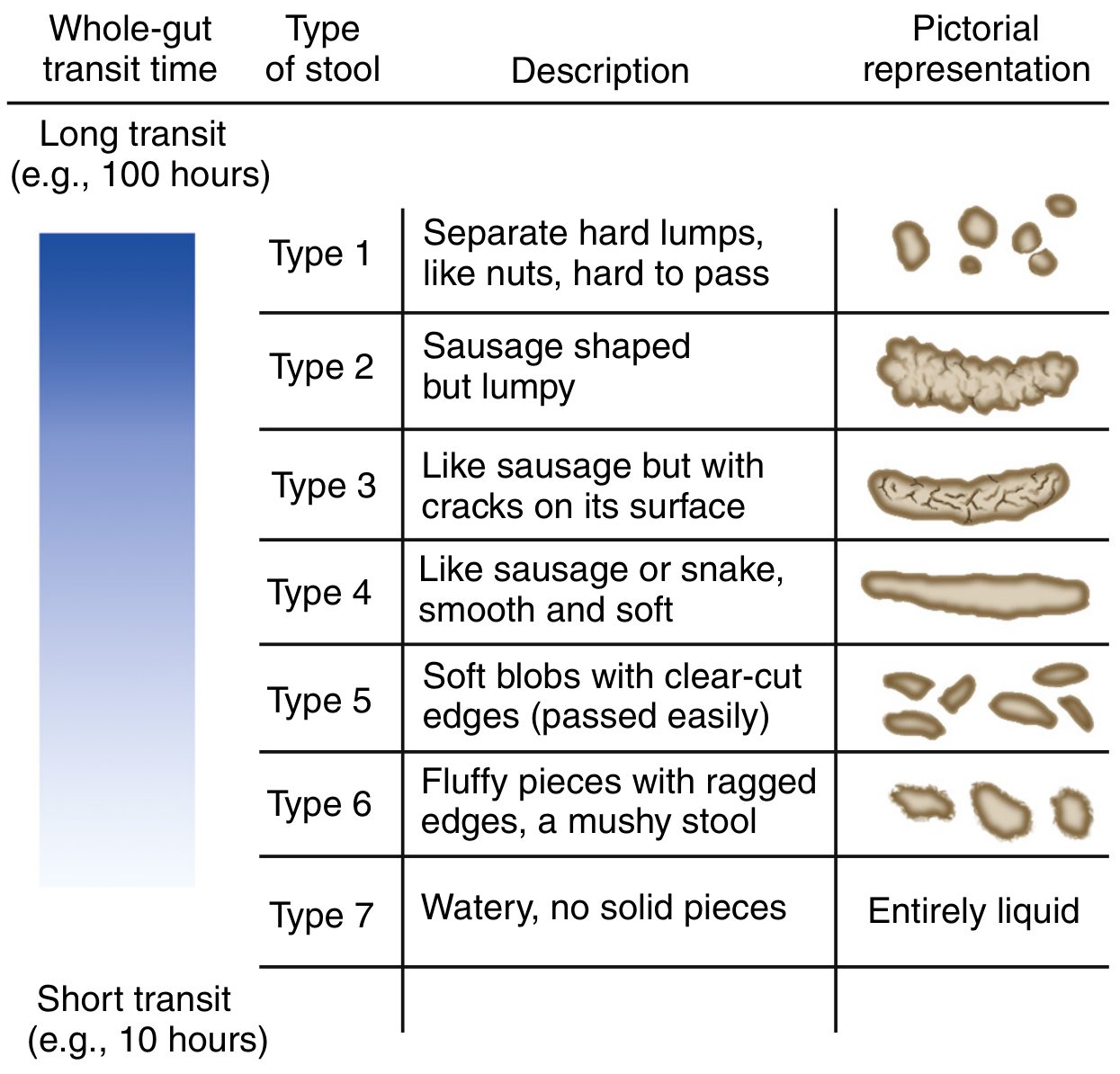
Stool consistency is a better predictor of whole-gut transit time than defecation frequency or stool volume. Types 1-2 are associated with long transit (constipation); Types 6-7 with short transit (diarrhea).
Risk Factors (Box 19.2)
- Female sex (particularly young women for slow-transit constipation)
- Older age (constipation affects 3-31% of the population; prevalent in women, children, older adults)
- Sedentary lifestyle / immobility
- Low dietary fiber and fluid intake
- Medications (opioids, anticholinergics, calcium channel blockers, tricyclic antidepressants, iron supplements, antacids containing calcium/aluminum)
- Systemic illnesses: hypothyroidism, hypercalcemia, diabetes mellitus, Parkinson's disease, multiple sclerosis, spinal cord lesions
- Mechanical obstruction (colorectal cancer, strictures)
- Pelvic floor dysfunction
Classification of Functional Constipation (Table 19.1)
In a study of >1,000 patients at the Mayo Clinic:
- 59% - Normal-transit constipation
- 25% - Defecatory disorder
- 13% - Slow-transit constipation
- 3% - Combined defecatory disorder + slow-transit constipation
1. Normal-Transit Constipation
- Stool travels at a normal rate through the colon
- Patients may have a perception of difficult defecation and hard stools despite normal colonic transit
- Features: incomplete evacuation, abdominal pain may be present
- Physiologic tests: Normal
- Often overlap with IBS-C; psychological distress, somatization, and visceral hypersensitivity may contribute
2. Slow-Transit Constipation
- Characterized by infrequent stools (≤1/week), lack of urge to defecate, poor response to fiber and laxatives, generalized symptoms (malaise, fatigue)
- More prevalent in young women
- Physiologic test results: Delay in colonic transit - retention of >20% of radiopaque markers in the colon 5 days after ingestion
- Pathophysiology: Reduced number of high-amplitude propagating contractions (HAPCs) in the colon; changes in enteric excitatory motor innervation of smooth muscle
- Histopathological changes in enteric nervous system (reduced interstitial cells of Cajal and neuropeptide Y-containing neurons described)
3. Defecatory Disorder (Rectal Evacuation Disorder / Dyssynergic Defecation / Pelvic Floor Dyssynergia)
- Features: frequent straining, incomplete evacuation, need for manual maneuvers to facilitate defecation
- Physiologic tests: Abnormal balloon expulsion or defecography; inappropriate muscle contraction on manometry/EMG
- The patient paradoxically contracts the puborectalis and external anal sphincter instead of relaxing during defecation
- Often diagnosed by anorectal manometry + balloon expulsion test
Diagnostic Tests
Tests for Structural Disease
- CT / MRI / Barium enema - assess width and length of colon, exclude obstructing lesion
- Colonoscopy - reserved for patients with alarm symptoms (rectal bleeding, recent change in bowel habits, weight loss, fever) or age ≥45-50 for colorectal cancer screening. Yield in absence of alarm symptoms is low (~5.5% polyps, no cancers found in 786 patients)
- Plain abdominal X-ray - can demonstrate fecal loading; used with radiopaque marker studies
Physiologic Testing (reserved for refractory cases)
1. Colonic Transit Time
- Radiopaque marker (Sitzmarks) study: Patient ingests 20-24 inert markers; abdominal X-rays taken at Day 3 (72 hr) and Day 5 (120 hr). Retention of >20% of markers at 120 hours = slow transit.
- Distribution pattern helps localize problem:
- Markers scattered throughout the colon = slow-transit constipation (colonic dysmotility)
- Markers concentrated in the rectosigmoid = defecatory disorder (outlet obstruction)
- Wireless motility capsule - newer non-radiation method to measure regional and whole-gut transit times and contractility
2. Anorectal Manometry
Assesses:
- Resting and maximum squeeze pressures of anal sphincters
- Rectoanal inhibitory reflex (RAIR) - absence suggests Hirschsprung's disease
- Rectal sensation thresholds
- Ability of the anal sphincter to relax during straining (paradoxical contraction = dyssynergia)
- High resting anal pressure suggests anal fissure or anismus
- A meta-analysis of 79 studies found abnormal manometry in 48% of patients with chronic constipation
3. Balloon Expulsion Test
- Patient attempts to expel a 50-mL water-filled balloon from the rectum (performed sitting on a commode)
- Suggests defecatory disorder if patient cannot expel or has significant delay
- Normal values: 4-75 seconds (women <50 yr); 3-15 seconds (women ≥50 yr)
- Used in conjunction with anorectal manometry (sensitivity enhanced when combined)
- Abnormal in 43% of patients with chronic constipation (meta-analysis)
4. Defecography (Evacuation Proctography)
- Thickened barium instilled into rectum; fluoroscopy (videos/films) obtained while patient rests, defers, and strains to defecate
- Evaluates:
- Rate and completeness of rectal emptying
- Anorectal angle changes (normally should open >15° on straining)
- Amount of perineal descent (abnormal: <1 cm or >4 cm)
- Structural abnormalities: large rectocele, internal mucosal prolapse, intussusception
- MRI defecography - preferred when available; no radiation, better soft tissue detail, detects cystoceles and colpoceles; limited by difficulty performing in sitting position
- Abnormal in 37% of patients with chronic constipation (excessive perineal descent criterion)
5. Electromyography (EMG)
- Assesses puborectalis and external anal sphincter activity
- Paradoxical increase in puborectalis activity on straining = dyssynergic defecation
- Abnormal EMG in 44% of patients with chronic constipation (meta-analysis)
Diagnosis of dyssynergic defecation (Rome criteria) requires 2 of the following 3:
- Impaired evacuation on balloon expulsion or defecography
- Inappropriate contraction of pelvic floor muscles on manometry, imaging, or EMG
- Inadequate propulsive forces on manometry or imaging
Management
Step 1 - Lifestyle and Dietary Measures (First-line)
- Increase dietary fiber to 20-35 g/day (gradually to avoid bloating)
- Adequate fluid intake
- Regular physical activity
- Establish a regular defecation schedule (utilize the gastrocolic reflex after meals)
- Biofeedback therapy shown to improve stool frequency and rectal evacuation in patients with pelvic floor dyssynergia and slow transit
Step 2 - Bulk-Forming Agents (Fiber Supplements)
| Agent | Mechanism | Notes |
|---|---|---|
| Psyllium (ispaghula) | Soluble fiber; retains water, increases stool bulk | Most evidence; best-studied |
| Methylcellulose | Insoluble synthetic fiber | Less gas/bloating |
| Calcium polycarbophil | Hydrophilic polyacrylic resin; resistant to bacterial degradation | Less gas/bloating than psyllium |
| Guar gum | Natural polysaccharide; highly viscous | High doses can cause intestinal obstruction |
| Flaxseed (linseed) | Mixed fiber | Limited/conflicting evidence |
| Wheat bran | Insoluble fiber | Effective for increasing stool frequency |
Step 3 - Osmotic Laxatives
Poorly absorbed ions:
- Magnesium hydroxide (Milk of Magnesia) - produces bowel movement within 6 hours; risk of hypermagnesemia in renal failure
- Magnesium sulfate - potent, produces large-volume liquid stool; risk of volume shifts
- Sodium phosphate - use with caution; risk of acute phosphate nephropathy (contraindicated in renal impairment, elderly)
Non-absorbable sugars/polyols:
- Lactulose - disaccharide metabolized by colonic bacteria; causes gas, bloating, abdominal cramps; sweet taste may worsen nausea (relevant in palliative care)
- Sorbitol - less expensive, equally effective as lactulose
- Polyethylene glycol (PEG / MiraLax) - large molecular weight polymer; not absorbed or metabolized; increases stool water content; excellent safety profile with minimal electrolyte disturbance; well tolerated long-term; the preferred osmotic agent
Step 4 - Stimulant Laxatives (Table 19.3/19.4)
| Drug | Class | Mechanism |
|---|---|---|
| Bisacodyl | Diphenylmethane | Stimulates colonic peristalsis and mucosal secretion |
| Sodium picosulfate | Diphenylmethane (pro-drug) | Hydrolyzed by colonic bacteria to active form |
| Senna (sennosides) | Anthraquinone | Bacterial hydrolysis yields active metabolites; stimulates myenteric plexus |
| Cascara sagrada | Anthraquinone | Similar to senna |
- Stimulant laxatives are effective for short-term use; long-term use may cause melanosis coli (harmless pigmentation) and historically was suspected to cause cathartic colon (largely refuted)
- In opioid-induced constipation: a bowel stimulant (not just a stool softener) is essential; transdermal fentanyl less constipating than oral morphine
Step 5 - Stool Softeners / Emollients
- Docusate sodium - anionic surfactant; reduces surface tension of stool, allowing water to penetrate
- Evidence of efficacy is limited; generally not adequate as monotherapy for significant constipation
- In palliative care, often ineffective due to multifactorial nature of constipation
Step 6 - Newer Secretagogues (for chronic/refractory constipation)
Lubiprostone
- Bicyclic fatty acid (prostaglandin E1 derivative); activates type 2 chloride channels (ClC-2) in intestinal epithelium
- Increases intestinal fluid secretion and transit
- FDA-approved: 24 mcg twice daily for chronic idiopathic constipation in adults; 8 mcg twice daily for IBS-C (women ≥18 yr)
- Most common side effect: nausea (nauseating, especially on empty stomach)
Linaclotide
- 14-amino acid peptide; activates guanylate cyclase C (GC-C) receptor on luminal surface of intestinal epithelium
- Increases intracellular cGMP → increased chloride and bicarbonate secretion into intestinal lumen → increased stool water content; also reduces afferent nerve firing (visceral analgesia)
- FDA-approved: 145 mcg once daily (chronic constipation); 290 mcg once daily (IBS-C)
- Phase 3 trials: 20% responders vs. 5% placebo (≥3 CSBM/week for ≥9/12 weeks)
- Diarrhea most common adverse effect (~4% discontinuation)
- Contraindicated in children <6 years (deaths in juvenile mice); not recommended ages 6-18
Plecanatide
- GC-C agonist; mechanistically similar to linaclotide
- FDA-approved: 3 mg once daily
- Phase 3 trials: ~20% responders vs. ~11% placebo
- Diarrhea in 5.1%; discontinuation in 2.7%
Step 7 - Serotonergic Agents (5-HT4 Agonists)
- Prucalopride - highly selective 5-HT4 agonist; accelerates colonic transit; effective for chronic constipation; FDA-approved (2018); available outside the USA for longer
- Tegaserod - partial 5-HT4 agonist; withdrawn from US market (2007) due to cardiovascular safety concerns; limited availability
- Cisapride - withdrawn due to potentially lethal cardiac dysrhythmias (QT prolongation)
Step 8 - Peripheral Opioid Antagonists (for opioid-induced constipation)
Opioids bind mu receptors in bowel smooth muscle → suppress peristalsis, raise anal sphincter tone.
- Methylnaltrexone - quaternary ammonium compound; does not cross the blood-brain barrier; antagonizes peripheral opioid receptors without reversing central analgesia
- Naloxegol - PEGylated naloxone; oral; peripherally acting
- Alvimopan - peripherally acting; used postoperatively
Step 9 - Biofeedback Therapy
- Treatment of choice for dyssynergic defecation / pelvic floor dyssynergia
- Shown to improve stool frequency and rectal evacuation in adults with pelvic floor dyssynergy
- Accelerates colonic transit in this subset
- No benefit demonstrated in constipated children
- Mode of action: extrinsic autonomic efferent pathways mediate the response
Step 10 - Surgical Options (rare, for refractory cases)
- Subtotal colectomy with ileorectal anastomosis - for severe, medically refractory slow-transit constipation confirmed by colonic transit studies; only after defecatory disorder has been excluded
- Surgery carries risk of diarrhea, incontinence, and small bowel obstruction
Special Populations
Opioid-Induced Constipation (Palliative Care - Table 132.5)
- Most patients on opioids experience constipation
- Transdermal fentanyl less constipating than oral morphine
- Stimulant laxative (not just softener) is required
- Bulk-forming agents often worsen constipation in palliative patients (poor oral intake)
- Osmotic agents (lactulose, sorbitol): many patients dislike sweet taste, may exacerbate nausea
- PEG: generally well tolerated
Neurologic Disease
- Parkinson's disease: slow transit, reduced postprandial colonic activity, paradoxical anal sphincter contraction; dopamine-deficient enteric neurons contribute; botulinum toxin injection into puborectalis may help outlet dysfunction
- Multiple sclerosis: constipation in 43-51%; multifactorial (reduced colonic motor activity, immobility, medications)
- Spinal cord lesions above sacral segments: upper motor neuron pattern; delayed rectosigmoid transit; abolished rectal sensation; require bowel management programs with stimulant suppositories, digital stimulation
Sleisenger and Fordtran's Gastrointestinal and Liver Disease, Chapter 19 (Constipation) - 10th/11th Edition
Acute and chronic pancreatitis from slesingers and new guidelines in detailed
Your credits are exhausted. You can purchase a top-up or subscribe to a plan to continue using Orris. If you're already subscribed, your daily credits will reset tomorrow.
This is a shared conversation. Sign in to Orris to start your own chat.