
Epidemiological approach
Reading File
The topic "Epidemiological approach" is broad. Let me search the medical library for dedicated sections on this topic.
Searching sources...
Finding Sources
Finding Sources
Park's Textbook has a dedicated section on "Epidemiological approach." Let me read both occurrences plus surrounding content for full coverage.
Reading File
Reading File
Now let me get more content from block1 to cover the full epidemiological approach section, including study designs and uses.
Reading File
Finding Sources
Let me also get the "uses of epidemiology" and "descriptive epidemiology" sections which are tightly linked to the approach.
Finding Sources
Finding Sources
Reading File
Reading File
I have rich content now. Let me also get the remaining uses of epidemiology (uses 4-7) and the descriptive epidemiology content.
Reading File
Finding Sources
Reading File
I now have comprehensive content. Let me also fetch the study design diagrams to include them visually.
Loading Image
Loading Image
I now have everything needed for a comprehensive, well-structured answer. Here it is:
The Epidemiological Approach
Source: Park's Textbook of Preventive and Social Medicine
Foundation: Two Major Pillars
The epidemiological approach to problems of health and disease rests on two major foundations:
- Asking questions
- Making comparisons
1. Asking Questions
Epidemiology has been defined as "a means of learning or asking questions... and getting answers that lead to further questions." The questions fall into two categories:
Related to health events:
- What is the event (the problem)?
- What is its magnitude?
- Where did it happen?
- When did it happen?
- Who are affected?
- Why did it happen?
Related to health action:
- What can be done to reduce this problem and its consequences?
- How can it be prevented in the future?
- What action should be taken by the community? By health services? By other sectors?
- What resources are required? How are activities to be organized?
- What difficulties may arise, and how might they be overcome?
Answers to these questions provide clues to disease aetiology and help the epidemiologist guide planning and evaluation.
2. Making Comparisons
The basic approach in epidemiology is to make comparisons and draw inferences - comparing groups with and without the disease (or with and without exposure to a risk factor), or comparing individuals. By making comparisons, the epidemiologist identifies crucial differences in host and environmental factors between those affected and not affected.
Comparability is a prerequisite: both study and control groups must be similar so that "like can be compared with like." Methods to ensure comparability include:
- Randomization (random allocation) - the best method
- Matching - used in case-control and cohort studies when randomization is not possible
- Standardization - limited to characteristics like age, sex, and parity
Basic Measurements in Epidemiology
Epidemiology focuses on measurement of mortality and morbidity in human populations. Measurements include:
| Domain | Examples |
|---|---|
| Mortality | Death rates, cause-specific mortality |
| Morbidity | Incidence, prevalence |
| Disability | Disability rates |
| Natality | Birth rates, fertility rates |
| Disease characteristics | Distribution of attributes |
| Health services | Utilization, health care needs |
| Environmental factors | Risk factor distribution |
| Demographic variables | Age, sex, population structure |
Basic requirements of any measurement: validity, reliability, accuracy, sensitivity, and specificity.
Study Types in the Epidemiological Approach
Descriptive Epidemiology
Describes the distribution of disease in terms of person, place, and time. Functions include:
- Providing data on the magnitude of disease burden (morbidity and mortality)
- Generating aetiological hypotheses (a disease more frequent in one group suggests a possible causal link)
- Providing background data for planning and evaluating health services
- Contributing to research by describing disease variation
Analytical Epidemiology
Tests hypotheses by studying the individual within a population (not just whole populations). Two main observational designs:
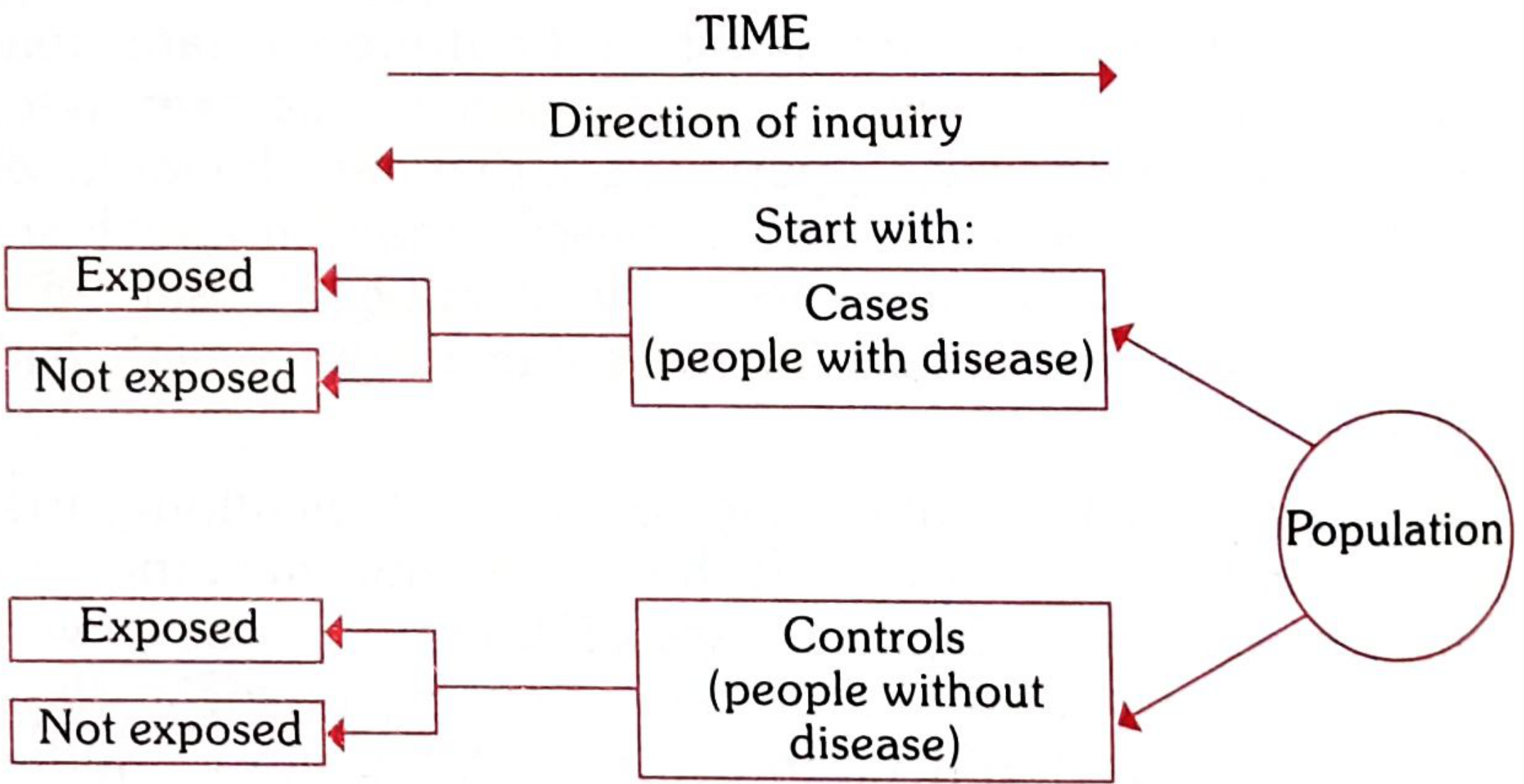
a. Case-Control Study - starts with cases (people with disease) and controls (people without), then looks backward in time for exposure:
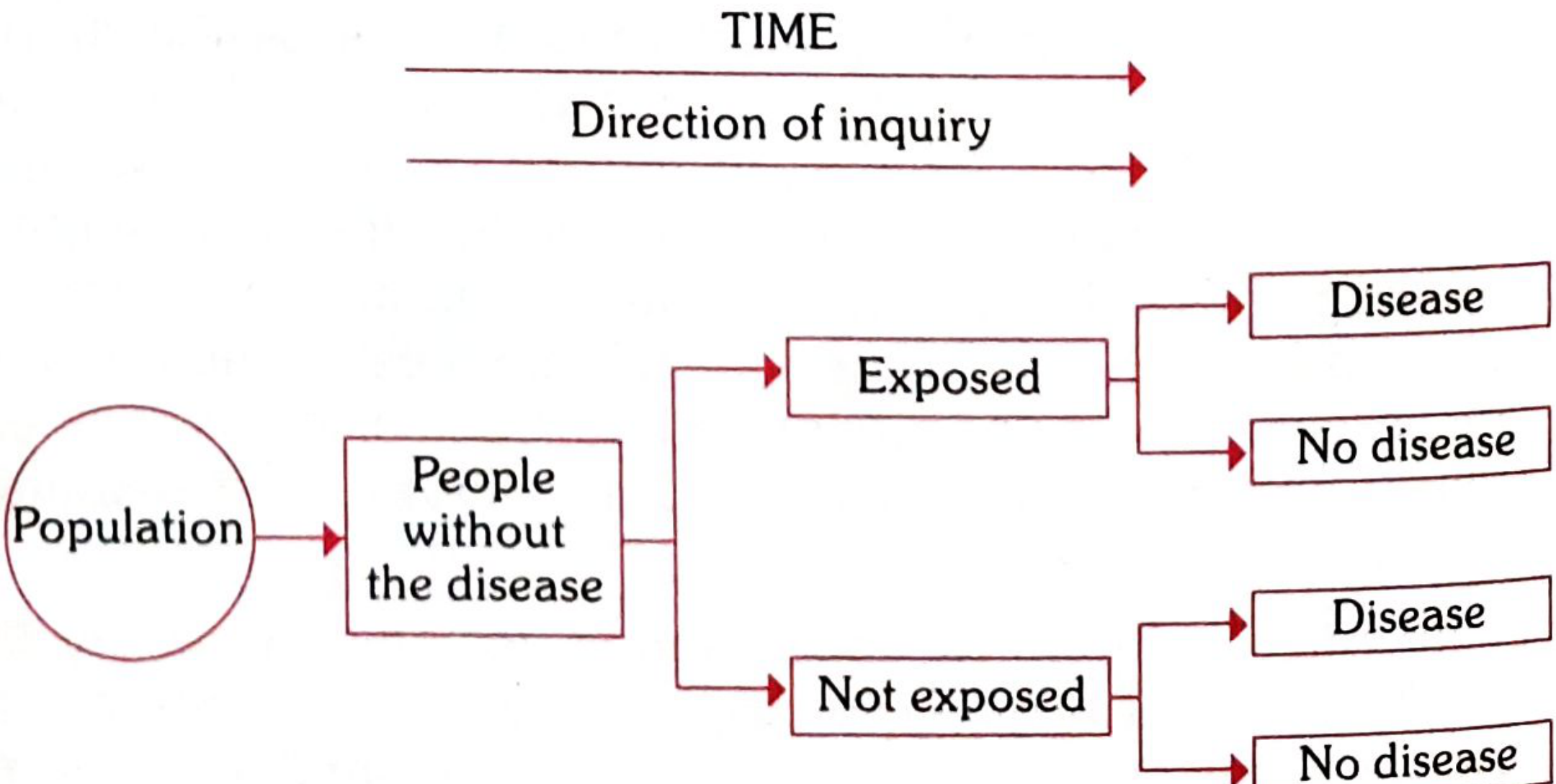
b. Cohort Study - starts with people without disease, classifies them by exposure, and follows forward in time for disease development:
Both designs determine:
- Whether a statistical association exists between a disease and a suspected factor
- The strength of that association
Seven Uses of Epidemiology (Morris)
J.N. Morris identified seven distinct uses of epidemiology, five of which extend it beyond just searching for causes:
| # | Use | Description |
|---|---|---|
| 1 | Historical study of disease | Study the rise and fall of diseases over time; project future trends and identify emerging health problems |
| 2 | Community diagnosis | Identify and quantify health problems in a community; lay down priorities for disease control; serves as a "diagnostic tool" of community medicine |
| 3 | Planning and evaluation | Provide the epidemiological basis for planning health services and assessing their impact; cost-effectiveness studies |
| 4 | Evaluation of individual risks | Calculate absolute risk (incidence rate), relative risk, and attributable risk; e.g., risk of Down syndrome with advancing maternal age; cancer risk in smokers |
| 5 | Syndrome identification | Define and refine disease syndromes using population observations; correct misconceptions (e.g., the Patterson-Kelly syndrome example) |
| 6 | Natural history of disease | Fill gaps in the natural history of disease by studying all cases in a defined population, not just hospital cases; e.g., recognizing that 1/3 to 2/3 of ischaemic heart disease deaths are sudden |
| 7 | Search for causes and risk factors | Identify causes of disease through interpopulation comparisons; e.g., linking rubella to congenital defects, thalidomide to teratogenicity, smoking to lung cancer |
The Epidemiological Approach in Specific Contexts
The epidemiological approach is applied broadly across health programs. For example, in eye care and blindness prevention, it involves:
- Population-level studies measuring incidence and prevalence of eye diseases and their risk factors
- Determining local epidemiological situations to guide action needed
- Conducting prevalence surveys as the first step in any national blindness prevention program
Summary: The epidemiological approach is fundamentally a population-based scientific method combining systematic questioning and rigorous comparison to understand the distribution and determinants of health and disease, with the ultimate goal of informing prevention, control, and health service planning.
- Park's Textbook of Preventive and Social Medicine, pp. 66-67, 83, 104-105
This is a shared conversation. Sign in to Orris to start your own chat.