
Rifaximin
Reading File
Finding Sources
Searching PubMed
rifaximin
Reading File
Reading File
Reading File
Finding Sources
Reading File
Reading File
Reading File
Reading File
Reading File
Finding Sources
Loading Image
Reading File
Reading File
Here is a comprehensive overview of Rifaximin:
Rifaximin
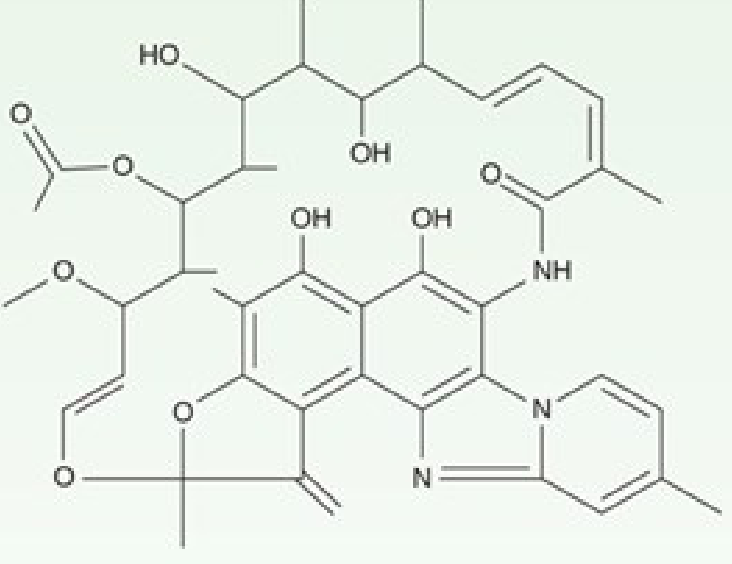
Rifaximin chemical structure — a rifamycin derivative
Class & Mechanism
Rifaximin is a semisynthetic derivative of rifampin belonging to the rifamycin class. It inhibits bacterial RNA synthesis by binding to the beta subunit of DNA-dependent RNA polymerase, blocking transcription.
It is active against:
- Gram-positive and gram-negative aerobes
- Anaerobes
Pharmacokinetics
The defining feature of rifaximin is its minimal systemic absorption: oral bioavailability is <0.5%, producing high intraluminal concentrations with negligible systemic levels.
- Following a 3-day course for traveler's diarrhea, fecal concentrations reach ~8,000 mcg/g
- Because it is not systemically absorbed, it is not associated with cytochrome P450-mediated drug interactions, unlike other rifamycins (e.g., rifampin)
FDA-Approved Indications & Dosing
| Indication | Dose | Duration |
|---|---|---|
| Traveler's diarrhea (non-invasive) | 200 mg TID or 400 mg BID | 3 days |
| IBS-D (irritable bowel syndrome, diarrhea-predominant) | 550 mg TID | 14 days |
| Hepatic encephalopathy (prophylaxis of recurrence) | 550 mg BID (maintenance) or 400 mg PO q8h (acute) | Ongoing/variable |
Up to 2 additional retreatment courses for IBS-D are effective for recurrent symptoms.
Clinical Uses in Detail
1. Traveler's Diarrhea
- Effective for non-invasive forms (e.g., enterotoxigenic E. coli)
- Not effective against invasive pathogens such as Campylobacter or Shigella
- May not be preferred if travel is to regions with high risk of these invasive organisms
- (Goldman-Cecil Medicine, Katzung Pharmacology)
2. IBS with Diarrhea (IBS-D)
- Phase III RCTs (TARGET 1 & 2) demonstrated significant improvement in global IBS symptoms over placebo
- Meta-analysis of 5 studies (rifaximin 550 mg TID vs placebo): global symptom improvement OR 1.57 (95% CI 1.22–2.01; NNT ≈ 10); bloating improvement OR 1.59 (NNT ≈ 10)
- Up to 64% of patients relapse within 18 weeks; retreatment is effective
- Effect on fecal microbiota is modest and transient — the mechanism likely involves modulation of microbial function (not composition), enhancing intestinal barrier integrity and reducing visceral hypersensitivity
- Positive lactulose hydrogen breath test (indicating SIBO) may predict favorable response
- ACG/AGA grade the evidence as moderate (2B) due to modest efficacy
- In a network meta-analysis of IBS-D therapies, rifaximin had the fewest adverse events compared to alosetron, ramosetron, and eluxadoline
- (Yamada's Gastroenterology, Goldman-Cecil Medicine)
3. Hepatic Encephalopathy (HE)
- Effective for both overt and minimal HE
- Recommended as adjunctive therapy alongside lactulose for prevention of recurrent HE
- Mechanism: modulates microbial function → increases serum saturated/unsaturated fatty acids → beneficial effects on brain function (not primarily by altering microbiome composition)
- A case-control study also described potential benefit for prevention of spontaneous bacterial peritonitis (SBP) in patients with HE
- (Yamada's Gastroenterology, Rosen's Emergency Medicine)
4. Small Intestinal Bacterial Overgrowth (SIBO)
- Strong recommendation, moderate evidence (GRADE) for rifaximin 800–1200 mg/day
- Doses studied range widely; a 7–10 day course improves symptoms for up to several months in 46–90% of patients and normalizes breath tests in 20–75%
- (Yamada's Gastroenterology)
5. Diverticular Disease (off-label / investigational)
- Cyclic rifaximin (1 week/month) + fiber supplementation reduced recurrent diverticulitis vs fiber alone (10.4% vs 19.3% recurrence), but the difference was not statistically significant
- The AGA recommends against its routine use for diverticulitis prevention
- (Yamada's Gastroenterology)
6. C. difficile Infection (adjunct)
- Used occasionally as an adjunct in recurrent or refractory C. difficile infection in adults
- C. difficile remains susceptible to rifaximin; retreatment does not appear to alter susceptibility
- (Katzung Pharmacology)
Adverse Effects
Rifaximin is generally very well tolerated. Most common side effects:
- Nausea
- Abdominal pain / flatulence
- Headache
- Upper respiratory infection (in clinical trials)
- Nasopharyngitis
In clinical trials for IBS-D, adverse event rates were comparable to placebo. There was one case of C. difficile colitis reported in the IBS-D retreatment trial (rifaximin group).
Key Advantages Over Systemic Antibiotics
- Negligible systemic absorption → minimal systemic toxicity
- No CYP450 drug interactions
- High intraluminal drug concentrations
- Broad-spectrum activity (gram-positive, gram-negative, aerobic, anaerobic)
- Minimal disruption of fecal microbiota compared to systemic antibiotics
Recent Evidence (2024–2025)
Two recent systematic reviews and meta-analyses confirm rifaximin's benefit in preventing hepatic encephalopathy:
- Hu et al. (2025, PLoS One) — efficacy and safety of rifaximin in preventing HE [PMID: 40378134]
- Huang et al. (2025, Medicine) — meta-analysis confirming prophylaxis benefit for HE [PMID: 39889173]
Sources: Katzung's Basic & Clinical Pharmacology (16th ed.) · Yamada's Textbook of Gastroenterology (7th ed.) · Goldman-Cecil Medicine · Rosen's Emergency Medicine · Sleisenger & Fordtran's GI and Liver Disease
This is a shared conversation. Sign in to Orris to start your own chat.