
Propofol vs fospropofol for md final exam - comprehensive review
Reading File
Now I'll run parallel searches across the library and PubMed simultaneously.
Finding Sources
Finding Sources
Searching PubMed
propofol fospropofol comparison sedation
Good - I have the key file paths. Now let me read the most comprehensive textbook sections in parallel.
Reading File
Reading File
Reading File
Excellent data. Let me now read the remaining sections - Miller's PK/PD details, Katzung fospropofol section, and the full CNS/CVS/side effects from Miller's:
Reading File
Reading File
Reading File
Reading File
Reading File
Reading File
Reading File
Reading File
Reading File
I now have comprehensive data from Miller's Anesthesia (10e), Morgan & Mikhail (7e), Katzung (16e), and Barash (9e). Let me now compile the full comprehensive review.
Loading Image
I now have all the material needed. Here is the comprehensive review:
Propofol vs Fospropofol - Comprehensive MD Final Exam Review
Sources: Miller's Anesthesia 10e, Morgan & Mikhail 7e, Katzung 16e, Barash 9e
1. Chemistry and Formulation
Propofol
- Class: Alkylphenol derivative - 2,6-diisopropylphenol
- Structural formula:
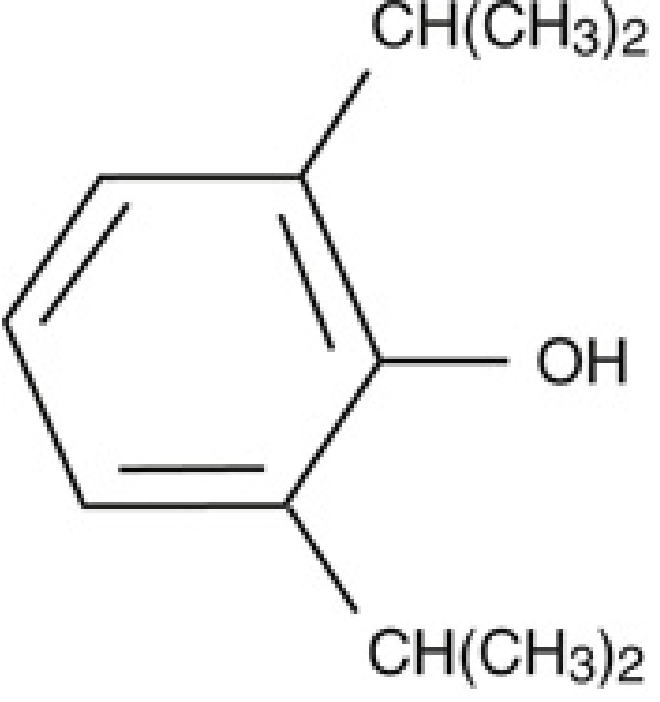
- Highly lipid-soluble, insoluble in aqueous solution
- Standard formulation: 1% propofol + 10% soybean oil + 1.2% purified egg phospholipid (emulsifier) + 2.25% glycerol (tonicity) + NaOH (pH 7)
- EDTA added for bacteriostatic activity (prevents microbial growth in high-fat emulsion)
- Appearance: slightly viscous, milky white substance (small lipid droplets)
- Available in 1% (standard) and 2% formulations; European formulations also use medium-chain + long-chain triglycerides
- Stable at room temperature; not light-sensitive; may be diluted with 5% dextrose in water
Fospropofol (Lusedra)
- Class: Water-soluble prodrug of propofol; disodium phosphonooxymethyl ester of propofol
- FDA approved December 2008 for monitored anesthesia care (MAC) in adults
- Formulation: sterile, aqueous, colorless, clear solution; 35 mg/mL; single-dose vial
- 1.86 mg fospropofol = molar equivalent of 1 mg propofol
- Metabolized by alkaline phosphatases in the liver → propofol + phosphate + formaldehyde
- Formaldehyde further metabolized by aldehyde dehydrogenase (liver and erythrocytes)
- Classified as a Schedule V controlled substance by the DEA (2009)
| Feature | Propofol | Fospropofol |
|---|---|---|
| Physical state | Lipid emulsion (milky white) | Aqueous solution (clear, colorless) |
| Formaldehyde production | No | Yes (metabolic byproduct) |
| DEA schedule | Not scheduled | Schedule V |
| pH | ~7 | Aqueous solution |
2. Mechanism of Action
Both drugs share the same ultimate mechanism - fospropofol works because it is converted to propofol in vivo.
Propofol mechanism:
- Primary: Positive allosteric modulator of GABA-A receptors - enhances Cl⁻ conductance, potentiates GABA inhibitory neurotransmission
- Also: Inhibits NMDA receptors, modulates slow calcium ion channels
- Anticonvulsant properties via GABA agonism and NMDA inhibition
- At high concentrations: antipruritic effects (unique to propofol among anesthetics)
3. Pharmacokinetics
Propofol PK
| Parameter | Detail |
|---|---|
| Distribution | Three-compartment model; very high lipid solubility |
| Redistribution | Responsible for short duration after single bolus |
| Protein binding | ~98% (albumin and erythrocytes) |
| Hepatic metabolism | Oxidized to 1,4-diisopropyl quinol in liver → conjugated with glucuronic acid → quinol-glucuronides |
| Renal excretion | <1% unchanged; metabolites excreted in urine (over 60 hrs post-anesthetic) |
| Clearance | High extraction ratio: 0.79-0.92 (susceptible to hepatic blood flow changes, not enzyme inhibition) |
| Context-sensitive half-time | Short - favorable for infusions |
Special population dose adjustments:
- Elderly (>65 yrs, esp. >80 yrs): 50% lower dose than 20-year-olds; decreased clearance + increased CNS sensitivity
- Children: Larger central compartment (50% more) + faster clearance (25% faster); children <3 yrs: even larger Vd and higher clearance → larger dose requirements
- Women: Larger Vd + higher clearance, but similar elimination t½ to men
- Hepatic disease: Larger steady-state and central compartment volumes; clearance unchanged; slight t½ prolongation - no significant dose adjustment needed (extrahepatic clearance compensates)
- Renal disease: Pharmacokinetics unaltered
- Hemorrhagic shock: Blood concentrations increase; dose requirements decrease 38-54% due to slower intercompartmental clearances and leftward shift of concentration-effect relationship
Drug interactions (PK):
- Midazolam (200 ng/mL) raises propofol concentrations ~25% by reducing metabolic clearance
- Alfentanil: Increases propofol concentrations by reducing elimination and distribution clearances
- Propofol increases remifentanil concentrations (↓ central Vd and distributional clearance by 41%, elimination clearance by 15%)
- Epidural ropivacaine (20-segment block): Reduces propofol dose/target by ~30%
Fospropofol PK
- Multicompartment model: 2-compartment for fospropofol + 3-compartment for liberated propofol
- After 6 mg/kg IV bolus: Parent drug peaks at 4 minutes; liberated propofol peaks at 12 minutes (delayed onset)
- Terminal elimination t½ of fospropofol: 0.88 hours
- Not affected by: Race, sex, mild-to-moderate renal impairment, age, or alkaline phosphatase activity levels
- Recovery is prolonged compared to propofol (prodrug must be converted first)
- Note: 6 studies on PK/PD published pre-2010 were retracted due to analytical assay inaccuracy - published data have significant limitations
4. Pharmacodynamics / Organ System Effects
Central Nervous System
Propofol:
| Effect | Detail |
|---|---|
| Sedation/hypnosis | Dose-dependent; subhypnotic doses → sedation + amnesia |
| Loss of consciousness | Blood level 2.5-4.5 mcg/mL (bolus); infusion concentration for consciousness ≥2 mg/kg/h for amnesia |
| BIS correlation | 50% no verbal response at BIS 63; 95% no verbal response at BIS 51 |
| EC50 verbal command | 2.35 mcg/mL |
| ICP | Decreases ICP 30-50%; also decreases CPP significantly |
| CMRO₂ | Decreases cerebral blood flow, volume, and metabolism |
| EEG | Initial ↑ alpha → shift to gamma/theta; burst suppression at >8 mcg/mL |
| Anticonvulsant | Yes - used to treat status epilepticus; BUT can also provoke excitatory phenomena and grand mal seizures (paradoxical) |
| Antiemetic | Yes - unique advantage; reduces PONV |
| Antipruritic | Yes |
| Intraocular pressure | Decreases by 30% |
| Excitatory phenomena | Muscle twitching, spontaneous movement, opisthotonus, hiccupping (during induction) |
| Addiction/abuse | Rare but documented; especially in healthcare workers |
| Malignant hyperthermia | Does NOT trigger MH - safe in susceptible patients |
| Tolerance | Can develop in ICU patients (20-40% require dose escalation) |
Fospropofol CNS: Effect profile similar to propofol; onset and recovery are prolonged.
Cardiovascular System
Propofol - key exam facts:
- 25-40% decrease in systolic BP after induction dose (2-2.5 mg/kg)
- Mechanism of hypotension: combined vasodilation + ↓ cardiac output + ↓ cardiac index (±15%), ↓ stroke volume index (±20%), ↓ SVR (15-25%), ↓ LVSWI (±30%)
- Vasodilation mechanisms: direct inhibition of smooth muscle calcium mobilization, inhibition of prostacyclin synthesis, reduction of angiotensin II-mediated calcium entry, K-ATP channel activation, ↑ nitric oxide
- Baroreflex impairment: Propofol resets/inhibits baroreflex → blunts tachycardic response to hypotension
- Heart rate: usually unchanged (↓ parasympathetic tone, but baroreflex impaired)
- Rare: severe bradycardia via Bezold-Jarisch reflex (vagally mediated from marked drop in cardiac filling)
- Hemodynamic depression lags behind hypnotic effect: t½ effect-site = 2-3 min for hypnosis vs. ~7 min for hemodynamic depression
- In hemorrhagic shock: hemodynamic depression markedly potentiated
- Cardioprotection: Postoperative troponin levels lower with propofol vs. sevoflurane in cardiac surgery (two large studies)
Respiratory System
Propofol:
- Profound respiratory depressant
- Apnea after induction dose
- Even at subanesthetic doses: inhibits hypoxic ventilatory drive, depresses response to hypercarbia
- Upper airway reflex depression exceeds thiopental → allows intubation/LMA/endoscopy without NMB
- Less bronchospasm than barbiturates or etomidate; lower histamine release → preferred in asthmatics
- KEY WARNING: Only trained airway management personnel should administer propofol for sedation
Fospropofol respiratory: Airway compromise is a major concern - same requirements; supplemental O₂ MUST be given to all patients receiving fospropofol.
Neuromuscular System
- No effect on evoked EMG or twitch tension
- Acceptable intubating conditions after propofol alone reported
5. Dosing
Propofol Dosing
| Indication | Dose |
|---|---|
| Induction (adult) | 1-2.5 mg/kg IV |
| Induction (children) | 2.5-3.5 mg/kg IV |
| Maintenance (balanced) | 100-200 mcg/kg/min (plasma level 3-8 mcg/mL) |
| ICU sedation | 25-75 mcg/kg/min (plasma level 1-2 mcg/mL) |
| Sedation (regional anesthesia) | 30-60 mcg/kg/min |
| PONV treatment | 10-20 mg IV bolus or 10 mcg/kg/min infusion |
Dose reductions needed in: elderly, ASA III-IV, premedicated patients, hemorrhagic shock.
Fospropofol Dosing (MAC sedation)
| Population | Dose |
|---|---|
| Standard adult | 6.5 mg/kg IV bolus, then 1.6 mg/kg supplemental doses as needed |
| Weight cap >90 kg | Use 90 kg for calculation |
| Weight floor <60 kg | Use 60 kg for calculation |
| Age >65 or ASA III/IV | Reduce by 25% |
Supplemental O₂ mandatory. Airway management personnel required.
6. Adverse Effects - High-Yield Exam Points
Propofol Adverse Effects
| Side Effect | Key Details |
|---|---|
| Pain on injection | Most common; reduced with large vein, lidocaine pretreatment, avoiding dorsum of hand |
| Hypotension | Dose-dependent; exacerbated by rapid injection, old age, large doses |
| Apnea | After induction dose |
| Myoclonus | Common during induction |
| Hypertriglyceridemia | With prolonged infusion (lipid vehicle); can cause pancreatitis |
| Infection risk | High-fat emulsion promotes microbial growth; opened vials linked to fatal systemic infections (Staph aureus, E. coli) |
| Propofol Infusion Syndrome (PRIS) | Rare but fatal; see below |
| FDA pregnancy warning | Dec 2016: concerns about fetal brain development with prolonged exposure (animal data) |
| Abuse/dependence | Rare; lethal self-administration documented in healthcare workers |
Propofol Infusion Syndrome (PRIS) - Must Know
- Definition: Rare, potentially fatal syndrome
- Threshold: Infusion ≥4 mg/kg/h for ≥48 hours (cases at lower doses/shorter duration reported)
- First described in: Children; later observed in critically ill adults
- Cardinal feature: Acute refractory bradycardia → asystole + ONE of:
- Metabolic acidosis (base deficit >10 mmol/L)
- Rhabdomyolysis
- Hyperlipidemia
- Enlarged/fatty liver
- Other features: Cardiomyopathy, acute cardiac failure, skeletal myopathy, hyperkalemia, hepatomegaly, lipemia
- Major risk factors: Poor O₂ delivery, sepsis, serious cerebral injury, large propofol dose
- Predisposing factors: Genetic disorders of fatty acid metabolism (MCAD deficiency), low carbohydrate supply
- Warning sign: Rising lipemia = early indicator of impending PRIS
- ACCA/CCM guidelines: Monitor for unexplained metabolic acidosis or arrhythmias in ICU patients on propofol
Fospropofol Adverse Effects
| Side Effect | Detail |
|---|---|
| Perineal/perianal paresthesia | Most characteristic; occurs in up to 74% of patients; minutes after bolus; mechanism unknown |
| Pruritus | Also reported |
| No injection pain | Major advantage over propofol |
| No lipid emulsion complications | Water-soluble → no hypertriglyceridemia |
| Formaldehyde production | Metabolic concern (minor at clinical doses) |
| Airway compromise | Same risk as propofol |
7. Clinical Uses and Indications
Propofol
- Induction and maintenance of general anesthesia (most common IV induction agent in USA)
- TIVA (Total Intravenous Anesthesia) - often combined with remifentanil, dexmedetomidine, or ketamine
- ICU sedation - mechanically ventilated patients (long-term feasible due to PK profile; weigh against PRIS risk)
- MAC sedation for procedures
- PONV treatment/prophylaxis - subhypnotic doses (10-20 mg)
- Status epilepticus - treatment
- Antipruritic - e.g., cholestatic pruritus
- Target-Controlled Infusion (TCI) - used extensively outside USA; uses PK models (Marsh, Schnider) based on patient characteristics
- Preferred in outpatient anesthesia due to PONV reduction and rapid clear-headed recovery
- Safe in malignant hyperthermia-susceptible patients
Fospropofol
- Approved use: MAC sedation during diagnostic and therapeutic procedures in adults ONLY
- Studies showed superiority to midazolam + fentanyl for endoscopy: more complete amnesia + better sedation
- NOT established for: pediatric use, ICU sedation, general anesthesia induction, TIVA
- Its place relative to other agents remains uncertain in clinical practice (Morgan & Mikhail)
8. Side-by-Side Comparison Table
| Feature | Propofol | Fospropofol |
|---|---|---|
| Structure | 2,6-diisopropylphenol | Prodrug (phosphonooxymethyl ester) |
| Solubility | Lipid emulsion | Water-soluble |
| Onset | Rapid (~30-45 sec) | Delayed (~4-12 min to peak effect) |
| Recovery | Fast | Slower (prodrug conversion step) |
| Injection pain | Common, often severe | Not present |
| Perineal paresthesia | No | Yes (up to 74%) |
| PONV | Reduced | Similar (via propofol) |
| Infection risk | Yes (lipid vehicle) | Lower |
| Hypertriglyceridemia | Yes (with prolonged use) | No |
| PRIS | Yes | Not reported (limited data) |
| DEA scheduling | Not scheduled | Schedule V |
| Approved age group | All ages | Adults only |
| FDA approvals | Induction, maintenance, sedation | MAC sedation only |
| Formaldehyde production | No | Yes (minor byproduct) |
| TCI compatible | Yes | Limited data |
| Use in pregnancy | FDA warning (2016) | Limited data |
9. Contraindications and Cautions
Propofol
- Allergy: Egg/soy allergy (standard emulsion) - caution; though the phospholipid is highly refined, cross-reactivity is debated
- Pediatric ICU sedation for prolonged periods: FDA recommends against it
- Elevated ICP: Use with extreme care (can critically reduce CPP); limit to mild-moderate sedation (blood concentration ~2 mcg/mL)
- Hemodynamic instability: High risk of severe hypotension
- Hypertriglyceridemia/pancreatitis history: Caution with lipid load
Fospropofol
- Not approved for pediatric use
- Formaldehyde metabolite - theoretical concern in patients with aldehyde dehydrogenase deficiency
- ASA III/IV and elderly: 25% dose reduction required
- Weight-capping at 60-90 kg (unique to fospropofol dosing)
10. Key Points for MD Final Exam
- Propofol causes dose-dependent hypotension - mechanism is combined vasodilation (via NO, Ca²⁺ channel inhibition, K-ATP activation) + cardiac depression; baroreflex is impaired
- Hemodynamic depression lags hypnosis by ~5 minutes (effect-site t½: 2-3 min hypnosis vs. ~7 min hemodynamic)
- Fospropofol = prodrug metabolized by alkaline phosphatase → propofol + phosphate + formaldehyde
- 1.86 mg fospropofol = 1 mg propofol (molar equivalence)
- 74% incidence of perineal paresthesia with fospropofol - its most distinctive adverse effect
- PRIS threshold: ≥4 mg/kg/h for ≥48h; key triad = bradycardia + metabolic acidosis + rhabdomyolysis
- Fospropofol is Schedule V (DEA) - propofol is not scheduled
- Propofol safe in MH - does not trigger malignant hyperthermia
- Propofol useful in asthmatics - less bronchospasm and histamine release vs. barbiturates
- Propofol decreases ICP by 30-50% but also decreases CPP - critical in head injury management
- Elderly patients (>80 yrs): 50% dose reduction of propofol needed
- Propofol antiemetic effect is its key advantage for outpatient anesthesia - uniquely reduces PONV
- Fospropofol NOT superior to propofol - slower onset, slower recovery, limited indications; its role is uncertain
- Six fospropofol PK studies retracted (pre-2010) due to assay inaccuracy - interpret older literature cautiously
- Propofol does NOT produce analgesia - analgesic adjuncts always required
Miller's Anesthesia (10e), pp. 2458-2490; Morgan & Mikhail's Clinical Anesthesiology (7e), pp. 339-341; Katzung's Basic and Clinical Pharmacology (16e), pp. 708-710; Barash Clinical Anesthesia (9e)
This is a shared conversation. Sign in to Orris to start your own chat.