

Explain this to me in simplest language possible
🎯 What is this paper about?
📝 LONG ESSAY QUESTIONS (20 marks)
⚡ TIER 1 - Most likely to appear:
- Cardiac Output - How much blood the heart pumps and how to measure it
- Cardiac Cycle - The sequence of events in one heartbeat (with ECG)
- Shock - What it is, types, especially low-blood-volume shock and how the body tries to fix it
🛡️ TIER 2 - Strong backup (also study these):
- Blood Pressure - What controls it short-term (baroreceptors, RAAS system)
- Hemostasis + Hemophilia A - How blood clots and what goes wrong in hemophilia
- Countercurrent mechanism in kidney - How kidneys concentrate urine
⭐ TIER 3 - Possible but less likely:
- GFR - How kidneys filter blood
- Neural control of breathing - How the brain controls breathing patterns
📋 SHORT NOTES (by body system)
❤️ Heart (CVS):
- Circulatory shock, baroreceptor reflex, coronary circulation, how the heart doesn't go into tetanus
🍽️ Gut (GIT):
- Peptic ulcers, how stomach makes acid (HCl), bile salts, swallowing, gut hormones
🫁 Lungs (Respiratory):
- Oxygen-hemoglobin curve, hypoxia types, surfactant (the substance that keeps lungs open), heat loss
🫘 Kidneys (Renal):
- GFR, tubuloglomerular feedback, JGA diagram, countercurrent mechanism
❓ "EXPLAIN WHY" POOL
- Why yogurt is better than milk in lactose intolerance
- Why protein leaks into urine in kidney disease (albuminuria)
- Why we breathe faster during exercise
- Why heart blood flow is highest during relaxation (diastole), not contraction
- Why hot water bottles are avoided in shock patients
- Why cardiac muscle can't be tetanized (kept in constant contraction)
- Why vaccines work less well in people with weak immune systems
🔑 Bottom Line
Make a quick reference poster comparing Tier 1, 2, and 3 topics
A clean, modern medical study quick reference poster titled "RUHS Physiology Paper II - Tier Comparison Guide". The poster has a dark navy blue background with three colored columns side by side. Left column (RED/orange gradient header with lightning bolt emoji): "TIER 1 - HIGHEST PRIORITY" listing: • Cardiac Output (determinants, measurement, cardiac index) • Cardiac Cycle (phases, P-V changes, ECG) • Shock (types, hypovolemic, compensatory mechanisms) • Circulatory Shock (classify, stages, management) • O2-Hb Dissociation Curve (Bohr effect, 2,3-BPG) • Hypoxia (types, hypoxic hypoxia) • Surfactant (RDS, hyaline membrane disease) • GFR (factors, tubuloglomerular feedback) • Peptic Ulcer (etiology, physiological basis) • HCl Secretion by parietal cells • Countercurrent multiplier mechanism Middle column (YELLOW/gold gradient header with shield emoji): "TIER 2 - STRONG BACKUP" listing: • Blood Pressure (baroreceptor, RAAS) • Hemostasis + Hemophilia A • Countercurrent mechanism in kidney • ECG (unipolar/bipolar leads, Lead II) • Venous Return • Factors affecting stroke volume • Phases of deglutition • Regulation of gastric emptying • GIT Hormones (gastrin, CCK) • Fat absorption • CO2 transport, Haldane effect • High-altitude acclimatization • Lung compliance Right column (GREEN gradient header with star emoji): "TIER 3 - POSSIBLE" listing: • GFR regulation • Neural regulation of respiration • Periodic breathing / Ondine's curse • Physiology of micturition • Role of kidney in acid-base balance • Transport maximum, glucose reabsorption • PCT functions • Innervation of urinary bladder • Oxygen debt • Peripheral chemoreceptors • VO2 max At the bottom, a pink/magenta section titled "EXPLAIN WHY - TOP PICKS" with two columns listing: Yogurt vs milk in lactose intolerance | Albuminuria in nephritis | Tachypnea during exercise | Coronary flow maximal in diastole | Blanket avoided in shock | Cardiac muscle can't be tetanized | Vaccines less effective in immunocompromised | Deficiency of surfactant causes IRDS The poster uses clear white bold text, icons/emojis for each tier, and a professional medical education aesthetic. Each column has a colored top badge. Footer says "Study Tip: Master Tier 1 first, then Tier 2. Tier 3 is bonus!"
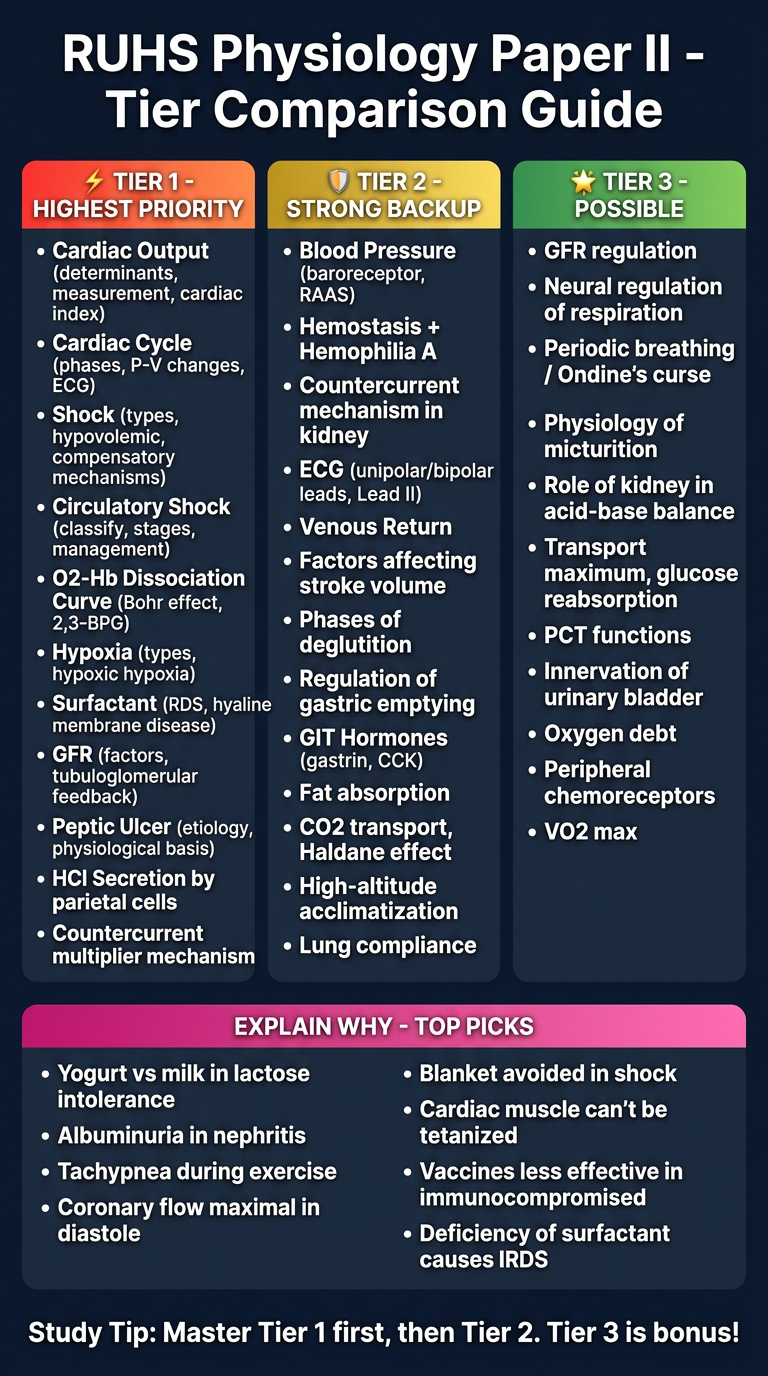
- Red column (Tier 1) - Your must-study topics. Spend 60% of your prep time here.
- Yellow column (Tier 2) - Strong backup. Cover these after Tier 1 is solid.
- Green column (Tier 3) - Skim if time permits.
- Pink bottom section - The "Explain Why" rapid-fire questions to revise last.
Make a mind map poster of Cardiac Output topic
A detailed, colorful medical mind map poster on a deep dark navy blue background. The central node in the middle is a bright red rounded rectangle labeled "CARDIAC OUTPUT" in large bold white text with a small heart icon. Subtitle inside: "CO = HR × SV | Normal: 5 L/min" Six major branches radiate outward from the center in different directions, each with a distinct color and their own sub-branches: BRANCH 1 (top-left, ORANGE): "DEFINITION & NORMAL VALUES" Sub-nodes: - Volume of blood pumped per minute - Normal adult: 4-8 L/min - At rest: ~5 L/min - During exercise: up to 25 L/min BRANCH 2 (top, BLUE): "COMPONENTS" Sub-nodes: - Heart Rate (HR): 60-100 bpm - Controlled by SA node - Sympathetic increases HR - Parasympathetic decreases HR - Stroke Volume (SV): 70 mL/beat - Preload - Afterload - Contractility BRANCH 3 (top-right, GREEN): "DETERMINANTS" Sub-nodes: - Preload (venous return, Frank-Starling law) - Afterload (peripheral resistance, aortic pressure) - Contractility (inotropy, Ca2+ ions) - Heart Rate (chronotropy) BRANCH 4 (right, PURPLE): "METHODS OF MEASUREMENT" Sub-nodes: - Fick's Principle: CO = O2 consumption / arteriovenous O2 difference - Indicator Dilution Method (dye dilution) - Thermodilution (Swan-Ganz catheter) - GOLD STANDARD - Echocardiography - Doppler ultrasound BRANCH 5 (bottom, YELLOW): "CARDIAC INDEX" Sub-nodes: - CI = CO / Body Surface Area (BSA) - Normal: 2.5 - 3.5 L/min/m² - Adjusted for body size - Used to compare patients BRANCH 6 (bottom-left, PINK/RED): "FACTORS AFFECTING CO" Sub-nodes: - Increases CO: Exercise, pregnancy, anxiety, fever, AV fistula - Decreases CO: Heart failure, hemorrhage, myocardial infarction, tamponade - Venous return is key driver - Sympathetic stimulation increases CO All nodes are rounded rectangles with bright colors. Connecting lines are thick, curved, and colored matching their branch. The mind map is spacious, clear, easy to read. Each sub-branch label is in white bold text on colored backgrounds. The poster has a title at the top in gold: "MIND MAP: CARDIAC OUTPUT" and a footer that reads "CO = HR × SV | Cardiac Index = CO/BSA | Fick's Principle = Gold Standard for Measurement"
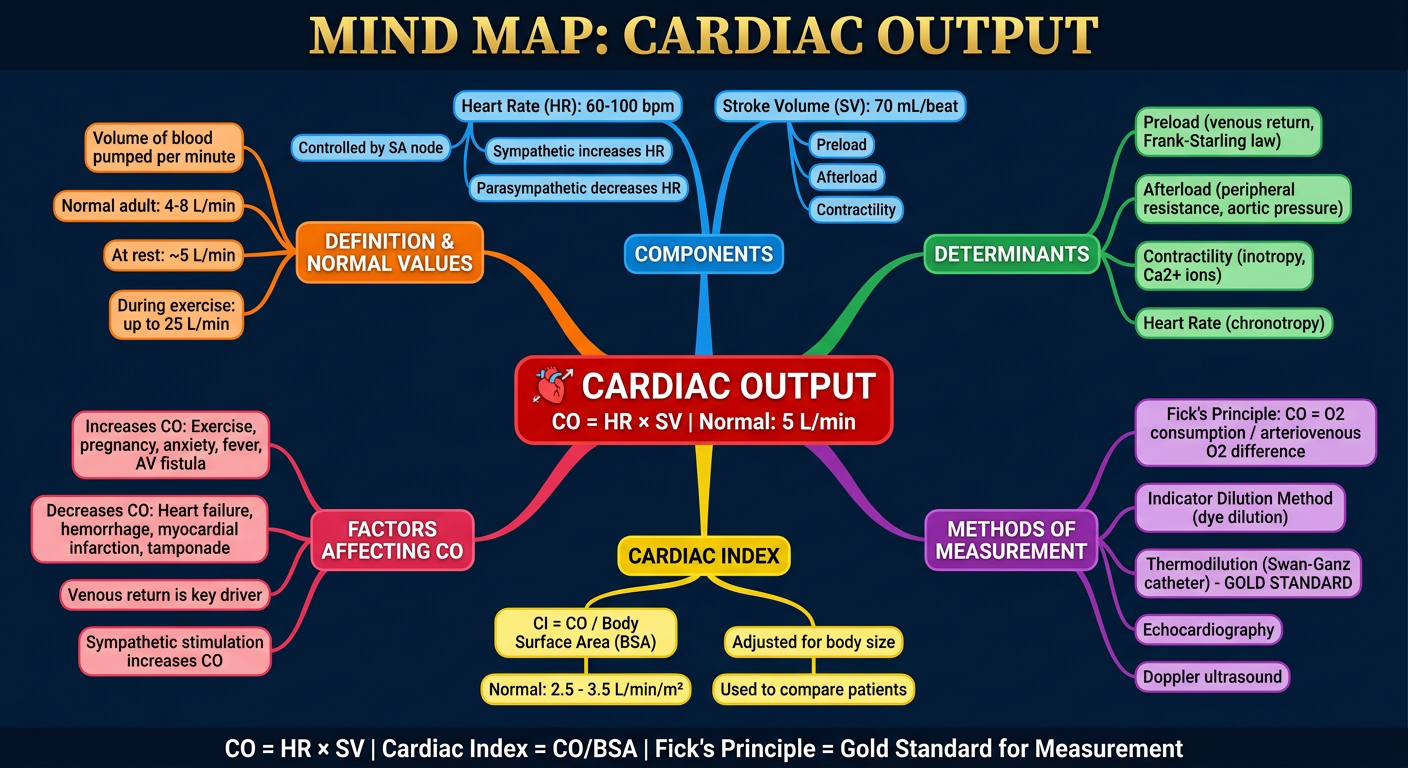
| Branch | Key Point |
|---|---|
| 🟠 Definition | CO = HR × SV, normal ~5 L/min at rest |
| 🔵 Components | HR (60-100 bpm) + SV (70 mL/beat) |
| 🟢 Determinants | Preload, Afterload, Contractility, HR |
| 🟣 Measurement | Fick's Principle, Thermodilution (gold standard) |
| 🟡 Cardiac Index | CO ÷ Body Surface Area = 2.5-3.5 L/min/m² |
| 🔴 Factors | Exercise/pregnancy raise it; Heart failure/hemorrhage lower it |
CO = HR × SV and Cardiac Index = CO / BSA
https://youtu.be/CnWFcOJBqRk?si=RnMeYVrSKXP9dH7Y Can you explain me to simple mind map poster
A detailed, colorful medical mind map poster on a deep dark navy blue background. Title at top in bold gold text: "BLOOD PRESSURE REGULATION & HYPERTENSION" with subtitle "Ninja Nerd | Prof. Zach Murphy" Central node in the middle: bright red rounded rectangle with bold white text "BLOOD PRESSURE" and "BP = CO × TPR" below it in yellow. Small heart icon next to it. Six main branches radiating outward, each as thick colored curved lines with rounded rectangle nodes: BRANCH 1 (top-left, ORANGE): "CORE EQUATION" Sub-nodes with orange background: • BP = Cardiac Output × Total Peripheral Resistance • CO = HR × Stroke Volume • TPR = arteriolar resistance • Increase CO or TPR → raises BP BRANCH 2 (top, BLUE): "SHORT-TERM REGULATION" Sub-nodes with blue background: • Baroreceptors (carotid sinus, aortic arch) • Detects stretch → signals brainstem • Sympathetic: increases HR, vasoconstriction • Parasympathetic: decreases HR • Chemoreceptors (O2, CO2, pH) • Response: seconds to minutes BRANCH 3 (top-right, GREEN): "LONG-TERM REGULATION" Sub-nodes with green background: • RAAS System (Renin-Angiotensin-Aldosterone) • Renin → Angiotensin I → ACE → Angiotensin II • Angiotensin II: vasoconstriction + aldosterone release • Aldosterone: Na+ & water retention → increases volume • ADH (Vasopressin): water reabsorption • Kidney fluid balance = key long-term controller BRANCH 4 (right, PURPLE): "HYPERTENSION" Sub-nodes with purple background: • Definition: BP > 130/80 mmHg (persistent) • Primary (Essential): 90-95% of cases, no single cause • Secondary: identifiable cause (renal disease, hyperaldosteronism) • Risk factors: obesity, salt intake, genetics, stress, age • Silent killer - often no symptoms BRANCH 5 (bottom-right, YELLOW/GOLD): "PATHOPHYSIOLOGY" Sub-nodes with gold/dark yellow background: • Increased CO: volume overload, high HR • Increased TPR: vasoconstriction, arterial stiffness • Overactive RAAS → chronic sodium retention • Sympathetic overdrive • Endothelial dysfunction • Vascular remodeling over time BRANCH 6 (bottom-left, TEAL): "COMPLICATIONS & TREATMENT" Sub-nodes with teal background: • Complications: stroke, MI, heart failure, CKD, retinopathy • Lifestyle: low-salt diet, exercise, weight loss • Drugs: - ACE inhibitors (block Ang II formation) - ARBs (block Ang II receptors) - Beta-blockers (lower HR & CO) - Diuretics (reduce volume) - Calcium channel blockers (reduce TPR) All nodes are rounded rectangles. Each branch has thick, smooth curved connecting lines matching branch color. White bold text on all colored nodes. The layout is spacious and clear with no overlapping. Footer at bottom: "Key Formula: BP = CO × TPR | RAAS drives long-term control | Baroreceptors drive short-term control"
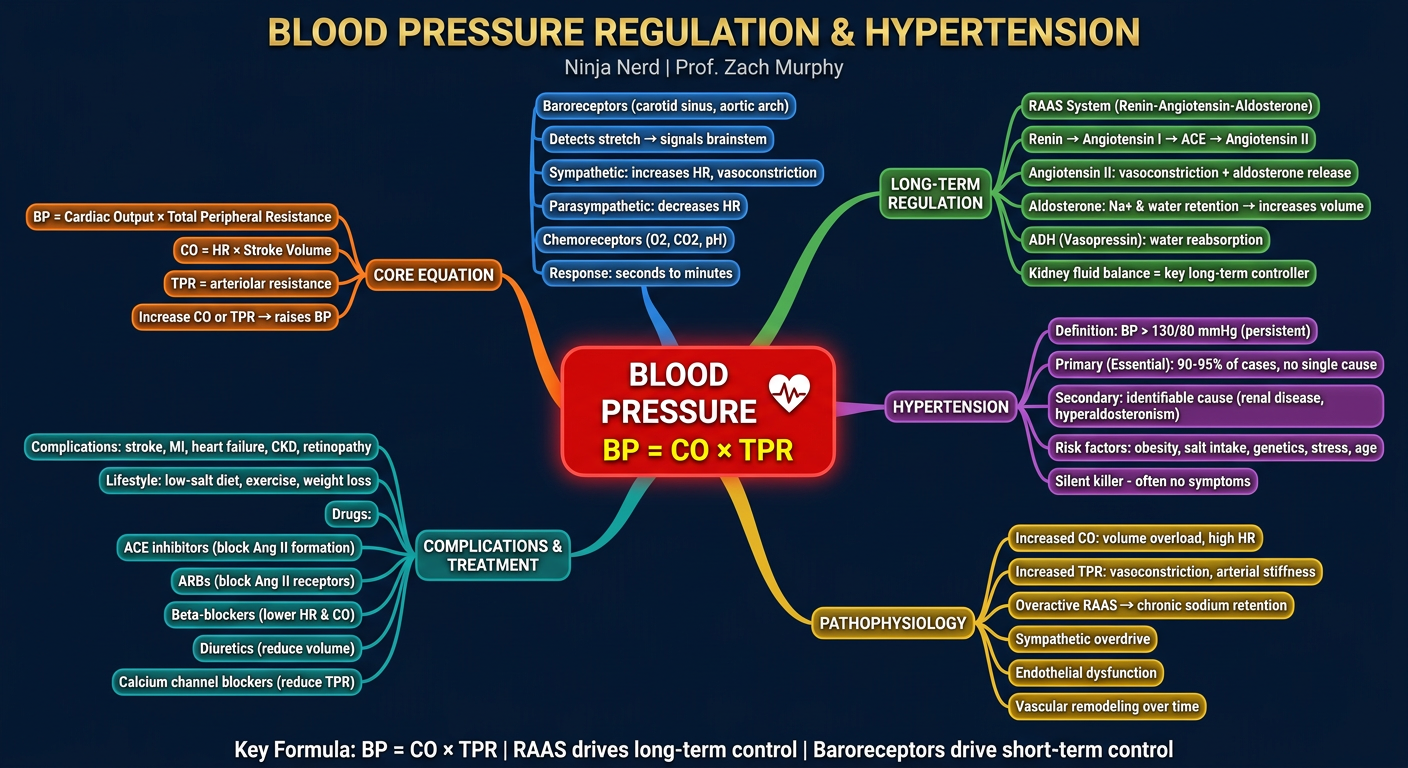
| Branch | What it covers |
|---|---|
| 🟠 Core Equation | BP = CO × TPR - the master formula |
| 🔵 Short-term Regulation | Baroreceptors + chemoreceptors (works in seconds) |
| 🟢 Long-term Regulation | RAAS system + kidneys (works over days/weeks) |
| 🟣 Hypertension | Definition, primary vs secondary, risk factors |
| 🟡 Pathophysiology | WHY BP goes up - high CO, high TPR, RAAS overactivation |
| 🔵 Complications & Treatment | Target organ damage + drug classes (ACE inhibitors, diuretics, etc.) |
BP = CO × TPR - everything in hypertension comes down to one (or both) of these being too high.
Now make simmilar mind map poster for this video too https://youtu.be/Yyz0E5CpCNQ?si=yS3hf7_vuwhkyoCN
A detailed, colorful medical mind map poster on a deep dark navy blue background. Title at top in bold gold text: "BLOOD PRESSURE REGULATION: HYPOTENSION" subtitle: "Ninja Nerd | Prof. Zach Murphy" Central node in the exact middle: bright red rounded rectangle with bold white text "HYPOTENSION" and below it "BP < 90/60 mmHg" in yellow. Small downward arrow icon next to it. Six main branches radiating outward, each as thick colored curved lines with rounded rectangle nodes, well spaced with no overlap: BRANCH 1 (top-left, ORANGE): "CORE EQUATION" Sub-nodes: • BP = CO × TPR • CO = HR × Stroke Volume • Hypotension = decreased CO or decreased TPR • OR both fall simultaneously BRANCH 2 (top-center, BLUE): "IMMEDIATE RESPONSE (seconds)" Sub-nodes: • Baroreceptors detect fall in BP • Located: carotid sinus + aortic arch • Signal to medulla (vasomotor center) • Sympathetic nervous system ACTIVATED • → Increases HR (tachycardia) • → Increases contractility (stronger beats) • → Vasoconstriction (raises TPR) • Parasympathetic tone WITHDRAWN BRANCH 3 (top-right, GREEN): "HORMONAL RESPONSE (minutes)" Sub-nodes: • Adrenal medulla releases Epinephrine + Norepinephrine • Epi: increases HR and CO • NE: powerful vasoconstriction • Both raise BP rapidly • ADH (Vasopressin) released from posterior pituitary • ADH: water retention + vasoconstriction BRANCH 4 (right, PURPLE): "RAAS ACTIVATION (hours-days)" Sub-nodes: • Low BP → kidneys sense decreased perfusion • Juxtaglomerular cells release RENIN • Renin → Angiotensin I (liver) • ACE (lungs) → Angiotensin II • Angiotensin II effects: - Vasoconstriction (raises TPR) - Aldosterone release from adrenal cortex - Aldosterone: Na+ and water retention - Increases blood volume → raises CO BRANCH 5 (bottom-right, GOLD/YELLOW): "CAUSES OF HYPOTENSION" Sub-nodes: • Hypovolemia: hemorrhage, dehydration, burns • Cardiogenic: heart failure, MI, arrhythmia • Distributive: septic shock, anaphylaxis, neurogenic • Orthostatic: standing up too fast (postural hypotension) • Medications: antihypertensives, diuretics, vasodilators BRANCH 6 (bottom-left, TEAL): "SYMPTOMS & TREATMENT" Sub-nodes: • Symptoms: dizziness, fainting, blurred vision, cold clammy skin, rapid weak pulse • Organ effects: decreased perfusion to brain, kidneys, heart • Treatment: - IV fluids (restore volume) - Vasopressors (norepinephrine, dopamine) - Treat underlying cause - Trendelenburg position (legs elevated) - Glucocorticoids (if adrenal insufficiency) All branches have thick smooth curved colored lines. All nodes are rounded rectangles with bright matching color backgrounds and bold white text. The layout is spacious, clear and well-spread with no overlapping. Footer at bottom in white: "Summary: Hypotension triggers → Baroreceptors → SNS activation + RAAS → Vasoconstriction + Volume retention → BP restored"
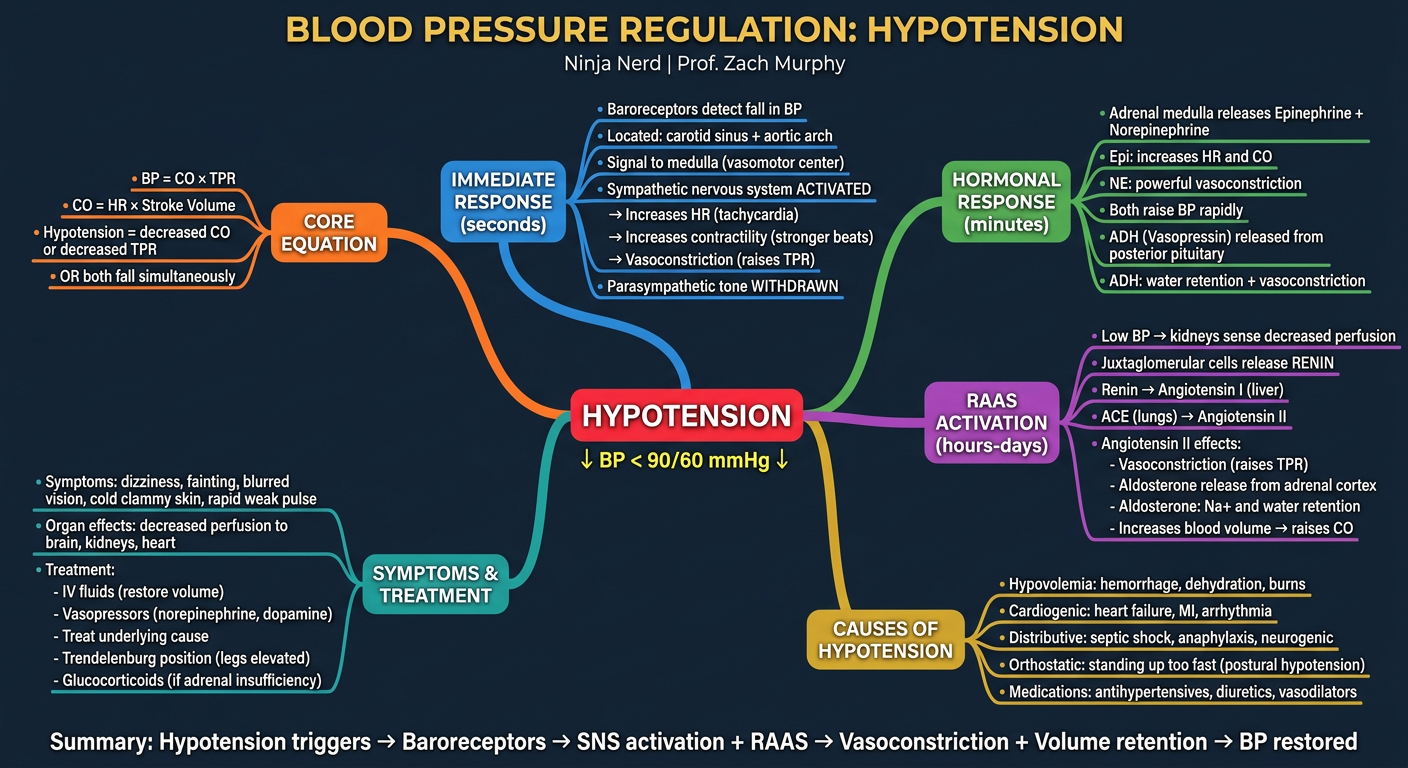
| Branch | What it covers |
|---|---|
| 🟠 Core Equation | BP = CO × TPR - hypotension = one or both fall |
| 🔵 Immediate Response | Baroreceptors → SNS activation → tachycardia + vasoconstriction (seconds) |
| 🟢 Hormonal Response | Epinephrine, Norepinephrine + ADH released (minutes) |
| 🟣 RAAS Activation | Renin → Angiotensin II → Aldosterone → fluid retention (hours-days) |
| 🟡 Causes | Hypovolemia, cardiogenic, distributive shock, orthostatic, drugs |
| 🔵 Symptoms & Treatment | Dizziness, fainting → IV fluids, vasopressors, treat cause |
Low BP → Baroreceptors detect → SNS fires → RAAS activates → Volume restored + vessels constrict → BP goes back up
Now compare those two hypertension and hypotension videos and make summary
🩺 Hypertension vs Hypotension - Ninja Nerd Comparison Summary
📐 The Master Formula (Same for Both)
BP = Cardiac Output (CO) × Total Peripheral Resistance (TPR) CO = Heart Rate × Stroke Volume
⚖️ Side-by-Side Comparison
| Feature | 🔴 HYPERTENSION | 🔵 HYPOTENSION |
|---|---|---|
| Definition | BP > 130/80 mmHg (chronic) | BP < 90/60 mmHg |
| What goes wrong | CO ↑ and/or TPR ↑ (too high) | CO ↓ and/or TPR ↓ (too low) |
| Baroreceptor response | Detects high stretch → suppresses SNS | Detects low stretch → activates SNS |
| Sympathetic NS | Overactive (drives the problem) | Activated as a rescue response |
| Heart Rate | Often elevated | Reflex tachycardia (compensation) |
| Vasoconstriction | Pathologically increased TPR | Triggered to try to raise BP |
| RAAS System | Overactivated → causes fluid overload | Activated to restore volume |
| Aldosterone | Excess → too much Na+/water retention | Released to recover lost volume |
| ADH/Vasopressin | Contributes to volume overload | Released to conserve water |
| Blood volume | Too high | Too low (usually) |
| Kidneys | Damaged long-term; also drives RAAS | Sense low perfusion → trigger RAAS |
| End-organ damage | Stroke, MI, heart failure, CKD, retinopathy | Brain hypoperfusion, AKI, cardiac ischemia |
| Timeline of problem | Chronic (develops over years) | Acute (happens in minutes-hours) |
🔁 Regulatory Mechanisms - Compared
Short-term (seconds)
| Hypertension | Hypotension | |
|---|---|---|
| Baroreceptors | Detect HIGH pressure → try to inhibit SNS (but fails chronically) | Detect LOW pressure → fire up SNS immediately |
| Result | SNS remains overactive despite feedback | HR ↑, contractility ↑, vasoconstriction ↑ |
Long-term (hours to days)
| Hypertension | Hypotension | |
|---|---|---|
| RAAS | Chronically activated → self-perpetuating cycle | Acutely activated → corrective mechanism |
| Angiotensin II | Causes persistent vasoconstriction + aldosterone | Causes temporary vasoconstriction + volume rescue |
| Fluid balance | Too much Na+/water retained | Na+/water retention is the fix |
🧪 Causes Compared
| Hypertension | Hypotension |
|---|---|
| Primary (essential) - 90-95%, unknown | Hypovolemia (bleeding, dehydration, burns) |
| Renal disease (secondary) | Cardiogenic (heart failure, MI) |
| Hyperaldosteronism | Distributive (sepsis, anaphylaxis, neurogenic) |
| Obesity, high salt diet, stress, genetics | Orthostatic (standing up quickly) |
| Medications (e.g. steroids, NSAIDs) | Medications (antihypertensives, diuretics) |
💊 Treatment Compared
| Hypertension | Hypotension |
|---|---|
| ACE inhibitors (block Ang II) | IV fluids (restore volume) |
| ARBs (block Ang II receptor) | Vasopressors (norepinephrine, dopamine) |
| Beta-blockers (lower HR & CO) | Epinephrine (anaphylaxis) |
| Diuretics (reduce blood volume) | Trendelenburg position (legs elevated) |
| Calcium channel blockers (reduce TPR) | Treat underlying cause |
| Lifestyle: low salt, exercise, weight loss | Glucocorticoids (if adrenal cause) |
🧠 The Big Picture - One Sentence Each
- Hypertension: The BP regulation system gets chronically stuck in "too much" mode - too much volume, too much vasoconstriction, too much RAAS activity.
- Hypotension: BP suddenly drops, and the body throws every short-term and long-term tool it has (SNS, catecholamines, RAAS, ADH) at the problem to pull it back up.
🔑 Exam Memory Trick
HIGH BP (Hypertension)  →  Everything is TOO much, TOO long
LOW BP (Hypotension)    →  Body goes into RESCUE MODE, fast
Both use the SAME tools (RAAS, SNS, baroreceptors) -
just in OPPOSITE directions!
Create a comparison poster of Hypertension vs Hypotension
A professional, visually striking medical comparison poster on a deep dark navy blue background. TOP HEADER: Bold gold title "HYPERTENSION vs HYPOTENSION" centered, subtitle below in white "Blood Pressure Regulation | Ninja Nerd Series | Prof. Zach Murphy" CENTER: A vertical dividing line in bright white/gold. At the very center top, a bold white label "BP = CO × TPR" inside a gold rounded rectangle - this is shared by both sides. LEFT HALF (RED theme - Hypertension): - Large header at top-left: "🔴 HYPERTENSION" in bold red text on dark red banner - Subheader: "BP > 130/80 mmHg - TOO HIGH" - Red upward arrow icon Sections stacked vertically with red rounded rectangle boxes: BOX 1 - "WHAT GOES WRONG": • CO ↑ and/or TPR ↑ • System stuck in "TOO MUCH" mode • Chronic problem (years) BOX 2 - "BARORECEPTORS": • Detect HIGH pressure • Try to suppress SNS - fails chronically • Feedback loop broken BOX 3 - "RAAS": • Chronically overactivated • Angiotensin II: persistent vasoconstriction • Aldosterone: excess Na+/water retention • Self-perpetuating vicious cycle BOX 4 - "CAUSES": • Primary/Essential: 90-95% (unknown) • Secondary: renal disease, hyperaldosteronism • Obesity, high salt, stress, genetics BOX 5 - "SYMPTOMS": • Often silent (silent killer) • Headache, blurred vision • Chronic end-organ damage BOX 6 - "END-ORGAN DAMAGE": • Stroke, MI, Heart Failure • Chronic Kidney Disease • Retinopathy BOX 7 - "TREATMENT" (red-orange): • ACE Inhibitors / ARBs • Beta-blockers (lower HR) • Diuretics (reduce volume) • Calcium channel blockers • Low salt diet, exercise RIGHT HALF (BLUE theme - Hypotension): - Large header at top-right: "🔵 HYPOTENSION" in bold blue text on dark blue banner - Subheader: "BP < 90/60 mmHg - TOO LOW" - Blue downward arrow icon Sections stacked vertically with blue rounded rectangle boxes: BOX 1 - "WHAT GOES WRONG": • CO ↓ and/or TPR ↓ • Body enters RESCUE MODE • Acute problem (minutes-hours) BOX 2 - "BARORECEPTORS": • Detect LOW pressure • Immediately fire up SNS • Reflex tachycardia + vasoconstriction BOX 3 - "RAAS": • Acutely activated as rescue • Angiotensin II: temporary vasoconstriction • Aldosterone: Na+/water retention to restore volume • ADH released: water conservation BOX 4 - "CAUSES": • Hypovolemia: bleeding, dehydration, burns • Cardiogenic: heart failure, MI • Distributive: sepsis, anaphylaxis • Orthostatic: sudden standing BOX 5 - "SYMPTOMS": • Dizziness, fainting, syncope • Cold clammy skin, rapid weak pulse • Blurred vision, confusion BOX 6 - "END-ORGAN EFFECTS": • Brain hypoperfusion (syncope) • Acute Kidney Injury • Cardiac ischemia BOX 7 - "TREATMENT" (blue-teal): • IV Fluids (restore volume) • Vasopressors (norepinephrine) • Epinephrine (anaphylaxis) • Trendelenburg position • Treat underlying cause BOTTOM FOOTER BANNER (gold background, dark text): "🔑 KEY INSIGHT: Both use the SAME tools (RAAS, SNS, Baroreceptors) in OPPOSITE directions | Hypertension = Everything TOO MUCH, TOO LONG | Hypotension = Body in RESCUE MODE, FAST" The poster is clean, well-organized, two-column layout, all text in bold white on colored boxes, professional medical education style. No overlapping. Adequate spacing between all boxes.
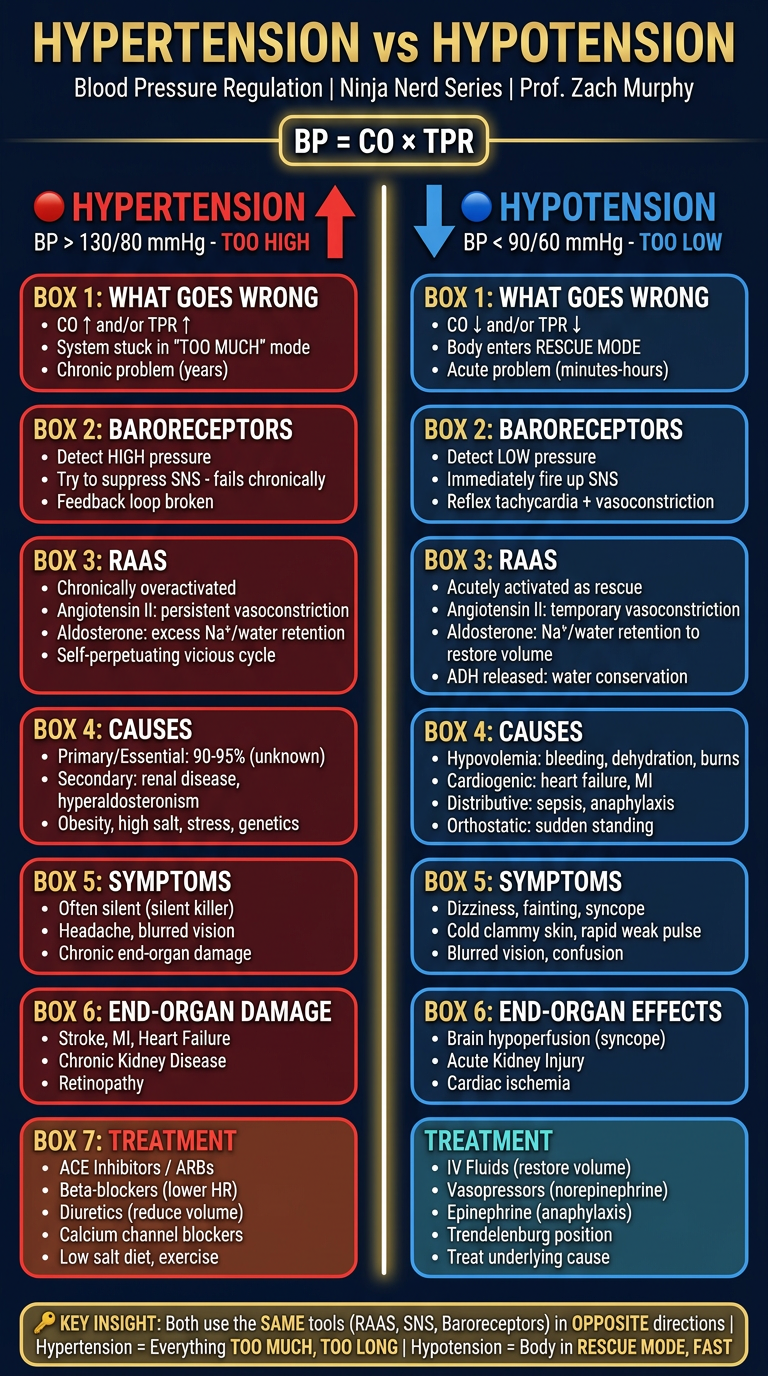
| Section | 🔴 Hypertension | 🔵 Hypotension |
|---|---|---|
| Definition | BP > 130/80 | BP < 90/60 |
| Problem | Everything TOO much, TOO long | Body in RESCUE MODE |
| Baroreceptors | Feedback broken | Immediately fire up SNS |
| RAAS | Chronically overactive | Acutely activated to save BP |
| Causes | Silent, lifestyle, genetics | Bleeding, shock, sepsis |
| Symptoms | Silent killer → organ damage | Dizzy, fainting, cold skin |
| Treatment | ACE inhibitors, diuretics, lifestyle | IV fluids, vasopressors |
Both conditions use the same tools (RAAS, SNS, baroreceptors) - just in opposite directions!