
Auditory pathway in detail according to standard ent textbook textbook
Reading File
Now let me search the library for auditory pathway content in ENT textbooks.
Finding Sources
Finding Sources
I have two ENT textbooks: Cummings Otolaryngology and K.J. Lee's Essential Otolaryngology. Let me search both, plus search for relevant headings.
Finding Sources
Finding Sources
Finding Sources
Excellent! I found the key sections. Now let me read the core auditory pathway content from Cummings (block28) - which has CENTRAL AUDITORY PATHWAYS, AUDITORY NERVE, Cochlear Nerve, and Auditory Cortex - and from K.J. Lee's.
Reading File
Reading File
Let me read more of the Cummings block28 content covering the cochlear nucleus, superior olivary complex, inferior colliculus, medial geniculate, and auditory cortex sections:
Reading File
Reading File
Good. Now let me read more of the Cummings block28, particularly the Superior Olivary Complex, Lateral Lemniscus, Inferior Colliculus, Medial Geniculate, and Auditory Cortex sections:
Reading File
Reading File
Now let me fetch the auditory pathway diagram from Cummings and also read the AUDITORY NERVE and Medial Geniculate sections:
Loading Image
Reading File
I now have all the key content. Let me also read the AUDITORY NERVE section and the efferent system section from Cummings:
Reading File
I now have comprehensive content from Cummings Otolaryngology. Let me compile the full detailed answer:
Auditory Pathway - Detailed Account
Based on Cummings Otolaryngology Head and Neck Surgery & K.J. Lee's Essential Otolaryngology
Overview
The auditory pathway encompasses all ascending (afferent) and descending (efferent) neuronal projections interconnecting the auditory nerve, brainstem, midbrain, thalamus, and cerebral cortex. Sound enters as acoustic energy, is transduced by the cochlea, and is relayed through several sequential synaptic stations before reaching conscious perception in the auditory cortex.
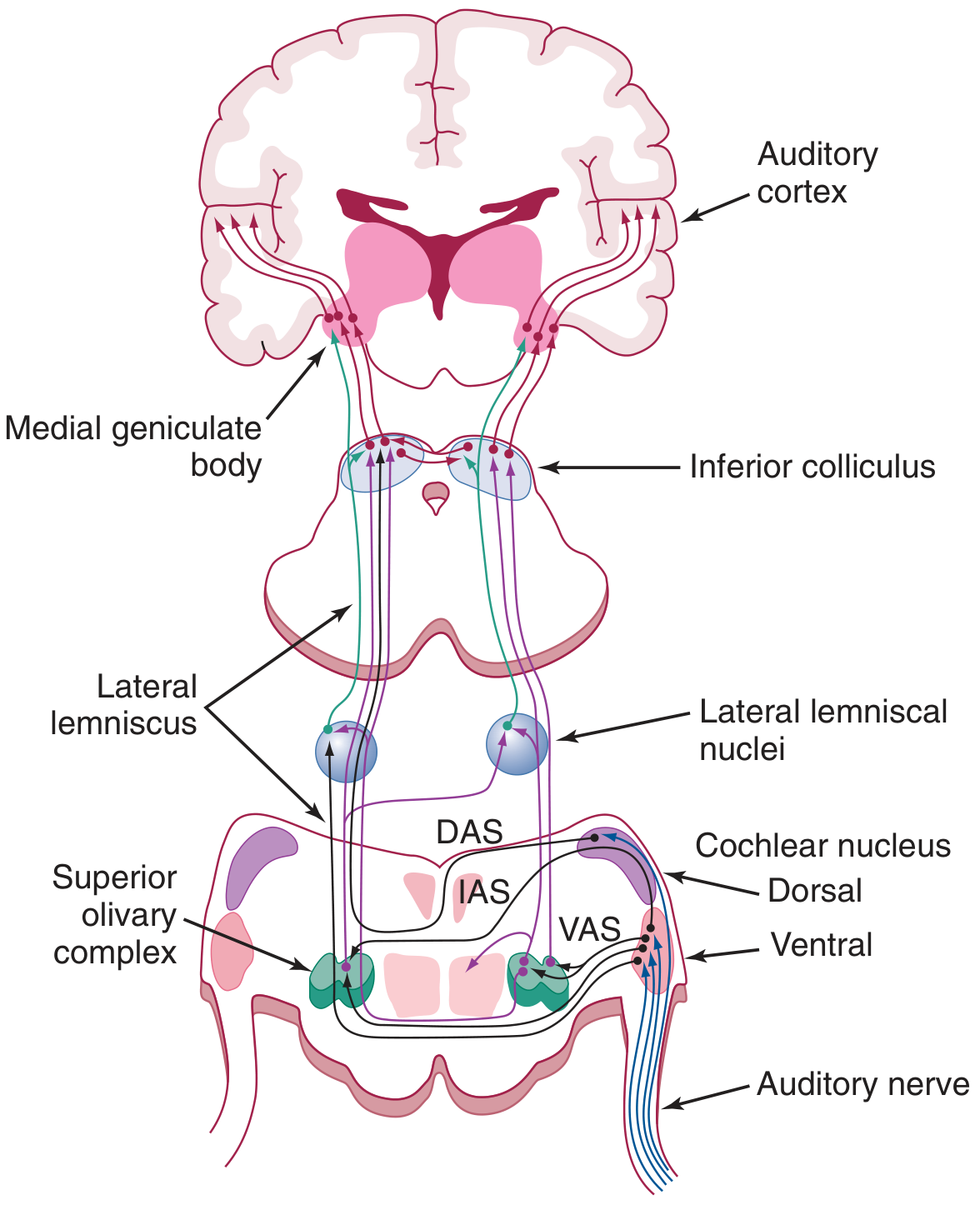
Fig. 127.6 from Cummings: Illustration of the major central ascending auditory pathways for sound entering via the right cochlea. DAS = Dorsal acoustic stria; IAS = Intermediate acoustic stria; VAS = Ventral acoustic stria.
1. Peripheral Component: From Sound to Neural Signal
Outer Ear
- The pinna collects and funnels sound waves into the external auditory canal (~2.5 cm long, resonance frequency ~2700 Hz for 2000-5500 Hz range).
- The pinna contributes to sound localization, especially in the vertical plane, and amplifies high-frequency sounds.
Middle Ear (Conductive Pathway)
- Sound waves set the tympanic membrane vibrating. Vibration travels through the ossicular chain (malleus - incus - stapes) to the oval window.
- The middle ear functions as an impedance-matching transformer, converting air-medium acoustic energy to fluid-medium (cochlear perilymph) energy, minimizing energy loss.
- Key mechanisms: area ratio of tympanic membrane (~55 mm² effective area) to stapes footplate (~3.2 mm²) gives a ~17:1 pressure amplification.
- Most efficient transmission: 500-3000 Hz (the speech range).
Inner Ear: Cochlear Transduction
- Movement of the stapes footplate at the oval window creates pressure waves in cochlear perilymph.
- The basilar membrane shows tonotopic frequency separation: high frequencies at the base, low frequencies at the apex.
- Outer hair cells (OHCs) electromotility amplifies basilar membrane motion (active cochlear amplifier).
- Inner hair cells (IHCs) are the primary sensory transducers: deflection of stereocilia opens mechanically gated ion channels, causing K⁺ influx, depolarization, and glutamate release at the afferent synapse.
2. First-Order Neurons: The Auditory (Cochlear) Nerve
Spiral Ganglion Cells
- Bipolar neurons; cell bodies lie in the Rosenthal canal of the modiolus.
- Humans have approximately 30,000 spiral ganglion cells.
- Type I (90%): Myelinated; each sends a single peripheral process forming a single synapse with a single IHC. Each IHC is thus innervated by multiple type I cells.
- Classified by spontaneous discharge rate: high (>18 spikes/s), medium (0.5-18 spikes/s), low (≤0.5 spikes/s).
- High spontaneous rate neurons have larger axon diameter.
- Type II (10%): Unmyelinated; each sends a peripheral process to synapse with multiple OHCs.
Course of the Cochlear Nerve in the IAC
- At the lateral fundus of the IAC: cochlear nerve lies anteroinferiorly, separated from the facial nerve superiorly by the transverse (falciform) crest.
- At the medial porus acousticus: the cochlear and vestibular nerves rotate ~90°; cochlear nerve lies inferior to the vestibular trunk at the porus.
- Myelin transitions from peripheral Schwann cell myelin to central oligodendrocyte myelin in the cerebellopontine angle (CPA). This transition zone is the traditional (though recently debated) site of acoustic neuroma origin.
- The cochleovestibular nerve enters the CNS at the pontomedullary junction (foramen of Luschka / lateral recess of 4th ventricle = site of auditory brainstem implant placement).
- Efferent note: Olivocochlear efferent fibers do NOT travel with the cochlear nerve - they travel with the inferior vestibular nerve, passing through the saccular ganglion and entering the spiral ganglion via the vestibulocochlear anastomosis of Oort.
3. Second-Order Neurons: Cochlear Nucleus (CN)
Location: Floor of the lateral recess of the 4th ventricle, pontomedullary junction.
All peripheral auditory information enters the CNS through the cochlear nucleus - it is the first central auditory center.
Subdivisions:
Dorsal Cochlear Nucleus (DCN)
- Laminar (cerebellar-like) organization
- Cell types: fusiform cells and giant cells
- Less prominent in humans (vs. mammals with mobile pinnae)
- Functions: sound source orientation (azimuthal localization), spectral shape coding
- Tonotopic: low frequencies ventrolateral, high frequencies dorsomedial
- Implicated as a potential site of tinnitus generation
Ventral Cochlear Nucleus (VCN)
- Anterior VCN (AVCN): Spherical bushy cells; large axons projecting to the olivary complex; important for sound localization (timing cues).
- Posterior VCN (PVCN): Multipolar/stellate cells (fine axons to multiple centers) and octopus cells; encode frequency, spectral shape, and sound intensity.
Output Projections via Three Acoustic Striae:
The cochlear nucleus axons project via three fiber bundles:
| Stria | Fibers | Destinations |
|---|---|---|
| Ventral acoustic stria (VAS) = Trapezoid body | Spherical and globular bushy cells | LSO, MSO, medial nucleus of trapezoid body (MNTB), inferior colliculus |
| Intermediate acoustic stria (IAS) | Octopus cells | Ventral nucleus of trapezoid body, LSO, periolivary region |
| Dorsal acoustic stria (DAS) | DCN fusiform and giant cells | Contralateral central nucleus of inferior colliculus |
4. Superior Olivary Complex (SOC)
Location: Pons (upper medullary-pontine junction)
The SOC is the first center to receive binaural input - it receives convergent input from both cochlear nuclei, making it the critical site for sound localization.
Key Subdivisions:
- Medial Superior Olive (MSO): Detects interaural time differences (ITDs) - used for low-frequency sound localization (left-right discrimination).
- Lateral Superior Olive (LSO): Detects interaural level (intensity) differences (ILDs) - used for high-frequency sound localization.
- Medial Nucleus of the Trapezoid Body (MNTB): Relay nucleus connecting contralateral AVCN to ipsilateral LSO; contains glycinergic neurons providing inhibitory input critical to ILD computation.
SOC Projections:
- Ascending (afferent limb): Fibers project via the lateral lemniscus to the nucleus of the lateral lemniscus and inferior colliculus.
- Descending (efferent limb): Gives rise to the olivocochlear bundle (OCB) - feedback to cochlear nucleus and to the cochlea itself.
The SOC plays an important role in improving signal-to-noise ratio and hearing in noise.
5. Lateral Lemniscus
The lateral lemniscus is the principal ascending auditory tract from the brainstem to the inferior colliculus (runs through the pons and midbrain).
- Two associated nuclei: ventral nucleus (VNLL) and dorsal nucleus (DNLL) of the lateral lemniscus.
- Receive input from ipsilateral and contralateral cochlear nuclei and SOC subdivisions.
- Most fibers terminate in the central nucleus of the inferior colliculus.
- Minor tracts ascend to the superior colliculus and descend back to the SOC and trapezoid body.
- The DNLL sends commissural fibers to the contralateral lateral lemniscus.
- Important for the acoustic startle reflex pathway (via ventral cochlear nucleus).
- Correlates with ABR waves III-V interval.
6. Inferior Colliculus (IC)
Location: Midbrain tectum (dorsal)
The inferior colliculus is a major synaptic convergence center - almost all ascending and descending auditory pathways between brainstem and forebrain synapse here. Principal functions: sound localization, frequency determination, integration with nonauditory systems.
Three Principal Neuronal Groups:
1. Central nucleus of the IC (ICC) - Dominant region
- Well-conserved across species
- Laminar, tonotopic organization
- Receives three types of projections:
- Direct monaural input from the contralateral cochlear nucleus
- Indirect binaural input via the SOC
- Polysynaptic input: cochlear nuclei → SOC → lateral lemniscus → IC
2. Cortex (shell) of the IC
- Laminar (typically 4 layers)
- Primarily receives descending projections from primary and secondary auditory cortex
- Few ascending fibers from cochlear nuclei
3. Paracentral nuclei of the IC
- Receive nonauditory (somatosensory) innervation
- Integration of multisensory inputs
The IC also interacts with the superior colliculus (saccadic eye movements, auditory orienting). All subnuclei of the IC send ascending fibers to the medial geniculate body.
7. Medial Geniculate Body (MGB)
Location: Posterior thalamus (metathalamus)
The MGB is the thalamic relay station - the portal for all ascending auditory innervation to the telencephalon.
Three Divisions:
Ventral Division (MGBv)
- Pars lateralis: Dominant, laminar, bushy cells; projects to layers III and IV of the auditory cortex; tonotopically organized.
- Pars ovoidea and Marginal zone: Less distinct lamination.
Dorsal Division (MGBd)
- Heterogeneous region with ~10 subnuclei (dorsal, superficial dorsal, deep dorsal, suprageniculate, posterior limitans nuclei, etc.)
- Inputs from inferior colliculus and other thalamic nuclei
- Auditory and nonauditory connections; plays a role in attentional modulation of acoustic stimuli.
Medial Division (MGBm)
- Contains some of the largest neurons in the geniculate body
- Projects to all auditory cortical regions and many nonauditory centers
- Receives input from vestibular nuclei and spinal cord
- Important for arousal responses to auditory stimuli
8. Auditory Cortex
Location: Deep within the Sylvian fissure, superior surface of the temporal lobe, within the transverse gyri of Heschl; in continuity with the posterior superior temporal gyrus.
The auditory cortex is tonotopically organized and structurally layered (layers I-VI).
Key Cortical Areas:
| Area | Brodmann Area | Function |
|---|---|---|
| Primary auditory cortex (AI) | Area 41 (Heschl's gyrus) | Primary auditory perception, tonotopic map |
| Secondary auditory cortex (AII) | Area 42 | Further auditory processing |
| Anterior auditory field (AAF/A) | - | Complex auditory processing |
| Ventral auditory field (V) | - | Processing auditory information |
| Ventral posterior auditory field (VP) | - | Higher processing |
| Posterior auditory field (P) | - | Directional hearing |
Association Areas:
- Wernicke's area (left area 22, posterior superior temporal gyrus + planum temporale): Receptive language; left hemisphere dominant in most humans.
- Angular gyrus and supramarginal gyrus (areas 39 and 40, inferior parietal lobe): Integrate auditory, somatosensory, and visual information; higher language functions (reading, writing); also implicated in tinnitus perception.
- Broca's area (areas 44-45, inferior frontal gyrus / pars triangularis): Expressive language and musical syntax; connected to Wernicke's area via the arcuate fasciculus; left hemisphere dominant.
Descending Projections from Auditory Cortex:
- Reciprocal (corticofugal) projections descend to:
- Medial geniculate body (thalamus)
- Inferior colliculus
- SOC
- Cochlear nuclei (modulating ascending input)
- These feedback loops modulate and refine afferent auditory processing.
9. Efferent Auditory System (Olivocochlear Bundle)
- Originates from neurons in and around the superior olivary complex.
- Travels (mainly with the inferior vestibular nerve, not the cochlear nerve) to the cochlea.
- Passes through the saccular ganglion → spiral ganglion via the anastomosis of Oort.
- Direct innervation: OHCs (direct synaptic contact with outer hair cells).
- Indirect modulation: IHCs (via modification of afferent dendrites).
- Functions: protects against acoustic trauma, improves detection of signals in noise, modulates auditory sensitivity.
Summary: Ascending Auditory Pathway (Station by Station)
Cochlea (IHC/spiral ganglion)
       ↓  [Cochlear nerve / CN VIII]
Cochlear Nucleus (CN) - dorsal & ventral divisions
       ↓  [Via DAS, IAS, VAS]
Superior Olivary Complex (SOC) - first binaural center
       ↓  [Via Lateral Lemniscus]
Nucleus of Lateral Lemniscus
       ↓
Inferior Colliculus (IC) - midbrain relay
       ↓  [Via brachium of inferior colliculus]
Medial Geniculate Body (MGB) - thalamic relay
       ↓  [Via auditory radiations / internal capsule]
Primary Auditory Cortex (AI, Brodmann area 41)
       ↓
Association Cortex (Wernicke's, Angular gyrus, Broca's)
Key Features to Remember:
- Tonotopic organization is maintained at every level.
- Decussation (crossing) occurs at multiple levels - the auditory pathway is predominantly crossed but also has significant ipsilateral representation, which is why unilateral cortical lesions rarely cause complete deafness.
- Each cochlear nucleus sends fibers bilaterally.
- Sound localization begins at the SOC (ITD at MSO, ILD at LSO).
- The inferior colliculus is the obligatory relay for almost all auditory signals.
- ABR waves correspond to: Wave I = CN VIII, Wave II = cochlear nucleus, Wave III = SOC, Waves IV-V = lateral lemniscus/inferior colliculus.
Sources: Cummings Otolaryngology Head and Neck Surgery (Chapter 127 & 128); K.J. Lee's Essential Otolaryngology (Chapter 14)
This is a shared conversation. Sign in to Orris to start your own chat.