
Diagnosis and management of endocrine disruptors induced disease
"endocrine disruptors"[MeSH Terms] AND diagnosis AND management
"endocrine disrupting chemicals"[MeSH Terms] AND "reproductive disorders"
endocrine disruptors mechanisms hormone interference diagram
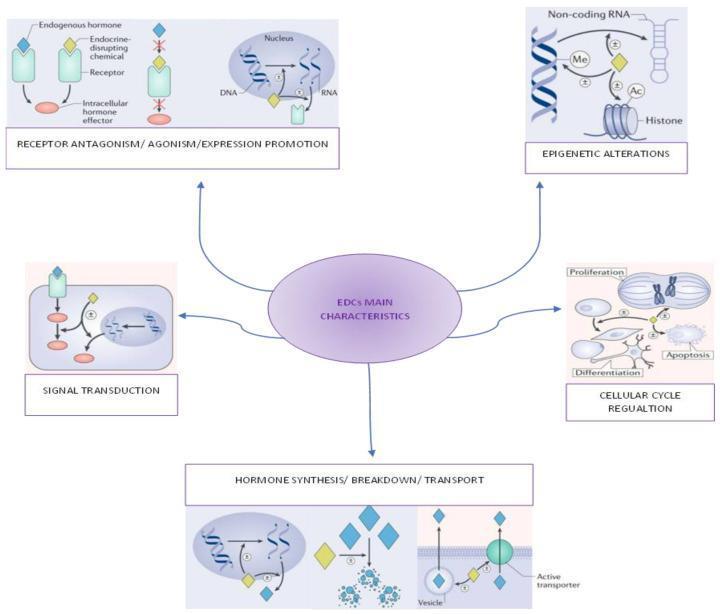
This pathophysiology diagram summarizes the main characteristics and mechanisms of Endocrine-Disrupting Chemicals (EDCs). The central oval, titled 'EDCs MAIN CHARACTERISTICS', connects to five thematic modules illustrating how EDCs interfere with biological processes. 1) 'RECEPTOR ANTAGONISM/AGONISM/EXPRESSION PROMOTION' depicts EDCs (yellow diamonds) competing with endogenous hormones (blue diamonds) for receptor binding and influencing nuclear transcription. 2) 'SIGNAL TRANSDUCTION' shows the disruption of intracellular signaling cascades. 3) 'EPIGENETIC ALTERATIONS' illustrates interference with DNA methylation (Me), histone acetylation (Ac), and non-coding RNA pathways. 4) 'CELLULAR CYCLE REGULATION' demonstrates EDCs influencing cell proliferation, differentiation, and apoptosis. 5) 'HORMONE SYNTHESIS/BREAKDOWN/TRANSPORT' highlights effects on hormone metabolic pathways, vesicular transport, and active transport across cell membranes. The diagram uses '+' and '-' symbols to indicate stimulatory or inhibitory effects on these processes, providing a comprehensive overview of endocrine toxicology and endocrine system signaling disruption.
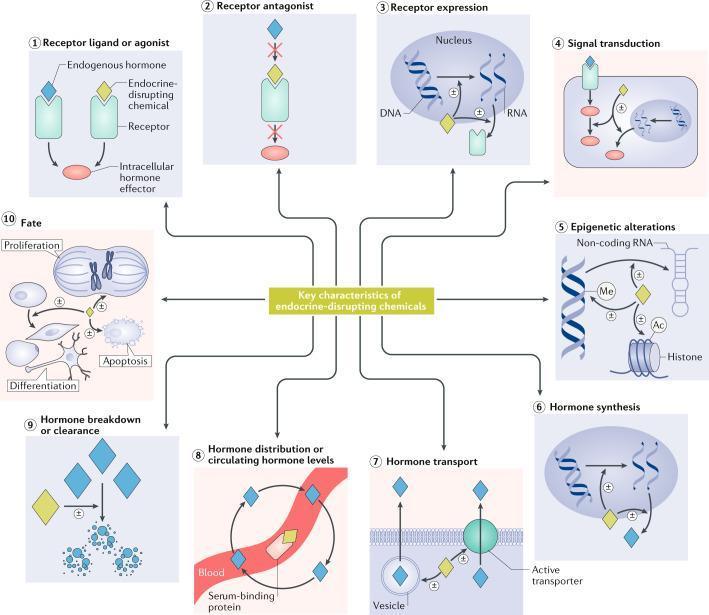
A multi-panel medical infographic illustrating the ten key characteristics (KCs) of endocrine-disrupting chemicals (EDCs). The diagram uses a central hub-and-spoke model to detail how EDCs interfere with endogenous hormone systems through various biological mechanisms. Visible pathways include: 1) Receptor agonism, where EDCs mimic endogenous hormones; 2) Receptor antagonism, where EDCs block binding; 3) Alteration of receptor expression via DNA/RNA modulation; 4) Interference with signal transduction pathways; 5) Induction of epigenetic alterations such as DNA methylation (Me), histone acetylation (Ac), and non-coding RNA changes; 6) Modification of hormone synthesis; 7) Alteration of cellular hormone transport and vesicle dynamics; 8) Interference with hormone distribution, serum-binding proteins, and circulating levels; 9) Modification of hormone metabolism, breakdown, or clearance; and 10) Alteration of cell fate, including impacts on proliferation, differentiation, and apoptosis. The +/- symbols denote that EDCs can either amplify or attenuate these physiological processes. This educational visual is designed for endocrinology and toxicology studies, detailing the systemic mechanisms of chemical-induced endocrine disruption.
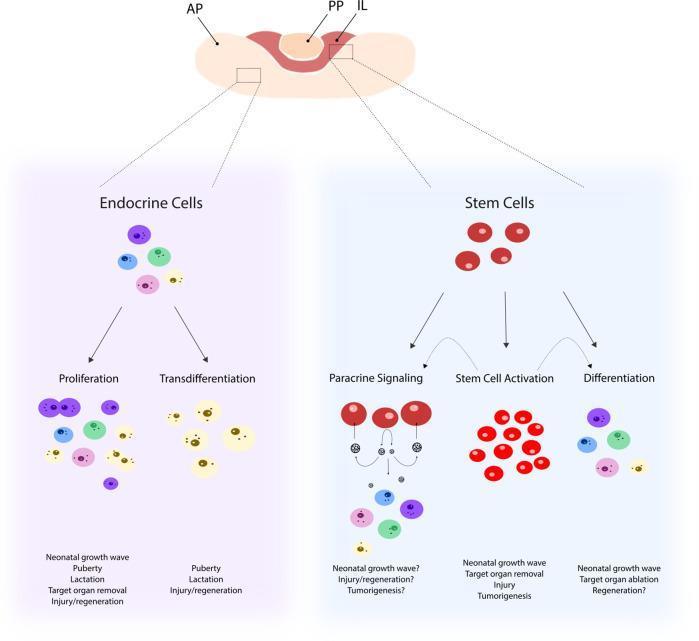
This medical pathophysiology diagram illustrates the cellular mechanisms underlying the remodeling of the pituitary gland landscape. At the top, a cross-section of the pituitary gland is shown with labels for the anterior pituitary (AP), posterior pituitary (PP), and intermediate lobe (IL). The diagram branches into two main pathways: Endocrine Cells and Stem Cells. The Endocrine Cells section demonstrates two modulation pathways: Proliferation (increase in cell number) and Transdifferentiation (transformation into different endocrine cell types), influenced by triggers like puberty, lactation, and injury. The Stem Cells section depicts three potential fates: Paracrine Signaling (releasing signals to surrounding cells), Stem Cell Activation (multiplication and upregulation of stemness), and Differentiation (maturation into specialized endocrine cells). These processes are linked to physiological and pathological states including the neonatal growth wave, target organ removal, tumorigenesis, and tissue regeneration. The illustration uses color-coded circles to represent various differentiated hormone-producing cells and red circles for undifferentiated stem cells.
endocrine disruptors clinical management diagnosis guidelines 2024 2025
Endocrine Disruptors: Diagnosis and Management of Induced Disease
1. Definition and Mechanistic Overview
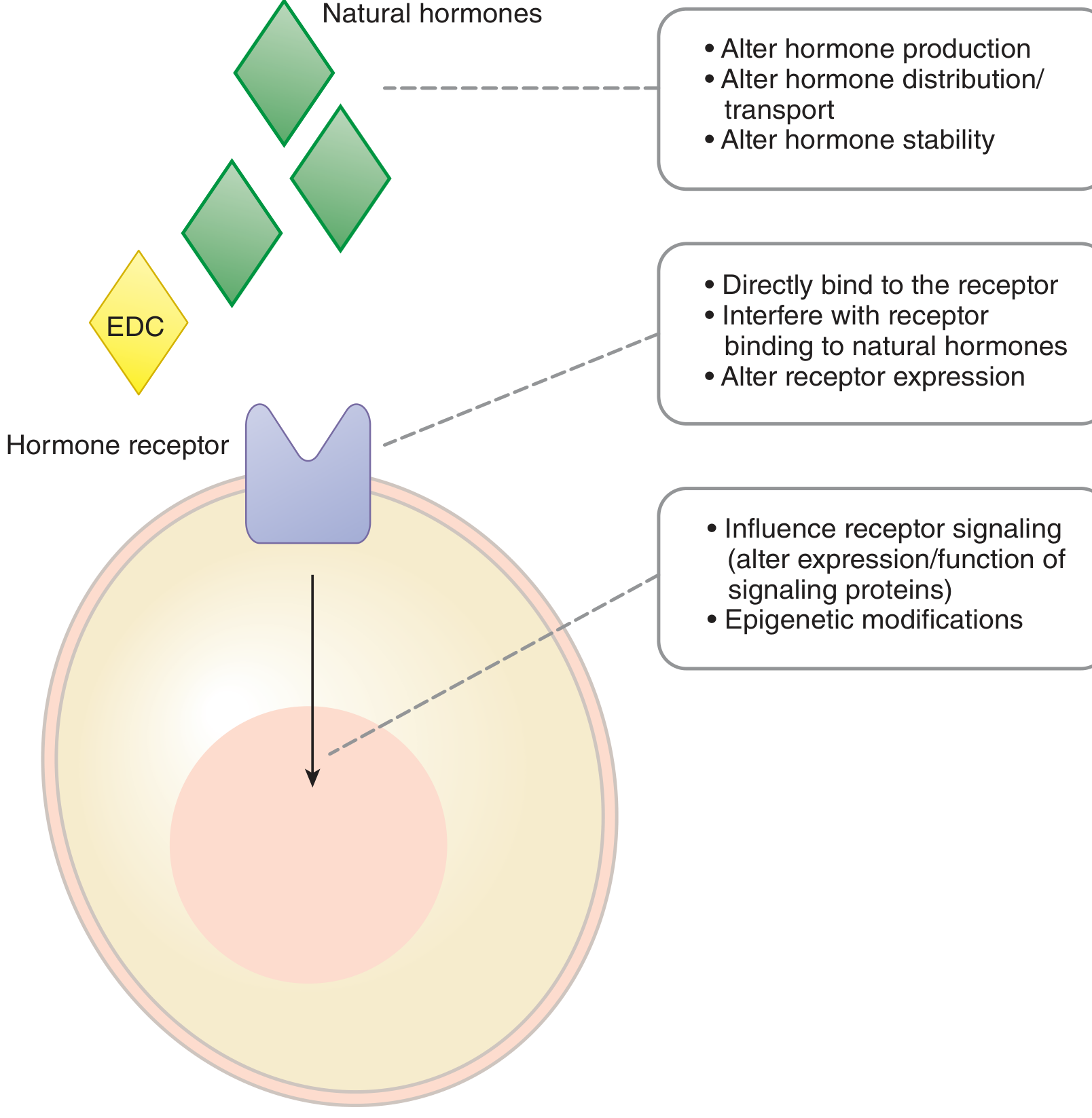
Key Mechanisms
| Mechanism | Action |
|---|---|
| Receptor agonism/antagonism | Mimic or block estrogen (ER), androgen (AR), thyroid hormone (TR) receptors |
| Altered hormone production | Disrupt synthesis, secretion, metabolism of endogenous hormones |
| Hormone transport disruption | Compete with serum-binding proteins; alter circulating hormone levels |
| Epigenetic modification | DNA methylation, histone acetylation, non-coding RNA alterations |
| Signal transduction interference | MAPK, NF-kB, PI3K/Akt pathway disruption |
| Immunomodulation | Secondary disruption via AhR activation (dioxins/TCDD) |
2. Major EDC Classes, Sources, and Target Systems
A. DDT and Organochlorines
- Source: Persistent organochlorine pesticide; still detectable in food chains worldwide despite bans (US ban 1972). Primary exposure route today: ingestion of contaminated food.
- Pharmacokinetics: Highly lipophilic; bioaccumulates in adipose tissue; primary metabolite DDE persists for decades.
- Mechanism: The o,p'-DDT isomer acts as an ERα/ERβ agonist; the p,p'-DDE metabolite is an AR antagonist; DDT also positively modulates FSHR downstream signaling.
- Health effects:
- Reproductive: increased risk of spontaneous abortion, preterm birth, decreased fertility
- Developmental: altered sexual development in males (decreased reproductive tissue weights), increased uterine weight and decreased estradiol in females
- Metabolic: developmental exposure linked to type 2 diabetes, obesity, liver cancer in later life
- Mild effects on thyroid function (T3, T4, TSH) in some studies
B. Phthalates
- Source: Ubiquitous plasticizers in PVC plastics, food packaging, personal care products, cosmetics, medical tubing. Exposure via ingestion (animal fats, dairy, cooking oils in plastic wrap), inhalation, dermal absorption; crosses the placental barrier.
- Mechanism: Modulate hormone levels; alter AR, ER, and PPAR signaling by mimicking the steroid A ring; affect MAPK, NF-kB, PI3K/Akt pathways. High-dose exposure upregulates FSHR, GnRH, LHR; low-dose exposure downregulates them (non-monotonic response).
- ADME: Plasma half-life <24 hours; metabolites measurable in urine as biomarkers.
- Health effects:
- Reproductive: reduced semen quality (male), increased pregnancy loss (female), risk of phthalate syndrome (cryptorchidism, hypospadias)
- Metabolic: increased risk of type 2 diabetes, obesity, inflammation
- Developmental: anogenital distance shortening in male offspring, precocious puberty
C. Bisphenol A (BPA)
- Source: Plastics, food/drink can linings, thermal receipt paper, dental composites. Detected in urine, blood, amniotic fluid, fetal plasma.
- Mechanism: Weak estrogenic agonist; epigenetic effects (reduces DNA methylation in animal models); crosses placental barrier readily.
- Health effects:
- Cardiovascular: retrospective studies link elevated urinary BPA to heart disease in adults
- Metabolic: type 2 diabetes, thyroid dysfunction
- Developmental: BPA is a proven endocrine disruptor; early exposure may increase breast cancer risk, affect neurodevelopment
- Epigenetic: linked to altered DNA methylation patterns with multigenerational effects
D. TCDD (Dioxins) and PCBs
- Source: Industrial combustion by-products, Agent Orange; food chain contamination (dairy, meat, fish). Occupational exposure in waste incineration.
- Mechanism: Activates the aryl hydrocarbon receptor (AhR); AhR-mediated immunosuppression; induces CYP enzyme system (alters drug metabolism).
- Health effects:
- Chloracne: folliculitis, acneiform dermatosis, hyperpigmentation/hyperkeratosis on face and behind ears (classic sign of dioxin/PCB poisoning - seen in Yusho/Yu-cheng disease and the Yushchenko poisoning case)
- Liver and CNS abnormalities
- Immunotoxicity: T-cell suppression, increased cancer risk, potential autoimmunity
- Teratogenicity: PCBs linked to stillbirth and developmental defects
E. PFAS ("Forever Chemicals")
- Source: Non-stick cookware coatings, food packaging, firefighting foams. Chemically inert; accumulate in body and environment.
- Health effects: Endocrine abnormalities, developmental delays, immune dysfunction, increased risk of certain cancers (thyroid, kidney, testicular).
3. Organ Systems Affected - Disease Spectrum
| System | Condition | Common EDCs |
|---|---|---|
| Reproductive (male) | Cryptorchidism, hypospadias, reduced semen quality, testicular germ cell cancer | Phthalates, BPA, DDT, dieldrin |
| Reproductive (female) | PCOS, endometriosis, reduced fertility, pregnancy loss, early menopause | BPA, phthalates, DDT |
| Thyroid | Thyroid dysfunction (T3/T4/TSH dysregulation), thyroid cancer | PBDE, PCB, phthalates, BPA, PFAS |
| Metabolic | Type 2 diabetes, obesity, insulin resistance | DDT, BPA, phthalates, dioxins |
| Cardiovascular | Heart disease, dyslipidemia | BPA, PCBs, PFAS |
| Neurological | Peripheral neuropathy, cognitive impairment, neurodevelopmental delays | DDT, PCBs, PFAS |
| Oncologic | Breast cancer, liver cancer, testicular cancer, bladder cancer | BPA, PCBs, vinyl chloride, DDT |
| Dermatological | Chloracne, hyperpigmentation | PCBs, dioxins/TCDD |
| Hematopoietic | Leukemia | Benzene (co-toxicant) |
4. Diagnosis
- Long latency between exposure and clinical manifestation
- Non-specific symptoms overlapping with common endocrine disorders
- Non-monotonic dose-response curves
- Mixture exposures in real life
A. Exposure History (Critical First Step)
- Occupational exposure (pesticide applicators, factory workers, dental technicians, firefighters)
- Dietary patterns (canned food, fatty animal products, fish consumption from contaminated waters)
- Geographic proximity to industrial sites
- Use of plastics (microwaving food in plastic containers)
- Personal care product use
B. Biomarker Testing
| EDC | Biomarker | Specimen |
|---|---|---|
| Phthalates | Urinary phthalate metabolites (MEHP, MEP, MBP) | Urine (spot or 24h) |
| BPA | Urinary BPA | Urine |
| DDT/DDE | Serum DDE | Serum (persists for decades) |
| TCDD/Dioxins | Serum TCDD, TEQ (toxic equivalents) | Serum |
| PCBs | Serum PCB congeners | Serum |
| PFAS | Serum PFAS panel | Serum |
| Heavy metals (lead, mercury, cadmium) | Blood/urine levels | Blood/urine |
Note: Due to short half-lives of phthalates (<24 hours), urine sampling must reflect recent/ongoing exposure. A single measurement may underrepresent chronic exposure.
C. Hormonal and Functional Workup
- Reproductive axis: FSH, LH, estradiol, testosterone, anti-Müllerian hormone, semen analysis, pelvic ultrasound
- Thyroid axis: TSH, free T3, free T4, thyroid antibodies, thyroid ultrasound
- Metabolic axis: Fasting glucose, HbA1c, lipid panel, insulin, HOMA-IR
- Adrenal axis: Cortisol, DHEA-S, aldosterone/renin ratio
- Screening for malignancy when indicated (breast imaging, testicular ultrasound, pap smear)
D. Epigenetic and Emerging Diagnostics
- RNA-based biosensors for assessing EDC impact on metabolic pathways are under active development (PMID 42275229)
- Epigenetic biomarkers (methylation patterns) represent a promising future diagnostic avenue
5. Management
A. Exposure Reduction (Primary Intervention)
- Avoid microwaving food in plastic containers
- Reduce canned food consumption
- Prefer fresh/frozen over canned; choose glass or stainless steel containers
- Reduce fatty animal product consumption (bioaccumulation of lipophilic EDCs)
- Choose organic produce where possible (reduce pesticide exposure)
- Replace non-stick cookware with cast iron or stainless steel
- Use fragrance-free, phthalate-free personal care products
- Avoid handling thermal paper receipts (BPA source)
- Use HEPA filters (reduces EDC-containing dust)
- Filter drinking water (PFAS, pesticide reduction)
- Appropriate PPE and engineering controls in industrial settings
- Regular biological monitoring in at-risk workers
B. Clinical Management of Specific EDC-Induced Conditions
| Condition | Management |
|---|---|
| EDC-related infertility | Assisted reproduction; exposure cessation; treat underlying hormonal imbalances (e.g., testosterone for hypogonadism) |
| EDC-related thyroid dysfunction | Standard thyroid replacement (levothyroxine) or antithyroid therapy; environmental modification |
| EDC-related type 2 diabetes/obesity | Standard metabolic management (lifestyle, metformin, GLP-1 agonists); reduce ongoing exposure |
| Chloracne (PCB/TCDD) | Decontamination; topical retinoids; treat secondary bacterial infection; TCDD has no specific antidote |
| Acute organochlorine poisoning | Activated charcoal (early), supportive care, benzodiazepines for seizures, cholestyramine for enterohepatic recirculation |
| PCOS associated with EDC exposure | Standard PCOS management (lifestyle, metformin, OCPs); counsel on exposure reduction |
| Endometriosis | Hormonal suppression, surgical therapy; dietary and exposure reduction strategies may reduce symptom burden (PMID 38869435) |
C. Chelation Therapy
- EDTA (CaNa2EDTA): IV chelation for lead poisoning; also binds zinc and manganese
- DMSA (Succimer): Oral chelation for lead and mercury
- DMPS: Mercury chelation
- Penicillamine: Used in Wilson disease (copper); also has chelation activity for lead and mercury - monitor for leukopenia, aplastic anemia, nephrotic syndrome
- Deferoxamine/Deferasirox/Deferiprone: Iron chelation
D. Pharmacological and Emerging Approaches
- Phytoestrogens and antioxidants: Some evidence of protective effects by competing with EDCs at receptor binding sites
- Receptor antagonists: For specific EDC-driven receptor overactivation (e.g., anti-estrogens in hormonally-driven cancers linked to EDC exposure)
- Personalized medicine: Genetic polymorphisms in CYP enzymes and metabolic pathways create variable susceptibility; pharmacogenomic profiling may guide individualized prevention and treatment strategies
- Gut microbiome modulation: Emerging area - microbiome composition influences EDC biotransformation
6. Special Populations
| Population | Consideration |
|---|---|
| Pregnant women | Critical developmental window; BPA, phthalates, DDT cross placenta; advise strict exposure reduction |
| Infants/Children | Higher body burden relative to weight; developmental windows of susceptibility; neurodevelopmental effects most concerning |
| Occupationally exposed workers | Regular biomonitoring; biological exposure indices (BEIs); periodic hormonal and metabolic screening |
| Patients with existing endocrine disease | EDC exposure may worsen thyroid disease, diabetes, PCOS; take routine EDC exposure history |
7. Prevention and Public Health
- Regulatory frameworks: WHO, EPA, and OECD continue to expand testing requirements for endocrine disruption (2025 OECD report on GHS classification)
- Precautionary principle: Avoid unnecessary exposures even before full proof of harm (especially in pregnancy and childhood)
- Clinician counseling role: The GlobalRPH 2025 clinical review emphasizes that clinicians should routinely counsel patients on common EDC sources and safer consumer choices
- ASCCP 2024 guidelines recommend specific screening for clear cell adenocarcinoma in patients with in-utero DES (diethylstilbestrol) exposure
Summary Table: EDC - Disease - Diagnosis - Management
| EDC | Key Disease | Diagnostic Biomarker | Management |
|---|---|---|---|
| DDT/DDE | Reproductive failure, diabetes, obesity | Serum DDE | Exposure avoidance; treat metabolic consequences |
| Phthalates | Male infertility, precocious puberty, diabetes | Urinary metabolites (MEHP, MEP) | Reduce plastic use; hormonal support |
| BPA | Thyroid dysfunction, breast cancer, CVD | Urinary BPA | Glass/steel containers; hormonal workup |
| TCDD/Dioxins | Chloracne, immunosuppression, cancer | Serum TEQ | Decontamination; supportive; lipid-lowering (enterohepatic) |
| PCBs | Chloracne, hepatotoxicity, neurotoxicity | Serum PCB panel | Supportive; dietary fat reduction |
| PFAS | Thyroid cancer, immune dysfunction | Serum PFAS panel | Avoid exposure; monitor thyroid/immune function |
| Lead | Peripheral neuropathy, male infertility | Blood lead level | Chelation (EDTA, DMSA); source removal |
| Mercury | Peripheral neuropathy, stillbirth | Blood/urine mercury | Chelation (DMPS, DMSA); avoid contaminated fish |
Give me shortanswer
Endocrine Disruptors - Quick Summary
What Are They?
Major EDCs and Their Diseases
| EDC | Source | Key Disease |
|---|---|---|
| DDT/DDE | Pesticide residues, food chain | Reproductive failure, diabetes, obesity |
| Phthalates | Plastics, cosmetics, food packaging | Male infertility, precocious puberty |
| BPA | Can linings, plastic bottles | Thyroid dysfunction, CVD, breast cancer |
| Dioxins/PCBs | Industrial combustion, contaminated food | Chloracne, immunosuppression, cancer |
| PFAS | Non-stick cookware, firefighting foam | Thyroid cancer, immune dysfunction |
Mechanisms (4 Key Ways)
- Mimic/block hormone receptors (ER, AR, TR)
- Alter hormone production or metabolism
- Epigenetic modifications
- Disrupt intracellular signaling (MAPK, NF-kB)
Diagnosis
- Exposure history (diet, occupation, consumer products)
- Urine: phthalate metabolites, urinary BPA
- Serum: DDE, PCBs, PFAS, dioxin TEQ, heavy metals
- Hormonal workup: TSH, FSH/LH, testosterone, HbA1c (targeted by system)
Management
| Step | Action |
|---|---|
| 1. Reduce exposure | Avoid plastics, canned food, non-stick cookware, thermal receipts |
| 2. Treat the condition | Standard hormonal/metabolic therapy for diabetes, thyroid disease, infertility, PCOS |
| 3. Chelation | DMSA/EDTA for lead; DMPS for mercury; deferoxamine for iron |
| 4. Chloracne | Decontamination + topical retinoids + supportive care |
| 5. Counsel | Dietary modification, PPE in occupational settings |