
Nerve supply and action of masseter
Reading File
The masseter is a powerful jaw muscle supplied by the masseteric nerve (a branch of the mandibular nerve, CN V3) and primarily acts to elevate the mandible (close the mouth/clench the jaw). Now let me pull detailed textbook content.
Searching sources...
Finding Sources
Finding Sources
Reading File
Finding Sources
Reading File
Loading Image
Here is a complete account of the masseter muscle's nerve supply and actions, drawn from Gray's Anatomy for Students and Cummings Otolaryngology:
Masseter Muscle
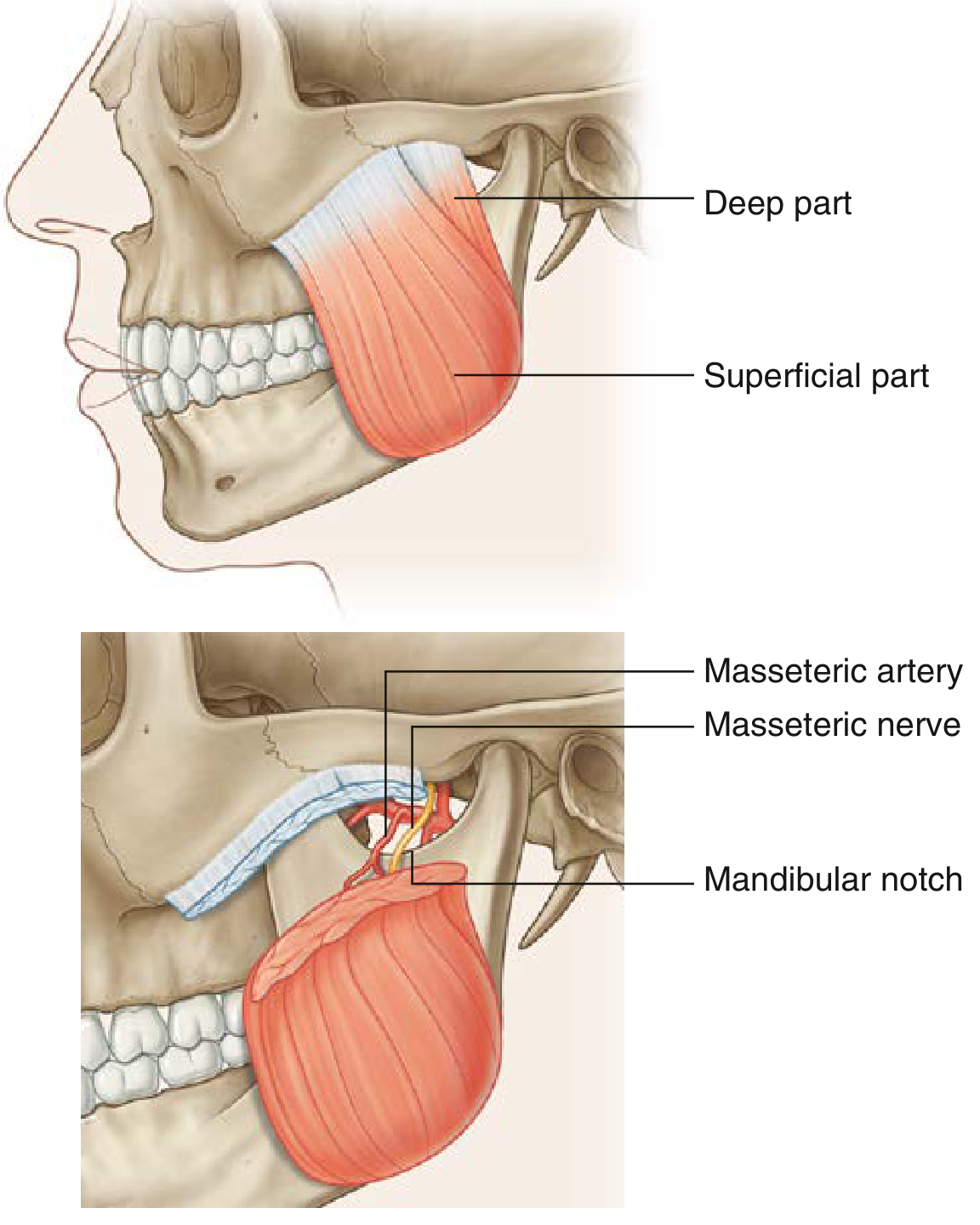
Fig. 8.144 - Masseter muscle (Gray's Anatomy for Students)
Overview
The masseter is a powerful, quadrangular muscle of mastication overlying the lateral surface of the ramus of the mandible. It is anchored above to the zygomatic arch and below to the lateral surface of the ramus.
Parts and Attachments
| Part | Origin | Insertion |
|---|---|---|
| Superficial | Maxillary process of zygomatic bone + zygomatic arch | Angle of mandible + posterior ramus (lateral surface) |
| Deep | Medial aspect of zygomatic arch + posterior inferior margin | Central and upper ramus up to the coronoid process |
Nerve Supply
- Motor nerve: Masseteric nerve - a branch of the mandibular nerve [CN V3]
- The masseteric nerve originates in the infratemporal fossa and passes laterally over the mandibular notch to enter the deep surface of the muscle.
- Blood supply runs alongside: the masseteric artery (from the maxillary artery) travels the same route.
All muscles of mastication (except geniohyoid, which is C1) are innervated by branches of CN V3 arising in the infratemporal fossa. - Gray's Anatomy for Students
Actions
The masseter performs two main movements of the mandible:
| Action | Notes |
|---|---|
| Elevation (jaw closure) | Primary and most powerful action - closes the mouth, generates biting force |
| Protrusion | Contraction also protrudes the mandible (forward movement) |
This is contrasted with the temporalis, which also elevates but retracts (not protrudes) the mandible, and the medial pterygoid, which only elevates.
From Cummings Otolaryngology (Table 86.2):
Masseter - Elevation and protrusion of the mandible.
The masseter, temporalis, and medial pterygoid are the three primary jaw-closing muscles. The masseter is especially adapted for sustained loading during mastication, with a high proportion of slow and hybrid myosin heavy-chain (MHC) isoforms including MHC-fetal and MHC-cardiac-α.
Summary Table
| Feature | Detail |
|---|---|
| Nerve | Masseteric nerve (CN V3 - mandibular division of trigeminal) |
| Nerve pathway | Infratemporal fossa → over mandibular notch → deep surface of masseter |
| Primary action | Elevation of mandible (jaw closure) |
| Secondary action | Protrusion of mandible |
| Blood supply | Masseteric artery (from maxillary artery) |
Sources: Gray's Anatomy for Students, p. 1117; Cummings Otolaryngology Head and Neck Surgery, p. 1560
Rima glottidis
The rima glottidis is the narrowest part of the laryngeal cavity - the gap between the true vocal folds anteriorly and the arytenoid cartilages posteriorly. Let me pull full textbook detail.
Searching sources...
Finding Sources
Finding Sources
Reading File
Reading File
Reading File
Loading Image
Here is a complete account of the rima glottidis from Gray's Anatomy for Students and Color Atlas of Human Anatomy:
Rima Glottidis
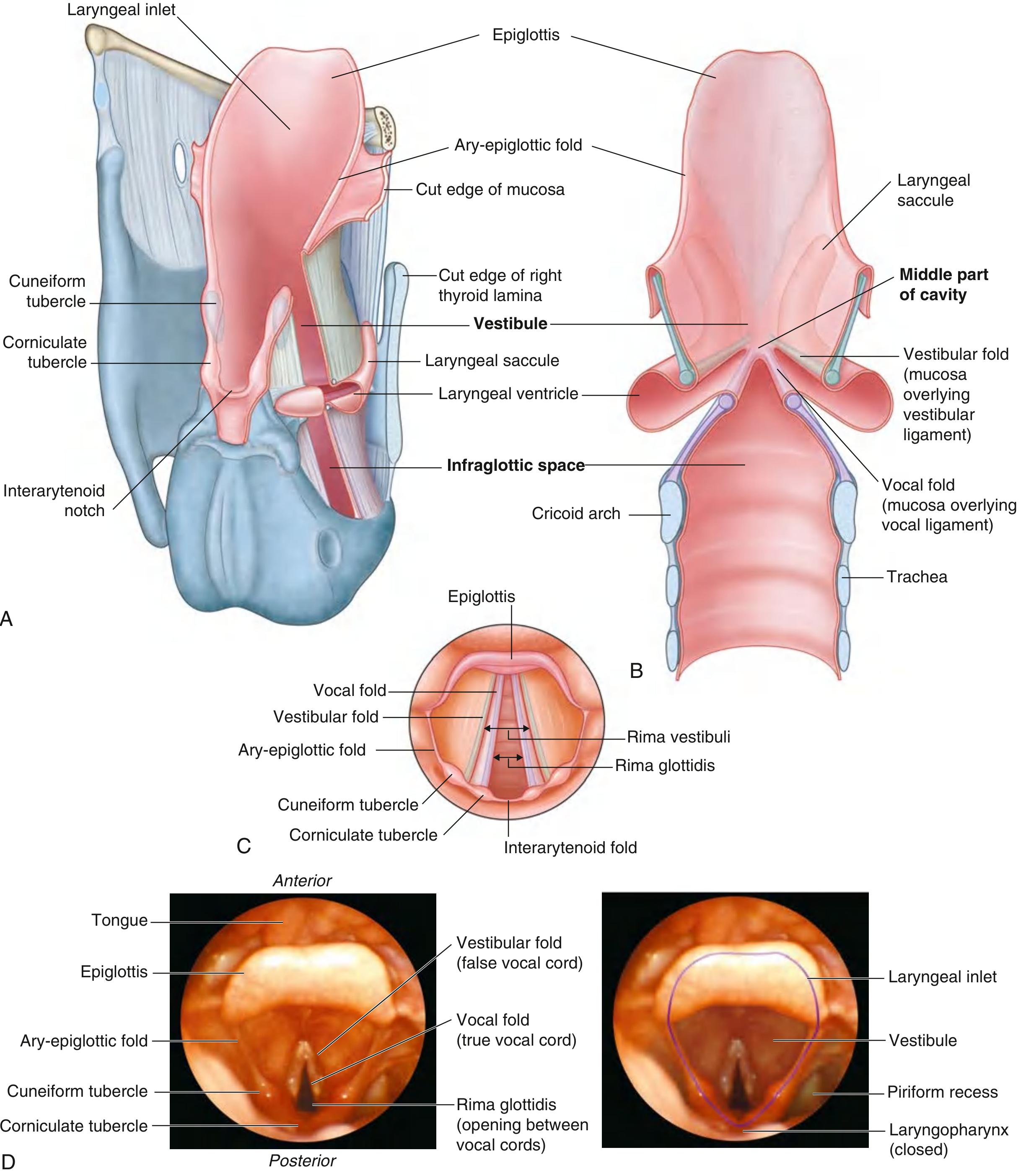
Fig. 8.224 - Laryngeal Cavity. (C) Superior view showing rima vestibuli and rima glottidis. (D) Laryngoscopic photographs - the rima glottidis is the opening between the true vocal cords.
Definition
The rima glottidis is the narrowest part of the laryngeal cavity - a triangular opening (when open) bounded by:
- Laterally: the vocal folds (true vocal cords) and the mucosa-covered arytenoid cartilages
- Anteriorly: the apex (pointed end, at the anterior commissure)
- Posteriorly: the base, formed by the interarytenoid fold of mucosa at the bottom of the interarytenoid notch
It separates the middle chamber of the larynx (above) from the infraglottic cavity (below).
Two Parts
The rima glottidis is divided into two portions:
| Part | Also Called | Boundaries | Notes |
|---|---|---|---|
| Anterior (longer) | Intermembranous part | Between the two vocal folds (overlying the vocal ligaments) | Involved in phonation |
| Posterior (shorter) | Intercartilaginous part | Between the two arytenoid cartilages | Involved in respiration |
Shape Changes with Function
The shape of the rima glottidis changes dynamically depending on the activity:
| Activity | Shape / State of Rima Glottidis |
|---|---|
| Quiet respiration | Triangular; arytenoids abducted; intercartilaginous part open |
| Forced/deep inspiration | Wide open - rhomboid shape; vocal folds fully abducted by posterior cricoarytenoid muscles |
| Phonation | First closed (vocal folds adducted); then opened by expiratory airstream causing vocal fold vibration |
| Whispering | Intermembranous part closed; intercartilaginous part forms a small triangular opening |
| Effort closure (e.g. coughing, lifting) | Completely closed - both rima glottidis and rima vestibuli shut |
| Foreign body entry / laryngospasm | Involuntary closure |
Opening and Closing
Both the rima glottidis and the rima vestibuli can be opened and closed by movement of the arytenoid cartilages and the associated fibro-elastic membranes. The key muscles involved are:
- Posterior cricoarytenoid - the ONLY abductor; widens the entire rima glottidis by rotating the vocal processes laterally
- Lateral cricoarytenoid - adducts (closes) the intermembranous part
- Transverse and oblique arytenoids - adduct the intercartilaginous part
- Thyroarytenoid / vocalis - tenses/relaxes vocal folds
Phonation Mechanism
When phonating:
- Arytenoid cartilages and vocal folds are adducted - closing the rima glottidis
- Vocal ligaments are tensed (by cricothyroid muscle)
- An expiratory stream of air forces the closed rima glottidis open
- The vocal folds vibrate, producing sound waves
- Volume depends on force of airstream; pitch depends on vibration frequency, which varies with length, thickness, and tension of the vocal ligaments
Clinical Significance
- Laryngospasm: Involuntary closure of the rima glottidis (e.g. triggered by foreign body, water, or irritants) can cause life-threatening airway obstruction
- Bilateral recurrent laryngeal nerve (RLN) injury: Paralyzed vocal folds meet in the rima glottidis, causing stridor and respiratory distress - may require tracheostomy
- Cricothyrotomy: If the rima glottidis is life-threateningly closed, an airway can be established by incision through the median cricothyroid ligament, which lies just below the level of the rima glottidis
- Laryngoscopy: Direct visualization of the rima glottidis (the image is inverted - anterior structures appear at the top)
Sources: Gray's Anatomy for Students, pp. 1199-1204; Color Atlas of Human Anatomy Vol. 2 (Internal Organs), p. 202
Give me summary in points
Rima Glottidis - Summary
Definition
- Narrowest part of the laryngeal cavity
- Opening between the two vocal folds (true vocal cords) and the arytenoid cartilages
- Separates the middle laryngeal chamber (above) from the infraglottic cavity (below)
Parts
- Intermembranous part (anterior, longer) - between the two vocal folds, overlying vocal ligaments
- Intercartilaginous part (posterior, shorter) - between the two arytenoid cartilages
Boundaries
- Laterally - vocal folds + mucosa-covered arytenoid cartilages
- Apex (anterior) - anterior commissure
- Base (posterior) - interarytenoid fold at the interarytenoid notch
Shape Changes
- Quiet respiration - triangular
- Forced inspiration - rhomboid (wide open)
- Phonation - first closed, then opened by expiratory airstream
- Whispering - only intercartilaginous part open
- Effort closure / swallowing - completely closed
Opening & Closing
- Opened by - posterior cricoarytenoid (only abductor)
- Closed by - lateral cricoarytenoid, transverse and oblique arytenoids
- Tension adjusted by - cricothyroid and vocalis muscles
Phonation
- Vocal folds adducted and tensed → expiratory air forces them apart → vibration → sound
- Pitch = depends on length, tension, thickness of vocal ligaments
- Volume = depends on force of airstream
Clinical Points
- Laryngospasm - involuntary closure, can be life-threatening
- Bilateral RLN palsy - folds meet in midline → stridor → may need tracheostomy
- Cricothyrotomy - performed just below rima glottidis level through cricothyroid membrane
- Visualized directly by laryngoscopy
Triceps surae short note
The triceps surae is the group of three muscles forming the bulk of the calf - gastrocnemius (two heads) and soleus. They share a common tendon (tendo calcaneus/Achilles) and primarily plantarflex the foot. Let me get full textbook detail.
Searching sources...
Finding Sources
Finding Sources
Reading File
Finding Sources
Reading File
Reading File
Reading File
Loading Image
Triceps Surae
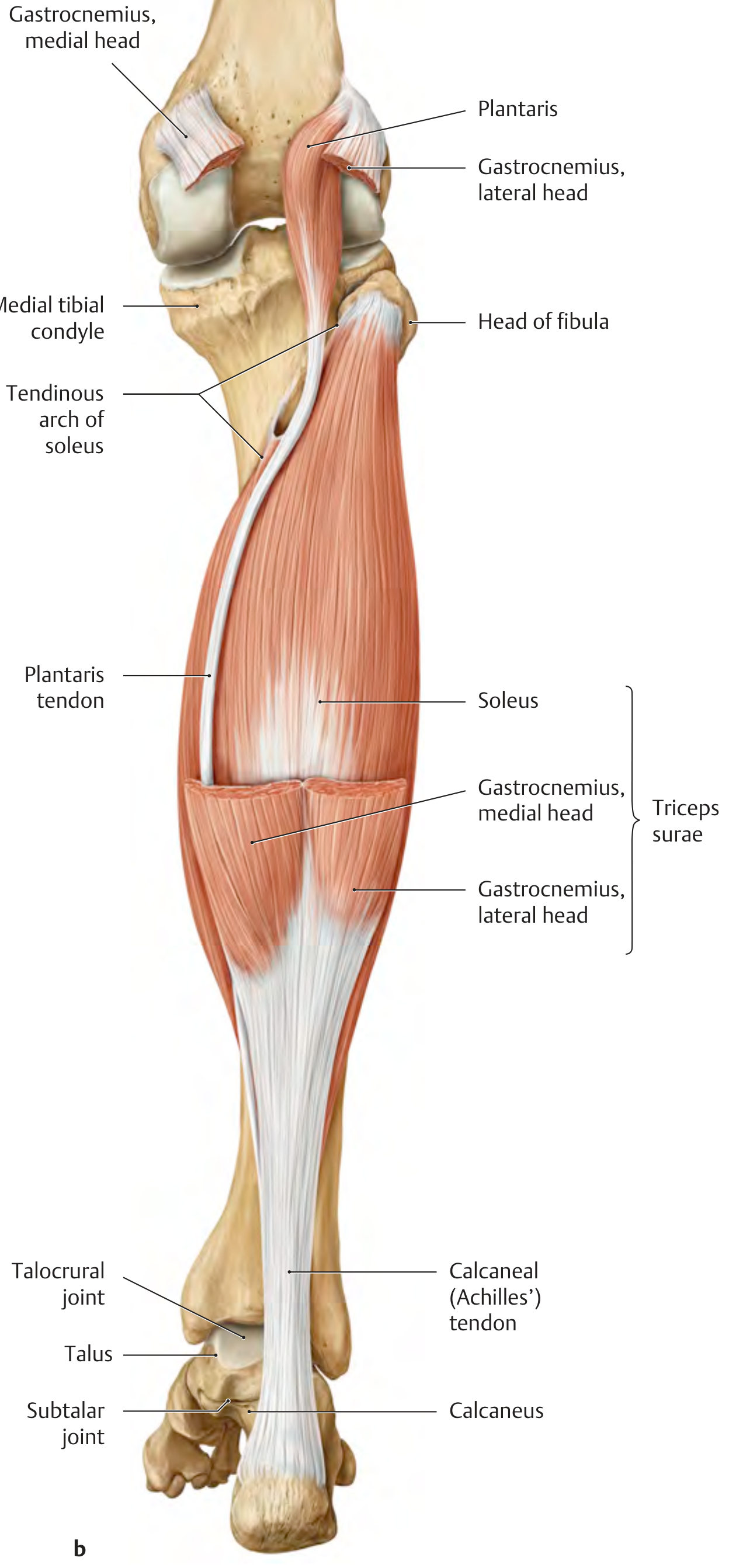
Posterior view - triceps surae comprising gastrocnemius (medial + lateral heads) and soleus, converging into the calcaneal (Achilles') tendon
Definition
- Triceps surae = collective name for the three-headed muscle group forming the bulk of the calf
- Comprises: gastrocnemius (medial head + lateral head) + soleus
- Located in the superficial posterior compartment of the leg
- Plantaris is sometimes considered the "4th head" due to its close association
Components, Origin & Insertion
| Muscle | Origin | Insertion |
|---|---|---|
| Gastrocnemius - medial head | Posterior surface of distal femur just superior to medial condyle | Via calcaneal tendon to posterior surface of calcaneus |
| Gastrocnemius - lateral head | Upper posterolateral surface of lateral femoral condyle | Via calcaneal tendon to posterior surface of calcaneus |
| Soleus | Soleal line + medial border of tibia; posterior head and neck of fibula; tendinous arch between both | Via calcaneal tendon to posterior surface of calcaneus |
| Plantaris (associated) | Inferior part of lateral supracondylar line of femur | Via calcaneal tendon to calcaneus |
Actions
| Muscle | Talocrural (Ankle) Joint | Knee Joint |
|---|---|---|
| Gastrocnemius | Plantarflexion | Flexion |
| Soleus | Plantarflexion | No action (does not cross knee) |
| Plantaris | Plantarflexion (negligible) | Flexion (negligible) |
- Soleus is the more powerful plantarflexor during walking (acts when knee is extended or flexed)
- Gastrocnemius is most effective as a plantarflexor when the knee is extended (since it crosses both joints)
Nerve Supply
- All three heads: Tibial nerve (S1, S2)
Calcaneal (Achilles') Tendon
- Common tendon of insertion of all three heads
- Average length: 20-25 cm; cross-sectional area ~70-80 mm²
- Breaking strength: 60-100 N/mm² (can bear ~1 ton when healthy)
- Thinnest blood supply at 2-6 cm proximal to calcaneal insertion - most common site of rupture
- Rupture signs: "whiplike snap," loss of active plantarflexion, palpable gap in tendon
- Tendon lies below skin with no muscular protection - vulnerable to direct trauma and overuse
Soleus - Special Features
- Does not cross the knee joint - acts as a plantarflexor regardless of knee position
- Its tendinous arch spans over the popliteal vessels and tibial nerve as they pass into the deep posterior compartment
- Acts as a peripheral venous pump ("peripheral heart") - important in venous return from the lower limb
Clinical Points
- Achilles tendon rupture: Sudden load, chronic overuse, fluoroquinolone use, or steroid injections predispose to rupture - typically 2-6 cm above insertion
- Calcaneus gait: Weakness of triceps surae (gastrocnemius-soleus) causes increased ankle dorsiflexion at heel strike
- DVT risk: Immobilization impairs soleus pump, increasing deep vein thrombosis risk
- Reflex: S1 ankle (Achilles) jerk tests the triceps surae - absence suggests S1 radiculopathy
Sources: THIEME Atlas of Anatomy - General Anatomy and Musculoskeletal System, p. 513-514; Gray's Anatomy for Students, p. 726-727
Make it short
Triceps Surae - Short Note
Definition
- Group of 3 muscles forming the calf bulk, in the superficial posterior compartment of the leg
Components
- Gastrocnemius (medial + lateral heads)
- Soleus
- Plantaris is sometimes considered the 4th head
Origin
- Gastrocnemius medial head - medial femoral condyle
- Gastrocnemius lateral head - lateral femoral condyle
- Soleus - soleal line of tibia + posterior head/neck of fibula (joined by a tendinous arch)
Insertion
- All three - calcaneal (Achilles') tendon → posterior surface of calcaneus
Actions
- Plantarflexion of foot (all three)
- Flexion of knee (gastrocnemius only - as it crosses the knee)
Nerve Supply
- Tibial nerve (S1, S2)
Calcaneal Tendon
- Common tendon of all three heads
- Most vulnerable at 2-6 cm above insertion (least blood supply - commonest rupture site)
- Rupture presents with a snap, palpable gap, and loss of active plantarflexion
Clinical Points
- S1 ankle jerk tests triceps surae
- Soleus acts as a peripheral venous pump - immobility increases DVT risk
- Calcaneus gait = triceps surae weakness
- Fluoroquinolones and steroid injections predispose to Achilles tendon rupture
Biceps femoris origin inserts nerve supply and action
Searching sources...
Finding Sources
Finding Sources
Reading File
Reading File
Biceps Femoris
Location
- Lateral muscle of the posterior compartment of the thigh
- Part of the hamstring group (along with semitendinosus and semimembranosus)
- Has two heads - long head and short head
Origin
| Head | Origin |
|---|---|
| Long head | Inferomedial part of the ischial tuberosity (common origin with semitendinosus); sacrotuberous ligament |
| Short head | Lateral lip of the linea aspera (middle third of femoral shaft) |
Insertion
- Head of the fibula (lateral surface)
- Extensions blend with the fibular collateral ligament and lateral knee joint ligaments
Nerve Supply
| Head | Nerve | Spinal Segments |
|---|---|---|
| Long head | Tibial division of sciatic nerve | L5, S1, S2 |
| Short head | Common fibular division of sciatic nerve | L5, S1, S2 |
Key point: The two heads have different nerve supplies - the only hamstring muscle where this occurs.
Actions
| Joint | Action |
|---|---|
| Knee joint (both heads) | Flexion + lateral rotation of leg |
| Hip joint (long head only) | Extension + lateral rotation of thigh |
| Pelvis (long head) | Stabilizes pelvis in sagittal plane |
Sources: Gray's Anatomy for Students, p. 725; THIEME Atlas of Anatomy - General Anatomy and Musculoskeletal System
Make it short
Biceps Femoris
Origin
- Long head - ischial tuberosity (common with semitendinosus) + sacrotuberous ligament
- Short head - lateral lip of linea aspera (femoral shaft)
Insertion
- Head of fibula
Nerve Supply
- Long head - tibial division of sciatic nerve (L5, S1, S2)
- Short head - common fibular division of sciatic nerve (L5, S1, S2)
- Only hamstring with dual nerve supply
Actions
- Knee - flexion + lateral rotation of leg (both heads)
- Hip - extension + lateral rotation of thigh (long head only)
Ejection fraction means
Ejection fraction (EF) is the percentage of blood ejected from the ventricle with each heartbeat. Normal left ventricular EF is 55-70%. Let me get the full textbook definition.
Searching sources...
Finding Sources
Reading File
Ejection Fraction (EF)
Definition
- The fraction (percentage) of blood in the ventricle that is ejected with each heartbeat
- Measures the effectiveness of ventricular contraction
Formula
EF = Stroke Volume / End-Diastolic Volume × 100
- Stroke Volume = End-Diastolic Volume (EDV) - End-Systolic Volume (ESV)
- So: EF = (EDV - ESV) / EDV × 100
Example
- EDV = 140 mL, ESV = 70 mL
- SV = 140 - 70 = 70 mL
- EF = 70/140 = 0.5 = 50%
Normal Value
- Approximately 55-70% (normal LV EF)
- Meaning: about 55-70% of blood in the ventricle is pumped out each beat; the rest remains
What it tells us
- EF is an indicator of myocardial contractility
- ↑ EF = increased contractility (e.g. sympathetic stimulation)
- ↓ EF = decreased contractility (e.g. heart failure, cardiomyopathy)
Clinical Classification (Heart Failure)
| Category | LVEF |
|---|---|
| HFrEF (reduced EF) | ≤ 40% |
| HFmrEF (mildly reduced) | 41-49% |
| HFpEF (preserved EF) | ≥ 50% |
Measured by
- Echocardiography (most common)
- Also used to guide ICD and cardiac resynchronization therapy (CRT) implantation
Source: Costanzo Physiology 7th Edition, p. 155
What is... Mambai stenosis. சொல்லுங்க.Hello.
வணக்கம்! 😊
"Mambai stenosis" என்பது சரியான medical term இல்லை - நீங்கள் Mitral Stenosis (மிட்ரல் ஸ்டெனோசிஸ்) கேட்கிறீர்களா?
இது மிகவும் common valvular heart disease - இடது இதயத்தின் mitral valve குறுகிப்போவது.
உறுதிப்படுத்தவும் - Mitral Stenosis பற்றி விளக்கட்டுமா?
This is a shared conversation. Sign in to Orris to start your own chat.