
Please give me the answer of this reasoning question acc to b.d chaurasiya bk of anatomy for 1 yr mbbs professional exams of mine. Which recurrent laryngeal nerve is more susceptible to injury during thoracic surgeries (like ductus arteriosus repair) and why?
Reading File
Finding Sources
Finding Sources
Finding Sources
Reading File
Reading File
Finding Sources
Loading Image
Reading File
Reading File
I now have comprehensive information to give you a thorough, exam-oriented answer based on standard anatomy references (aligned with BD Chaurasiya's teaching). Here it is:
LEFT Recurrent Laryngeal Nerve — More Susceptible to Injury in Thoracic Surgeries
Short Answer (For Exam)
The left recurrent laryngeal nerve (LRLN) is more susceptible to injury during thoracic surgeries such as patent ductus arteriosus (PDA) ligation / repair, because of its longer intrathoracic course and its intimate anatomical relationship with the ductus arteriosus (ligamentum arteriosum after birth).
Anatomy — Why the Left Side is Different (Embryological Basis)
Both recurrent laryngeal nerves originally hook around the 6th pharyngeal arch artery on their respective sides. However, their adult anatomy diverges due to differential regression of arch arteries:
| Side | Artery it hooks around | Location of loop |
|---|---|---|
| Right RLN | Right subclavian artery (4th arch derivative) | In the root of the neck — relatively short intrathoracic course |
| Left RLN | Arch of aorta + ligamentum arteriosum (remnant of ductus arteriosus / left 6th arch) | Deep in the superior mediastinum — long intrathoracic course |
Why the difference? On the right, the distal part of the right 6th pharyngeal arch artery degenerates, so the right RLN slips upward to hook around the right subclavian artery in the neck. On the left, the 6th arch artery persists as the ductus arteriosus, keeping the LRLN tethered deep in the chest, looping under the arch of the aorta, immediately lateral to the ligamentum arteriosum.
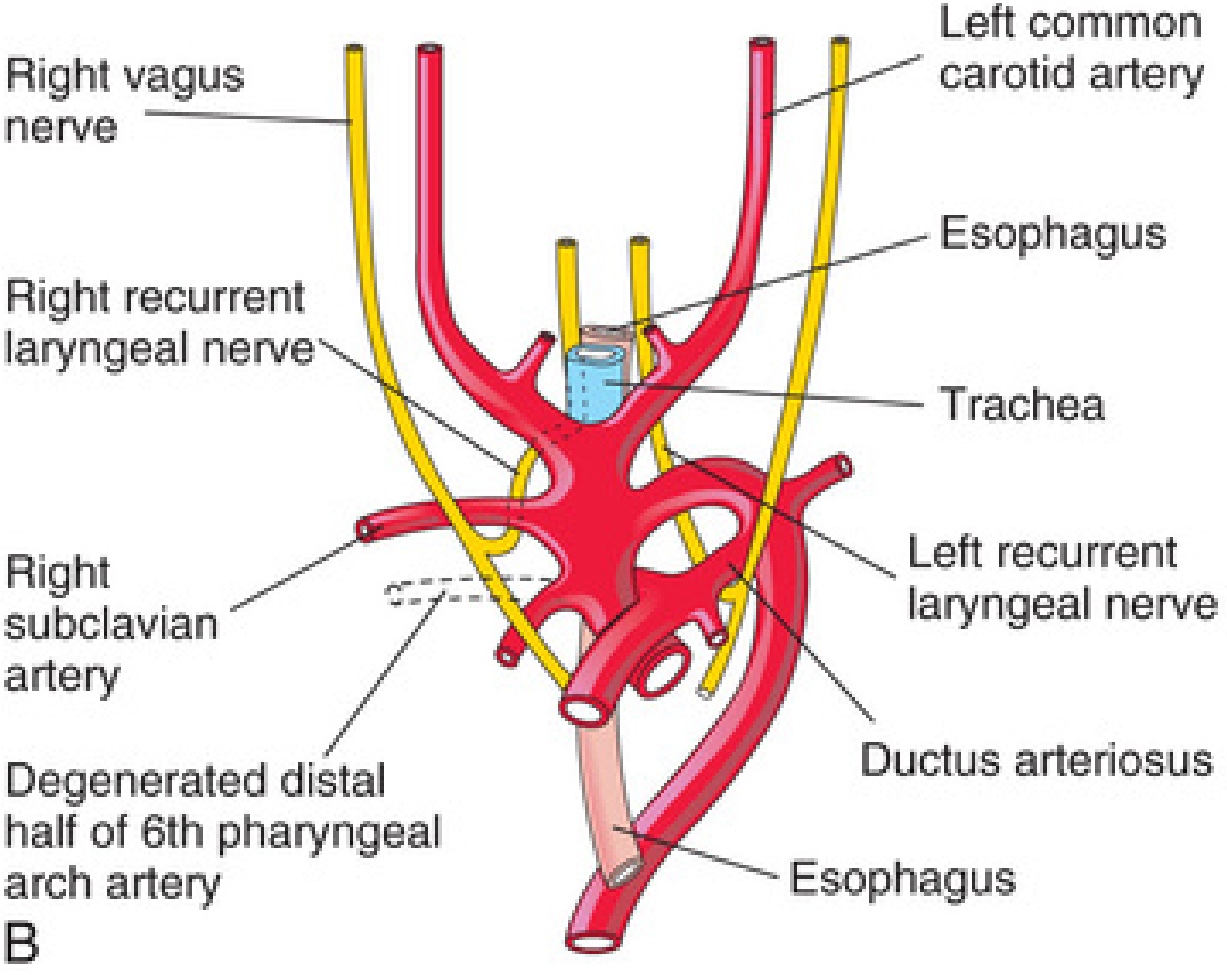
Exact Course of the Left RLN — Why it's in the Surgical Field
- The left vagus nerve descends through the thorax, crossing the arch of the aorta
- At the inferior margin of the arch of the aorta, just lateral to the ligamentum arteriosum (the fibrous remnant of the ductus arteriosus), the left RLN branches off
- It hooks below and behind the arch of the aorta and the ligamentum arteriosum
- It then ascends in the tracheo-esophageal groove to reach the larynx
During PDA ligation, the surgeon works exactly in the area of the ligamentum arteriosum/ductus arteriosus — placing the LRLN directly in the operative field.
"The left recurrent laryngeal nerve is susceptible to injury at the point that it passes around the ductus arteriosus unless a right aortic arch is present. The incidence of recurrent laryngeal nerve injury is estimated at 1%–7.4% of patent ductus arteriosus ligation cases." — Cummings Otolaryngology
"Surgical repair of a patent ductus arteriosus requires that the surgeon identify and preserve the left recurrent laryngeal nerve... Injury to the left laryngeal nerve causes hoarseness." — Gray's Anatomy for Students
Comparison Table (Exam Favourite)
| Feature | Left RLN | Right RLN |
|---|---|---|
| Hooks around | Arch of aorta + ligamentum arteriosum | Right subclavian artery |
| Intrathoracic course | Long (descends into mediastinum) | Short (loops only in root of neck) |
| Relevant surgeries | PDA ligation, aortic arch surgery, mediastinal tumors | Right apical lung surgery, right neck dissection |
| Vulnerable to | Mediastinal malignancy (aortopulmonary window), PDA repair | Apical lung cancers, thyroid/neck surgery |
| Effect of injury | Hoarseness → aphonia (unilateral vocal cord paralysis) | Same |
Key Points to Write in Exam (BD Chaurasiya Style)
- Left RLN is more susceptible due to its longer course in the thorax.
- It arises from the left vagus at the inferior margin of the arch of the aorta, immediately lateral to the ligamentum arteriosum (remnant of ductus arteriosus).
- During PDA repair, the surgeon operates near this structure, placing the nerve at risk.
- Injury → unilateral vocal cord paralysis → hoarseness.
- Right RLN loops only in the neck (around subclavian), so it is NOT in the thoracic surgical field.
Bottom line for your professional exam: The left RLN is injured because it anatomically wraps around the ductus arteriosus/ligamentum arteriosum — the exact structure being surgically ligated or repaired. This is a direct consequence of the embryological persistence of the left 6th pharyngeal arch artery.
This is a shared conversation. Sign in to Orris to start your own chat.