
rbc
Reading File
The query "rbc" is quite brief. Let me clarify what you're looking for before diving in.
Asking for Preferences
What aspect of RBCs are you interested in?
RBCs are biconcave discs packed with hemoglobin, lacking a nucleus and most organelles at maturity. Their unique shape maximizes surface area for gas exchange while allowing deformation through narrow capillaries.
Searching sources...
Finding Sources
Finding Sources
Finding Sources
Finding Sources
Good hits. Let me pull the key sections from Guyton & Hall (physiology), Basic Medical Biochemistry (membrane structure), and Harper's (cytoskeleton).
Reading File
Reading File
Reading File
Excellent content. Let me fetch the RBC microscopy image and read the metabolism section.
Loading Image
Reading File
Let me also fetch the cytoskeleton diagram and read the RBC metabolism section.
Loading Image
Finding Sources
Reading File
I have all the material I need for a thorough response. Let me now compose it.
Red Blood Cell (Erythrocyte) - Structure & Physiology
Shape and Size
The mature RBC is a biconcave disc - flattened in the center and thicker at the rim. Key dimensions:
| Parameter | Value |
|---|---|
| Diameter | ~7.8 µm |
| Thickness (rim) | ~2.5 µm |
| Thickness (center) | ~1 µm |
| Volume | 90-95 µm³ |
| Surface area | ~140 µm² |
Scanning electron micrograph showing the characteristic biconcave disc shape:
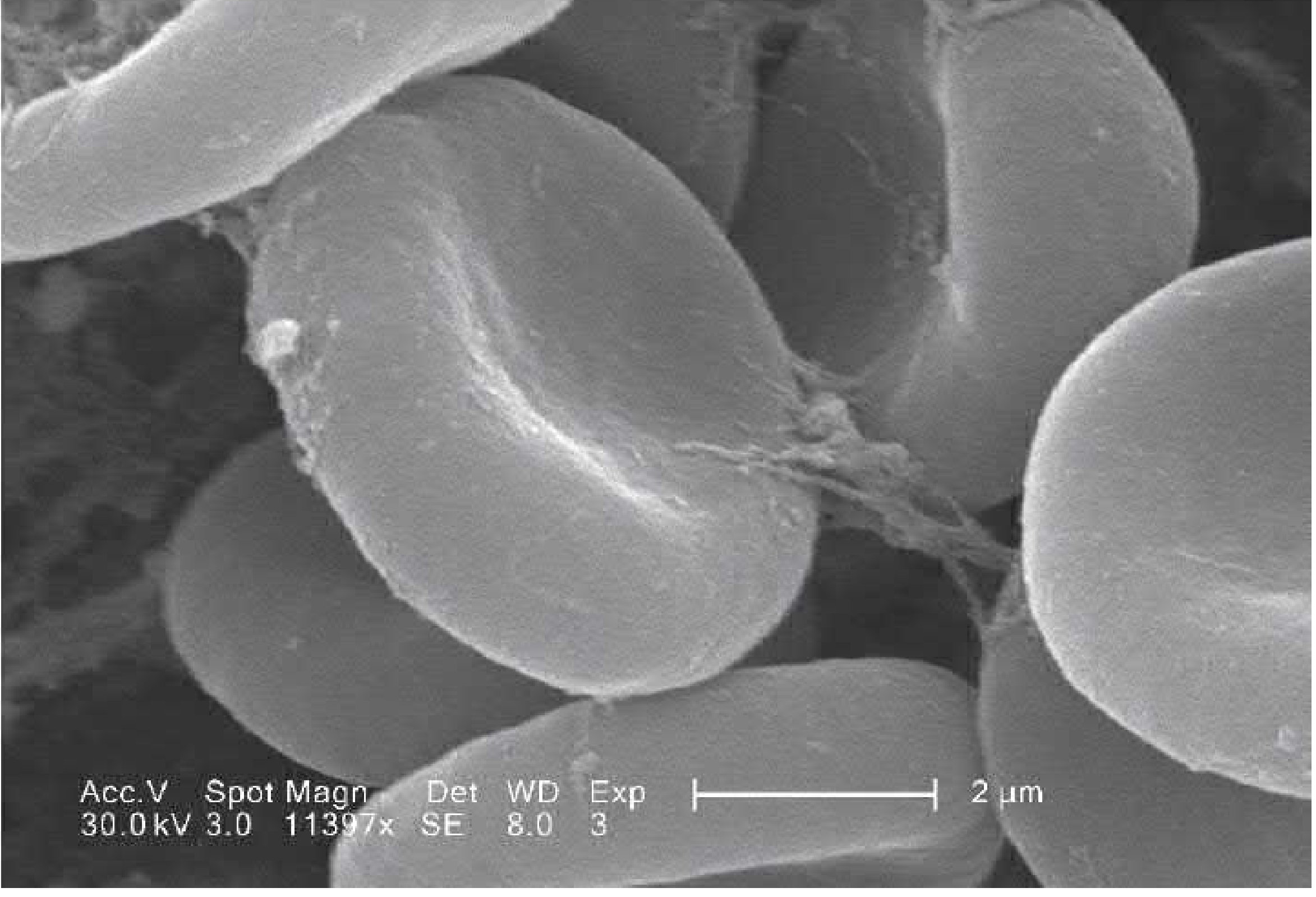
The biconcave shape is not just geometric elegance - it has clear functional purposes:
-
Maximizes surface area relative to volume, improving gas exchange efficiency
-
Creates excess membrane (140 µm² actual vs 98 µm² needed for a sphere), allowing deformation without rupture
-
Enables the cell to fold and squeeze through capillaries and splenic sinusoids as narrow as ~3 µm in diameter
-
Guyton and Hall Textbook of Medical Physiology, p. 441
-
Basic Medical Biochemistry - A Clinical Approach, 6e, p. 1530
Normal Counts and Hemoglobin Content
| Parameter | Men | Women |
|---|---|---|
| RBC count | ~5.2 million/mm³ | ~4.7 million/mm³ |
| Hemoglobin | ~15 g/100 mL blood | ~14 g/100 mL blood |
| Hematocrit | 40-45% | 40-45% |
| Max Hb concentration in cell | 34 g/100 mL cells | same |
Each gram of hemoglobin carries 1.34 mL O₂ at full saturation, giving ~20 mL O₂/100 mL blood in men.
- Guyton and Hall, p. 441
The Mature RBC is "Stripped Down"
The mature erythrocyte has ejected its nucleus and lost most organelles (mitochondria, ribosomes, Golgi) during maturation. Consequences:
- No oxidative phosphorylation - relies entirely on anaerobic glycolysis for ATP
- Cannot synthesize new proteins - membrane proteins cannot be replaced
- Cannot divide
- Lifespan ~120 days, after which senescent cells are cleared by splenic macrophages
Membrane Architecture
The RBC membrane has two components: a lipid bilayer with integral proteins, and an internal cytoskeletal lattice.
Integral Membrane Proteins
| Protein | Function |
|---|---|
| Band 3 | Anion exchanger (Cl⁻/HCO₃⁻); most abundant (~1.2 million copies/cell); anchors cytoskeleton via ankyrin; aging marker |
| Glycophorin A | Carries MN blood group antigens; provides negative surface charge (sialic acid) |
| Glycophorin C | Anchors band 4.1 complex to membrane |
The Cytoskeleton
The internal meshwork gives the RBC its deformability. The diagram below shows the key connections:
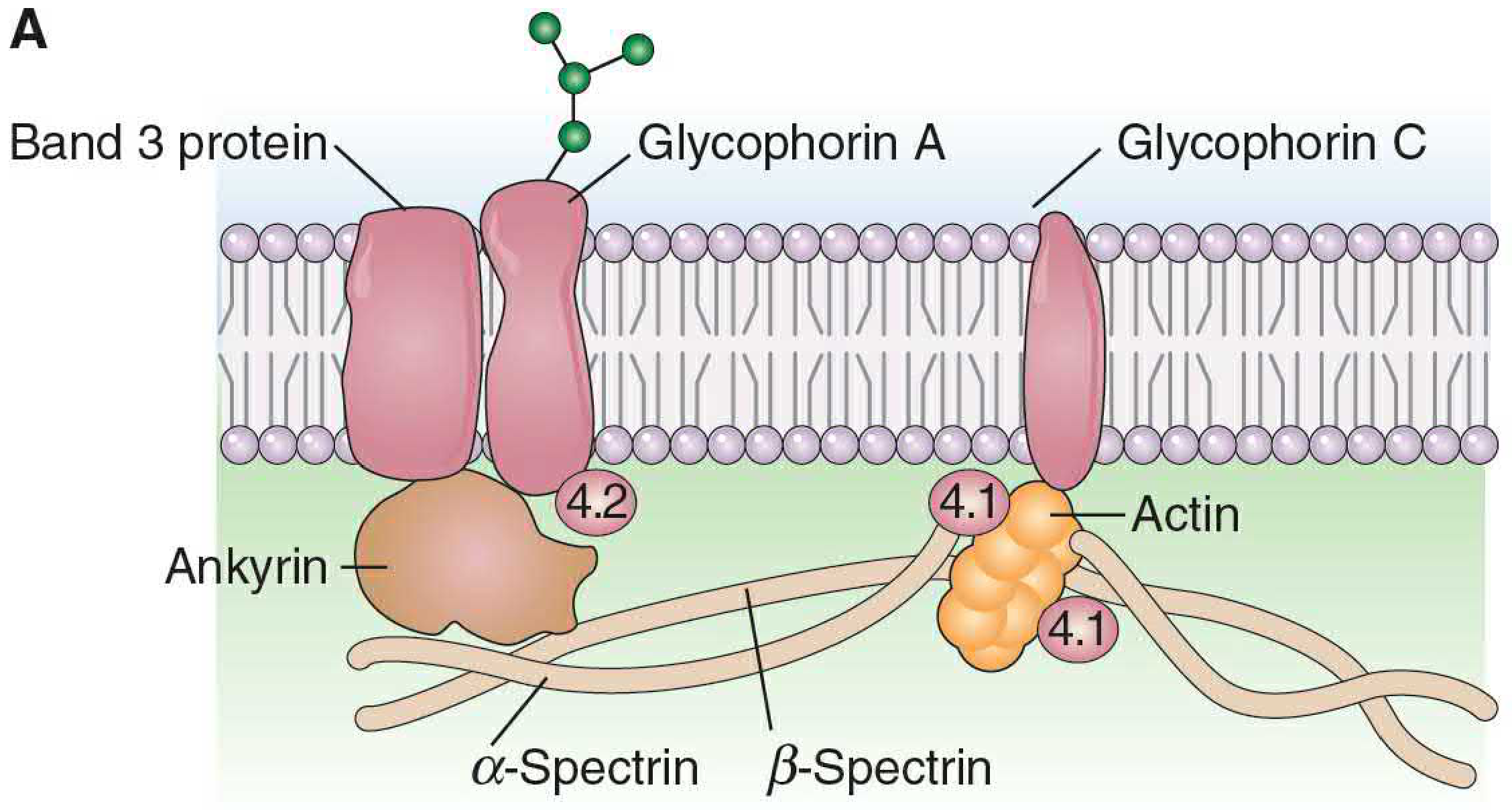
Key cytoskeletal proteins:
- Spectrin (bands 1 & 2 = α and β chains) - the dominant scaffold protein. α and β chains intertwine antiparallel to form ~100 nm dimers, which head-to-head associate into ~200 nm tetramers. Forms the underlying mesh.
- Ankyrin (band 2.1) - pyramid-shaped linker that binds β-spectrin AND band 3, anchoring the mesh to the membrane
- Band 4.2 - stabilizes the ankyrin-band 3 connection
- Actin (band 5) - short F-actin filaments serve as nodes where multiple spectrin tetramers converge
- Band 4.1 - links spectrin-actin complex to glycophorin C (and glycophorin A), providing a second membrane anchor point
- Adducin, tropomyosin - accessory proteins that regulate actin filament length
When the cell is mechanically stressed, spectrin molecules uncoil and extend or compress, changing cell shape without changing surface area. This is the molecular basis of RBC deformability.
Defects in any of these proteins (especially spectrin or ankyrin) cause hereditary spherocytosis (autosomal dominant; ~1:5,000 Northern Europeans) or hereditary elliptocytosis.
- Harper's Illustrated Biochemistry, 32nd Ed, p. 671
- Basic Medical Biochemistry - A Clinical Approach, 6e, p. 1531-1532
Metabolism
Because the RBC has no mitochondria, it depends on two main metabolic pathways:
1. Embden-Meyerhof Pathway (Glycolysis)
- Source of ATP - used for Na⁺/K⁺-ATPase (cation pump) and membrane maintenance
- Generates NADH - used by methemoglobin reductase to keep hemoglobin iron in the ferrous (Fe²⁺) state (ferric = methemoglobin = cannot carry O₂)
2. Hexose Monophosphate Shunt (Pentose Phosphate Pathway)
- Generates NADPH - reduces glutathione via glutathione reductase
- Reduced glutathione (GSH) protects the cell against oxidative stress
- G6PD (glucose-6-phosphate dehydrogenase) is the rate-limiting enzyme; G6PD deficiency is the most common RBC enzyme deficiency worldwide
3. Rapoport-Luebering Shunt
-
Produces 2,3-bisphosphoglycerate (2,3-BPG)
-
2,3-BPG binds the central cavity of deoxyhemoglobin, reducing O₂ affinity (right-shifts the O₂-Hb dissociation curve), promoting O₂ delivery to tissues
-
Harrison's Principles of Internal Medicine 22E (2025), p. 835
Lifespan and Destruction
- Normal RBC lifespan: ~120 days
- Senescent RBCs accumulate damage; band 3 proteins cluster on the surface and become recognized by natural anti-band 3 IgG antibodies
- Opsonized cells are phagocytosed by macrophages in the spleen, liver, and bone marrow (extravascular hemolysis)
- Hemoglobin is broken down: globin → amino acids (recycled); heme → bilirubin → conjugated in liver → excreted in bile → urobilinogen/stercobilin in feces
Summary Table
| Feature | Detail |
|---|---|
| Shape | Biconcave disc |
| Diameter | ~7.8 µm |
| Lifespan | ~120 days |
| Nucleus | Absent (ejected during maturation) |
| Organelles | None (no mitochondria) |
| Energy source | Anaerobic glycolysis only |
| Main protein | Hemoglobin (34 g/100 mL cell) |
| Key scaffold | Spectrin-ankyrin-actin cytoskeleton |
| O₂ affinity regulator | 2,3-BPG |
| Oxidant defense | G6PD → NADPH → reduced glutathione |
| Clearance site | Spleen (primarily) |
This is a shared conversation. Sign in to Orris to start your own chat.