
Management of paranoychia ?
Reading File
Now let me search the medical library and PubMed in parallel for paronychia management.
Finding Sources
Searching PubMed
paronychia management treatment
Good results from multiple textbooks. Let me read the most comprehensive sources in parallel.
Reading File
Reading File
Reading File
Let me get the rest of the Roberts and Hedges content plus the Bailey & Love and Goldman-Cecil sections for completeness.
Reading File
Reading File
Reading File
I now have rich, comprehensive content from multiple authoritative textbooks. Let me also fetch one of the clinical images to include.
Loading Image
I now have everything needed for a comprehensive answer. Let me compile it.
Management of Paronychia
Paronychia is inflammation/infection of the proximal and lateral nail folds. Management differs based on whether it is acute (bacterial) or chronic (fungal/irritant), and whether an abscess has formed.
Causative Organisms
| Type | Common Pathogens |
|---|---|
| Acute bacterial | S. aureus (most common), streptococci, CA-MRSA |
| Oral flora exposure (nail biting, finger sucking) | Anaerobes, gram-negative bacilli |
| Chronic | Candida albicans, mixed flora |
| Viral (herpetic whitlow) | Herpes simplex virus type 1 or 2 |
- In children, anaerobes are frequent due to finger sucking and nail biting. A group A beta-hemolytic streptococcal paronychia can develop from thumb sucking with concurrent pharyngitis.
- Cases have been reported with antiretroviral therapy for HIV and EGFR inhibitors (e.g., amivantamab, cetuximab).
- Studies show ~25% anaerobic, 25% aerobic, and 50% mixed aerobic/anaerobic causation.
Acute Paronychia
Stage 1: Cellulitis (No Abscess)
- Warm soaks 3 times daily (warm water or chlorhexidine soaks)
- Oral antibiotics: first-generation cephalosporin (e.g., cephalexin) or antistaphylococcal penicillin (e.g., dicloxacillin)
- If anaerobes/gram-negatives suspected (oral flora exposure): oral clindamycin or amoxicillin-clavulanate (Augmentin)
- Topical antibiotics with or without topical corticosteroids can be used
- Incision has no value at this stage
Stage 2: Abscess Formed
Drainage is the definitive treatment and is usually quickly curative.
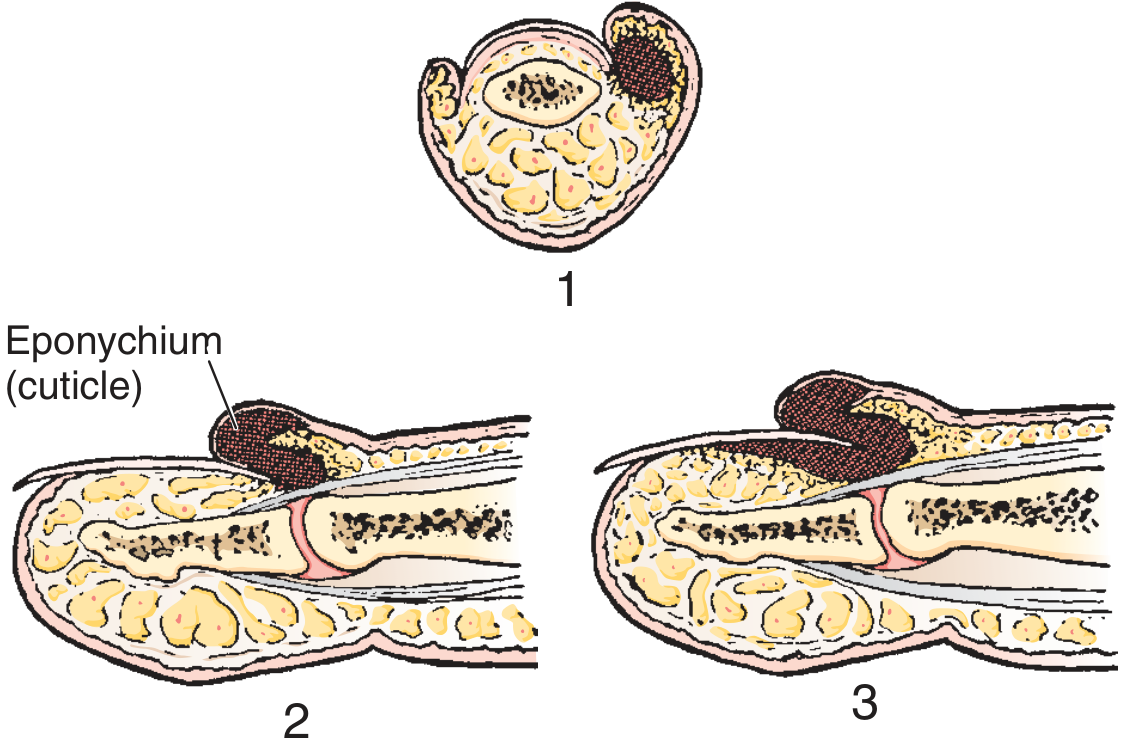
Key principle: A paronychia is not a true cutaneous abscess but a pus collection in the potential space between the cuticle and the proximal nail - adequate drainage can almost always be achieved by lifting the eponychial fold without formal skin incision.
Drainage procedure:
- Perform a digital nerve block for anesthesia
- Soften the eponychium with a warm soak
- Advance a No. 11 scalpel blade, scissors, or a 21-23 gauge needle parallel to the nail and under the eponychium at the point of maximal swelling
- Allow pus to drain - no packing or sutures usually needed
- Dress loosely
If abscess involves one corner only: Incise at that corner, angling the knife away from the nail bed (to avoid a later nail ridge).
If abscess has spread under the nail: A second incision on the opposite side + fold the proximal skin back + excise the proximal one-third of the nail. Pack loosely with iodoform gauze for 48 hours.
If subungual abscess extends further: Nail removal may be required (rarely needed as initial treatment).
A simple nick through the most translucent/fluctuant area is often all that is required.
Post-drainage antibiotics: Case studies suggest antibiotics are probably unnecessary in most drained cases. Reserve for significant cellulitis, immunocompromised patients, or comorbid conditions.
Chronic Paronychia
- Caused by repeated mechanical/environmental trauma (water, irritants) that breaks down the cuticle barrier
- Features: edema and erythema of the proximal nail fold, absence of cuticles, Beau lines, nail plate surface abnormalities
- Often colonized by Candida albicans
Treatment:
- Protective measures: cotton-lined rubber gloves to avoid contact with water and irritants
- Topical steroids (e.g., betamethasone) to reduce inflammation
- Topical antifungals (e.g., clotrimazole, miconazole)
- Topical antimicrobials
- Avoid cuticle manipulation
Herpetic Whitlow (Viral Paronychia) - Key Differential
- Caused by HSV-1 or HSV-2; common in healthcare workers and immunocompromised patients
- Presents with localized swelling and clear vesicle formation, lymphangitis, lymphadenopathy
- Diagnosis: viral culture, Tzanck smear, serum antibody titers
- I&D is CONTRAINDICATED (can disseminate or cause bacterial superinfection)
- Treatment: Supportive; antivirals (acyclovir/valacyclovir) if within 48 hours of onset; suppressive antiviral therapy for recurrent cases
Summary Table
| Situation | Treatment |
|---|---|
| Early cellulitis, no abscess | Warm soaks + oral antistaphylococcal antibiotics |
| Definite abscess | Digital block + drainage (elevate eponychium / needle/No.11 blade) |
| Abscess with subungual extension | Drainage + partial nail removal (proximal 1/3) |
| Chronic (fungal) | Protective measures + topical steroids + topical antifungals |
| Herpetic whitlow | Supportive; antivirals early; NO I&D |
| MRSA concern | TMP-SMX or clindamycin |
Sources: Roberts and Hedges' Clinical Procedures in Emergency Medicine, 6e, p. 888-889; Campbell's Operative Orthopaedics 15e, 2026; Pfenninger and Fowler's Procedures for Primary Care, 3e; Goldman-Cecil Medicine, International Ed.
This is a shared conversation. Sign in to Orris to start your own chat.