
label digram of sphygmomanometer
Reading File
Generating Image
A clear educational labeled diagram of a manual aneroid sphygmomanometer, showing and labeling the inflatable cuff, rubber bladder inside cuff, connecting rubber tubing, pressure gauge with dial marked mmHg, inflation bulb, and air-release valve. Include an inset indicating the cuff placed around the upper arm and the brachial artery. Ensure every label is legible and correctly points to its part.
Searching PubMed
sphygmomanometer AND blood pressure
Searching the Web
manual sphygmomanometer components cuff inflation bulb air release valve pressure gauge
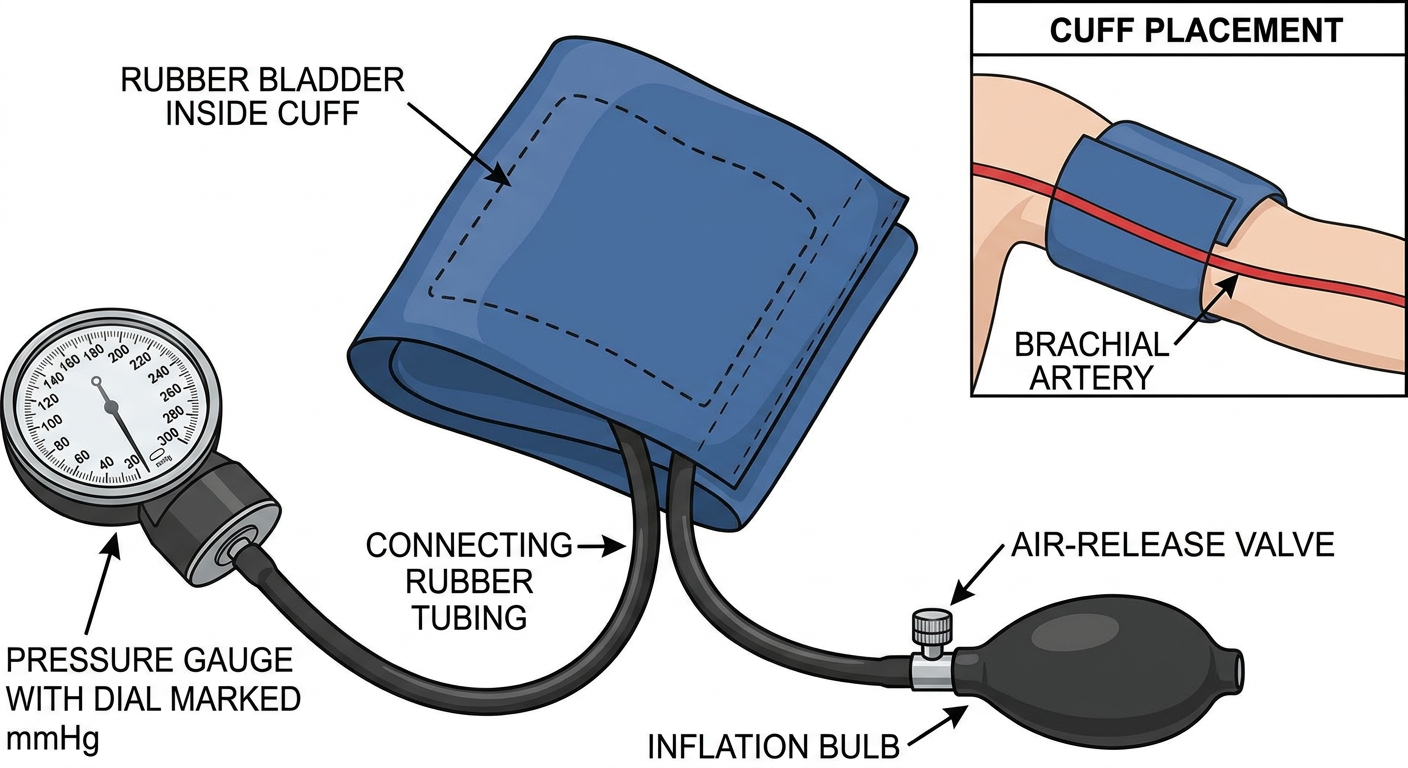
Parts labeled:
- Inflatable cuff
- Rubber bladder inside the cuff
- Connecting rubber tubes
- Pressure gauge or aneroid manometer, calibrated in mmHg
- Inflation bulb
- Air-release valve
- Brachial artery location on the upper arm
A manual sphygmomanometer is used with a stethoscope to measure blood pressure.
what is idial lenth of cuf
Reading File
Finding Sources
Searching PubMed
blood pressure cuff size
Searching the Web
American Heart Association blood pressure cuff bladder length 80% arm circumference width 40%
The ideal cuff bladder length is at least 80% of the mid-upper arm circumference.
- Width: about 40% of arm circumference
- Length: 80% or more of arm circumference
Example: for an arm circumference of 30 cm, the bladder should be about 24 cm long and 12 cm wide.
A cuff that is too small gives a falsely high blood-pressure reading. AHA cuff-sizing guidance supports these proportions.
This is a shared conversation. Sign in to Orris to start your own chat.