
Hemangioma according 2nd MBBS pathology
I'll read the medical library skill first, then search for hemangioma content.
Reading File
Now let me search the library for hemangioma content in parallel:
Finding Sources
Finding Sources
Now let me search specifically for pathology-focused hemangioma content and also look at the Robbins/pathology books:
Finding Sources
Finding Sources
Robbins Pathologic Basis of Disease has a dedicated VASCULAR TUMORS section. Let me read both Robbins books for the full hemangioma content:
Reading File
Reading File
I have the classification and intro. Now I need the detailed hemangioma content from both Robbins books:
Reading File
Reading File
I need to read the hemangioma section specifically. Let me search for it more precisely:
Finding Sources
Let me read the dedicated hemangioma section from both Robbins books:
Reading File
Reading File
I can see the hemangioma image reference. Now I need the actual hemangioma section from Robbins. Let me find it:
Reading File
Excellent! I have rich hemangioma content. Let me read a bit more to get complete details including pyogenic granuloma and the image, and fetch the hemangioma histology image:
Reading File
Loading Image
I now have all the information needed to write a comprehensive 2nd MBBS-level pathology answer on hemangioma. Let me compile it:
Hemangioma - Pathology (2nd MBBS)
Source: Robbins & Cotran Pathologic Basis of Disease / Robbins Basic Pathology
Definition
Hemangiomas are benign tumors composed of blood-filled vascular channels lined by endothelial cells (ECs). They are the most common tumor of infancy and childhood, occurring in approximately 1 in 10 individuals.
Classification of Vascular Tumors (Table 11.5 - Robbins)
| Grade | Tumors |
|---|---|
| Benign | Hemangioma (capillary, cavernous, pyogenic granuloma), Lymphangioma, Glomus tumor, Vascular ectasias |
| Intermediate | Kaposi sarcoma, Hemangioendothelioma |
| Malignant | Angiosarcoma |
Cell of origin: Vascular neoplasms arise from endothelium (hemangioma, lymphangioma, angiosarcoma) or cells supporting blood vessels (e.g., glomus tumor - modified smooth muscle cells).
Key Distinguishing Features: Benign vs. Malignant
| Feature | Benign (Hemangioma) | Malignant (Angiosarcoma) |
|---|---|---|
| Vascular channels | Well-formed, obvious | Poorly formed or absent |
| Endothelial cells | Bland monolayer | Cytologic atypia, cellular proliferation |
| Structure | Blood-filled channels | Solidly cellular |
| IHC markers | CD31, vWF (confirmatory) | CD31, vWF needed to confirm endothelial origin |
Types of Hemangioma
1. Capillary Hemangioma
- Most common type of hemangioma
- Sites: Skin, subcutaneous tissues, mucous membranes of oral cavity and lips, liver, spleen, kidneys
- Histology: Thin-walled capillaries with scant stroma, lined by bland endothelial cells
- Gross: Small, red-blue nodule
Juvenile (Strawberry) Hemangioma
- Extremely common - occurs in 1 in 200 births; can be multiple
- Grows rapidly for a few months, then fades by 1-3 years of age
- Completely regresses by age 7 years in most cases - important exam point
- Confined mostly to head, neck, and thoracic skin
2. Cavernous Hemangioma
- Composed of large, dilated vascular channels (as opposed to thin capillaries)
- More deeply situated than capillary type
- Liver is a common internal site (most common benign liver tumor)
- In the liver: discrete red-blue, soft nodule, usually <2 cm, subcapsular location
- Histology: Dilated thin-walled vascular channels filled with blood, separated by fibrous septa
- Less well-circumscribed than capillary type; can involve deep structures (e.g., brain - cavernous malformation)
- Associated with von Hippel-Lindau disease (cerebellar/retinal hemangioblastomas)
3. Pyogenic Granuloma
- A capillary hemangioma variant (not truly pyogenic, not a true granuloma - misnomer)
- Gross: Rapidly growing, red, pedunculated lesion on skin, gingiva, or oral mucosa
- Bleeds easily; often ulcerated
- Roughly 1/4 of lesions develop after trauma, reaching 1-2 cm within weeks
- Treatment: Curettage and cautery
- Special variant: Granuloma gravidarum (pregnancy tumor) - occurs in gingiva of 1% of pregnant females; may regress after delivery or require excision
Histology Summary
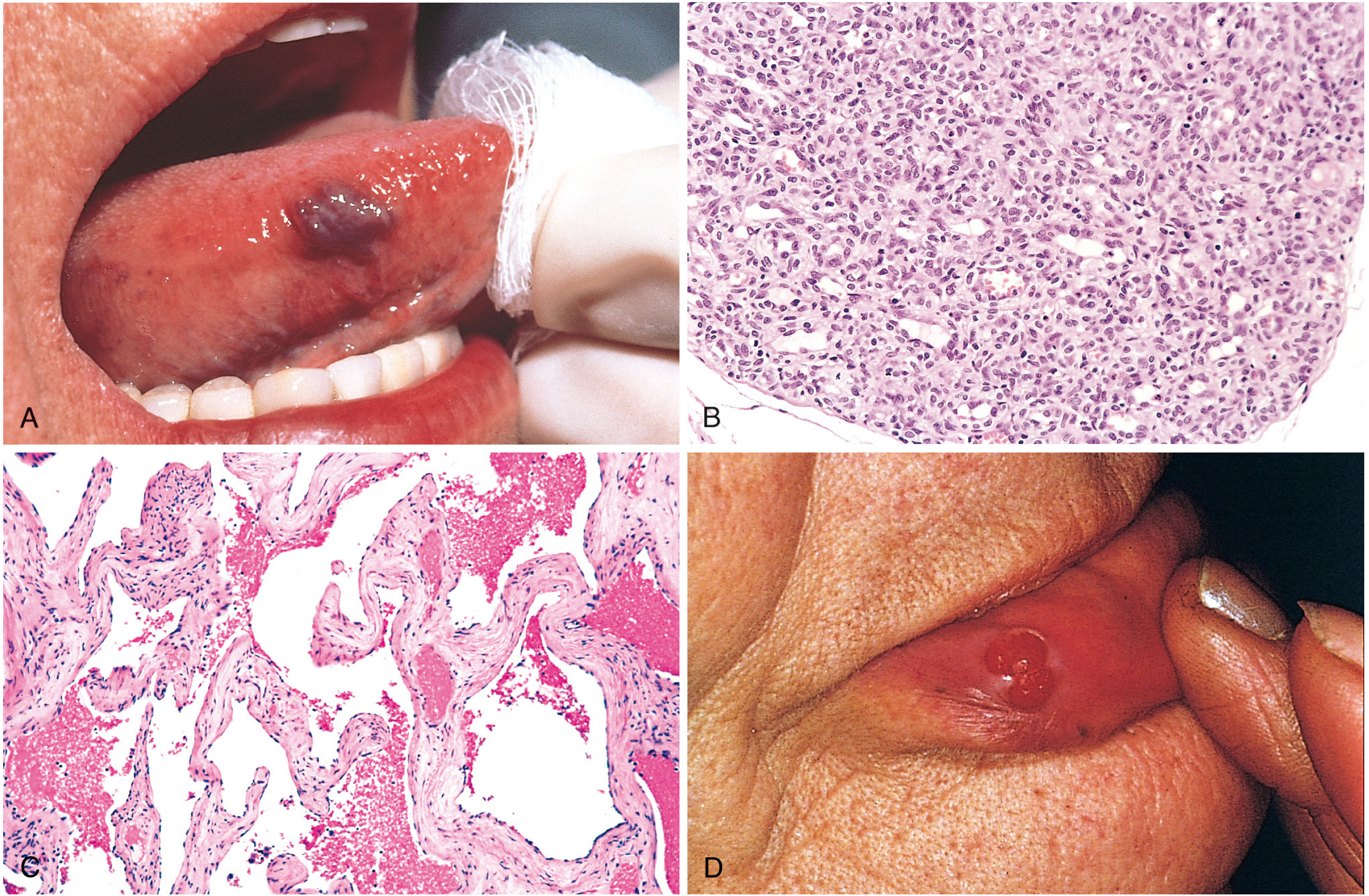
Fig. 11.29 - Robbins Pathologic Basis of Disease: (A) Hemangioma of the tongue (B) Juvenile capillary hemangioma - small thin-walled capillaries packed together with scant stroma (C) Cavernous hemangioma - large dilated blood-filled channels with fibrous walls (D) Pyogenic granuloma of the lip - red pedunculated lesion
General Features
- Malignant transformation is rare
- Most hemangiomas present early in life, initially increase in size, but many eventually regress spontaneously
- Typical location: Head, neck, and thoracic skin; also arise internally
- Nearly 1/3 of internal lesions occur in the liver
- Can occasionally be extensive - angiomatosis (widespread involvement)
Lymphangiomas (Benign Lymphatic Counterparts)
Since these are always asked alongside hemangiomas:
| Type | Features |
|---|---|
| Simple (capillary) lymphangioma | Slightly elevated/pedunculated, up to 1-2 cm; head, neck, axilla; distinguished from capillary channels by lymphatic markers (VEGFR-3, LYVE-1) or absence of RBCs |
| Cavernous lymphangioma (Cystic hygroma) | Neck/axilla in children; can be up to 15 cm; associated with Turner syndrome; massively dilated lymphatic spaces with lymphoid aggregates; unencapsulated, resection difficult |
Glomus Tumor (Glomangioma) - Distinguish from Hemangioma
- Origin: Modified smooth muscle cells of glomus bodies (NOT endothelial cells)
- Location: Distal digits, especially subungual (under fingernails)
- Clinically: Benign but exquisitely painful
- Treatment: Excision is curative
High-Yield Points for 2nd MBBS Exam
- Hemangioma = most common tumor of infancy and childhood
- Capillary hemangioma = most common type
- Juvenile (strawberry) hemangioma regresses completely by age 7 - no treatment needed
- Cavernous hemangioma = most common benign liver tumor
- Pyogenic granuloma = a capillary hemangioma (not a granuloma); bleeds easily; associated with trauma and pregnancy
- Granuloma gravidarum = pyogenic granuloma in pregnant females
- Malignant transformation in hemangioma is rare
- Cystic hygroma (cavernous lymphangioma) = associated with Turner syndrome
- Glomus tumor = painful subungual tumor from SMCs, NOT from ECs
Sources: Robbins & Cotran Pathologic Basis of Disease (10th ed.), p. 489-490; Robbins & Kumar Basic Pathology
This is a shared conversation. Sign in to Orris to start your own chat.