
Give a detailed notes on GERD regarding definition, causes, pathophysiology,signs and symptoms, investigation, treatment
Reading File
Now let me search the medical library and PubMed in parallel for comprehensive GERD coverage.
Finding Sources
Searching PubMed
"gastroesophageal reflux disease"[MeSH Terms] AND management
Excellent sources found. Now let me read the primary GI textbook content and search for specific subtopics in parallel.
Reading File
Reading File
Finding Sources
The first read was off-target (obesity chapter). Let me get the dedicated GERD chapters from Sleisenger and Schwartz's Surgery, plus search for treatment content.
Finding Sources
Finding Sources
Now let me read the most authoritative GERD sections from Sleisenger & Fordtran (primary GI textbook), Schwartz's Surgery, and Sabiston's Surgery in parallel:
Reading File
Reading File
Reading File
The block offsets led me to adjacent content. Let me now get the dedicated GERD chapter from Goldman-Cecil Medicine and the endoscopy textbook, which will have comprehensive adult GERD content:
Finding Sources
Reading File
Good content. Now let me search for the comprehensive GERD chapter from Goldman-Cecil and Sleisenger that will give definition, pathophysiology, signs/symptoms, and treatment:
Finding Sources
Finding Sources
Excellent. Now let me read the Goldman-Cecil GERD chapter and Robbins pathology section simultaneously:
Reading File
Reading File
Excellent content from Goldman-Cecil and Robbins. Let me continue reading both files for more clinical details, pathophysiology, and treatment:
Reading File
Reading File
Now let me get the treatment section from Goldman-Cecil and fetch key GERD diagnostic images:
Reading File
Loading Image
I now have comprehensive content from multiple authoritative textbooks. Let me also get the GERD treatment section from Goldman-Cecil (the section right above the drug table) and get a Barrett's esophagus image:
Reading File
Loading Image
I now have all the essential information needed from authoritative textbooks. Let me compile the comprehensive GERD notes.
Gastroesophageal Reflux Disease (GERD) — Detailed Notes
1. Definition
Gastroesophageal reflux disease (GERD) is a chronic disorder in which gastric contents (acid, pepsin, bile) reflux into the esophagus, causing mucosal injury and/or troublesome symptoms. It is distinguished from physiological gastroesophageal reflux (GER), which occurs transiently in all individuals, by its symptomatic nature and potential to cause tissue damage.
Reflux of gastric contents into the lower esophagus is the most frequent cause of esophagitis and the most common outpatient GI diagnosis in the United States. — Robbins Pathologic Basis of Disease
Prevalence: ~20–40% in Europe, North America, South America, and the Middle East; ≤10% in East Asia. Incidence has risen significantly over the last 20 years, paralleling the obesity epidemic.
2. Causes / Risk Factors
| Category | Specific Factors |
|---|---|
| Lifestyle | Obesity, smoking, alcohol, caffeine, spicy/fatty foods, large meals, late-night eating |
| Anatomical | Hiatal hernia (especially sliding type — most common), shortened intraabdominal esophageal segment |
| Physiological | Pregnancy, delayed gastric emptying, increased gastric volume |
| Pharmacological | CNS depressants, anticholinergics, calcium channel blockers, theophylline, β-agonists (reduce LES tone) |
| Metabolic | Obesity (especially abdominal) — raises intraabdominal pressure, reduces LES pressure, increases gastric acid production |
| Other | Scleroderma and connective tissue disorders (esophageal motility dysfunction), Zollinger-Ellison syndrome (hypersecretion) |
Obesity quantified: OR for GERD = 1.43 in overweight (BMI 25–29.9) vs. normal; rises to 1.94 in BMI >30. — Yamada's Textbook of Gastroenterology
3. Pathophysiology
GERD results from failure of the anti-reflux barrier and/or impaired esophageal clearance/mucosal defense.
3a. Anti-reflux Barrier Failure
Transient Lower Esophageal Sphincter Relaxation (tLESR) is the primary mechanism. This is mediated via vagal pathways and triggered by gastric distention (e.g., after meals). Unlike swallow-induced LES relaxation, tLESRs are not associated with esophageal peristalsis, allowing prolonged acid contact.
Other mechanisms include:
- Abrupt ↑ in intraabdominal pressure (coughing, bending, straining, Valsalva)
- Persistent ↓ in LES basal pressure (from drugs, alcohol, tobacco, obesity)
- Hiatal hernia: displaces the gastroesophageal junction into the thorax, disrupting the crural diaphragm's augmentation of LES tone and creating a "reservoir" for acid above the diaphragm
3b. Impaired Esophageal Clearance
- Reduced amplitude/frequency of peristaltic contractions → prolonged acid contact
- Decreased salivary bicarbonate production (e.g., in Sjögren's, smoking) → impaired acid neutralization
- Delayed gastric emptying → increased gastric volume → more reflux events
3c. Mucosal Defense Failure
Normal esophageal epithelium has surface mucus, bicarbonate secretion, tight intercellular junctions, and blood flow that limit damage. Chronic acid exposure overwhelms these defenses, causing:
- Intracellular acidification → epithelial cell damage
- Prostaglandin-mediated inflammation
- Reactive oxygen species production
3d. Tissue Injury Cascade
When protective mechanisms are overwhelmed, the injury sequence progresses:
Repeated acid/bile exposure
        ↓
Intercellular edema ("dilated intercellular spaces")
        ↓
Basal zone hyperplasia + elongation of lamina propria papillae
        ↓
Eosinophil/neutrophil infiltration → erosions → ulcers
        ↓
Fibrosis → peptic stricture
        ↓
Columnar metaplasia → Barrett's esophagus → adenocarcinoma
4. Signs and Symptoms
Typical (Esophageal) Symptoms
| Symptom | Description |
|---|---|
| Heartburn | Most common — substernal burning sensation, typically postprandial or when supine; worse on bending forward |
| Acid regurgitation | Sour-tasting gastric contents reaching the mouth or pharynx |
| Waterbrash | Sudden flood of saliva in the mouth (reflex salivary hypersecretion) |
| Belching | From air-swallowing or gas reflux |
Atypical (Esophageal) Symptoms
| Symptom | Description |
|---|---|
| Dysphagia | Difficulty swallowing — may signal stricture or Barrett's adenocarcinoma (alarm feature) |
| Odynophagia | Painful swallowing — suggests ulceration |
| Non-cardiac chest pain | Can be indistinguishable from angina; must exclude cardiac cause first |
Extraesophageal (Atypical) Manifestations
These occur due to microaspiration and/or vagally mediated reflexes:
| System | Manifestations |
|---|---|
| Respiratory | Chronic cough, asthma (particularly nocturnal), aspiration pneumonia, hoarseness (laryngitis), subglottic stenosis |
| ENT | Laryngitis, pharyngitis, sinusitis, otitis media, vocal cord granuloma |
| Oral | Dental enamel erosion (especially palatal surfaces of maxillary teeth), tooth sensitivity |
| Pediatric | Failure to thrive, recurrent vomiting, apnea/ALTE, recurrent bronchitis |
| Elderly | Atypical presentation — regurgitation, dyspepsia, noncardiac chest pain rather than classic heartburn |
Important: Severity of symptoms does NOT correlate well with histologic damage. — Robbins Pathology
Alarm Features (Red Flags — require urgent investigation)
- Dysphagia / odynophagia
- Unintentional weight loss
- GI bleeding (hematemesis, melena)
- Anemia
- Persistent heartburn unresponsive to 4–8 weeks of therapy
- Age >45 with new-onset symptoms
Complications
- Erosive esophagitis (grade A–D by Los Angeles classification)
- Peptic stricture — fibrotic narrowing causing progressive dysphagia to solids
- Barrett's esophagus — replacement of squamous by specialized intestinal-type columnar epithelium; premalignant (OR for Barrett's with obesity = 4.0)
- Esophageal adenocarcinoma — most serious complication; RR 4.8 in obese patients
- Pulmonary complications — aspiration pneumonia, pulmonary fibrosis
5. Investigations
Clinical Diagnosis (Often Sufficient)
- Classic heartburn + acid regurgitation responding to empiric antisecretory therapy = clinical diagnosis of GERD; no further workup required in uncomplicated cases.
When to Investigate
| Investigation | Indication & What It Shows |
|---|---|
| Upper GI Endoscopy (EGD) | Gold standard for mucosal assessment. Indicated for alarm symptoms, failure of empiric therapy after 4–8 weeks, screening for Barrett's esophagus. Finds erosive esophagitis (Los Angeles Grade A–D), ulcers, strictures, Barrett's. ~2/3 of GERD patients have normal endoscopy. Biopsies exclude eosinophilic esophagitis. |
| 24-hour Ambulatory pH Monitoring | Documents abnormal acid exposure (pH <4 for >4–6% of total time). Gold standard for diagnosis of acid GERD when endoscopy is normal. Can correlate symptoms with reflux events (symptom index). |
| 48–96 Hour Wireless pH Capsule | Better tolerated than nasal catheter; increases diagnostic yield by capturing day-to-day variation. |
| Combined Impedance-pH Monitoring | Detects BOTH acid AND non-acid reflux by measuring intraluminal conductance changes. Best test for patients with persistent symptoms on PPI therapy. |
| Esophageal Manometry (High-Resolution) | Measures LES pressure, esophageal body peristalsis. Used to exclude achalasia before anti-reflux surgery; identifies weak peristalsis (risk factor for post-fundoplication dysphagia). Not diagnostic for GERD per se. |
| Barium Swallow | Limited role — shows hiatal hernia, peptic stricture, gross motility disorders. No role in routine uncomplicated GERD diagnosis. Useful in pediatric workup. |
| Radionuclide Gastric Emptying Scan | Tc-99m-labeled meal; normal = 50% emptied at 60 min, ~80% at 90 min. Used when delayed gastric emptying is suspected. |
| Empiric PPI Trial | 4–8 weeks of once-daily PPI; symptomatic relief supports GERD diagnosis (sensitivity ~70%). |
Histological Findings in Reflux Esophagitis (on biopsy)
- Basal zone hyperplasia
- Elongation of lamina propria papillae
- Intercellular edema (dilated intercellular spaces)
- Eosinophil infiltration into squamous mucosa
- "Balloon cells" (distended pale squamous cells)
- Surface erosions/ulceration in severe cases
- Changes most prominent in distal 8–10 cm; biopsy >2 cm above GEJ for reliability
(Endoscopic view of reflux esophagitis showing multiple erosions — arrows indicate erosions, arrowhead indicates metaplastic Barrett's patches)
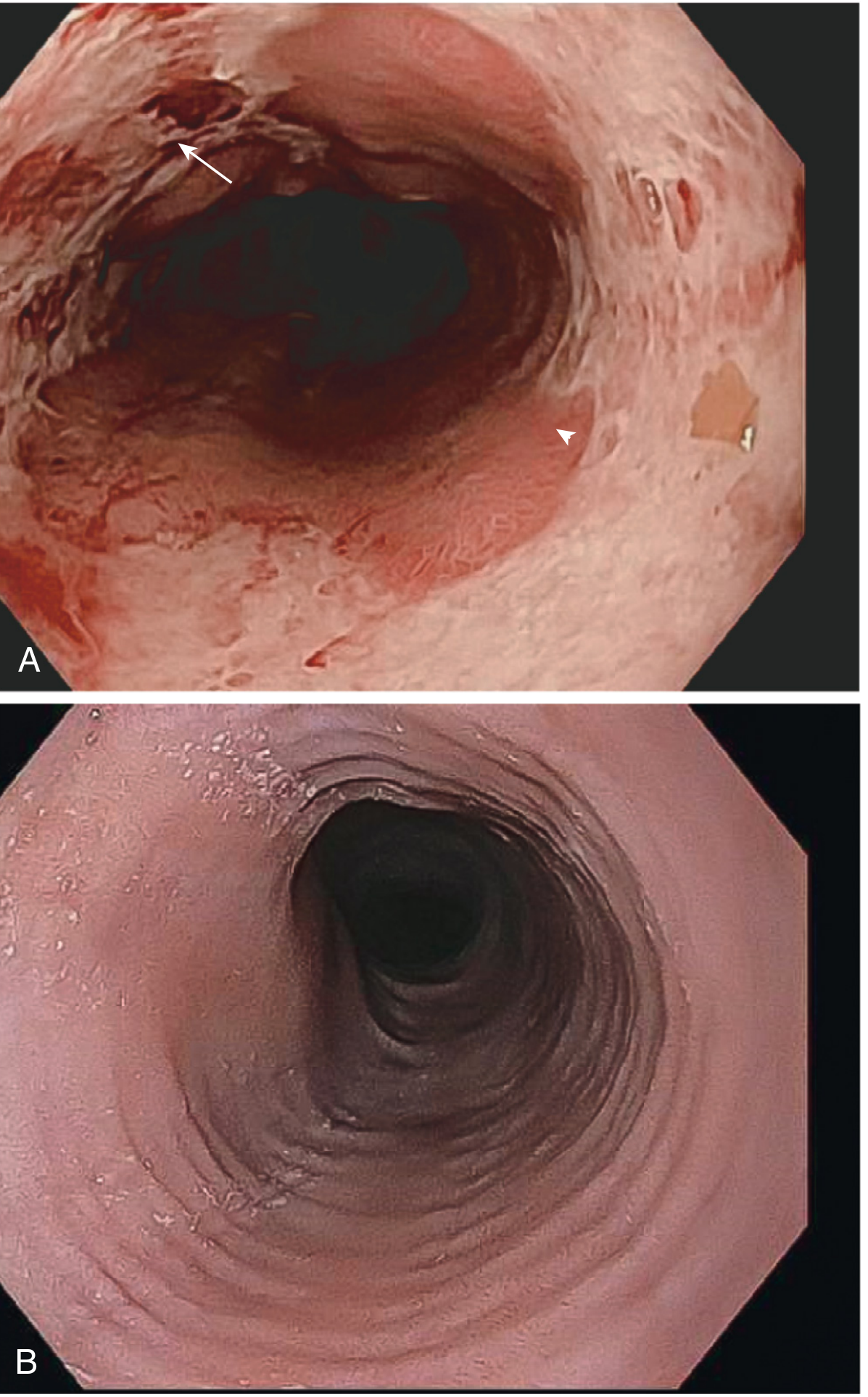
Fig. 17.6 — Robbins Pathologic Basis of Disease. (A) Endoscopic view of reflux esophagitis with erosions (arrow) and tan metaplastic Barrett's epithelium (arrowhead). (B) "Feline" ringed appearance typical of eosinophilic esophagitis for comparison.
6. Treatment
Treatment is stepwise — lifestyle modification → pharmacotherapy → surgery.
Step 1: Lifestyle Modifications
| Modification | Rationale |
|---|---|
| Weight loss (especially abdominal) | Reduces intraabdominal pressure; most evidence-based lifestyle intervention |
| Elevate head of bed (6–8 inches / wedge) | Reduces nocturnal supine reflux |
| Avoid late meals (≥3 hours before bedtime) | Allows gastric emptying before recumbency |
| Avoid triggers: alcohol, coffee, spicy/fatty foods, chocolate, peppermint | Reduce gastric acid or lower LES tone |
| Small, frequent meals | Reduces gastric distension |
| Avoid tight clothing | Reduces intraabdominal pressure |
| Smoking cessation | Tobacco reduces LES tone and impairs mucosal defence |
Note: While physiologically rational, clinical trial evidence for dietary modifications alone is limited. — Goldman-Cecil Medicine
Step 2: Pharmacological Treatment
A. Antacids
- Mechanism: Neutralize gastric acid, transiently increase LES pressure
- Agents: Mylanta, Maalox (Al/Mg hydroxide combinations), calcium carbonate
- Dose: 15 mL QID — 1 hour after meals and at bedtime
- Role: Rapid but short-lived symptom relief for mild/infrequent GERD; not for maintenance
B. Alginates (Gaviscon)
- Mechanism: Forms a viscous mechanical raft on top of gastric contents, acting as a physical barrier against reflux; also buffers acid
- Composition: Al(OH)₃ + NaHCO₃ + Mg trisilicate + alginic acid
- Dose: 2–4 tablets QID and at bedtime
- Role: Useful for postprandial heartburn, especially in pregnancy
C. H₂-Receptor Antagonists (H2RAs)
- Mechanism: Competitively block histamine H₂ receptors on parietal cells → ↓ acid secretion
- Agents & Doses:
- Cimetidine 400 mg BD or 200 mg QID
- Ranitidine 150 mg BD–QID
- Famotidine 20–40 mg BD
- Nizatidine 150 mg BD
- Role: Second-line when PPIs not available/tolerated; useful for nocturnal symptoms. Less effective than PPIs for esophagitis healing. Subject to tachyphylaxis with continuous use.
D. Proton Pump Inhibitors (PPIs) ⭐ Cornerstone of treatment
- Mechanism: Irreversibly inhibit H⁺/K⁺-ATPase (proton pump) on parietal cell canalicular membrane → profound suppression of acid secretion. Activated in acidic environment → taken 30 minutes before meals for maximum efficacy.
- Agents & Doses:
| Drug | Acute Dose | Maintenance Dose |
|---|---|---|
| Omeprazole | 20–40 mg/day | 20 mg/day |
| Lansoprazole | 15–30 mg/day | 15 mg/day |
| Pantoprazole | 40 mg/day | 40 mg/day |
| Rabeprazole | 20 mg/day | 10–20 mg/day |
| Esomeprazole | 20–40 mg/day | 20 mg/day |
| Dexlansoprazole | 30–60 mg/day | 30 mg/day |
- Efficacy: PPIs are superior to H2RAs for both healing of esophagitis and symptom control. Twice-daily dosing heals esophagitis faster but not symptoms faster vs. once-daily. Symptomatic relief in up to 90% of patients.
- Safety concerns with long-term use: Vitamin B12 deficiency, Clostridioides difficile infection, community-acquired pneumonia, hip fracture/metabolic bone disease, hypomagnesemia, small intestinal bacterial overgrowth.
- PPI-refractory GERD: Consider combined impedance-pH monitoring to identify non-acid reflux; if confirmed acid reflux, consider dose escalation or surgical referral.
E. Prokinetics
- Metoclopramide: Increases LES pressure and gastric emptying. However, no high-quality evidence supports its use in GERD; neurological side effects (tardive dyskinesia) limit its use. Not routinely recommended.
Step 3: Endoscopic Therapies (for selected patients)
- Transoral Incisionless Fundoplication (TIF): Endoscopic reconstruction of the gastroesophageal valve; normalizes acid exposure in ~50% of patients
- Radiofrequency ablation (Stretta): Delivers RF energy to LES/cardia to improve barrier function
- Magnetic sphincter augmentation (LINX): Implanted ring of magnetic beads around LES
Step 4: Surgical Treatment — Anti-reflux Surgery
Indications:
- Documented esophagitis not responsive to or intolerant of PPIs
- Persistent voluminous regurgitation despite PPI therapy (PPIs control acid but not volume)
- Patient preference to avoid lifelong medication
- Complications (stricture, large hiatal hernia)
Gold standard: Nissen Fundoplication (360° wrap)
- Fundus of stomach wrapped 360° around distal esophagus to augment LES
- Performed laparoscopically (standard of care)
- Equivalent to PPI therapy for esophagitis healing and symptom control
- Superior to PPIs for persistent regurgitation
- Complications: Dysphagia (too tight a wrap), gas bloat syndrome, vagal nerve injury, diarrhea; ~15–20% recurrence requiring repeat procedure
Partial wraps:
- Toupet (270° posterior wrap) — lower dysphagia rate; preferred in poor motility
- Dor (270° anterior wrap)
Pediatric: Same principles apply; Nissen fundoplication is gold standard for children with GERD unresponsive to medical therapy. Gastrostomy tube placed concurrently in infants <1 year.
Treatment of Complications
| Complication | Management |
|---|---|
| Peptic stricture | Endoscopic balloon/bougie dilation + long-term PPI; surgical correction if recurrent |
| Barrett's esophagus | Surveillance endoscopy every 3–5 years (no dysplasia); endoscopic ablation (radiofrequency ablation, cryotherapy) for dysplasia; esophagectomy for high-grade dysplasia/early carcinoma |
| Esophageal adenocarcinoma | Endoscopic mucosal resection (early), esophagectomy, +/- neoadjuvant chemoradiation |
Summary Table
| Aspect | Key Points |
|---|---|
| Definition | Chronic symptomatic reflux of gastric contents causing mucosal injury |
| Primary mechanism | Transient LES relaxations (vagal-mediated) |
| Classic symptoms | Heartburn, acid regurgitation |
| Gold standard dx | 24-hr pH monitoring (acid exposure); EGD (mucosal damage) |
| First-line treatment | Lifestyle changes + PPI once daily before meals |
| Definitive surgery | Laparoscopic Nissen fundoplication |
| Dreaded complication | Barrett's esophagus → esophageal adenocarcinoma |
Sources: Goldman-Cecil Medicine (26th ed.), Robbins Pathologic Basis of Disease (10th ed.), Yamada's Textbook of Gastroenterology (7th ed.), Clinical Gastrointestinal Endoscopy (3rd ed.), Schwartz's Principles of Surgery (11th ed.), Sabiston Textbook of Surgery
Create a summary document or PDF quick-reference guide on GERD management
Reading File
Reading File
Running Command
ls -la /home/daytona/workspace/ 2>/dev/null || echo "workspace empty or missing"
Running Command
mkdir -p /home/daytona/workspace/gerd-guide && python3 -c "import reportlab; print('reportlab ok')"
Writing File
~/gerd-guide/generate_gerd_pdf.py
#!/usr/bin/env python3
"""
GERD Quick-Reference Guide PDF Generator
Uses reportlab with a clean, clinical design.
"""
from reportlab.lib.pagesizes import A4
from reportlab.lib import colors
from reportlab.lib.units import cm, mm
from reportlab.lib.styles import getSampleStyleSheet, ParagraphStyle
from reportlab.lib.enums import TA_LEFT, TA_CENTER, TA_JUSTIFY
from reportlab.platypus import (
SimpleDocTemplate, Paragraph, Spacer, Table, TableStyle,
HRFlowable, KeepTogether, PageBreak
)
from reportlab.platypus.flowables import HRFlowable
from reportlab.lib.colors import HexColor
# ── Colour palette ────────────────────────────────────────────────────────────
BLUE_DARK = HexColor("#1a3a5c") # dark navy – headings / header
BLUE_MID = HexColor("#2e6da4") # medium blue – section bars
BLUE_LIGHT = HexColor("#dbeaf7") # pale blue – table alternating rows
RED_ALERT = HexColor("#c0392b") # alarm / warning red
GREEN_OK = HexColor("#1e8449") # treatment green
ORANGE = HexColor("#d35400") # highlights
GREY_TEXT = HexColor("#2c3e50") # body text
GREY_LINE = HexColor("#bdc3c7")
WHITE = colors.white
BG_HEADER = BLUE_DARK
PAGE_W, PAGE_H = A4 # 595 x 842 pt
MARGIN = 1.8 * cm
OUTPUT = "/home/daytona/workspace/gerd-guide/GERD_Quick_Reference.pdf"
# ── Styles ────────────────────────────────────────────────────────────────────
def make_styles():
base = getSampleStyleSheet()
s = {}
s["doc_title"] = ParagraphStyle(
"doc_title",
fontName="Helvetica-Bold",
fontSize=22,
textColor=WHITE,
alignment=TA_CENTER,
spaceAfter=2,
leading=26,
)
s["doc_subtitle"] = ParagraphStyle(
"doc_subtitle",
fontName="Helvetica",
fontSize=11,
textColor=HexColor("#aed6f1"),
alignment=TA_CENTER,
spaceAfter=4,
)
s["section_header"] = ParagraphStyle(
"section_header",
fontName="Helvetica-Bold",
fontSize=11,
textColor=WHITE,
alignment=TA_LEFT,
spaceBefore=4,
spaceAfter=4,
leftIndent=6,
)
s["subsection"] = ParagraphStyle(
"subsection",
fontName="Helvetica-Bold",
fontSize=9.5,
textColor=BLUE_DARK,
spaceBefore=6,
spaceAfter=2,
)
s["body"] = ParagraphStyle(
"body",
fontName="Helvetica",
fontSize=8.5,
textColor=GREY_TEXT,
leading=12,
spaceAfter=3,
alignment=TA_JUSTIFY,
)
s["bullet"] = ParagraphStyle(
"bullet",
fontName="Helvetica",
fontSize=8.5,
textColor=GREY_TEXT,
leading=12,
leftIndent=10,
firstLineIndent=-8,
spaceAfter=2,
)
s["small_bold"] = ParagraphStyle(
"small_bold",
fontName="Helvetica-Bold",
fontSize=8,
textColor=BLUE_DARK,
)
s["table_header"] = ParagraphStyle(
"table_header",
fontName="Helvetica-Bold",
fontSize=8,
textColor=WHITE,
alignment=TA_CENTER,
)
s["table_cell"] = ParagraphStyle(
"table_cell",
fontName="Helvetica",
fontSize=8,
textColor=GREY_TEXT,
leading=10,
)
s["table_cell_bold"] = ParagraphStyle(
"table_cell_bold",
fontName="Helvetica-Bold",
fontSize=8,
textColor=GREY_TEXT,
leading=10,
)
s["alert"] = ParagraphStyle(
"alert",
fontName="Helvetica-Bold",
fontSize=8.5,
textColor=RED_ALERT,
leading=12,
leftIndent=10,
firstLineIndent=-8,
)
s["footer"] = ParagraphStyle(
"footer",
fontName="Helvetica",
fontSize=7,
textColor=HexColor("#7f8c8d"),
alignment=TA_CENTER,
)
return s
# ── Helper builders ───────────────────────────────────────────────────────────
def section_bar(title, s):
"""Returns a coloured section-header bar."""
p = Paragraph(title, s["section_header"])
tbl = Table([[p]], colWidths=[PAGE_W - 2 * MARGIN])
tbl.setStyle(TableStyle([
("BACKGROUND", (0, 0), (-1, -1), BLUE_MID),
("TOPPADDING", (0, 0), (-1, -1), 5),
("BOTTOMPADDING", (0, 0), (-1, -1), 5),
("LEFTPADDING", (0, 0), (-1, -1), 8),
("RIGHTPADDING", (0, 0), (-1, -1), 8),
("ROUNDEDCORNERS", [4]),
]))
return tbl
def two_col_table(data, col_widths, s, header_bg=BLUE_DARK):
"""Styled two-column table with alternating rows."""
rows = []
for i, row in enumerate(data):
rows.append([
Paragraph(str(row[0]), s["table_cell_bold"] if i == 0 else s["table_cell"]),
Paragraph(str(row[1]), s["table_header"] if i == 0 else s["table_cell"]),
])
style = [
("BACKGROUND", (0, 0), (-1, 0), header_bg),
("TEXTCOLOR", (0, 0), (-1, 0), WHITE),
("FONTNAME", (0, 0), (-1, 0), "Helvetica-Bold"),
("FONTSIZE", (0, 0), (-1, 0), 8),
("ALIGN", (0, 0), (-1, 0), "CENTER"),
("TOPPADDING", (0, 0), (-1, -1), 4),
("BOTTOMPADDING", (0, 0), (-1, -1), 4),
("LEFTPADDING", (0, 0), (-1, -1), 6),
("RIGHTPADDING", (0, 0), (-1, -1), 6),
("GRID", (0, 0), (-1, -1), 0.4, GREY_LINE),
("VALIGN", (0, 0), (-1, -1), "MIDDLE"),
]
for i in range(1, len(rows)):
bg = BLUE_LIGHT if i % 2 == 0 else WHITE
style.append(("BACKGROUND", (0, i), (-1, i), bg))
tbl = Table(rows, colWidths=col_widths)
tbl.setStyle(TableStyle(style))
return tbl
def three_col_table(data, col_widths, s, header_bg=BLUE_DARK):
rows = []
for i, row in enumerate(data):
if i == 0:
rows.append([Paragraph(str(c), s["table_header"]) for c in row])
else:
rows.append([Paragraph(str(c), s["table_cell"]) for c in row])
style = [
("BACKGROUND", (0, 0), (-1, 0), header_bg),
("TEXTCOLOR", (0, 0), (-1, 0), WHITE),
("FONTNAME", (0, 0), (-1, 0), "Helvetica-Bold"),
("FONTSIZE", (0, 0), (-1, 0), 8),
("ALIGN", (0, 0), (-1, 0), "CENTER"),
("TOPPADDING", (0, 0), (-1, -1), 4),
("BOTTOMPADDING", (0, 0), (-1, -1), 4),
("LEFTPADDING", (0, 0), (-1, -1), 6),
("RIGHTPADDING", (0, 0), (-1, -1), 6),
("GRID", (0, 0), (-1, -1), 0.4, GREY_LINE),
("VALIGN", (0, 0), (-1, -1), "MIDDLE"),
]
for i in range(1, len(rows)):
bg = BLUE_LIGHT if i % 2 == 0 else WHITE
style.append(("BACKGROUND", (0, i), (-1, i), bg))
tbl = Table(rows, colWidths=col_widths)
tbl.setStyle(TableStyle(style))
return tbl
def alert_box(text_lines, s):
"""Red-bordered alert box."""
content = [Paragraph(f"⚠ {line}", s["alert"]) for line in text_lines]
inner = Table([[c] for c in content], colWidths=[PAGE_W - 2*MARGIN - 20])
inner.setStyle(TableStyle([
("TOPPADDING", (0, 0), (-1, -1), 2),
("BOTTOMPADDING", (0, 0), (-1, -1), 2),
("LEFTPADDING", (0, 0), (-1, -1), 4),
]))
outer = Table([[inner]], colWidths=[PAGE_W - 2*MARGIN])
outer.setStyle(TableStyle([
("BOX", (0, 0), (-1, -1), 1.5, RED_ALERT),
("BACKGROUND", (0, 0), (-1, -1), HexColor("#fdf2f2")),
("TOPPADDING", (0, 0), (-1, -1), 6),
("BOTTOMPADDING", (0, 0), (-1, -1), 6),
("LEFTPADDING", (0, 0), (-1, -1), 8),
("RIGHTPADDING", (0, 0), (-1, -1), 8),
]))
return outer
def info_box(text_lines, s, bg=HexColor("#eafaf1"), border=GREEN_OK):
content = [Paragraph(f"✓ {line}", s["bullet"]) for line in text_lines]
inner = Table([[c] for c in content], colWidths=[PAGE_W - 2*MARGIN - 20])
inner.setStyle(TableStyle([
("TOPPADDING", (0, 0), (-1, -1), 2),
("BOTTOMPADDING", (0, 0), (-1, -1), 2),
]))
outer = Table([[inner]], colWidths=[PAGE_W - 2*MARGIN])
outer.setStyle(TableStyle([
("BOX", (0, 0), (-1, -1), 1.5, border),
("BACKGROUND", (0, 0), (-1, -1), bg),
("TOPPADDING", (0, 0), (-1, -1), 6),
("BOTTOMPADDING", (0, 0), (-1, -1), 6),
("LEFTPADDING", (0, 0), (-1, -1), 8),
("RIGHTPADDING", (0, 0), (-1, -1), 8),
]))
return outer
# ── Header / footer callbacks ─────────────────────────────────────────────────
def on_first_page(canvas, doc):
w, h = A4
# Header banner
canvas.setFillColor(BG_HEADER)
canvas.rect(0, h - 80, w, 80, fill=1, stroke=0)
# Title
canvas.setFillColor(WHITE)
canvas.setFont("Helvetica-Bold", 22)
canvas.drawCentredString(w / 2, h - 38, "GASTROESOPHAGEAL REFLUX DISEASE (GERD)")
canvas.setFont("Helvetica", 11)
canvas.setFillColor(HexColor("#aed6f1"))
canvas.drawCentredString(w / 2, h - 56, "Quick-Reference Management Guide")
canvas.setFont("Helvetica", 9)
canvas.drawCentredString(w / 2, h - 70, "Based on Goldman-Cecil Medicine | Robbins Pathology | Yamada's Gastroenterology | Schwartz's Surgery")
# Footer
canvas.setFillColor(HexColor("#7f8c8d"))
canvas.setFont("Helvetica", 7)
canvas.drawCentredString(w / 2, 18, f"Page {doc.page} | GERD Quick-Reference Guide | For educational use only")
canvas.setStrokeColor(GREY_LINE)
canvas.line(MARGIN, 28, w - MARGIN, 28)
def on_later_pages(canvas, doc):
w, h = A4
# Slim header bar
canvas.setFillColor(BLUE_MID)
canvas.rect(0, h - 28, w, 28, fill=1, stroke=0)
canvas.setFillColor(WHITE)
canvas.setFont("Helvetica-Bold", 9)
canvas.drawCentredString(w / 2, h - 16, "GERD Quick-Reference Guide")
# Footer
canvas.setFillColor(HexColor("#7f8c8d"))
canvas.setFont("Helvetica", 7)
canvas.drawCentredString(w / 2, 18, f"Page {doc.page} | GERD Quick-Reference Guide | For educational use only")
canvas.setStrokeColor(GREY_LINE)
canvas.line(MARGIN, 28, w - MARGIN, 28)
# ── Main content builder ──────────────────────────────────────────────────────
def build_story(s):
story = []
W = PAGE_W - 2 * MARGIN # usable width
def sp(n=6): return Spacer(1, n)
def hr(): return HRFlowable(width=W, thickness=0.5, color=GREY_LINE, spaceAfter=4, spaceBefore=4)
# ── PAGE 1 ───────────────────────────────────────────────────────────────
story.append(sp(10))
# ── 1. DEFINITION & EPIDEMIOLOGY ─────────────────────────────────────────
story.append(section_bar("1. DEFINITION & EPIDEMIOLOGY", s))
story.append(sp(4))
story.append(Paragraph(
"GERD is a <b>chronic disorder</b> in which gastric contents (acid, pepsin, bile) reflux "
"into the esophagus, causing mucosal injury and/or troublesome symptoms — distinguished "
"from physiological GER by its clinical impact.",
s["body"]
))
epi_data = [
["Parameter", "Key Figure"],
["Global prevalence (Western)", "20–40% | East Asia: <10%"],
["US annual outpatient visits", "Most common GI outpatient diagnosis"],
["Obesity (BMI >30) OR for GERD", "1.94 vs. normal weight"],
["GERD → Barrett's esophagus OR", "4.0 (95% CI 1.4–11.1)"],
["PPI symptom relief rate", "Up to 90% of patients"],
]
story.append(two_col_table(epi_data, [W*0.45, W*0.55], s))
story.append(sp(8))
# ── 2. RISK FACTORS ───────────────────────────────────────────────────────
story.append(section_bar("2. RISK FACTORS / CAUSES", s))
story.append(sp(4))
rf_data = [
["Category", "Specific Factors"],
["Lifestyle", "Obesity (esp. abdominal), smoking, alcohol, caffeine, fatty/spicy foods, large late meals"],
["Anatomical", "Hiatal hernia (sliding >95%), short intraabdominal esophageal segment"],
["Physiological", "Pregnancy, delayed gastric emptying, increased gastric volume/acid secretion"],
["Drugs", "Anticholinergics, CCBs, theophylline, beta-agonists, nitrates, NSAIDs, bisphosphonates"],
["Systemic disease", "Scleroderma, CREST syndrome (oesophageal dysmotility), Zollinger-Ellison syndrome"],
["Other", "CNS depressants, nasogastric tubes, post-surgical (e.g. Heller myotomy)"],
]
story.append(two_col_table(rf_data, [W*0.25, W*0.75], s))
story.append(sp(8))
# ── 3. PATHOPHYSIOLOGY ───────────────────────────────────────────────────
story.append(section_bar("3. PATHOPHYSIOLOGY", s))
story.append(sp(4))
story.append(Paragraph("<b>Three-layer failure model:</b>", s["subsection"]))
patho_data = [
["Mechanism", "Detail"],
["Transient LES Relaxation (tLESR) — PRIMARY",
"Vagally-mediated; triggered by gastric distension; unaccompanied by peristalsis → prolonged acid exposure"],
["Decreased basal LES pressure",
"Drugs, alcohol, tobacco, obesity, scleroderma → persistent LES incompetence"],
["Hiatal hernia",
"Displaces GEJ into thorax; disrupts crural diaphragm augmentation; creates acid reservoir above diaphragm"],
["Impaired esophageal clearance",
"Weak peristalsis → prolonged acid contact; reduced saliva (bicarbonate) — worsened by smoking"],
["Increased intraabdominal pressure",
"Obesity, pregnancy, coughing, straining, bending → overcomes LES barrier transiently"],
["Mucosal defence failure",
"Breakdown of tight junctions, mucus layer, bicarbonate secretion → intracellular acidification → inflammation"],
]
story.append(two_col_table(patho_data, [W*0.35, W*0.65], s))
story.append(sp(4))
story.append(Paragraph("<b>Injury cascade:</b> Acid exposure → intercellular oedema → basal hyperplasia / papillary elongation "
"→ eosinophil infiltration → erosions / ulcers → fibrosis (stricture) → columnar metaplasia "
"(Barrett's) → adenocarcinoma", s["body"]))
story.append(sp(8))
# ── 4. SIGNS & SYMPTOMS ──────────────────────────────────────────────────
story.append(section_bar("4. SIGNS & SYMPTOMS", s))
story.append(sp(4))
# Two side-by-side mini tables
typical_data = [
["Typical (Esophageal)", "Description"],
["Heartburn", "Substernal burning, postprandial / supine, worsened bending forward"],
["Acid regurgitation", "Sour/bitter taste reaching pharynx or mouth"],
["Waterbrash", "Sudden flood of saliva (reflex hypersalivation)"],
["Belching", "Air swallowing / gas reflux"],
["Dysphagia*", "Solid food sticking — may signal stricture (alarm)"],
["Odynophagia*", "Painful swallowing — suggests ulceration"],
["Chest pain", "May mimic cardiac angina; exclude cardiac cause first"],
]
atypical_data = [
["Extraesophageal (Atypical)", "Mechanism"],
["Chronic cough", "Microaspiration / vagal reflex"],
["Laryngitis / hoarseness", "Acid injury to larynx"],
["Asthma exacerbation", "Vagal reflex bronchospasm / aspiration"],
["Dental enamel erosion", "Acid dissolves palatal enamel (irreversible)"],
["Sinusitis / otitis media", "Proposed — less clear causality"],
["Pharyngitis / throat clearing", "Laryngopharyngeal reflux"],
["Aspiration pneumonia", "Microaspiration of gastric contents"],
]
t1 = two_col_table(typical_data, [W*0.3, W*0.2], s)
t2 = two_col_table(atypical_data, [W*0.3, W*0.2], s)
side_by_side = Table([[t1, sp(6), t2]], colWidths=[W*0.48, 6, W*0.48])
side_by_side.setStyle(TableStyle([("VALIGN", (0,0), (-1,-1), "TOP")]))
story.append(side_by_side)
story.append(sp(4))
story.append(Paragraph(
"<i>*Severity of symptoms does NOT correlate with degree of histologic damage (Robbins Pathology).</i>",
s["body"]
))
story.append(sp(6))
# Alarm features
story.append(alert_box([
"ALARM FEATURES — require urgent endoscopy / investigation:",
"Dysphagia or odynophagia | Unintentional weight loss | GI bleeding (haematemesis / melaena)",
"Iron-deficiency anaemia | Persistent symptoms despite 4–8 weeks PPI | Age >45, new-onset symptoms",
], s))
story.append(sp(8))
# ── COMPLICATIONS ─────────────────────────────────────────────────────────
story.append(section_bar("5. COMPLICATIONS", s))
story.append(sp(4))
comp_data = [
["Complication", "Features", "Management Overview"],
["Erosive Esophagitis\n(LA Grade A–D)",
"Grade A: <5 mm breaks; Grade D: >75% circumference with ulcers",
"PPI therapy; heal in 4–8 weeks"],
["Peptic Stricture",
"Progressive solid-food dysphagia; fibrous narrowing distal esophagus",
"Endoscopic dilation (balloon/bougie) + long-term PPI"],
["Barrett's Esophagus",
"Columnar (intestinal) metaplasia; salmon-pink mucosa on endoscopy; OR 4.0 with obesity",
"Surveillance EGD q3–5 yr; RFA / cryoablation for dysplasia"],
["Esophageal Adenocarcinoma",
"Arises from Barrett's high-grade dysplasia; RR 4.8 in obese; dysphagia + weight loss",
"EMR (early) / esophagectomy + neo-adjuvant CRT"],
["Aspiration Pneumonia",
"Nocturnal microaspiration; recurrent lower lobe infiltrates",
"Optimize acid suppression; consider antireflux surgery"],
]
cw = [W*0.23, W*0.42, W*0.35]
story.append(three_col_table(comp_data, cw, s))
story.append(sp(10))
# ── PAGE 2 ───────────────────────────────────────────────────────────────
story.append(PageBreak())
# ── 6. INVESTIGATIONS ────────────────────────────────────────────────────
story.append(sp(10))
story.append(section_bar("6. INVESTIGATIONS", s))
story.append(sp(4))
story.append(Paragraph(
"<b>Clinical diagnosis is sufficient</b> when classic heartburn + regurgitation respond to empiric PPI therapy. "
"Investigate when alarm features are present, symptoms are atypical, or treatment fails after 4–8 weeks.",
s["body"]
))
story.append(sp(4))
inv_data = [
["Investigation", "Indication", "Key Findings / Notes"],
["Empiric PPI Trial\n(4–8 weeks)",
"Typical symptoms, no alarm features",
"~70% sensitivity; response supports GERD diagnosis"],
["Upper GI Endoscopy (EGD)",
"Alarm symptoms; PPI failure; Barrett's screening",
"Erosions, ulcers, stricture, Barrett's; ~2/3 GERD pts have NORMAL endoscopy"],
["24-hr Ambulatory pH\nMonitoring",
"EGD normal + symptoms persist (OFF PPI)",
"Gold standard for acid exposure; pH <4 for >4–6% = abnormal; correlates symptom-reflux"],
["48–96 hr Wireless pH\nCapsule (Bravo)",
"Better tolerated alternative to nasal catheter",
"Higher diagnostic yield; day-to-day variation captured"],
["Combined Impedance-pH\nMonitoring (MII-pH)",
"Persistent symptoms ON PPI",
"Detects acid AND non-acid reflux; best for PPI-refractory GERD"],
["High-Resolution\nManometry (HRM)",
"Pre-surgical evaluation; exclude achalasia",
"Measures LES pressure + peristalsis; identifies poor motility (risk for wrap dysphagia)"],
["Barium Swallow",
"Structural assessment (stricture, hernia)\nPaediatric workup",
"NOT recommended for routine uncomplicated GERD; limited sensitivity/specificity"],
["Gastric Emptying Scan\n(Tc-99m)",
"Suspected gastroparesis contributing to GERD",
"Normal: 50% emptied at 60 min, ~80% at 90 min"],
]
story.append(three_col_table(inv_data, [W*0.24, W*0.31, W*0.45], s))
story.append(sp(4))
story.append(Paragraph(
"<b>Histology on biopsy:</b> Basal zone hyperplasia | Papillary elongation | Intercellular oedema "
"| Eosinophil infiltration | 'Balloon' cells | Erosions (severe). "
"Biopsies should be taken >2 cm above GEJ. Changes most prominent in distal 8–10 cm.",
s["body"]
))
story.append(sp(8))
# ── 7. TREATMENT ─────────────────────────────────────────────────────────
story.append(section_bar("7. TREATMENT — STEPWISE APPROACH", s))
story.append(sp(4))
# Step 1 – Lifestyle
story.append(Paragraph("STEP 1 — Lifestyle Modifications", s["subsection"]))
story.append(info_box([
"Weight loss (strongest evidence — reduces intraabdominal pressure and gastric acid production)",
"Elevate head of bed 6–8 inches / wedge pillow — for nocturnal heartburn",
"Avoid meals <3 hours before lying down",
"Avoid triggers: alcohol, caffeine, spicy/fatty foods, chocolate, peppermint, carbonated drinks",
"Small, frequent meals; eat slowly",
"Smoking cessation (reduces LES tone + impairs mucosal defence)",
"Avoid tight abdominal clothing",
"Review medications that lower LES tone (CCBs, nitrates, anticholinergics)",
], s))
story.append(sp(6))
# Step 2 – Pharmacotherapy
story.append(Paragraph("STEP 2 — Pharmacological Treatment", s["subsection"]))
story.append(sp(3))
drug_data = [
["Drug Class", "Agent / Dose", "Mechanism", "Role / Notes"],
["Antacids",
"Al/Mg hydroxide 15 mL QID\n1 hr after meals + bedtime",
"Neutralise gastric acid; transiently increase LES pressure",
"Rapid but short-lived relief; mild / infrequent GERD; NOT for maintenance"],
["Alginates\n(Gaviscon)",
"2–4 tablets QID + bedtime\n(Al(OH)3 + NaHCO3 + alginic acid)",
"Forms viscous raft on gastric surface as mechanical barrier; buffers acid",
"Post-prandial heartburn; safe in pregnancy; adjunct to PPI"],
["H2-Receptor\nAntagonists",
"Famotidine 20–40 mg BD\nRanitidine 150 mg BD–QID\nCimetidine 400 mg BD\nNizatidine 150 mg BD",
"Block parietal-cell H2 receptors → reduce acid secretion",
"Second-line; useful for nocturnal breakthrough; subject to tachyphylaxis; inferior to PPIs for esophagitis healing"],
["Proton Pump\nInhibitors (PPIs)\n— FIRST-LINE",
"Omeprazole 20–40 mg/day\nLansoprazole 15–30 mg/day\nPantoprazole 40 mg/day\nEsomeprazole 20–40 mg/day\nRabeprazole 20 mg/day\nDexlansoprazole 30–60 mg/day",
"Irreversibly inhibit H+/K+-ATPase on parietal-cell canalicular membrane; activated in acidic environment",
"CORNERSTONE of treatment. Take 30 min before meals. Superior to H2RAs. Relief in up to 90%. Titrate to lowest effective dose for maintenance."],
["Long-term PPI\nAdverse Effects",
"— (monitoring required)",
"Prolonged acid suppression",
"Vit B12 deficiency | C. difficile infection | Community pneumonia | Hip fracture | Hypomagnesaemia | SIBO | Diabetes (weak signal)"],
["Prokinetics\n(NOT routinely used)",
"Metoclopramide",
"Increases LES pressure + gastric emptying",
"No high-quality RCT data; risk of tardive dyskinesia; NOT recommended as monotherapy or adjunct"],
]
story.append(three_col_table(drug_data, [W*0.16, W*0.24, W*0.28, W*0.32], s))
story.append(sp(6))
# Step 3 – Endoscopic
story.append(Paragraph("STEP 3 — Endoscopic / Minimally Invasive Therapies (selected patients)", s["subsection"]))
endo_data = [
["Procedure", "Description", "Efficacy"],
["Transoral Incisionless\nFundoplication (TIF)",
"Endoscopic reconstruction of gastroesophageal valve; no incision",
"Normalises acid exposure in ~50%; suitable for small hernias"],
["Radiofrequency Ablation\n(Stretta)",
"RF energy delivered to LES/cardia; improves barrier function via fibrosis",
"Modest symptom improvement; reduces PPI use"],
["LINX (Magnetic\nSphincteR Augmentation)",
"Ring of magnetic beads implanted laparoscopically around LES",
"Prevents reflux while allowing swallowing; reversible; avoid in large hernias"],
]
story.append(three_col_table(endo_data, [W*0.25, W*0.42, W*0.33], s))
story.append(sp(6))
# Step 4 – Surgery
story.append(Paragraph("STEP 4 — Surgical Treatment (Anti-reflux Surgery)", s["subsection"]))
story.append(sp(3))
surg_ind = [
"Documented esophagitis not responding to or intolerant of PPIs",
"Persistent voluminous regurgitation despite PPI (PPIs control acid, NOT volume)",
"Patient preference to avoid lifelong medication",
"Complications — symptomatic hiatal hernia, peptic stricture",
"Pre-Barrett's dysplasia management (selected cases)",
]
story.append(info_box(surg_ind, s, bg=HexColor("#eaf2fb"), border=BLUE_MID))
story.append(sp(4))
surg_data = [
["Procedure", "Description", "Outcomes / Notes"],
["Nissen Fundoplication\n(360° wrap) — GOLD STANDARD",
"Fundus wrapped 360° around distal esophagus; laparoscopic approach standard",
"Equivalent to PPIs for esophagitis healing; SUPERIOR for persistent regurgitation; 15–20% recurrence"],
["Toupet Fundoplication\n(270° posterior wrap)",
"Partial posterior wrap; preferred when esophageal motility is poor",
"Lower dysphagia rate than Nissen; similar reflux control"],
["Dor Fundoplication\n(270° anterior wrap)",
"Partial anterior wrap; often used after Heller myotomy for achalasia",
"Reduces post-myotomy reflux"],
["Complications of Surgery",
"Dysphagia (tight wrap), gas-bloat syndrome, vagal nerve injury, diarrhoea",
"Require careful patient selection + meticulous technique"],
]
story.append(three_col_table(surg_data, [W*0.26, W*0.40, W*0.34], s))
story.append(sp(8))
# ── 8. MANAGEMENT ALGORITHM ──────────────────────────────────────────────
story.append(section_bar("8. MANAGEMENT ALGORITHM (SUMMARY FLOWCHART)", s))
story.append(sp(4))
algo_rows = [
["Typical symptoms\n(heartburn + regurgitation)",
"→",
"Empiric PPI\n(4–8 wks once daily,\n30 min before meals)\n+ Lifestyle measures",
"→",
"Symptoms resolve?\nYes → Lowest-dose\nmaintenance or PRN\nNo → Step up"],
["Alarm features\npresent or PPI failure",
"→",
"Upper GI Endoscopy\n(EGD)",
"→",
"Erosive esophagitis →\nIntensify PPI (BD dose)\nBarrett's → Surveillance\nNormal → pH monitoring"],
["PPI-refractory\n(symptoms persist on PPI)",
"→",
"MII-pH monitoring ON PPI\n(combined impedance-pH)",
"→",
"Acid breakthrough →\nDose adjust / switch PPI\nNon-acid reflux →\nSurgical referral"],
["Surgical candidate\n(regurgitation dominant\nor PPI intolerant)",
"→",
"Manometry +\npH testing OFF PPI",
"→",
"Laparoscopic Nissen\nFundoplication\n(or Toupet if poor motility)"],
]
algo_col = [W*0.21, W*0.04, W*0.26, W*0.04, W*0.45]
algo_table_data = []
for row in algo_rows:
tr = []
for i, cell in enumerate(row):
if i in (1, 3):
tr.append(Paragraph("<b>→</b>", ParagraphStyle("arr", fontName="Helvetica-Bold",
fontSize=14, textColor=BLUE_MID, alignment=TA_CENTER)))
elif i == 0:
tr.append(Paragraph(cell, ParagraphStyle("box0", fontName="Helvetica-Bold",
fontSize=7.5, textColor=BLUE_DARK, alignment=TA_CENTER, leading=10)))
elif i == 2:
tr.append(Paragraph(cell, ParagraphStyle("box2", fontName="Helvetica",
fontSize=7.5, textColor=GREY_TEXT, alignment=TA_CENTER, leading=10)))
else:
tr.append(Paragraph(cell, ParagraphStyle("box4", fontName="Helvetica",
fontSize=7.5, textColor=GREY_TEXT, alignment=TA_LEFT, leading=10)))
algo_table_data.append(tr)
algo_tbl = Table(algo_table_data, colWidths=algo_col, rowHeights=None)
algo_style = [
("VALIGN", (0, 0), (-1, -1), "MIDDLE"),
("TOPPADDING", (0, 0), (-1, -1), 6),
("BOTTOMPADDING", (0, 0), (-1, -1), 6),
("LEFTPADDING", (0, 0), (-1, -1), 6),
("RIGHTPADDING", (0, 0), (-1, -1), 6),
("GRID", (0, 0), (0, -1), 0.5, GREY_LINE),
("GRID", (2, 0), (2, -1), 0.5, GREY_LINE),
("GRID", (4, 0), (4, -1), 0.5, GREY_LINE),
("ROWBACKGROUNDS", (0, 0), (-1, -1), [BLUE_LIGHT, WHITE, BLUE_LIGHT, WHITE]),
]
for r in range(len(algo_rows)):
bg = BLUE_LIGHT if r % 2 == 0 else WHITE
algo_style += [
("BACKGROUND", (0, r), (0, r), HexColor("#dbeef9")),
("BACKGROUND", (2, r), (2, r), HexColor("#eafaf1")),
("BACKGROUND", (4, r), (4, r), bg),
]
algo_tbl.setStyle(TableStyle(algo_style))
story.append(algo_tbl)
story.append(sp(8))
# ── 9. SPECIAL POPULATIONS ───────────────────────────────────────────────
story.append(section_bar("9. SPECIAL POPULATIONS", s))
story.append(sp(4))
sp_data = [
["Population", "Key Considerations"],
["Pregnancy",
"First-line: antacids + alginates (safest). H2RAs (famotidine) if needed. PPI: generally avoid in T1; "
"use only if clearly indicated in T2/T3. Positional measures essential."],
["Elderly",
"Atypical presentation — regurgitation, dyspepsia, noncardiac chest pain rather than heartburn. "
"Higher risk of complications (strictures, Barrett's). Caution with long-term PPI (fracture, B12 deficiency)."],
["Paediatric / Infants",
"Physiological GER normal until 6–12 months. GERD diagnosed with failure to thrive, apnea, recurrent aspiration. "
"Formula thickening + positioning first; H2RA/PPI if needed; Nissen fundoplication for severe/refractory cases."],
["Scleroderma / CTD",
"Profound esophageal dysmotility; high aspiration risk. PPI backbone; avoid fundoplication "
"(complete wrap worsens dysphagia); partial wrap or no surgery."],
["Non-erosive Reflux\nDisease (NERD)",
"~2/3 of GERD patients have normal EGD. Diagnose with pH monitoring. "
"Respond less well to PPIs; consider MII-pH; exclude functional heartburn."],
]
story.append(two_col_table(sp_data, [W*0.22, W*0.78], s))
story.append(sp(8))
# ── 10. PROGNOSIS ─────────────────────────────────────────────────────────
story.append(section_bar("10. PROGNOSIS", s))
story.append(sp(4))
story.append(Paragraph(
"The majority of patients with GERD do well with conservative antireflux measures and PPI therapy. "
"Long-term maintenance therapy is often required for erosive esophagitis. When anti-reflux surgery is performed "
"in appropriately selected patients, the outcome is usually excellent. Patients with Barrett's esophagus "
"require endoscopic surveillance; ablative therapy for dysplasia has excellent results. "
"The overall 5-year survival for esophageal adenocarcinoma detected early (T1) approaches 80%, "
"underlining the importance of Barrett's surveillance.",
s["body"]
))
story.append(sp(6))
# Sources
story.append(hr())
story.append(Paragraph(
"<b>Sources:</b> Goldman-Cecil Medicine (26th ed.) | Robbins Pathologic Basis of Disease (10th ed.) | "
"Yamada's Textbook of Gastroenterology (7th ed.) | Clinical Gastrointestinal Endoscopy (3rd ed.) | "
"Schwartz's Principles of Surgery (11th ed.) | Sabiston Textbook of Surgery",
s["footer"]
))
return story
# ── Entry point ───────────────────────────────────────────────────────────────
def main():
s = make_styles()
doc = SimpleDocTemplate(
OUTPUT,
pagesize=A4,
leftMargin=MARGIN,
rightMargin=MARGIN,
topMargin=88, # room for header on p1
bottomMargin=36,
)
story = build_story(s)
doc.build(
story,
onFirstPage=on_first_page,
onLaterPages=on_later_pages,
)
print(f"PDF saved to: {OUTPUT}")
if __name__ == "__main__":
main()
Your credits are exhausted. Your daily credits reset tomorrow, or you can purchase a top-up for more.
This is a shared conversation. Sign in to Orris to start your own chat.