
BLS
Reading File
Finding Sources
Searching the Web
BLS basic life support 2025 AHA guidelines
Reading File
Reading File
Reading File
Reading Web Page
https://safetytrainingseminars.com/new-guidelines
Searching Images
BLS adult CPR algorithm basic life support
Basic Life Support (BLS)
BLS is the foundation of emergency resuscitation — the set of life-saving interventions that can be initiated without advanced equipment or medications.
What BLS Includes
BLS encompasses:
- Scene safety assessment and activation of EMS (911)
- High-quality CPR (cardiopulmonary resuscitation)
- Airway management (head-tilt/chin-lift, basic oral/nasal airways, bag-mask ventilation)
- Defibrillation with an automated external defibrillator (AED)
- Choking/foreign-body airway obstruction (FBAO) management
- Hemorrhage control, fracture/spine immobilization (in EMS BLS systems)
BLS is performed by emergency medical responders (EMRs), EMTs, trained healthcare providers, and trained lay bystanders.
Adult BLS Sequence (C-A-B) — 2025 AHA Guidelines
The current standard follows the Compressions → Airway → Breathing sequence (C-A-B), prioritizing chest compressions over ventilation:
| Step | Action |
|---|---|
| 1. Scene safety | Ensure the scene is safe |
| 2. Assess responsiveness | Shout, tap shoulders |
| 3. Activate EMS | Call 911; get AED |
| 4. Check breathing & pulse | Simultaneously, ≤10 seconds |
| 5. Begin chest compressions | Start immediately if no normal breathing or no pulse |
| 6. Airway | Head-tilt/chin-lift (jaw thrust if trauma suspected) |
| 7. Rescue breaths | 2 breaths after every 30 compressions (30:2 ratio) |
| 8. AED | Attach and follow prompts as soon as available; minimize interruptions |
High-Quality CPR Parameters
| Parameter | Target |
|---|---|
| Compression rate | 100–120/min |
| Compression depth (adult) | ≥2 inches (5 cm), not >2.4 inches (6 cm) |
| Hand placement | Heel of hand on lower half of sternum |
| Chest recoil | Full — allow complete recoil between compressions |
| Interruptions | Minimize; pause <10 seconds for rhythm check |
| Compression-to-breath ratio | 30:2 (single or 2-rescuer adult BLS) |
| Ventilation duration | ~1 second per breath; visible chest rise |
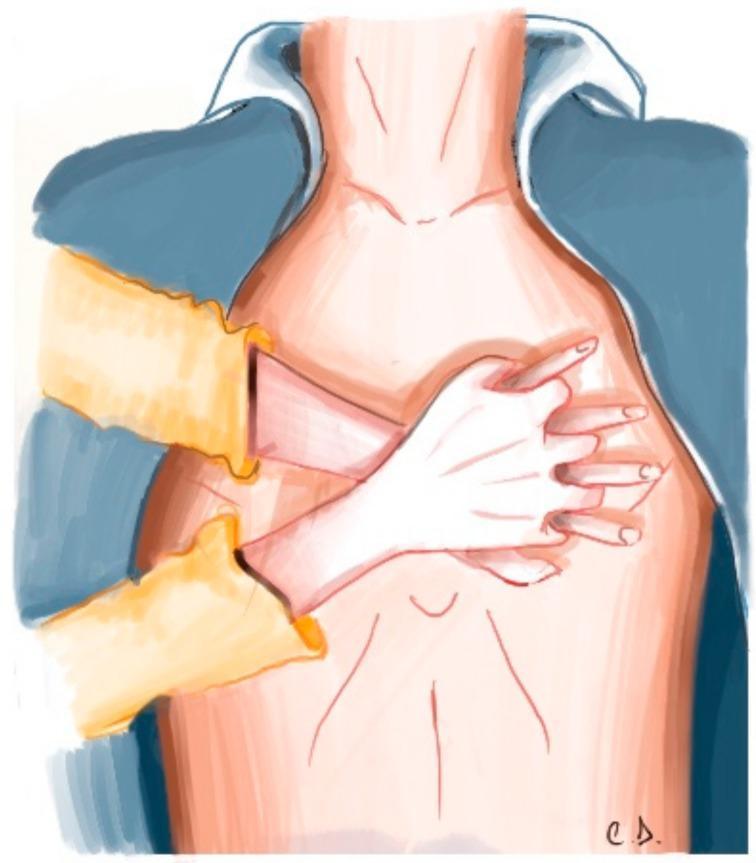
2025 AHA Updates (Key Changes)
The 2025 AHA BLS Guidelines represent the most comprehensive revision in years:
- C-A-B reinforced: Compressions-first approach is solidified across all adult algorithms
- Naloxone integration: Opioid antagonist (naloxone) is now explicitly incorporated into BLS for respiratory/cardiac arrest suspected to be opioid-related
- Choking standardized: Adults and conscious children → 5 back blows + 5 abdominal thrusts, repeated until airway cleared or victim becomes unresponsive
- Compression-only CPR: Acceptable for untrained bystanders or those unwilling to give rescue breaths
- System-level emphasis: Outcomes depend on the full Chain of Survival — bystander CPR, AED access, EMS dispatch, and hospital post-arrest care
- Simplified algorithms: Reduced special-case branching to allow faster decisions under stress
AED Use
- Power on the AED
- Attach pads: Upper right chest (infraclavicular) + lower left lateral chest (apex)
- Analyze rhythm — stand clear
- Deliver shock if advised, then immediately resume CPR
- Repeat every 2 minutes until ALS arrives or ROSC
Pediatric BLS Highlights
- Age groups: newborn (≤1 month), infant (1 month–1 year), child (1 year to puberty)
- Infants/children: 15:2 compression-to-breath ratio with 2 rescuers; 30:2 with lone rescuer
- Infant FBAO: 5 back blows + 5 chest thrusts (NOT abdominal thrusts — risk of organ injury)
- Compression depth: ~1.5 inches for infants, ~2 inches for children
BLS vs. ALS
| BLS | ALS (Advanced Life Support) |
|---|---|
| No/minimal medications | IV/IO access, drug administration |
| Basic airway (BVM, OPA/NPA) | Advanced airway (intubation, supraglottic) |
| AED | Manual defibrillation, cardiac monitoring, 12-lead ECG |
| EMR/EMT level | AEMT/Paramedic level |
Sources: Goldman-Cecil Medicine; Tintinalli's Emergency Medicine; Rosen's Emergency Medicine; 2025 AHA BLS Guidelines (PMID: 41122888)
Is there a specific aspect of BLS you want to focus on — adult CPR, pediatric, AED use, choking management, or something else?
This is a shared conversation. Sign in to Orris to start your own chat.