
Teach me ecg
Reading File
ECG interpretation is a broad topic. Let me clarify the level before diving in.
Asking for Preferences
What level are you starting from? · Any specific area you want to focus on?
Let me pull from the medical textbooks for a thorough beginner-level guide on normal ECG and intervals.
Searching sources...
Finding Sources
Finding Sources
Finding Sources
Reading File
Reading File
Finding Sources
Finding Sources
Finding Sources
Reading File
Reading File
Loading Image
Loading Image
Reading File
Reading File
Finding Sources
Reading File
Reading File
Loading Image
Loading Image
I now have all the core content I need. Let me put together a thorough beginner's guide to ECG.
ECG for Complete Beginners: Normal ECG & Intervals
1. What is an ECG?
An electrocardiogram (ECG or EKG) is a recording of tiny electrical potential differences on the body's surface that reflect the electrical activity of the heart. Because the heart depolarizes and repolarizes in a specific sequence - atria first, then ventricles - electrodes on the skin can detect these voltage changes over time and plot them as waves on a graph.
"The ECG is a measurement of tiny potential differences on the surface of the body that reflect the electrical activity of the heart." - Costanzo Physiology, 7th Edition
2. The Cardiac Conduction System (Why the ECG looks the way it does)
Before reading an ECG, you need to know the electrical "wiring" of the heart:
| Structure | Role |
|---|---|
| SA node | The natural pacemaker; located at the junction of the SVC and right atrium. Fires spontaneously to start each beat. |
| AV node | Receives the signal from the atria; delays it briefly (to let the atria finish contracting before ventricles start). Located near the coronary sinus. |
| Bundle of His | Carries the signal from the AV node into the ventricular septum. |
| Right & Left bundle branches | Split to carry the signal down both sides of the ventricles. |
| Purkinje fibers | Terminal fibers that spread excitation rapidly across ventricular muscle, triggering contraction from apex upward. |
This one-way, top-to-bottom, then apex-upward pathway is what creates the recognizable shape of the ECG.
3. The ECG Paper
Standard ECG paper has a grid of small and large boxes:
- Horizontal axis = Time
- 1 small box = 0.04 sec (40 ms)
- 1 large box (5 small boxes) = 0.20 sec (200 ms)
- Vertical axis = Voltage (amplitude)
- 1 small box = 0.1 mV
- 10 small boxes (1 large box height) = 1 mV
- Standard recording speed: 25 mm/sec
- A standard 12-lead ECG records 10 seconds of activity
4. The ECG Waves, Segments & Intervals
Here is the classic waveform of a single heartbeat:
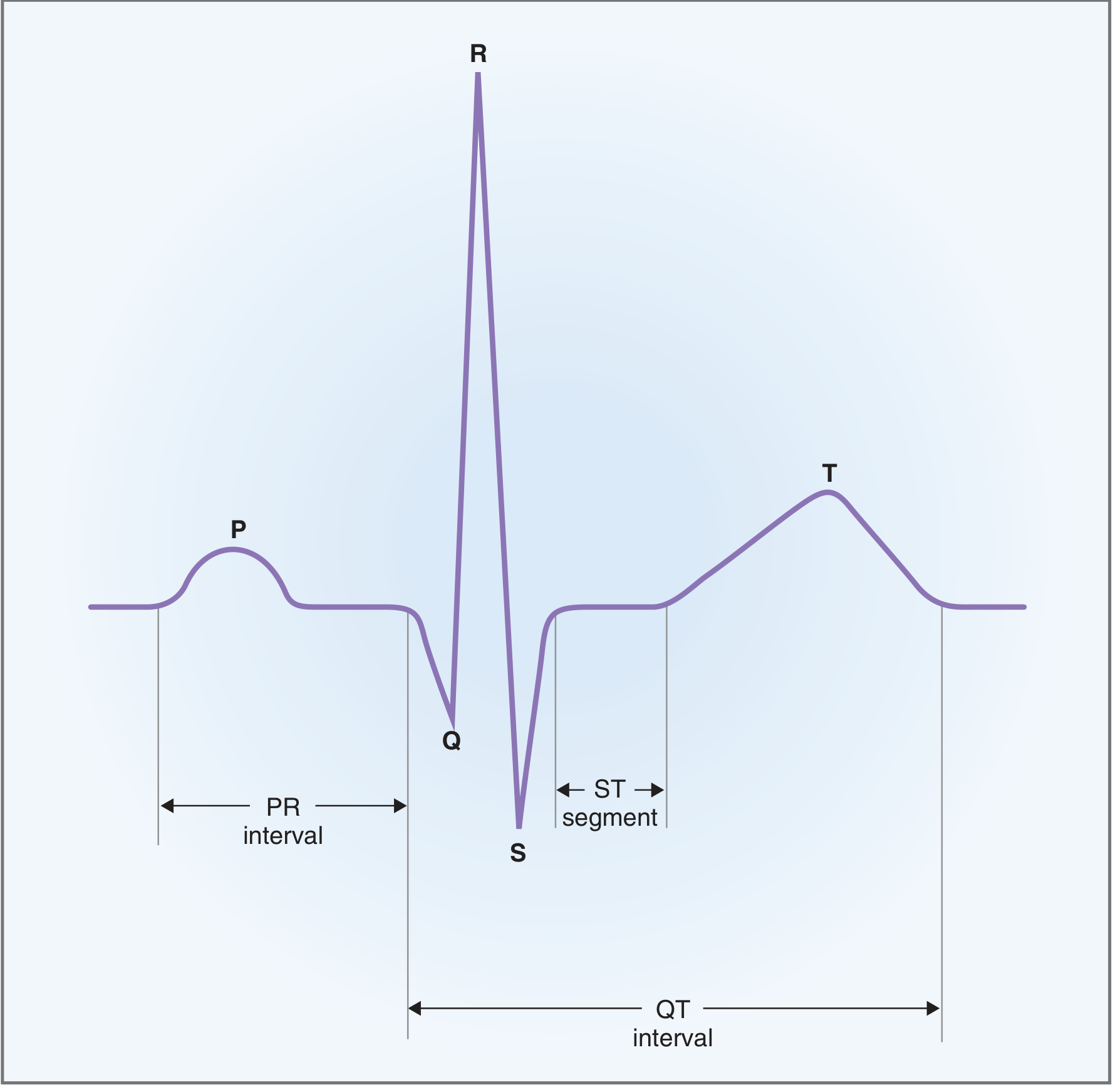
From Costanzo Physiology, 7th Edition - Fig. 4.17: The electrocardiogram measured from lead II
The Waves
| Wave | What it represents |
|---|---|
| P wave | Atrial depolarization (the atria "fire"). Rounded, small wave. |
| QRS complex | Ventricular depolarization (the ventricles "fire"). The big spike. |
| T wave | Ventricular repolarization (the ventricles "recharge"). |
| U wave | Sometimes visible; thought to reflect repolarization of Purkinje fibers (not always present). |
Note: Atrial repolarization is not visible on a normal ECG - it is buried inside the QRS complex because ventricular muscle mass is so much larger that it overwhelms the signal.
The Intervals and Segments
The key distinction: intervals include waves, segments do not.
| Measurement | What it covers | Normal value |
|---|---|---|
| PR interval | Start of P wave → Start of QRS. Represents AV node conduction time. | 0.09-0.20 sec (90-200 ms) |
| QRS duration | Start to end of the QRS complex. Time for ventricular depolarization. | 0.075-0.11 sec (75-110 ms) |
| ST segment | End of QRS (J point) → Start of T wave. Should be flat (isoelectric). Elevation or depression = ischemia signal. | Isoelectric |
| QT interval | Start of QRS → End of T wave. Covers all ventricular activity. Must be corrected for heart rate (QTc). | QTc: men ≤450 ms, women ≤460 ms |
| RR interval | R wave to next R wave. Used to calculate heart rate. | Depends on HR |
5. Calculating Heart Rate
The quickest method using the large-box rule:
Count the number of large boxes between two consecutive R waves, then divide into 300.
| Large boxes between R waves | Heart rate |
|---|---|
| 1 | 300 bpm |
| 2 | 150 bpm |
| 3 | 100 bpm |
| 4 | 75 bpm |
| 5 | 60 bpm |
| 6 | 50 bpm |
Mnemonic: 300 - 150 - 100 - 75 - 60 - 50
Normal resting HR: 60-100 bpm (some sources suggest 50-90 is more accurate for healthy adults).
6. The 12 Leads - Viewing the Heart from 12 Angles
A standard ECG has 12 leads, each providing a different "camera angle" on the heart's electrical activity. You get 12 views from just 10 electrodes.
Limb Leads (Frontal Plane)
These 6 leads look at the heart from the front in a flat, left-right, up-down plane:
| Lead | Electrode pair | What it "sees" |
|---|---|---|
| I | RA(-) → LA(+) | Lateral (left side) |
| II | RA(-) → LL(+) | Inferior |
| III | LA(-) → LL(+) | Inferior |
| aVR | Right arm | Superior-right (opposite to heart vector - usually negative deflections) |
| aVL | Left arm | High lateral |
| aVF | Left foot | Inferior |
Precordial Leads (Horizontal Plane)
These 6 chest leads encircle the heart in a horizontal plane:
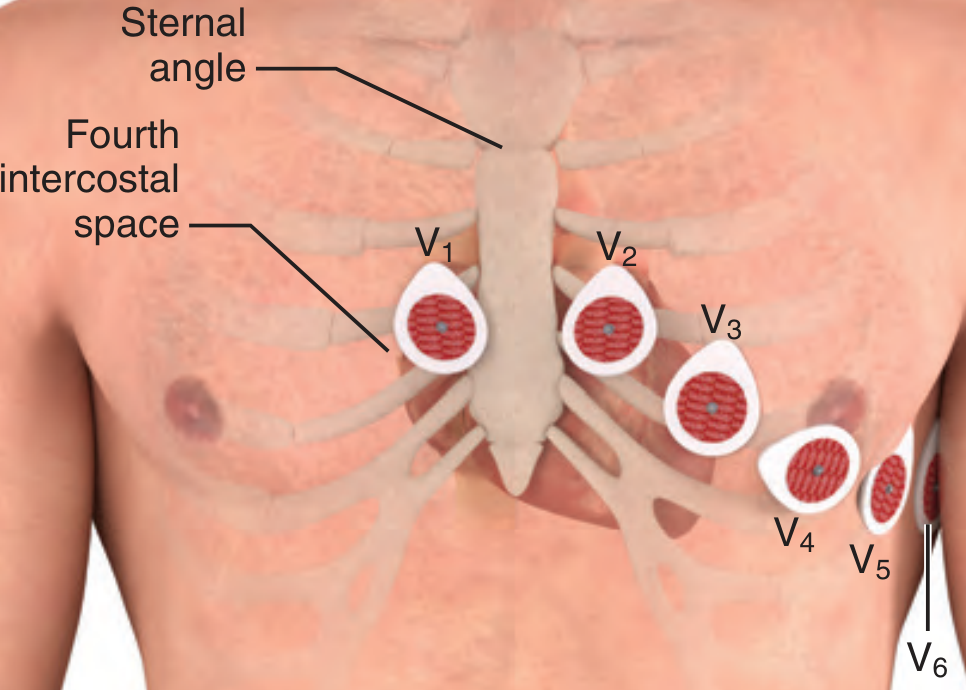
From Roberts and Hedges' Clinical Procedures in Emergency Medicine
| Lead | Placement | What it "sees" |
|---|---|---|
| V1 | 4th intercostal space, right sternal border | Septal |
| V2 | 4th intercostal space, left sternal border | Septal |
| V3 | Between V2 and V4 | Anterior |
| V4 | 5th intercostal space, midclavicular line | Anterior |
| V5 | Anterior axillary line (same level as V4) | Lateral |
| V6 | Midaxillary line (same level as V4) | Lateral |
The Hexaxial Reference System
This diagram shows all 6 limb leads arranged like clock hands around the heart, each separated by 30°. This is used to determine the QRS axis (the overall direction the heart's electrical vector points).
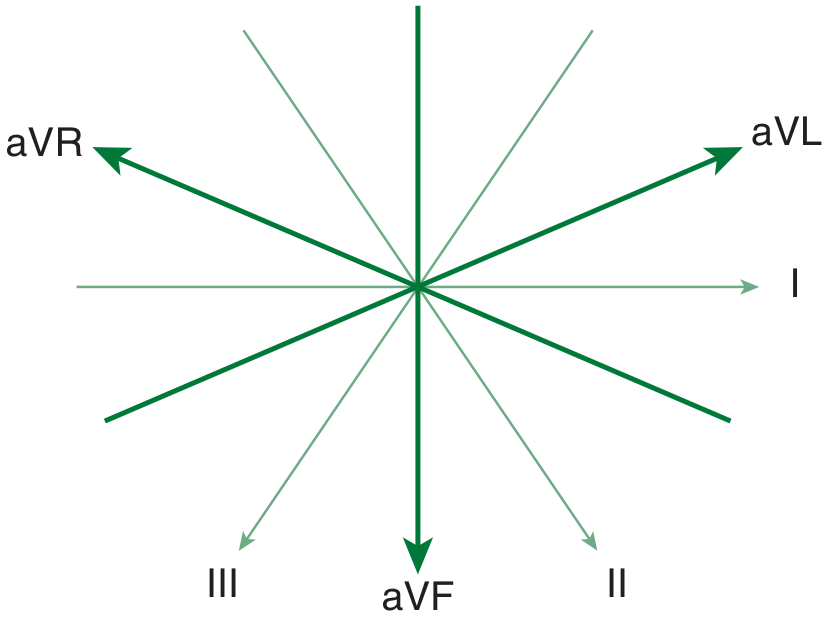
From Roberts and Hedges' Clinical Procedures in Emergency Medicine - the hexaxial system
Normal QRS axis: -30° to +90° (points left and downward, toward the bulk of the left ventricle).
7. Normal Interval Reference Table
| Parameter | Normal Range |
|---|---|
| Heart rate | 60-100 bpm |
| P wave duration | < 120 ms (< 3 small boxes) |
| PR interval | 90-200 ms (2.5-5 small boxes) |
| QRS duration | 75-110 ms (< 3 small boxes) |
| QTc (males) | 390-450 ms |
| QTc (females) | 390-460 ms |
| QRS axis | -30° to +90° |
Source: Goldman-Cecil Medicine, International Edition
8. A Systematic Approach to Reading Any ECG
When you pick up an ECG, always go in this order - never skip steps:
- Rate - How fast? (large-box method or 300/RR)
- Rhythm - Regular or irregular? Is every P followed by a QRS?
- P waves - Present? Upright in lead II? One before every QRS?
- PR interval - Normal (90-200 ms)? Constant?
- QRS duration - Narrow (<110 ms) or wide (≥120 ms)?
- QT interval - Corrected QTc within normal limits?
- ST segment - Flat, elevated, or depressed?
- T waves - Upright in most leads? Inverted anywhere?
- Axis - Normal? Left or right deviation?
9. What Normal Sinus Rhythm Looks Like
A completely normal ECG in sinus rhythm has:
- Regular P waves, all identical in shape
- P wave upright in leads I and aVF
- Every P wave followed by a QRS
- PR interval constant at 90-200 ms
- Narrow QRS (< 110 ms)
- Flat ST segments
- Upright T waves in most leads (except aVR where they are normally inverted)
- Rate 60-100 bpm
What's Next?
Now that you know the normal ECG, the natural next topics to build toward are:
- Heart rate & rhythm analysis (sinus tachycardia, bradycardia)
- Axis deviation (left vs. right)
- Bundle branch blocks (wide QRS patterns)
- Arrhythmias (AF, SVT, VT)
- ST changes (MI and ischemia patterns)
Just ask and I can continue with any of these!
Sources: Goldman-Cecil Medicine (International Edition), Costanzo Physiology 7th Ed., Roberts and Hedges' Clinical Procedures in Emergency Medicine, Gray's Anatomy for Students
This is a shared conversation. Sign in to Orris to start your own chat.