
Make a poster in topic NFHS 6 with every information including it
NFHS 6 National Family Health Survey India key findings data 2024
https://www.pib.gov.in/PressReleasePage.aspx?PRID=2266600&re…
A detailed informational poster titled "NFHS-6: National Family Health Survey 2023-24" for India. The poster has a clean, professional government health survey design with a tricolor-inspired color scheme (saffron, white, green, and navy blue accents). It is divided into clearly labeled sections: HEADER: Large bold title "NFHS-6 | National Family Health Survey 2023-24" with subtitle "Ministry of Health & Family Welfare | Nodal Agency: IIPS Mumbai | Coverage: 6.79 Lakh Households | 715 Districts" SECTION 1 - DEMOGRAPHICS (light blue background): - Total Fertility Rate (TFR): 2.0 (below replacement level of 2.1) - Contraceptive Prevalence Rate: 66.7% → 69.1% SECTION 2 - MATERNAL HEALTH (light green background): - Antenatal Care Registration: 95.9% - ANC in First Trimester: 70.0% → 76.2% - 4+ ANC Visits: 58.5% → 65.2% - Institutional Deliveries: 88.6% → 90.6% - Skilled Birth Attendance: 89.4% → 91.3% - Postnatal Care (within 2 days): 79.1% → 85.3% - IFA 100+ days supplementation: 44.1% → 54.9% SECTION 3 - CHILD HEALTH & NUTRITION (light orange background): - Full Vaccination Coverage (12-23 months): 83.8% → 87.1% - Rotavirus Vaccination: 36.4% → 85.4% - Measles 2nd dose: 58.6% → 71.8% - Exclusive Breastfeeding (<6 months): 95.6% - Early Breastfeeding (within 1 hr): 41.8% → 50.1% - Stunting reduced by 17%: 35.5% → 29.3% - Severe Wasting reduced by 32%: 7.7% → 5.2% - Underweight: 32.1% → 31.8% - ARI prevalence: 2.8% → 1.9% - Severe Diarrhoea: down to 0.5% SECTION 4 - WOMEN'S EMPOWERMENT (light purple background): - Internet Usage (women): 33.3% → 64.3% - Mobile Phone Ownership: 53.9% → 63.6% - Bank/Savings Account: 78.6% → 89.0% - Menstrual Hygiene (15-24 yrs): 77.6% → 79.2% SECTION 5 - CHALLENGES (light red background): - Rising C-section rates - Increasing obesity & NCDs - Persistent child undernutrition - Breastfeeding initiation still low at 50.1% FOOTER: "Source: MoHFW, Government of India | Released: May 29, 2026 | NFHS-5 (2019-21) vs NFHS-6 (2023-24)" All text is crisp, readable, with icons for each section. Arrows (↑ and ↓) show changes. The layout is organized, modern, and visually appealing with data comparisons highlighted in bold.
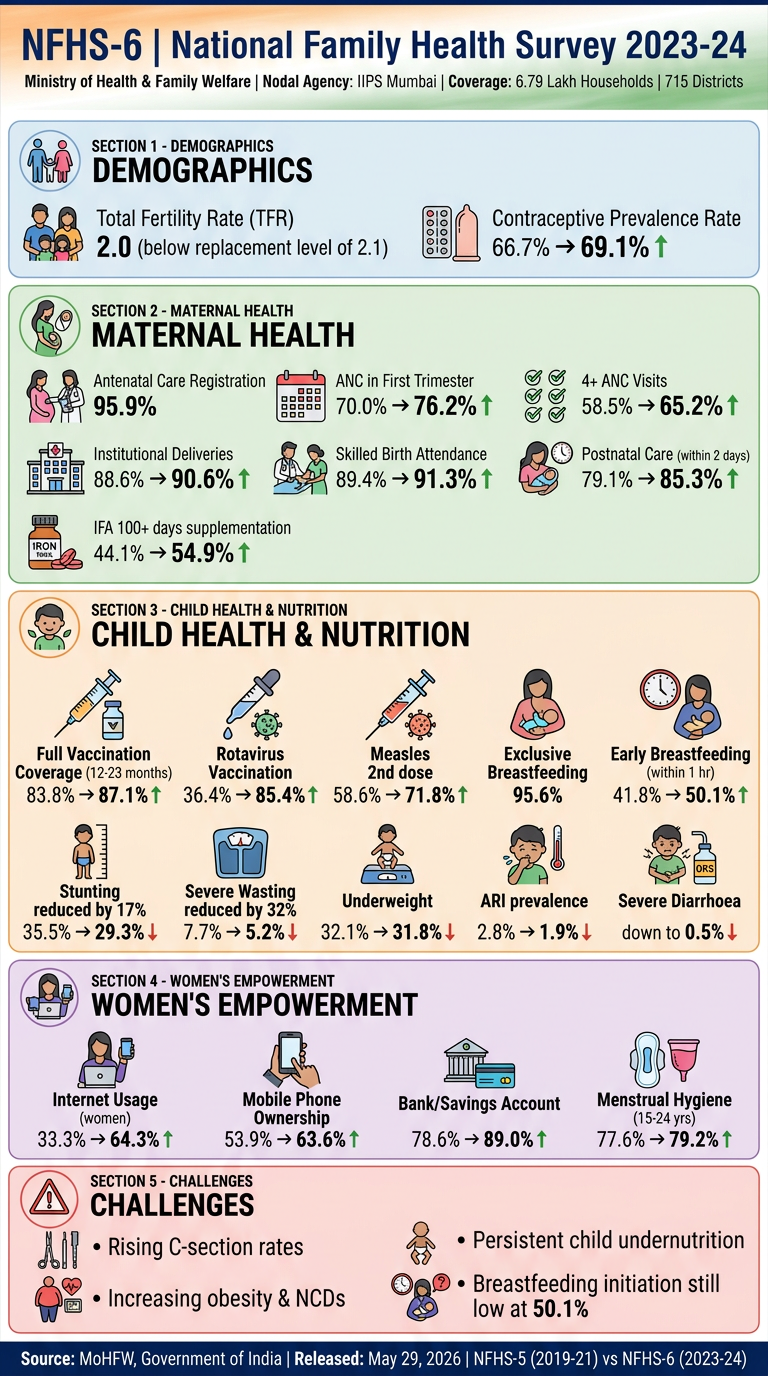
NFHS-6 | National Family Health Survey 2023-24
Demographics
| Indicator | NFHS-5 | NFHS-6 |
|---|---|---|
| Total Fertility Rate (TFR) | 2.0 | 2.0 (stable, below replacement 2.1) |
| Contraceptive Prevalence Rate (CPR) | 66.7% | 69.1% |
Maternal Health
| Indicator | NFHS-5 | NFHS-6 |
|---|---|---|
| Overall ANC Registration | - | 95.9% |
| ANC in First Trimester | 70.0% | 76.2% |
| 4+ ANC Visits | 58.5% | 65.2% |
| Institutional Deliveries | 88.6% | 90.6% |
| Skilled Birth Attendance | 89.4% | 91.3% |
| Postnatal Care (within 2 days) | 79.1% | 85.3% |
| IFA Supplementation 100+ days | 44.1% | 54.9% |
| IFA Supplementation 180+ days | 26.0% | 37.8% |
Child Health & Nutrition
| Indicator | NFHS-5 | NFHS-6 |
|---|---|---|
| Full Vaccination (12-23 months) | 83.8% | 87.1% |
| Rotavirus Vaccination | 36.4% | 85.4% |
| Measles 2nd Dose | 58.6% | 71.8% |
| Exclusive Breastfeeding (<6 months) | - | 95.6% |
| Early Breastfeeding (within 1 hr) | 41.8% | 50.1% |
| Complementary Feeding (6-8 months) | 45.9% | 59.5% |
| Stunting (under-5) | 35.5% | 29.3% (-17%) |
| Severe Wasting (under-5) | 7.7% | 5.2% (-32%) |
| Underweight (under-5) | 32.1% | 31.8% |
| ARI Prevalence | 2.8% | 1.9% |
| Severe Diarrhoea | - | 0.5% |
Women's Empowerment
| Indicator | NFHS-5 | NFHS-6 |
|---|---|---|
| Women using Internet | 33.3% | 64.3% (nearly doubled) |
| Women owning mobile phones | 53.9% | 63.6% |
| Women with bank/savings account | 78.6% | 89.0% |
| Menstrual Hygiene (15-24 yrs) | 77.6% | 79.2% |
Key Challenges Flagged
- Rising C-section rates
- Increasing obesity and non-communicable diseases (NCDs)
- Persistent child undernutrition despite improvements
- Breastfeeding initiation still below target
- Drop in some biomarker data collection (anaemia data removed this round)
Give me important topics for mpmsu mbbs exam 2026 3 year from the demography unit community medicine subject
MPMSU MBBS 3rd year community medicine demography unit syllabus important topics exam 2026
https://www.scribd.com/document/644986839/166801806096-pdf
MPMSU MBBS 3rd Year - Community Medicine
Demography Unit: Important Topics for 2026 Exam
🔴 HIGH PRIORITY (Most Frequently Asked - Long Questions)
1. Demographic Cycle (5 Stages)
- Stage 1 - High Stationary: High BR + High DR → population stationary (India till 1920)
- Stage 2 - Early Expanding: DR falls, BR unchanged → population grows (South Asia, Africa)
- Stage 3 - Late Expanding: DR declines further, BR begins to fall (India is HERE)
- Stage 4 - Low Stationary: Low BR + Low DR → population stationary (UK, Scandinavia)
- Stage 5 - Declining: BR < DR → population shrinks (Germany, Hungary)
2. Fertility-Related Statistics (All 14 - Formula + Definition)
| # | Statistic | Formula |
|---|---|---|
| 1 | Crude Birth Rate (CBR) | Live births / Mid-year population × 1000 |
| 2 | General Fertility Rate (GFR) | Live births / Women (15-44 yrs) × 1000 |
| 3 | General Marital Fertility Rate (GMFR) | Live births / Married women (15-44 yrs) × 1000 |
| 4 | Age-Specific Fertility Rate (ASFR) | Live births to women in age group / Women in that age group × 1000 |
| 5 | Age-Specific Marital Fertility Rate (ASMFR) | As above but for married women only |
| 6 | Total Fertility Rate (TFR) | Sum of all ASFRs × 5 (currently 2.0 in India - NFHS-6) |
| 7 | Total Marital Fertility Rate (TMFR) | Sum of ASMFRs × 5 |
| 8 | Gross Reproduction Rate (GRR) | TFR × proportion of female births |
| 9 | Net Reproduction Rate (NRR) | GRR adjusted for female mortality; NRR = 1 = replacement |
| 10 | Child-Woman Ratio | Children <5 yrs / Women (15-44 yrs) × 1000 |
| 11 | Pregnancy Rate | Pregnancies / Women (15-44 yrs) × 1000 |
| 12 | Abortion Rate | Abortions / Women (15-44 yrs) × 1000 |
| 13 | Abortion Ratio | Abortions / Live births × 1000 |
| 14 | Marriage Rate | Marriages / Mid-year population × 1000 |
Exam Tip: "Why is NRR superior to GRR?" - NRR accounts for female mortality before reproductive age, making it more realistic for measuring population replacement. This is an "Explain Why" type question.
3. Population Pyramid
- Definition, construction, and types (expansive, constrictive, stationary)
- India has an expansive pyramid (wide base) showing young population
- Used for planning healthcare, education, workforce needs
4. Mortality Rates (Measurement of Mortality)
- Crude Death Rate (CDR)
- Specific Death Rates (age, sex, cause)
- Infant Mortality Rate (IMR) - deaths <1 year / 1000 live births
- Under-5 Mortality Rate (U5MR)
- Neonatal Mortality Rate (NMR) - deaths in first 28 days
- Maternal Mortality Rate (MMR) and Maternal Mortality Ratio
- Standardized (Adjusted) Death Rates - direct and indirect methods
- Case Fatality Rate (CFR)
- Proportional Mortality Rate (PMR/PMRatio)
5. Demographic Characteristics of India (NFHS-6 Updated Data)
- Current population, growth rate
- TFR = 2.0 (NFHS-6, 2023-24), below replacement level 2.1
- Sex ratio (females per 1000 males)
- Literacy rates, urban-rural distribution
- Census data (decadal growth)
🟡 MEDIUM PRIORITY (Short Notes / 5-7 Mark Questions)
6. Sources of Demographic Data in India
- Population Census (decennial) - most comprehensive
- Registration of Vital Events (Civil Registration System - CRS)
- National Sample Survey (NSS)
- National Family Health Survey (NFHS)
- Sample Registration System (SRS)
- Ad hoc demographic studies
7. Family Planning - National Population Policy 2000
- Immediate objectives, medium-term, long-term goals
- National Population Policy 2000 - targets, Mission Parivar Vikas
- Eligible couples, target couples, Couple Protection Rate (CPR)
- CPR = currently 69.1% (NFHS-6)
- Small-family norm
8. Contraceptive Methods (Classification + Details)
- Barrier: Condom (male + female), Diaphragm, Vaginal sponge
- Chemical: Spermicides
- IUDs (1st, 2nd, 3rd generation - Lippes loop, Copper-T, LNG-IUS)
- Oral contraceptive pills (combined, progestin-only)
- Emergency contraception
- Vasectomy (conventional vs. NSV - No Scalpel Vasectomy)
- Tubectomy (Minilap, Laparoscopic)
Frequently asked: IUD types, mechanism of action, contraindications, side effects/complications of IUD (IUCD)
9. Factors Affecting Fertility
- Age at marriage
- Duration of married life
- Spacing of children
- Education
- Economic status
- Caste and religion
- Nutrition
- Family planning
- Other factors (urbanization, employment of women)
10. World Population Trends
- Doubling time concept
- Growth rates and projections
- Demographic dividend
🟢 SHORT NOTES (3-5 Marks)
| Topic | Key Points to Remember |
|---|---|
| Unmet Need for Family Planning | Women who want to space/limit births but not using contraception |
| Demographic Transition | Shift from high BR+DR to low BR+DR |
| Census | Definition, purpose, de jure vs de facto |
| Vital Statistics | Registration of births, deaths, marriages |
| Sex Ratio | India - 943 females/1000 males (Census 2011) |
| Dependency Ratio | (Young + Old) / Working age × 100 |
| Life Expectancy | At birth vs at age 1 |
| Migration | Push/pull factors, types |
| Replacement Level Fertility | TFR = 2.1 (NRR = 1) |
| Emergency Contraception | Cu-T within 5 days, Levonorgestrel within 72 hrs |
| NSV (No-Scalpel Vasectomy) | Technique, advantages |
| Genetic Counselling | Indications, types |
📝 Exam Strategy Tips
- Long question (10-12 marks): Demographic cycle OR Fertility statistics OR Family planning in India are the most repeated
- Always include current Indian data from NFHS-6 (2023-24) - examiners love updated figures
- NRR vs GRR - classic "explain why" question - practice it
- Population pyramid - always draw a labeled diagram
- IUD complications - know the 7 side effects from Park's
Sample resistration system
Sample Registration System SRS India features dual record system enumerator methodology
Sample Registration System (SRS)
Source: Park's Textbook of Preventive and Social Medicine, Chapter 12
Definition
Background and History
| Milestone | Year |
|---|---|
| Pilot scheme initiated | 1964-65 |
| Became fully operational | 1969-70 |
| Coverage | All States and Union Territories |
- Initiated because the Civil Registration System (CRS) in India was grossly deficient, unreliable, and incomplete
- Funded initially with assistance from the Ford Foundation under the Third Five Year Plan
- One of the largest continuous demographic household sample surveys in the world
Why SRS Was Needed
- Illiteracy and ignorance among the population
- Lack of motivation for voluntary registration
- Lack of uniformity in collection and compilation
- Multiple registration agencies (health, panchayat, police, revenue)
- Under-reporting, especially in rural areas
Key Feature: Dual Record System
Component 1 - Continuous Enumeration
- Done by a resident part-time enumerator posted in the sample unit
- Maintains:
- Form 4 - Birth Record
- Form 5 - Death Record
- Records ALL births and deaths continuously throughout the year
- Covers:
- Usual residents inside the sample unit
- Usual residents who died/delivered outside the unit
- In-migrants present and absent
- Visitors inside the sample unit (listed but not counted in rates)
Component 2 - Independent Half-Yearly Retrospective Survey
- Done by a full-time supervisor/investigator (different from enumerator)
- Conducted every 6 months independently
- Retrospectively identifies births and deaths
- Serves as a cross-check on the continuous enumeration
Matching Process (The Core Methodology)
- Matching - Events from both sources are matched
- Unmatched events - Those not found in one source are reverified in the field
- Partially matched events - Also reverified
- Final result = Unduplicated, correct count of all births and deaths
Sample Size and Coverage
| Parameter | Details |
|---|---|
| Total sample units | ~8,121 units (rural + urban) |
| Rural sample units | Villages or portion of village (population >2000) |
| Urban sample units | Census Enumeration Blocks (750-1000 population) |
| Population covered | ~8.1 million persons |
| Households covered | ~1.5 million households |
| Sampling frame | Based on Census - recalculated after each census |
Data Provided by SRS
| Indicator | Abbreviation |
|---|---|
| Crude Birth Rate | CBR |
| Crude Death Rate | CDR |
| Infant Mortality Rate | IMR |
| Under-5 Mortality Rate | U5MR |
| Neonatal Mortality Rate | NMR |
| Total Fertility Rate | TFR |
| Maternal Mortality Ratio | MMR |
| Age-Specific Fertility Rates | ASFR |
| Age-Specific Mortality Rates | ASMR |
| Life Expectancy at birth | e₀ |
SRS is the only source for annual, state-level estimates of IMR and fertility/mortality in India.
Organization / Administration
National Level:
Vital Statistics Division, Office of Registrar General, India (ORGI)
↓
State Level:
Directorate of Census Operations / State Vital Statistics Authorities
↓
Field Level:
Supervisor (full-time) → Enumerator (part-time, resident)
SRS vs Civil Registration System
| Feature | SRS | CRS (Civil Registration) |
|---|---|---|
| Coverage | Sample (statistical) | Universal (all events) |
| Nature | Continuous + biannual survey | Continuous |
| Reliability | High (self-evaluating) | Low (incomplete) |
| Legal force | None | Yes (compulsory) |
| Purpose | Rate estimation | Legal documentation |
| Self-evaluation | Yes (dual system) | No |
Advantages of SRS
- Self-evaluating - dual system catches errors automatically
- Produces annual estimates (unlike census which is decennial)
- Covers all states and UTs
- Provides state-level data, not just national
- Large sample size gives statistical reliability
- Free from legal/registration formalities
- Trained field staff ensures quality
Limitations of SRS
- Only a sample - cannot provide district-level data
- Expensive to maintain compared to a single-round survey
- Does not cover cause of death in detail
- Dependent on quality of enumerator's work
- Cannot replace a full civil registration system
SRS Bulletin
- Results are published as SRS Bulletins by the Office of Registrar General, India
- Available on: www.censusindia.gov.in → Vital Statistics → SRS Bulletins
- Published annually with 1-2 year lag
Exam-Ready Summary Points
- Started: 1964-65 (pilot) → 1969-70 (fully operational)
- Run by: ORGI, Ministry of Home Affairs
- Type: Dual-record system = Continuous enumeration + 6-monthly retrospective survey
- Enumerator: resident, part-time; Supervisor: full-time
- Main output: IMR, CBR, CDR, TFR, MMR at national and state level
- Special feature: Self-evaluating (matching + re-verification)
- Covers: ~8.1 million population across India
Civil registration system
Civil Registration System India Registration of Births Deaths Act 1969 features limitations vital statistics
Civil Registration System (CRS)
Source: Park's Textbook of Preventive and Social Medicine
Definition
UN Definition: "Legal registration, statistical recording and reporting of the occurrence of, and the collection, compilation, presentation, analysis and distribution of statistics pertaining to vital events - i.e., live births, deaths, foetal deaths, marriages, divorces, adoptions, legitimations, recognitions, annulments and legal separations." (Park's, Block 12)
Key Features (4 Pillars of CRS)
| Feature | Meaning |
|---|---|
| Continuous | Recording happens throughout the year, not periodically |
| Permanent | Records are maintained indefinitely |
| Compulsory | Legally mandated - registration is not voluntary |
| Universal | Covers ALL vital events and ALL persons in the country |
Historical Background in India
| Year | Event |
|---|---|
| 1873 | Births, Deaths and Marriages Registration Act passed - but only voluntary |
| Individual states | Tamil Nadu, Karnataka, Assam passed their own acts - non-uniform |
| Pre-1969 | System was unreliable, deficient, non-uniform |
| 1969 | Registration of Births and Deaths Act enacted (Central law) |
| 1 April 1970 | Act came into force |
| 2018 | Aadhaar number made mandatory for registration of death |
| 2023 | Registration of Births and Deaths (Amendment) Act, 2023 passed |
The Registration of Births and Deaths Act, 1969
Salient Features:
- Registration of births and deaths is compulsory throughout India
- Replaced all diverse state-level laws with a single uniform central law
- Applies irrespective of nationality (even non-citizens' events occurring in India must be registered)
- Both births and deaths must be registered within 21 days uniformly across India
- Late registration attracts a late fee/penalty
| Person Reporting | Responsibility |
|---|---|
| Parents/relatives | Events in households |
| Heads of hospitals, nursing homes | Institutional births and deaths |
| Heads of hotels, jails, dharmashalas | Events occurring in those institutions |
Central Level:
Registrar General of India (RGI) - under Ministry of Home Affairs
↓
State Level:
Chief Registrar of Births and Deaths (State Govt.)
↓
District Level:
District Registrar
↓
Local Area:
Registrar (appointed by State/UT Govt.)
- Vital statistics are compiled by the states to ensure uniformity and comparability
- Published annually as "Vital Statistics of India based on CRS" by ORGI
- Aadhaar number is mandatory for registration of death
Vital Events Covered Under CRS
- Live births
- Deaths (including cause of death via death certificate)
- Foetal deaths / Stillbirths
- Marriages
- Divorces
- Adoptions, legitimations, recognitions
- Annulments and legal separations
Importance / Uses of CRS
For the Individual:
- Provides legal identity (birth certificate = basis for all documents)
- Establishes nationality and citizenship
- Enables access to government entitlements and services
- Required for school admission, passport, voter ID, Aadhaar
For the Government / Public Health:
- Primary source of vital statistics (birth rate, death rate, cause of death)
- Used for health planning and policy making
- Monitors population growth and demographic trends
- Provides cause-specific mortality data (via death certificates)
- Basis for computing IMR, MMR, CDR, CBR at all administrative levels
- Supports Sustainable Development Goals (SDG) tracking
Lay Reporting (Associated Concept)
- Definition: Collection of information, its use, and transmission to higher levels by non-professional health workers
- In India: Village Health Guides, ASHAs, ANMs record vital events in their area
- This is a first-line supplement to the formal registration system
The demographic survey is a temporary substitute for CRS, but can never replace it.
Limitations of CRS in India
- Under-registration - especially in rural and tribal areas
- Illiteracy and ignorance - public unaware of reporting obligation
- Lack of motivation - no immediate personal benefit perceived
- Multiple agencies - health dept, panchayat, police, revenue dept all involved - creates confusion
- Urban-rural disparity in data collection methods
- Non-uniform prior to 1969 - different rules in different states
- Late fee often not enforced - delays common
- Cause of death inadequately recorded - verbal autopsy often needed
- Biomarker data absent
- COVID-19 pandemic exposed delayed death registration as a major flaw
CRS vs SRS - Comparison
| Feature | CRS (Civil Registration) | SRS (Sample Registration) |
|---|---|---|
| Coverage | Universal - all events | Sample - statistical estimate |
| Nature | Continuous | Continuous + biannual survey |
| Legal backing | Yes (compulsory by law) | No |
| Reliability in India | Poor (incomplete) | Good (self-evaluating) |
| Purpose | Legal documentation + statistics | Rate estimation only |
| Data at | District/state/national level | State/national level only |
| Self-correction | No | Yes (dual system) |
| Operated by | State/UT Registrars under ORGI | ORGI directly |
Registration of Births and Deaths (Amendment) Act, 2023
- Digital integration - mandatory digital registration
- Linkage with national databases (Aadhaar, NPR, voter ID, passport, driving licence, ration card)
- Improved timeliness and completeness
- Strengthened penalties for non-compliance
- Better interministerial coordination
Exam-Ready Summary Points
- CRS = Continuous, Permanent, Compulsory, Universal recording of vital events
- Governed by: Registration of Births and Deaths Act, 1969 (in force from 1 April 1970)
- Authority: Registrar General of India (ORGI) at central level
- Registration time limit: 21 days for both births and deaths
- Aadhaar mandatory for death registration from October 2018
- CRS is the ideal/gold standard source of vital statistics
- In India, CRS is deficient - hence SRS was started as an alternative
- Individual benefit: legal identity; National benefit: vital statistics for planning