
Teach ecg
What is your current level with ECGs? · What do you want to focus on?
ECG interpretation complete beginner guide systematic approach 2024
📋 ECG (Electrocardiogram) - Complete Beginner's Guide
PART 1 - What Is an ECG?
- Is the heart beating at the right rate and rhythm?
- Is electricity traveling through the right pathway?
- Is any part of the heart muscle damaged or under strain?
"When a cardiac impulse passes through the heart, electrical current spreads from the heart into adjacent tissues... a small portion spreads all the way to the surface of the body. If electrodes are placed on the skin on opposite sides of the heart, electrical potentials generated by the current can be recorded." - Guyton & Hall Textbook of Medical Physiology
PART 2 - The Electrical Conduction System (How the Heart Generates the Signal)
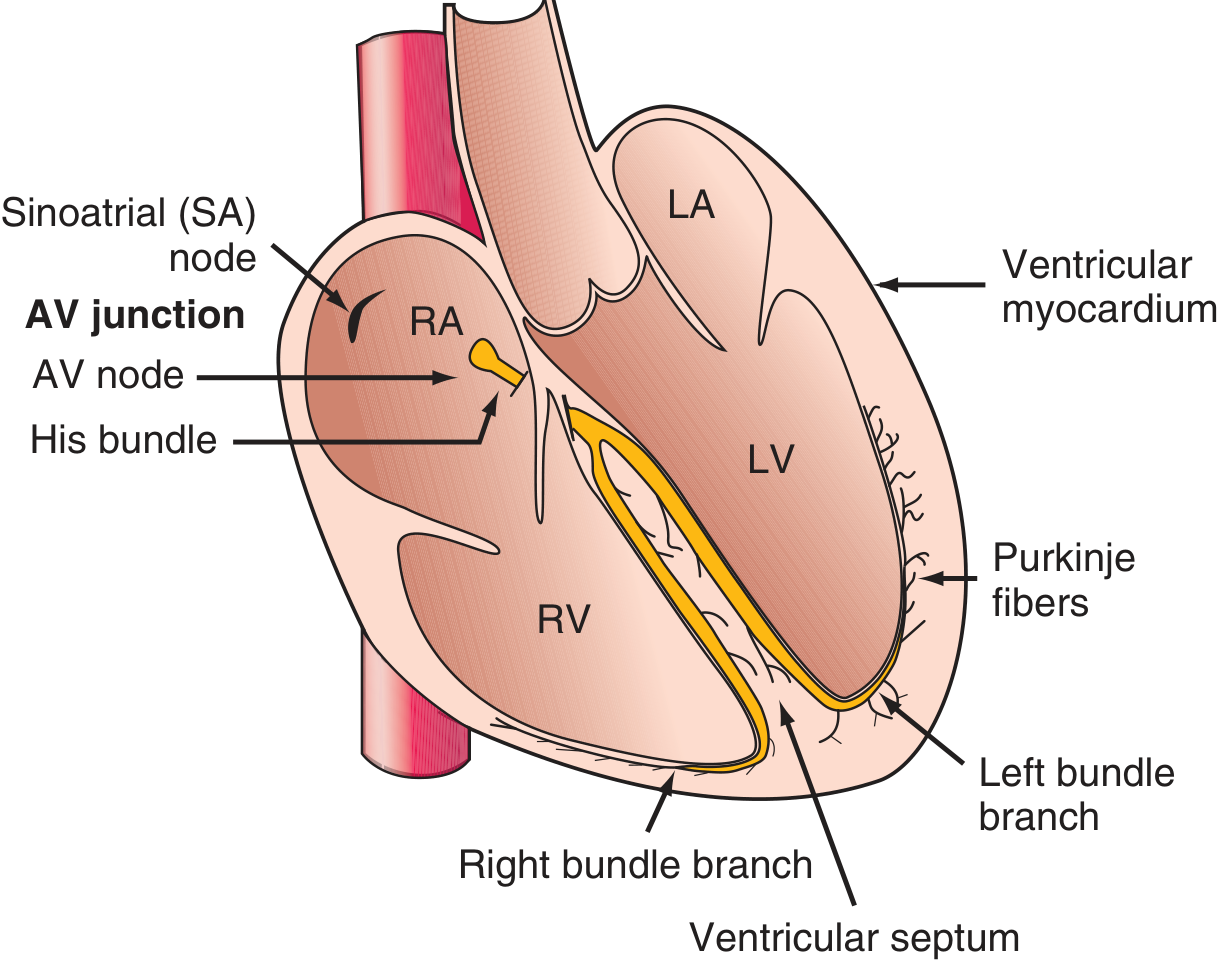
| Step | Structure | What Happens |
|---|---|---|
| 1 | SA node | Generates the impulse spontaneously |
| 2 | Right and left atria | Depolarize → atrial contraction |
| 3 | AV node | Delays the signal (gives atria time to empty into ventricles) |
| 4 | Bundle of His | Passes signal to ventricles |
| 5 | Right & Left bundle branches | Split to each ventricle |
| 6 | Purkinje fibers | Rapidly spread activation across ventricular myocardium |
| 7 | Ventricular myocardium | Depolarizes → ventricular contraction |
- Harrison's Principles of Internal Medicine 22E, p. 1911
PART 3 - The ECG Waveforms Explained
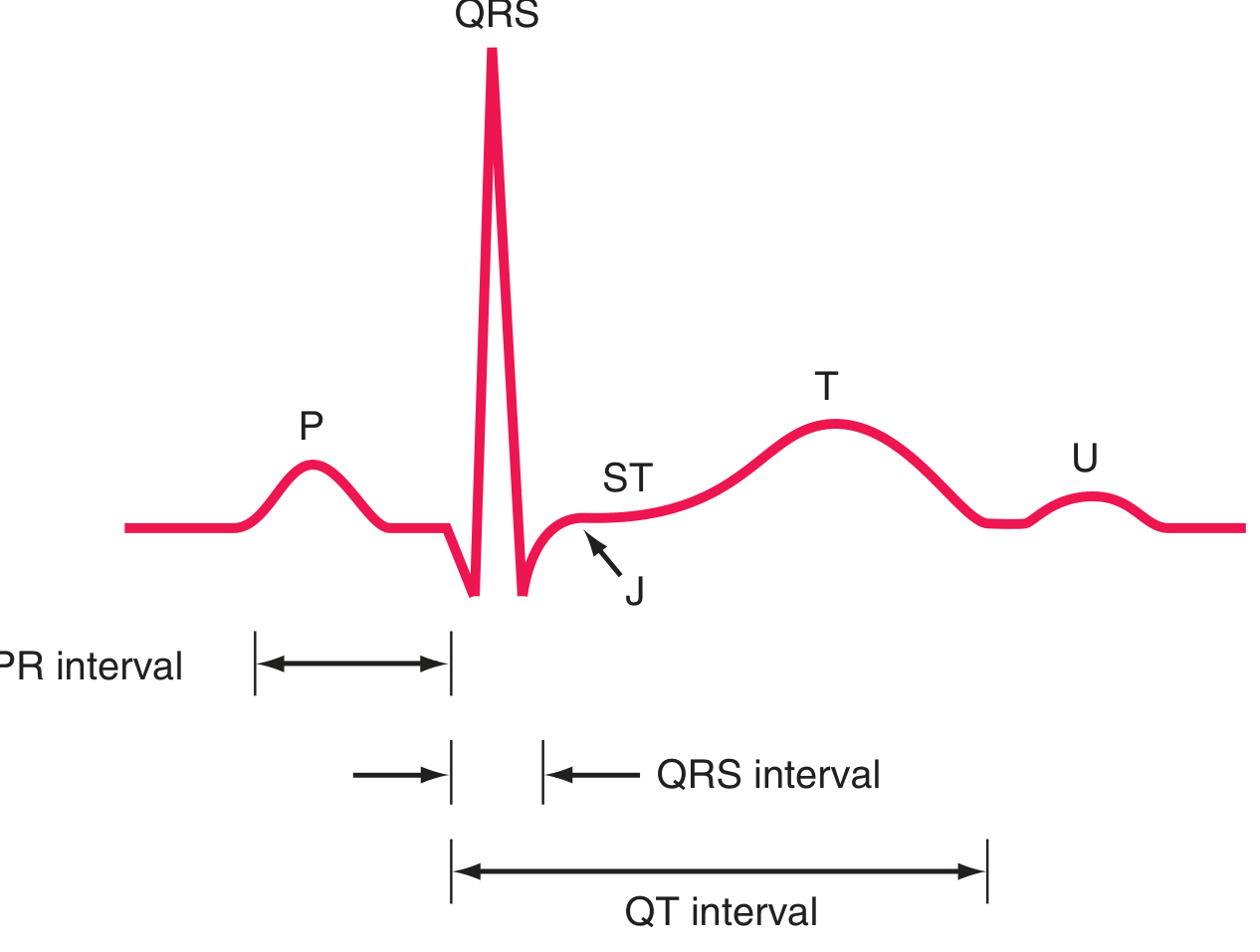
The Waves
| Wave / Segment | What it Represents | Normal Appearance |
|---|---|---|
| P wave | Atrial depolarization (atria contracting) | Small, rounded, upright |
| QRS complex | Ventricular depolarization (ventricles contracting) | Sharp, tall deflection |
| ST segment | Early ventricular repolarization (ventricles at rest before recovery) | Flat, at baseline |
| T wave | Ventricular repolarization (ventricles recovering) | Broad, rounded, upright |
| U wave | Possibly Purkinje fiber repolarization | Small, may follow T wave |
Q, R, and S - Breaking Down the QRS
- Q wave - first downward deflection before the R
- R wave - first upward deflection
- S wave - downward deflection after the R
"The P wave is caused by electrical potentials generated when the atria depolarize before atrial contraction begins. The QRS complex is caused by potentials generated when the ventricles depolarize before contraction... The T wave is caused by potentials generated as the ventricles recover from depolarization." - Guyton & Hall
PART 4 - The ECG Paper and Measurements
Horizontal axis = TIME
  - 1 small box = 1 mm = 40 ms (0.04 s)
  - 5 small boxes = 1 large box = 200 ms (0.20 s)
  - Paper speed = 25 mm/s (standard)

Vertical axis = VOLTAGE (amplitude)
  - 1 mV = 10 mm (with standard calibration)
Key Intervals (with Normal Values)
| Interval | What It Measures | Normal Range |
|---|---|---|
| RR interval | Time between consecutive heartbeats | Varies by rate |
| PR interval | Atrial to ventricular conduction (includes AV delay) | 120-200 ms (3-5 small boxes) |
| QRS interval | Ventricular depolarization duration | ≤110 ms (~2.5 small boxes) |
| QT interval | Total ventricular depolarization + repolarization | Varies; corrected QTc ≤450 ms (men), ≤460 ms (women) |
- Harrison's Principles of Internal Medicine 22E, p. 1912
PART 5 - The 12 Leads (12 Camera Angles of the Heart)
Limb Leads (Frontal Plane - front-to-back view)
| Lead | View |
|---|---|
| I | Left side of heart |
| II | Inferior-left |
| III | Inferior |
| aVR | Right shoulder (cavity view) |
| aVL | Left shoulder (high lateral) |
| aVF | Feet (inferior) |
Chest (Precordial) Leads (Horizontal Plane - side cross-section)
| Lead | Position | Area Viewed |
|---|---|---|
| V1 | 4th intercostal space, right sternal border | Septal |
| V2 | 4th intercostal space, left sternal border | Septal |
| V3 | Between V2 and V4 | Anterior |
| V4 | 5th intercostal space, midclavicular line | Anterior |
| V5 | Anterior axillary line, same level as V4 | Lateral |
| V6 | Midaxillary line, same level as V4/V5 | Lateral |
| ECG Region | Leads | Coronary Artery |
|---|---|---|
| Inferior | II, III, aVF | Right coronary artery (RCA) |
| Lateral | I, aVL, V5, V6 | Left circumflex artery |
| Anterior/Septal | V1-V4 | Left anterior descending (LAD) |
| Right ventricle | V1, V3R-V6R | RCA |
PART 6 - Systematic Approach to Reading an ECG
Step 1 - Rate
- Quick method: Count the number of large boxes between two R waves, then divide 300 by that number
- 1 large box = 300 bpm, 2 = 150, 3 = 100, 4 = 75, 5 = 60, 6 = 50
- Normal: 60-100 bpm
- Bradycardia: <60 bpm
- Tachycardia: >100 bpm
Step 2 - Rhythm
- Is the rhythm regular (RR intervals equal) or irregular?
- Are there P waves?
- Does every P wave have a QRS after it?
- Does every QRS have a P wave before it?
- A regular rhythm with P before every QRS = sinus rhythm (normal)
Step 3 - PR Interval
- Measure from start of P to start of QRS
- Short PR (<120 ms) → pre-excitation (e.g., WPW syndrome)
- Long PR (>200 ms) → first-degree AV block
Step 4 - QRS Complex
- Width: Narrow (<110 ms) = normal. Wide (≥120 ms) = bundle branch block or ventricular rhythm
- Height: Tall voltages → hypertrophy; low voltages → effusion, obesity, COPD
- Q waves: Pathological Q waves (>1 mm wide, >¼ of the QRS height) = old MI
Step 5 - ST Segment
- ST elevation (>1 mm above baseline) = acute MI (STEMI) or pericarditis
- ST depression (below baseline) = ischemia or NSTEMI
- The J point is where QRS ends and ST begins
Step 6 - T Waves
- Normal: upright in most leads, inverted in aVR
- T-wave inversion = ischemia, strain, bundle branch block
- Peaked/tall T waves = early MI (hyperacute T waves) or hyperkalemia
Step 7 - QT Interval
- Measure from start of QRS to end of T wave
- Correct for rate with the Bazett formula: QTc = QT ÷ √RR (both in seconds)
- Prolonged QTc → risk of torsades de pointes (dangerous arrhythmia)
PART 7 - Common Abnormal Patterns to Know
| Finding | What It Looks Like | Likely Cause |
|---|---|---|
| ST elevation | ST segment raised above baseline | STEMI, pericarditis |
| ST depression | ST segment below baseline | Ischemia (NSTEMI), digoxin effect |
| Wide QRS | QRS ≥120 ms | Bundle branch block, ventricular rhythm |
| Prolonged PR | PR >200 ms | First-degree AV block |
| No P waves, irregular RR | Chaotic baseline, irregularly irregular | Atrial fibrillation |
| Sawtooth baseline | Flutter waves at ~300/min | Atrial flutter |
| Peaked T waves | Very tall, narrow T waves | Hyperkalemia, early ischemia |
| Low voltages | QRS <5 mm in limb leads | Pericardial effusion, COPD, obesity |
| Delta wave + short PR | Slurred upstroke of QRS | Wolff-Parkinson-White (WPW) |
PART 8 - Bundle Branch Blocks (Quick Summary)
| Right BBB (RBBB) | Left BBB (LBBB) | |
|---|---|---|
| QRS duration | ≥120 ms | ≥120 ms |
| V1 pattern | rSR' ("rabbit ears") | Broad, deep QS or rS |
| V6 pattern | qRS (wide S wave) | Tall, broad R (no Q, no S) |
| ST/T direction | Opposite to terminal QRS | Opposite to QRS |
| Significance | Often benign | Often significant cardiac disease |
- Harrison's Principles of Internal Medicine 22E, p. 1913
PART 9 - Reading Your First ECG (Checklist)
□ 1. Rate:          _____ bpm  (normal 60-100)
□ 2. Rhythm:        Regular / Irregular   P waves present? Y/N
□ 3. PR interval:   _____ ms   (normal 120-200)
□ 4. QRS width:     _____ ms   (normal <110)
□ 5. ST segment:    Normal / Elevated / Depressed
□ 6. T waves:       Upright / Inverted / Peaked
□ 7. QTc:          _____ ms   (normal <450/460 ms)
□ 8. Axis:          Normal / LAD / RAD
□ 9. Overall:       _______________________
Summary Table - Normal ECG Values
| Parameter | Normal Value |
|---|---|
| Heart rate | 60-100 bpm |
| PR interval | 120-200 ms (3-5 small boxes) |
| QRS duration | <110 ms (<2.75 small boxes) |
| QTc | <450 ms (men), <460 ms (women) |
| P wave | <120 ms wide, <2.5 mm tall |
| ST segment | At baseline (isoelectric) |
| T wave | Upright in I, II, V3-V6; inverted in aVR |
- Guyton and Hall Textbook of Medical Physiology - Fundamentals of Electrocardiography
- Harrison's Principles of Internal Medicine, 22E (2025) - Basic ECG Waveforms and Intervals, ECG Leads
Yes
Which topic do you want to go deeper into?
📋 ECG Deep Dive - Advanced Interpretation
MODULE 1 - Arrhythmias
1.1 Normal Sinus Rhythm (the reference)
- Rate: 60-100 bpm
- Regular rhythm
- P wave before every QRS, every P wave followed by a QRS
- PR interval 120-200 ms
- Narrow QRS (<110 ms)
1.2 Rate Abnormalities
| Rhythm | Rate | P Waves | QRS | Cause |
|---|---|---|---|---|
| Sinus tachycardia | >100 bpm | Normal, before every QRS | Narrow | Pain, fever, anxiety, bleeding, PE, thyrotoxicosis |
| Sinus bradycardia | <60 bpm | Normal, before every QRS | Narrow | Athletes, vagal, hypothyroid, beta-blockers, inferior MI |
1.3 Atrial Arrhythmias
Atrial Fibrillation (AF)
- Irregularly irregular RR intervals (no two RR intervals the same)
- No discrete P waves - replaced by a fibrillatory baseline (chaotic wiggles)
- Narrow QRS (unless bundle branch block or pre-excitation is present)
- Rate: ventricular rate usually 100-160 bpm (uncontrolled)
"Performing an ECG during an episode of palpitations is extremely useful in making a definitive diagnosis." - Goldman-Cecil Medicine
- AF causes loss of the atrial "kick" (atrial contraction) - reduces cardiac output by ~20%
- Blood pools in the atria (especially the left atrial appendage) - risk of clot and stroke
- Treatment goals: rate control, rhythm control, anticoagulation
Atrial Flutter
- Sawtooth (flutter) waves at ~300/min, best seen in leads II, III, aVF
- Regular ventricular rate, classically at 150 bpm (2:1 block), or 100 (3:1) or 75 (4:1)
- Narrow QRS (unless BBB)
- No distinct P waves - replaced by the flutter waves
Supraventricular Tachycardia (SVT)
- Rate: typically 150-250 bpm
- Narrow QRS (regular)
- P waves may be hidden within or just after QRS (retrograde conduction)
- Sudden onset and offset ("paroxysmal")
1.4 Ventricular Arrhythmias
Premature Ventricular Complex (PVC)
- Wide, bizarre QRS not preceded by a P wave
- Followed by a compensatory pause
- T wave is opposite in direction to the QRS
- Isolated PVCs are common and often benign; frequent (>10/hour), multiform, or on-T ("R-on-T") PVCs raise concern
Ventricular Tachycardia (VT)
- Wide QRS tachycardia (QRS ≥120 ms) at rate >100 bpm
- Rate typically 100-250 bpm
- AV dissociation (P waves and QRS complexes firing independently) is diagnostic of VT
- Life-threatening - causes hemodynamic collapse
Ventricular Fibrillation (VF)
- Completely chaotic, irregular, no recognizable QRS
- Cardiac arrest - requires immediate defibrillation
1.5 AV Blocks (Conduction Problems)
| Degree | PR Interval | All P waves conduct? | ECG Pattern | Clinical Significance |
|---|---|---|---|---|
| 1st degree | >200 ms (prolonged) | Yes (1:1) | Long PR, every P has a QRS | Benign, no treatment |
| 2nd degree Mobitz I (Wenckebach) | Progressively lengthens | No (some Ps "dropped") | PR gets longer, then a QRS is dropped | Usually benign, vagal in origin |
| 2nd degree Mobitz II | Fixed (constant) | No (some Ps dropped without warning) | Constant PR, then sudden dropped QRS | Serious - may progress to complete block |
| 3rd degree (Complete) | N/A - no relationship | No | P waves and QRS complexes completely independent, slow ventricular escape rate | Emergency - requires pacemaker |
- Mobitz I (Wenckebach) = "The PR interval lengthens until a beat drops" - like a Wenckebach pattern (easier to remember: "longer, longer, longer, DROP")
- Mobitz II = No warning, just sudden dropped beats - much more dangerous
MODULE 2 - ST Changes and Ischemia
2.1 Why the ST Changes in Ischemia
"Severe, acute ischemia lowers the resting membrane potential and shortens the duration of the action potential. Such changes cause a voltage gradient between normal and ischemic zones. These currents of injury are represented on the surface ECG by deviation of the ST segment." - Harrison's Principles of Internal Medicine, 22E
2.2 Transmural vs Subendocardial Ischemia
| Type | Depth | ST on ECG | Example |
|---|---|---|---|
| Transmural (full wall thickness) | Outer (epicardial) layers involved | ST elevation in leads facing the ischemic zone | STEMI |
| Subendocardial (inner lining only) | Inner (endocardial) layers | ST depression in overlying leads | NSTEMI, demand ischemia |
2.3 STEMI - ST-Elevation MI
- New ST elevation at the J point in ≥2 contiguous leads
- ≥2 mm in V2-V3 (men) or ≥1.5 mm (women)
- ≥1 mm in all other contiguous leads
| Territory | Leads with ST elevation | Culprit Artery |
|---|---|---|
| Anteroseptal | V1, V2 (+/- V3) | LAD (proximal) |
| Anterior | V1, V2, V3, V4 | LAD |
| Anterolateral | V1-V6, I, aVL | LAD + circumflex |
| Lateral | I, aVL | Left circumflex |
| Inferior | II, III, aVF | RCA (80%) or circumflex (20%) |
| Inferolateral | II, III, aVF + V5, V6 | RCA or circumflex |
| Right ventricular | II, III, aVF + ST elevation V3R-V6R | Proximal RCA |
| Posterior | Tall R in V1-V2, ST depression V1-V3 | RCA or circumflex |
2.4 Evolutionary Changes of MI
Minutes → Hours:
  Hyperacute T waves (tall, peaked, broad)
  ↓
Hours:
  ST elevation
  ↓
Hours to Days:
  T wave inversion (in leads with ST elevation)
  Q waves develop
  ↓
Days to Weeks:
  ST returns to baseline
  T-wave inversions persist
  Q waves persist (permanent marker of old MI)
- Width ≥40 ms (1 small box)
- Depth ≥25% of the overall QRS height
- Must be present in ≥2 contiguous leads
2.5 Important ST Mimics (Not Always MI)
| Condition | ST Pattern | How to Distinguish |
|---|---|---|
| Pericarditis | Diffuse ST elevation (all leads), saddle-shaped | PR depression; no reciprocal changes; no Q waves |
| Early repolarization | ST elevation V2-V5, notch at J point | Benign; young athletes; stable; no symptoms |
| Left bundle branch block | ST discordance (opposite to QRS) | Wide QRS, LBBB pattern |
| Brugada syndrome | Coved ST elevation V1-V2 + RBBB-like pattern | No chest pain; familial; risk of VF |
| Takotsubo (stress) cardiomyopathy | Anterior ST elevation or T inversion | Emotional trigger; apical ballooning on echo; coronaries normal |
| Hypercalcemia | Short QT, shortened ST | Calcium levels elevated |
MODULE 3 - Electrical Axis
3.1 Normal Axis
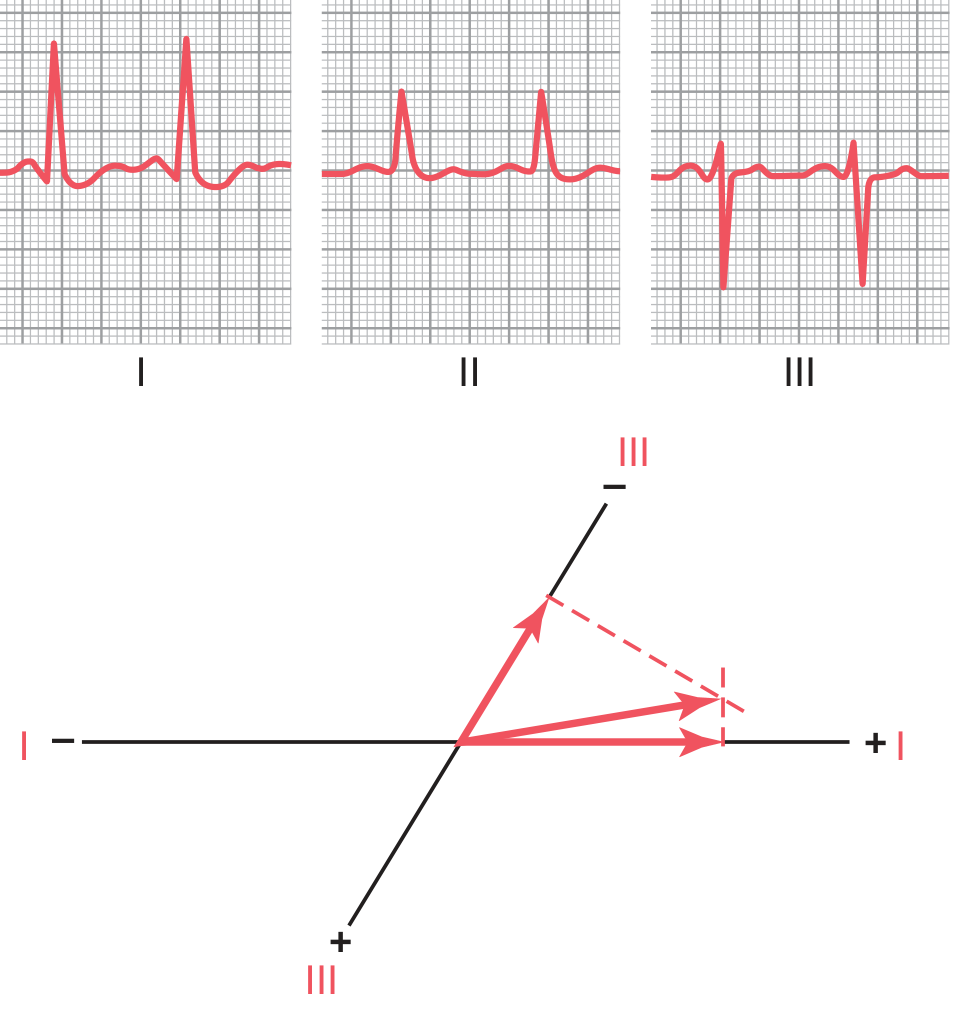
3.2 Axis Summary Table
| Category | Degrees | Leads I and aVF |
|---|---|---|
| Normal axis | -30° to +90° | Both positive |
| Left axis deviation (LAD) | -30° to -90° | I positive, aVF negative |
| Right axis deviation (RAD) | +90° to +180° | I negative, aVF positive |
| Extreme axis ("no man's land") | -90° to ±180° | Both negative |
3.3 Quick Bedside Axis Method (using Leads I and aVF)
- Look at the QRS in Lead I - is it mostly upright (+) or mostly downward (-)?
- Look at the QRS in Lead aVF - is it mostly upright (+) or mostly downward (-)?
Lead I (+), aVF (+) → Normal axis
Lead I (+), aVF (-) → Left axis deviation
Lead I (-), aVF (+) → Right axis deviation
Lead I (-), aVF (-) → Extreme (northwest) axis
3.4 Causes of Axis Deviation
| Left Axis Deviation (LAD) | Right Axis Deviation (RAD) |
|---|---|
| Left ventricular hypertrophy | Right ventricular hypertrophy |
| Left anterior fascicular block | Left posterior fascicular block |
| Inferior MI (Q waves pull axis away) | Right bundle branch block |
| Wolff-Parkinson-White syndrome | Lateral MI |
| LBBB | Pulmonary hypertension / PE (acute cor pulmonale) |
| Hyperkalemia | Dextrocardia |
"Left axis deviation results from hypertension causing left ventricular hypertrophy... Right axis deviation may result from congenital pulmonary valve stenosis, tetralogy of Fallot, or other conditions causing right ventricular hypertrophy." - Guyton & Hall Textbook of Medical Physiology
MODULE 4 - Hypertrophy Patterns
4.1 Left Ventricular Hypertrophy (LVH)
- SV1 + RV5 or RV6 >35 mm (Cornell: RaVL >20 mm women, >28 mm men)
- Left axis deviation
- Left atrial enlargement (bifid P wave in II, biphasic P in V1)
- "Strain" pattern: ST depression + T-wave inversion in I, aVL, V5, V6 (leads with tall R waves)
4.2 Right Ventricular Hypertrophy (RVH)
- Right axis deviation (>+90°)
- Tall R wave in V1 (R>S in V1, or R>7 mm)
- Deep S waves in V5, V6
- T-wave inversion V1-V3
- Right atrial enlargement: peaked P wave in II >2.5 mm ("P pulmonale")
MODULE 5 - Special Patterns to Know
5.1 Wolff-Parkinson-White (WPW)
- Short PR interval (<120 ms) - signal bypasses AV node delay
- Delta wave - slurred upstroke at the start of QRS (slow conduction through myocardium before normal conduction catches up)
- Wide QRS (total from delta to end)
- Risk: rapid conduction down the accessory pathway in AF can trigger VF
5.2 Long QT Syndrome
- QTc >450 ms (men) or >460 ms (women)
- Causes: drugs (amiodarone, quinidine, haloperidol, erythromycin), hypokalemia, hypomagnesemia, congenital
- Risk: Torsades de pointes - a polymorphic VT that looks like a twisting ribbon, which can degenerate to VF and cause sudden death
5.3 Brugada Syndrome
- Coved-type ST elevation in V1-V2 with RBBB-like morphology
- Can be unmasked by fever, sodium channel blockers
- Risk of sudden cardiac death from VF - ICD implantation needed
5.4 Hyperkalemia (Potassium Effect on ECG)
K+ 5.5-6.5: Peaked (tall, narrow, symmetric) T waves
K+ 6.5-7.5: Wide QRS, prolonged PR, flattened P waves
K+ >7.5:   Loss of P waves → "sine wave" pattern
K+ >8-9:   VF or asystole
Summary - The Full Approach in One Place
Step 1  Rate:           _____ bpm (normal 60-100)
Step 2  Rhythm:         Regular/Irregular | P before every QRS?
Step 3  PR interval:    _____ ms (normal 120-200)
Step 4  QRS width:      _____ ms (<110 normal)
Step 5  Axis:           Lead I ___ aVF ___ → Normal/LAD/RAD
Step 6  ST segment:     Normal/Elevated/Depressed
           If elevated → Which leads? → Localize territory
           Reciprocal changes? → Confirms STEMI
Step 7  T waves:        Upright/Inverted/Hyperacute/Peaked
Step 8  QTc:            _____ ms (men <450, women <460)
Step 9  Hypertrophy:    Voltage criteria? Strain pattern?
Step 10 Pattern:        BBB? WPW? Brugada? Ischemia?
- Harrison's Principles of Internal Medicine, 22E (2025) - ECG Waveforms, Myocardial Ischemia and Infarction
- Guyton and Hall Textbook of Medical Physiology - Axis Deviation, ECG Fundamentals
- Tintinalli's Emergency Medicine - STEMI Criteria, ST-Segment Based Diagnosis
- Goldman-Cecil Medicine - Electrocardiography, Arrhythmia Diagnosis
Create a practice case deck with 10 ECGs
- Atrial Fibrillation -
c85541618159f7da9530493cfb243ab6826c7ea2c50edece5d0bd203ac7f6bb6.png - Inferior STEMI (RCA) -
e30f337203edbe720805bc753caca4b6ae448f7e006d83ca604f83e144d2f782.png - Anterior STEMI (LAD distal) -
dc6d5cd22f8672f0b27b85a097c90de9ee666d76b0d0e89b4b46115b0fe5f154.png - Anterior STEMI (LAD proximal) -
2892df61f6a4e33f8814ab62d11c2ad4ffb8a3cb8023eeeb775ea3cf982cde82.png - RV Infarction -
591d741e2ea55e526228f79f8dd6a2cf080b0626906cbf806282e2992df06b17.png - PE / S1Q3T3 -
28043f05c25edcd2ef040a7618f8d8af42facf9c194292f826202ab262a09da3.png - Atrial Flutter -
012b4fbfc7465f18d6c3598dd526531fd9e11dcda15d8da6c0faae3de3d1520f.png - High-grade AV block -
261b1c6b1574e2e999daf13b011387a0122373806c4f1abfa30243401b33c870.png - LBBB concordant/discordant ST -
ce8f5f11790c18bb6281489bc410aada31d4b45782ce90e05721fccf4be3822e.png - AF initiating (PAC + AF) -
17684e22a76b3488c70edf5d6e238d7feaf1c716f9e05f1e73b4e1deb5429cb4.png
mkdir -p /home/daytona/workspace/ecg-practice-deck && ls /home/daytona/workspace/ecg-practice-deck/
~/ecg-practice-deck/build.js
const pptxgen = require("pptxgenjs");
const { execSync } = require("child_process");

// ─── Color Palette ──────────────────────────────────────────────────────────
const BG_DARK   = "0D1B2A";   // deep navy - title / answer slides
const BG_CASE   = "112233";   // slightly lighter navy - case slides
const BG_LIGHT  = "F0F4F8";   // off-white - ECG slides
const ACCENT    = "E63946";   // medical red
const GOLD      = "F4A261";   // warm gold for highlights
const WHITE     = "FFFFFF";
const LIGHT_TXT = "B8C8D8";
const GREEN     = "2EC4B6";   // teal-green for correct answers

// ─── ECG Cases Data ─────────────────────────────────────────────────────────
const cases = [
  {
    number: 1,
    clinicalContext: "65-year-old man with hypertension presents with palpitations and mild dyspnea for 2 days. HR 110, BP 130/85.",
    clues: ["Note the ventricular rhythm carefully", "Look for P waves", "Is every RR interval equal?"],
    imageUrl: "https://cdn.orris.care/cdss_images/c85541618159f7da9530493cfb243ab6826c7ea2c50edece5d0bd203ac7f6bb6.png",
    diagnosis: "Atrial Fibrillation (AF)",
    keyFindings: [
      "Irregularly irregular RR intervals",
      "No discrete P waves — chaotic baseline",
      "Narrow QRS complexes (AV node conducting normally)",
      "Ventricular rate ~110 bpm (uncontrolled)"
    ],
    teaching: "AF is the most common sustained arrhythmia. The chaotic atrial activity (>600 impulses/min) produces no organised P waves. The AV node acts as a 'gatekeeper', allowing only some impulses through — resulting in an irregularly irregular rhythm. Stroke risk must be assessed (CHA₂DS₂-VASc score).",
    management: "Rate control (beta-blocker/diltiazem) → Anticoagulation (CHA₂DS₂-VASc ≥2) → Consider rhythm control"
  },
  {
    number: 2,
    clinicalContext: "80-year-old man with sudden onset chest pain radiating to the jaw. Diaphoretic, BP 95/60, HR 88.",
    clues: ["Focus on leads II, III, and aVF", "Check leads I and aVL", "Look for reciprocal changes"],
    imageUrl: "https://cdn.orris.care/cdss_images/e30f337203edbe720805bc753caca4b6ae448f7e006d83ca604f83e144d2f782.png",
    diagnosis: "Inferior STEMI (RCA Occlusion)",
    keyFindings: [
      "ST elevation in leads II, III, aVF (inferior leads)",
      "ST elevation in lead III > lead II → favours RCA over circumflex",
      "Reciprocal ST depression in lead I and aVL",
      "Must get right-sided leads to rule out RV infarction"
    ],
    teaching: "Inferior STEMI is caused by RCA occlusion in ~80% of cases. The hallmark is ST elevation in II, III, and aVF. Reciprocal ST depression in I and aVL confirms it. Always obtain lead V4R — ST elevation in V4R indicates co-existing RV infarction and means the patient will NOT tolerate nitrates.",
    management: "Aspirin + P2Y12 inhibitor → Emergency PCI (door-to-balloon <90 min) → Avoid nitrates if RV infarction suspected"
  },
  {
    number: 3,
    clinicalContext: "52-year-old man with 1 hour of crushing central chest pain, sweating. BP 140/90, HR 92. No prior cardiac history.",
    clues: ["Look at precordial leads V1-V4", "Check leads I and aVL", "Note the pattern of ST elevation"],
    imageUrl: "https://cdn.orris.care/cdss_images/dc6d5cd22f8672f0b27b85a097c90de9ee666d76b0d0e89b4b46115b0fe5f154.png",
    diagnosis: "Anterior STEMI (Distal LAD Occlusion)",
    keyFindings: [
      "ST elevation in V1, V2, V3 and lead I",
      "No ST depression in II, III, aVF (distal LAD — inferior wall spared)",
      "Anterior territory involvement: septum + anterior wall",
      "Distal LAD: less territory than proximal occlusion"
    ],
    teaching: "Anterior STEMI from LAD occlusion is the most haemodynamically dangerous MI. ST elevation in V1-V4 + I, aVL indicates anterior/lateral territory. Occlusion proximal to the first septal perforator affects a larger territory and carries higher mortality. Look for ST elevation in aVR (main stem equivalent).",
    management: "Dual antiplatelet + Emergency PCI → Monitor for LBBB, VT, VF, acute MR, cardiogenic shock"
  },
  {
    number: 4,
    clinicalContext: "65-year-old woman with chest pain for 45 minutes, shortness of breath. Known COPD. BP 105/70, HR 115.",
    clues: ["Compare ST elevation across all leads", "Look for any lead with ST depression", "Check leads aVR and V1"],
    imageUrl: "https://cdn.orris.care/cdss_images/2892df61f6a4e33f8814ab62d11c2ad4ffb8a3cb8023eeeb775ea3cf982cde82.png",
    diagnosis: "Anterior STEMI (Proximal LAD Occlusion)",
    keyFindings: [
      "ST elevation V1, V2, V3, V4 with associated aVL involvement",
      "Extensive anterior territory = proximal LAD",
      "Reciprocal ST depression in inferior leads",
      "Risk of cardiogenic shock — large territory at risk"
    ],
    teaching: "Proximal LAD occlusion (before the first diagonal or septal branch) produces massive anterior STEMI affecting the anterior wall, septum, apex, and often the lateral wall. These patients have the highest in-hospital mortality among all STEMIs. Expect complications: VT, VF, AV block, LV failure.",
    management: "Fastest possible PCI → ICU monitoring → Inotropic support if cardiogenic shock"
  },
  {
    number: 5,
    clinicalContext: "33-year-old man post-long-haul flight, sudden onset pleuritic chest pain and breathlessness. HR 105, O₂ sat 91% on air. Leg swollen.",
    clues: ["Look at lead I for S waves", "Look at lead III for Q waves and T-wave changes", "Check right precordial leads for RBBB pattern"],
    imageUrl: "https://cdn.orris.care/cdss_images/28043f05c25edcd2ef040a7618f8d8af42facf9c194292f826202ab262a09da3.png",
    diagnosis: "Pulmonary Embolism (S1Q3T3 Pattern)",
    keyFindings: [
      "S wave in lead I",
      "Q wave in lead III",
      "T-wave inversion in lead III (S1Q3T3)",
      "Incomplete RBBB with T-wave inversion V1–V4 (right heart strain)",
      "Sinus tachycardia"
    ],
    teaching: "The S1Q3T3 pattern reflects acute right ventricular strain from PE. The most common ECG finding is sinus tachycardia. S1Q3T3 is specific but not sensitive (~20%). T-wave inversion V1-V4 indicates RV pressure overload. The ECG is most useful for excluding MI and supporting PE diagnosis.",
    management: "CT pulmonary angiogram to confirm → Anticoagulation (LMWH/DOAC) → Thrombolysis if massive PE + haemodynamic collapse"
  },
  {
    number: 6,
    clinicalContext: "Patient with regular narrow-complex tachycardia at HR 150 bpm. Asymptomatic except mild palpitations. BP 118/75.",
    clues: ["A rate of exactly 150 bpm should trigger a specific suspicion", "Look at the baseline between QRS complexes in leads II, III, aVF", "Is there any sawtooth pattern?"],
    imageUrl: "https://cdn.orris.care/cdss_images/012b4fbfc7465f18d6c3598dd526531fd9e11dcda15d8da6c0faae3de3d1520f.png",
    diagnosis: "Atrial Flutter (2:1 AV Block)",
    keyFindings: [
      "Sawtooth flutter waves at ~300/min in inferior leads",
      "Positive flutter waves in V1",
      "Regular ventricular rate ~150 bpm (300 ÷ 2 = 150)",
      "2:1 AV conduction ratio",
      "Narrow QRS complexes"
    ],
    teaching: "Atrial flutter arises from a single reentry circuit in the right atrium cycling at ~300/min. The AV node blocks every other impulse, giving a ventricular rate of ~150 bpm. RULE: any regular narrow-complex tachycardia at exactly 150 bpm → think flutter until proven otherwise. Vagal manoeuvres/adenosine will slow the rate transiently, unmasking the flutter waves.",
    management: "Rate control → Anticoagulation (same as AF) → Rhythm control: cardioversion or catheter ablation (>95% curative)"
  },
  {
    number: 7,
    clinicalContext: "73-year-old man with dizziness and near-syncope. HR 38, BP 90/60. Permanent pacemaker not fitted.",
    clues: ["Count the P waves and QRS complexes separately", "Are P waves and QRS complexes related to each other?", "What is the ventricular escape rate?"],
    imageUrl: "https://cdn.orris.care/cdss_images/261b1c6b1574e2e999daf13b011387a0122373806c4f1abfa30243401b33c870.png",
    diagnosis: "High-Grade AV Block",
    keyFindings: [
      "P waves and QRS complexes not always related (intermittent dissociation)",
      "Variable RR intervals — some P waves conduct, others are blocked",
      "Sinus rate 82 bpm; slower ventricular rate",
      "Beats 4 and 5 have shorter preceding RR → these conduct",
      "This is high-grade (not complete) AV block"
    ],
    teaching: "High-grade AV block (also called advanced second-degree) means most P waves are blocked. In complete (third-degree) block, NO P waves conduct — the atria and ventricles beat completely independently. The ventricular escape rate is <40/min with wide QRS. Both are pacemaker indications. Causes: inferior MI, drugs (digoxin, beta-blockers), degenerative conduction disease.",
    management: "IV atropine (temporary) → Transcutaneous pacing if unstable → Permanent pacemaker"
  },
  {
    number: 8,
    clinicalContext: "55-year-old woman with progressive exertional dyspnoea and fatigue. History of hypertension for 15 years. BP 165/95.",
    clues: ["Look at QRS voltage in precordial leads", "Check for ST and T-wave changes in lateral leads (V5, V6, I, aVL)", "Calculate: S in V1 + R in V5 or V6"],
    imageUrl: "https://cdn.orris.care/cdss_images/17684e22a76b3488c70edf5d6e238d7feaf1c716f9e05f1e73b4e1deb5429cb4.png",
    diagnosis: "Normal Sinus Rhythm with PAC Initiating AF",
    keyFindings: [
      "Two normal sinus beats at the start",
      "A blocked premature atrial contraction (PAC) after the 2nd QRS",
      "A subsequent PAC then triggers atrial fibrillation",
      "Demonstrates how most AF is triggered by atrial ectopy from pulmonary veins"
    ],
    teaching: "Most episodes of AF are triggered by premature atrial contractions (PACs) originating from the pulmonary veins. A PAC fires at a critical moment when part of the atrium is still partially refractory, initiating re-entry and AF. This is the rationale for pulmonary vein isolation (PVI) catheter ablation. PACs appear on the ECG as early P waves with different morphology.",
    management: "Identify triggers → Treat underlying cause → Antiarrhythmic therapy or PVI ablation for paroxysmal AF"
  },
  {
    number: 9,
    clinicalContext: "58-year-old man presents with chest pain. ECG shows ST abnormalities in left bundle branch block. How do you interpret this?",
    clues: ["In LBBB, the ST segment is normally discordant to the QRS", "Concordant = ST goes SAME direction as QRS dominant deflection", "Excessive discordance >5mm is also abnormal"],
    imageUrl: "https://cdn.orris.care/cdss_images/ce8f5f11790c18bb6281489bc410aada31d4b45782ce90e05721fccf4be3822e.png",
    diagnosis: "LBBB with Modified Sgarbossa Criteria",
    keyFindings: [
      "A: Discordant ST depression (normal in LBBB)",
      "B: Discordant ST elevation (normal in LBBB)",
      "C: CONCORDANT ST elevation → strongly suggests acute MI",
      "D: Concordant ST depression → suggests acute MI",
      "E: Excessive discordant ST elevation >5mm → weakly suggestive"
    ],
    teaching: "In LBBB, the ST segment is normally discordant (opposite direction to main QRS deflection) because repolarisation is abnormal. Finding concordant ST changes breaks this rule and suggests acute ischaemia on top of LBBB (Sgarbossa criteria). A new LBBB in chest pain was historically treated as STEMI equivalent, but now the modified Sgarbossa criteria are more specific.",
    management: "Concordant ST changes in LBBB + chest pain → treat as STEMI → Emergency PCI"
  },
  {
    number: 10,
    clinicalContext: "A 47-year-old man with right ventricular infarction complicating inferior STEMI. Note the classic findings.",
    clues: ["Look at the inferior leads II, III, aVF", "Check for ST elevation in right-sided leads V3R-V6R", "Observe lead V1 carefully"],
    imageUrl: "https://cdn.orris.care/cdss_images/591d741e2ea55e526228f79f8dd6a2cf080b0626906cbf806282e2992df06b17.png",
    diagnosis: "RV Infarction with Inferior STEMI",
    keyFindings: [
      "ST elevation in II, III, aVF (inferior STEMI)",
      "ST elevation in V1 on standard ECG",
      "Right-sided leads (V3R-V6R): ST elevation confirms RV infarction",
      "This pattern indicates proximal RCA occlusion",
      "RV infarction in ~30-50% of inferior STEMIs"
    ],
    teaching: "RV infarction complicates proximal RCA occlusion. On the standard 12-lead, ST elevation in V1 alongside inferior STEMI should trigger right-sided leads. Haemodynamically, these patients are volume-dependent — their RV needs preload. AVOID nitrates (cause massive BP drop), diuretics, and morphine. Give IV fluids. Management is different from standard STEMI.",
    management: "IV fluid boluses (cautious) → No nitrates/diuretics → Urgent PCI of proximal RCA → Dobutamine if refractory"
  }
];

// ─── Fetch all ECG images via skill script ───────────────────────────────────
const imageUrls = cases.map(c => c.imageUrl);
console.log("Fetching ECG images...");
const fetchResult = execSync(
  `node /home/daytona/skills/shared/scripts/fetch_images.js ${imageUrls.map(u => `"${u}"`).join(" ")}`
).toString();
const images = JSON.parse(fetchResult);
console.log(`Fetched ${images.filter(i => !i.error).length}/${images.length} images successfully`);

// ─── Build Presentation ──────────────────────────────────────────────────────
let pres = new pptxgen();
pres.layout = "LAYOUT_16x9";
pres.title = "ECG Practice Cases";
pres.author = "Orris Medical Education";

// ══════════════════════════════════════════════════════════════════════════════
// TITLE SLIDE
// ══════════════════════════════════════════════════════════════════════════════
{
  let slide = pres.addSlide();
  slide.addShape(pres.ShapeType.rect, { x: 0, y: 0, w: 10, h: 5.625, fill: { color: BG_DARK } });
  // Red accent bar
  slide.addShape(pres.ShapeType.rect, { x: 0, y: 2.2, w: 10, h: 0.05, fill: { color: ACCENT } });
  // ECG-like decorative lines (horizontal)
  for (let i = 0; i < 5; i++) {
    slide.addShape(pres.ShapeType.rect, { x: 0, y: 0.3 + i * 0.28, w: 10, h: 0.01, fill: { color: "1A2E45" } });
  }
  slide.addText("ECG Practice Cases", {
    x: 0.6, y: 0.7, w: 8.8, h: 1.2,
    fontSize: 44, bold: true, color: WHITE, fontFace: "Calibri", align: "center"
  });
  slide.addText("10 Clinical Scenarios — Test Your Interpretation Skills", {
    x: 0.6, y: 1.85, w: 8.8, h: 0.55,
    fontSize: 18, color: LIGHT_TXT, fontFace: "Calibri", align: "center"
  });
  slide.addShape(pres.ShapeType.rect, { x: 3.5, y: 2.35, w: 3, h: 0.06, fill: { color: ACCENT } });

  const topics = ["Arrhythmias", "STEMI Localization", "AV Blocks", "Bundle Branch Blocks", "PE & RV Strain"];
  topics.forEach((t, i) => {
    const col = i < 3 ? 0 : 1;
    const row = i < 3 ? i : i - 3;
    slide.addShape(pres.ShapeType.rect, {
      x: 1.5 + col * 4.5, y: 2.6 + row * 0.52, w: 3.5, h: 0.42,
      fill: { color: "162840" }, line: { color: ACCENT, width: 1 }
    });
    slide.addText(t, {
      x: 1.5 + col * 4.5, y: 2.6 + row * 0.52, w: 3.5, h: 0.42,
      fontSize: 15, color: GOLD, bold: true, align: "center", valign: "middle"
    });
  });

  slide.addText("Each case: Clinical Context → ECG → Answer & Teaching", {
    x: 0.5, y: 5.1, w: 9, h: 0.35,
    fontSize: 13, color: "607890", align: "center", italic: true
  });
}

// ══════════════════════════════════════════════════════════════════════════════
// HELPER: HOW TO USE SLIDE
// ══════════════════════════════════════════════════════════════════════════════
{
  let slide = pres.addSlide();
  slide.addShape(pres.ShapeType.rect, { x: 0, y: 0, w: 10, h: 5.625, fill: { color: BG_DARK } });
  slide.addShape(pres.ShapeType.rect, { x: 0, y: 0, w: 0.12, h: 5.625, fill: { color: ACCENT } });
  slide.addText("How to Use This Deck", {
    x: 0.4, y: 0.2, w: 9.2, h: 0.7,
    fontSize: 28, bold: true, color: WHITE, fontFace: "Calibri"
  });
  const steps = [
    ["STEP 1 — Read the Clinical Context", "Age, symptoms, vitals — form your differential before seeing the ECG."],
    ["STEP 2 — Interpret the ECG", "Use your 7-step system: Rate → Rhythm → PR → QRS → Axis → ST → QT. Read the clues for hints."],
    ["STEP 3 — Commit to a Diagnosis", "Write it down or say it out loud before advancing to the answer slide."],
    ["STEP 4 — Check the Answer", "Review key findings, teaching points, and management pearls."],
  ];
  steps.forEach(([title, desc], i) => {
    slide.addShape(pres.ShapeType.rect, {
      x: 0.4, y: 1.0 + i * 1.1, w: 9.2, h: 0.95,
      fill: { color: "0F2035" }, line: { color: GOLD, width: 1.5 }
    });
    slide.addText(title, {
      x: 0.6, y: 1.05 + i * 1.1, w: 8.8, h: 0.35,
      fontSize: 14, bold: true, color: GOLD
    });
    slide.addText(desc, {
      x: 0.6, y: 1.38 + i * 1.1, w: 8.8, h: 0.5,
      fontSize: 12, color: LIGHT_TXT
    });
  });
}

// ══════════════════════════════════════════════════════════════════════════════
// CASE SLIDES (Case + ECG + Answer) × 10
// ══════════════════════════════════════════════════════════════════════════════
cases.forEach((c, idx) => {
  const img = images[idx];

  // ── CASE CONTEXT SLIDE ─────────────────────────────────────────────────────
  {
    let slide = pres.addSlide();
    slide.addShape(pres.ShapeType.rect, { x: 0, y: 0, w: 10, h: 5.625, fill: { color: BG_CASE } });
    // Case number badge
    slide.addShape(pres.ShapeType.rect, { x: 0, y: 0, w: 10, h: 0.72, fill: { color: ACCENT } });
    slide.addText(`CASE ${c.number}  /  10`, {
      x: 0.4, y: 0.08, w: 5, h: 0.56,
      fontSize: 22, bold: true, color: WHITE, fontFace: "Calibri"
    });
    slide.addText("CLINICAL CONTEXT", {
      x: 5, y: 0.08, w: 4.6, h: 0.56,
      fontSize: 13, color: "FFCCD0", align: "right", italic: true
    });

    // Clinical scenario box
    slide.addShape(pres.ShapeType.rect, { x: 0.4, y: 0.85, w: 9.2, h: 1.35, fill: { color: "0A1929" }, line: { color: GOLD, width: 1.5 } });
    slide.addText("Patient Presentation", {
      x: 0.6, y: 0.9, w: 8.8, h: 0.3,
      fontSize: 12, color: GOLD, bold: true, italic: true
    });
    slide.addText(c.clinicalContext, {
      x: 0.6, y: 1.18, w: 8.8, h: 0.9,
      fontSize: 14, color: WHITE, fontFace: "Calibri"
    });

    // Systematic approach reminder
    slide.addText("Apply Your 7-Step ECG System:", {
      x: 0.4, y: 2.3, w: 9.2, h: 0.35,
      fontSize: 13, color: LIGHT_TXT, bold: true
    });
    const steps7 = ["Rate", "Rhythm", "PR Interval", "QRS Width", "Axis", "ST Segment", "T Waves / QTc"];
    steps7.forEach((s, i) => {
      const col = i < 4 ? 0 : 1;
      const row = i < 4 ? i : i - 4;
      slide.addShape(pres.ShapeType.roundRect, {
        x: 0.4 + col * 4.8, y: 2.7 + row * 0.48, w: 4.3, h: 0.4,
        fill: { color: "162840" }, line: { color: "2A4A6A", width: 1 }, rectRadius: 0.05
      });
      slide.addText(`${i + 1}. ${s}`, {
        x: 0.4 + col * 4.8, y: 2.7 + row * 0.48, w: 4.3, h: 0.4,
        fontSize: 12, color: LIGHT_TXT, align: "center", valign: "middle"
      });
    });

    // Hint clues
    slide.addShape(pres.ShapeType.rect, { x: 0.4, y: 4.65, w: 9.2, h: 0.8, fill: { color: "1A3A1A" }, line: { color: GREEN, width: 1 } });
    slide.addText("💡  Clues: " + c.clues.join("  |  "), {
      x: 0.5, y: 4.68, w: 9.0, h: 0.74,
      fontSize: 11.5, color: GREEN, italic: true, valign: "middle"
    });
  }

  // ── ECG SLIDE ─────────────────────────────────────────────────────────────
  {
    let slide = pres.addSlide();
    slide.addShape(pres.ShapeType.rect, { x: 0, y: 0, w: 10, h: 5.625, fill: { color: BG_LIGHT } });
    // Top bar
    slide.addShape(pres.ShapeType.rect, { x: 0, y: 0, w: 10, h: 0.5, fill: { color: BG_DARK } });
    slide.addText(`CASE ${c.number}  —  ECG`, {
      x: 0.4, y: 0.05, w: 6, h: 0.4,
      fontSize: 16, bold: true, color: WHITE
    });
    slide.addText("What is your diagnosis?", {
      x: 5, y: 0.05, w: 4.6, h: 0.4,
      fontSize: 14, color: GOLD, align: "right", italic: true
    });

    if (img && !img.error) {
      slide.addImage({
        data: img.base64,
        x: 0.3, y: 0.6, w: 9.4, h: 4.9
      });
    } else {
      slide.addText("ECG image could not be loaded", {
        x: 2, y: 2.5, w: 6, h: 1,
        fontSize: 18, color: ACCENT, align: "center"
      });
    }
  }

  // ── ANSWER SLIDE ──────────────────────────────────────────────────────────
  {
    let slide = pres.addSlide();
    slide.addShape(pres.ShapeType.rect, { x: 0, y: 0, w: 10, h: 5.625, fill: { color: BG_DARK } });
    slide.addShape(pres.ShapeType.rect, { x: 0, y: 0, w: 0.15, h: 5.625, fill: { color: GREEN } });
    // Header
    slide.addShape(pres.ShapeType.rect, { x: 0, y: 0, w: 10, h: 0.65, fill: { color: "051020" } });
    slide.addText(`CASE ${c.number}  —  ANSWER`, {
      x: 0.4, y: 0.1, w: 4, h: 0.45,
      fontSize: 15, bold: true, color: LIGHT_TXT
    });

    // Diagnosis banner
    slide.addShape(pres.ShapeType.rect, { x: 0.25, y: 0.75, w: 9.5, h: 0.75, fill: { color: ACCENT }, line: { color: ACCENT } });
    slide.addText(`✓  ${c.diagnosis}`, {
      x: 0.35, y: 0.75, w: 9.3, h: 0.75,
      fontSize: 22, bold: true, color: WHITE, valign: "middle", fontFace: "Calibri"
    });

    // Key Findings
    slide.addText("KEY ECG FINDINGS", {
      x: 0.3, y: 1.62, w: 4.4, h: 0.3,
      fontSize: 11, bold: true, color: GOLD, charSpacing: 2
    });
    slide.addShape(pres.ShapeType.rect, { x: 0.25, y: 1.93, w: 4.55, h: 2.3, fill: { color: "0A1929" }, line: { color: GOLD, width: 1 } });
    c.keyFindings.forEach((f, i) => {
      slide.addText(`▸  ${f}`, {
        x: 0.35, y: 1.98 + i * 0.47, w: 4.35, h: 0.42,
        fontSize: 11.5, color: WHITE
      });
    });

    // Teaching point
    slide.addText("TEACHING POINT", {
      x: 5.05, y: 1.62, w: 4.6, h: 0.3,
      fontSize: 11, bold: true, color: GOLD, charSpacing: 2
    });
    slide.addShape(pres.ShapeType.rect, { x: 5.0, y: 1.93, w: 4.75, h: 1.55, fill: { color: "0A1929" }, line: { color: LIGHT_TXT, width: 1 } });
    slide.addText(c.teaching, {
      x: 5.1, y: 1.98, w: 4.55, h: 1.45,
      fontSize: 10.5, color: LIGHT_TXT
    });

    // Management pearl
    slide.addText("MANAGEMENT PEARL", {
      x: 5.05, y: 3.57, w: 4.6, h: 0.3,
      fontSize: 11, bold: true, color: GOLD, charSpacing: 2
    });
    slide.addShape(pres.ShapeType.rect, { x: 5.0, y: 3.87, w: 4.75, h: 1.45, fill: { color: "0F2530" }, line: { color: GREEN, width: 1 } });
    slide.addText(c.management, {
      x: 5.1, y: 3.92, w: 4.55, h: 1.3,
      fontSize: 11, color: GREEN
    });

    // Mini ECG thumbnail on answer slide
    if (img && !img.error) {
      slide.addImage({
        data: img.base64,
        x: 0.25, y: 4.28, w: 4.55, h: 1.2
      });
    }
  }
});

// ══════════════════════════════════════════════════════════════════════════════
// SUMMARY / QUICK REFERENCE SLIDE
// ══════════════════════════════════════════════════════════════════════════════
{
  let slide = pres.addSlide();
  slide.addShape(pres.ShapeType.rect, { x: 0, y: 0, w: 10, h: 5.625, fill: { color: BG_DARK } });
  slide.addShape(pres.ShapeType.rect, { x: 0, y: 0, w: 10, h: 0.65, fill: { color: ACCENT } });
  slide.addText("ECG Quick Reference Card", {
    x: 0.4, y: 0.08, w: 9.2, h: 0.5,
    fontSize: 22, bold: true, color: WHITE, align: "center"
  });

  const diagnoses = [
    ["AF", "Irregularly irregular, no P waves, narrow QRS"],
    ["A. Flutter", "Sawtooth ~300/min, regular rate ~150 (2:1)"],
    ["Inf. STEMI", "ST↑ II, III, aVF + reciprocal depression I, aVL"],
    ["Ant. STEMI", "ST↑ V1-V4 ± I, aVL (LAD)"],
    ["PE", "S1Q3T3, sinus tachy, T inv V1-V4, RBBB pattern"],
    ["3° AV Block", "P waves + QRS independent, escape rate <40"],
    ["LBBB", "QRS ≥120ms, broad R V5/V6, QS in V1"],
    ["RBBB", "QRS ≥120ms, rSR' V1 (rabbit ears), wide S V6"],
    ["LVH", "SV1 + RV5/V6 >35mm, strain pattern I/aVL"],
    ["WPW", "Short PR, delta wave, wide QRS"],
  ];
  diagnoses.forEach(([dx, features], i) => {
    const col = i < 5 ? 0 : 1;
    const row = i < 5 ? i : i - 5;
    slide.addShape(pres.ShapeType.rect, {
      x: 0.2 + col * 4.9, y: 0.78 + row * 0.93, w: 4.65, h: 0.86,
      fill: { color: "0A1929" }, line: { color: "2A4A6A", width: 1 }
    });
    slide.addText(dx, {
      x: 0.3 + col * 4.9, y: 0.82 + row * 0.93, w: 1.1, h: 0.35,
      fontSize: 12, bold: true, color: GOLD
    });
    slide.addText(features, {
      x: 0.3 + col * 4.9, y: 1.14 + row * 0.93, w: 4.45, h: 0.4,
      fontSize: 10.5, color: LIGHT_TXT
    });
  });
}

// ── WRITE FILE ─────────────────────────────────────────────────────────────
const outputPath = "/home/daytona/workspace/ecg-practice-deck/ECG_Practice_Cases.pptx";
pres.writeFile({ fileName: outputPath }).then(() => {
  console.log(`✅ Presentation saved to: ${outputPath}`);
}).catch(err => {
  console.error("Error writing file:", err);
  process.exit(1);
});
cd /home/daytona/workspace/ecg-practice-deck && node build.js 2>&1
cd /home/daytona/workspace/ecg-practice-deck # Fetch images one at a time and save each to a JSON file URLS=( "https://cdn.orris.care/cdss_images/c85541618159f7da9530493cfb243ab6826c7ea2c50edece5d0bd203ac7f6bb6.png" "https://cdn.orris.care/cdss_images/e30f337203edbe720805bc753caca4b6ae448f7e006d83ca604f83e144d2f782.png" "https://cdn.orris.care/cdss_images/dc6d5cd22f8672f0b27b85a097c90de9ee666d76b0d0e89b4b46115b0fe5f154.png" "https://cdn.orris.care/cdss_images/2892df61f6a4e33f8814ab62d11c2ad4ffb8a3cb8023eeeb775ea3cf982cde82.png" "https://cdn.orris.care/cdss_images/28043f05c25edcd2ef040a7618f8d8af42facf9c194292f826202ab262a09da3.png" "https://cdn.orris.care/cdss_images/012b4fbfc7465f18d6c3598dd526531fd9e11dcda15d8da6c0faae3de3d1520f.png" "https://cdn.orris.care/cdss_images/261b1c6b1574e2e999daf13b011387a0122373806c4f1abfa30243401b33c870.png" "https://cdn.orris.care/cdss_images/17684e22a76b3488c70edf5d6e238d7feaf1c716f9e05f1e73b4e1deb5429cb4.png" "https://cdn.orris.care/cdss_images/ce8f5f11790c18bb6281489bc410aada31d4b45782ce90e05721fccf4be3822e.png" "https://cdn.orris.care/cdss_images/591d741e2ea55e526228f79f8dd6a2cf080b0626906cbf806282e2992df06b17.png" ) mkdir -p imgs for i in "${!URLS[@]}"; do node /home/daytona/skills/shared/scripts/fetch_images.js "${URLS[$i]}" > "imgs/img${i}.json" echo "Fetched image $i" done echo "All done"
cd /home/daytona/workspace/ecg-practice-deck && mkdir -p imgs && node -e " const { execSync } = require('child_process'); const urls = [ 'https://cdn.orris.care/cdss_images/c85541618159f7da9530493cfb243ab6826c7ea2c50edece5d0bd203ac7f6bb6.png', 'https://cdn.orris.care/cdss_images/e30f337203edbe720805bc753caca4b6ae448f7e006d83ca604f83e144d2f782.png', 'https://cdn.orris.care/cdss_images/dc6d5cd22f8672f0b27b85a097c90de9ee666d76b0d0e89b4b46115b0fe5f154.png', 'https://cdn.orris.care/cdss_images/2892df61f6a4e33f8814ab62d11c2ad4ffb8a3cb8023eeeb775ea3cf982cde82.png', 'https://cdn.orris.care/cdss_images/28043f05c25edcd2ef040a7618f8d8af42facf9c194292f826202ab262a09da3.png', 'https://cdn.orris.care/cdss_images/012b4fbfc7465f18d6c3598dd526531fd9e11dcda15d8da6c0faae3de3d1520f.png', 'https://cdn.orris.care/cdss_images/261b1c6b1574e2e999daf13b011387a0122373806c4f1abfa30243401b33c870.png', 'https://cdn.orris.care/cdss_images/17684e22a76b3488c70edf5d6e238d7feaf1c716f9e05f1e73b4e1deb5429cb4.png', 'https://cdn.orris.care/cdss_images/ce8f5f11790c18bb6281489bc410aada31d4b45782ce90e05721fccf4be3822e.png', 'https://cdn.orris.care/cdss_images/591d741e2ea55e526228f79f8dd6a2cf080b0626906cbf806282e2992df06b17.png' ]; const fs = require('fs'); for (let i = 0; i < urls.length; i++) { const result = execSync(\`node /home/daytona/skills/shared/scripts/fetch_images.js \\\"\${urls[i]}\\\"\`); fs.writeFileSync(\`imgs/img\${i}.json\`, result); console.log('Saved img' + i + '.json, size=' + result.length); } console.log('All images fetched'); " 2>&1
~/ecg-practice-deck/build.js
Successfully replaced 1 instance(s) of the string in '/home/daytona/workspace/ecg-practice-deck/build.js'
cd /home/daytona/workspace/ecg-practice-deck && node build.js 2>&1
ls -lh /home/daytona/workspace/ecg-practice-deck/ECG_Practice_Cases.pptx
ECG Practice Cases
Presentation · PPTX
| # | ECG Diagnosis | Key Teaching |
|---|---|---|
| 1 | Atrial Fibrillation | Irregularly irregular, no P waves |
| 2 | Inferior STEMI (RCA) | ST↑ II/III/aVF, reciprocal I/aVL |
| 3 | Anterior STEMI - distal LAD | ST↑ V1-V3, no inferior reciprocal |
| 4 | Anterior STEMI - proximal LAD | Extensive ST↑, high mortality |
| 5 | Pulmonary Embolism - S1Q3T3 | Right heart strain pattern |
| 6 | Atrial Flutter 2:1 | Sawtooth waves, rate = 150 |
| 7 | High-Grade AV Block | P waves + QRS intermittently dissociated |
| 8 | PAC triggering AF | How AF starts - pulmonary vein ectopy |
| 9 | LBBB + Sgarbossa criteria | Concordant ST = MI in LBBB |
| 10 | RV Infarction with inferior STEMI | V4R ST↑, NO nitrates |