
Mid day meal scheme
Searching the Web
Mid Day Meal Scheme India overview 2024 2025
Reading Web Page
https://educationforallinindia.com/a-critical-review-of-mid-…
Here is a thorough overview of the Mid Day Meal Scheme (now PM-POSHAN):
Mid Day Meal Scheme (PM-POSHAN)
What Is It?
The Mid-Day Meal (MDM) Scheme is a free, cooked school lunch programme run by the Government of India for children in government and government-aided schools from Classes 1 to 8. It is the world's largest school feeding programme, currently serving approximately 120 million (12 crore) children across 1.27 lakh+ schools and Education Guarantee Scheme centres.
In 2021, it was officially renamed Pradhan Mantri Poshan Shakti Nirman (PM-POSHAN).
Historical Background
| Year | Milestone |
|---|---|
| 1925 | Madras Municipal Corporation started the first midday meal for 165 students in Chennai |
| 1930 | Expanded under French administration in Puducherry |
| 1956 | Tamil Nadu pioneered state-wide implementation under CM K. Kamaraj |
| 1984 | Kerala introduced its midday meal scheme |
| 1990-91 | 12 states had universalized cooked meals using state funds |
| 1995 | Launched nationally on August 15 as the National Programme of Nutritional Support to Primary Education (NP-NSPE) |
| 1997-98 | Implemented across all states |
| 2001 | Supreme Court of India mandated implementation in all government/government-aided primary schools |
| 2007 | Extended to upper primary classes (VI-VIII) in educationally backward blocks |
| 2021 | Renamed PM-POSHAN |
Objectives
- Improve nutritional status of school-age children
- Boost enrolment, attendance, and retention - especially for girls, Dalits, and Adivasis
- Reduce classroom hunger, improving concentration and learning outcomes
- Promote social equity by encouraging children from all communities to eat together
- Support women's employment through cook-cum-helper roles
Who Is Eligible?
- Children enrolled in Classes 1 to 8 (primary and upper primary)
- Students in government schools, government-aided schools, local body schools, anganwadis (pre-school), madrasas, and maqtabs
- Students in Education Guarantee Scheme centres
Note: Private unaided schools are excluded, which leaves approximately 12 crore students (45% of total enrolment) without coverage.
Nutritional Norms
| Level | Calories | Protein | Food Grains |
|---|---|---|---|
| Primary (Classes I-V) | 450 kcal | 12 g | 100 g |
| Upper Primary (Classes VI-VIII) | 700 kcal | 20 g | 150 g |
Meals must include pulses, vegetables, and oils in addition to grains.
Funding and Financial Structure (PM-POSHAN 2021-26)
- Total central outlay: Rs. 54,061 crore for the 2021-26 period
- FY 2024-25 budget estimate: Rs. 12,467.39 crore (~USD 1.49 billion)
- Cooking cost per child/day (revised May 1, 2025):
- Primary: Rs. 6.78
- Upper Primary: Rs. 10.17
- Centre-State cost sharing:
- General states: 60:40 (Centre:State)
- Special category states (NE, hilly): 90:10
- Food grains: Supplied free by the Centre at Rs. 3/kg, with transport subsidies up to Rs. 100/quintal in special states
Key Benefits
- Education: Higher enrolment and lower dropout rates - especially for girls and marginalized communities
- Nutrition: Addresses protein-energy malnutrition in school-going children
- Social integration: Caste and class barriers reduced when children eat together
- Women's empowerment: Cook-cum-helper positions (minimum Rs. 1,000/month honorarium; 1 per 25 students) provide rural women with income
- Economic stimulus: Local procurement of food grains supports farmers
Implementation Mechanism
- Meals are cooked on school premises using kitchen infrastructure (minimum 20 m² for 100 students)
- The Government of India partners with NGOs and not-for-profit organizations such as Akshaya Patra for decentralized implementation
- The scheme is independently monitored twice a year through Review Missions comprising central government, state government, UNICEF, and Supreme Court commissioner representatives
- UDISE+ data is used for tracking coverage and identifying gaps
Challenges and Criticisms
- Funding gaps: States like West Bengal have criticized the Centre for inadequate funding, forcing states to bear extra costs for enhanced menus (eggs, chicken)
- Quality and hygiene: Incidents of food contamination and poor kitchen facilities have been reported
- Coverage gaps: Private unaided school students (12 crore children) are excluded
- Rural implementation hurdles: Irregular grain supply, shortage of trained cooks, and infrastructure deficits in remote areas
- Cooking cost revision lag: Actual food prices often outpace the centrally fixed cooking cost rates
Recent Status (2024-26)
The scheme continues under the PM-POSHAN banner with its 2021-26 phase. Based on UDISE+ 2024-25 data, coverage stands at 118 million+ children daily across 1.12 million schools. Pilot programmes in states like Delhi have demonstrated 15% attendance gains from expanding the scheme to low-fee private schools, suggesting potential for future policy expansion.
In summary, the Mid Day Meal Scheme / PM-POSHAN is a cornerstone of India's child welfare and education policy - functioning simultaneously as a nutrition programme, an education incentive, and a social equity intervention for over a century in its various forms.
Artery supply for the thyroid gland
Reading File
The thyroid gland receives blood from three main arteries: the superior thyroid artery (from the external carotid), the inferior thyroid artery (from the thyrocervical trunk of the subclavian), and occasionally the thyroid ima artery (from the aorta or brachiocephalic trunk). Let me get the full textbook detail.
Searching sources...
Finding Sources
Finding Sources
Reading File
Reading File
Reading File
Loading Image
Here is a complete account of the arterial supply to the thyroid gland, drawn from multiple surgical textbooks:
Arterial Supply of the Thyroid Gland
The thyroid is a highly vascular gland with abundant and redundant blood supply. It receives blood from two paired arteries and one inconstant unpaired artery.
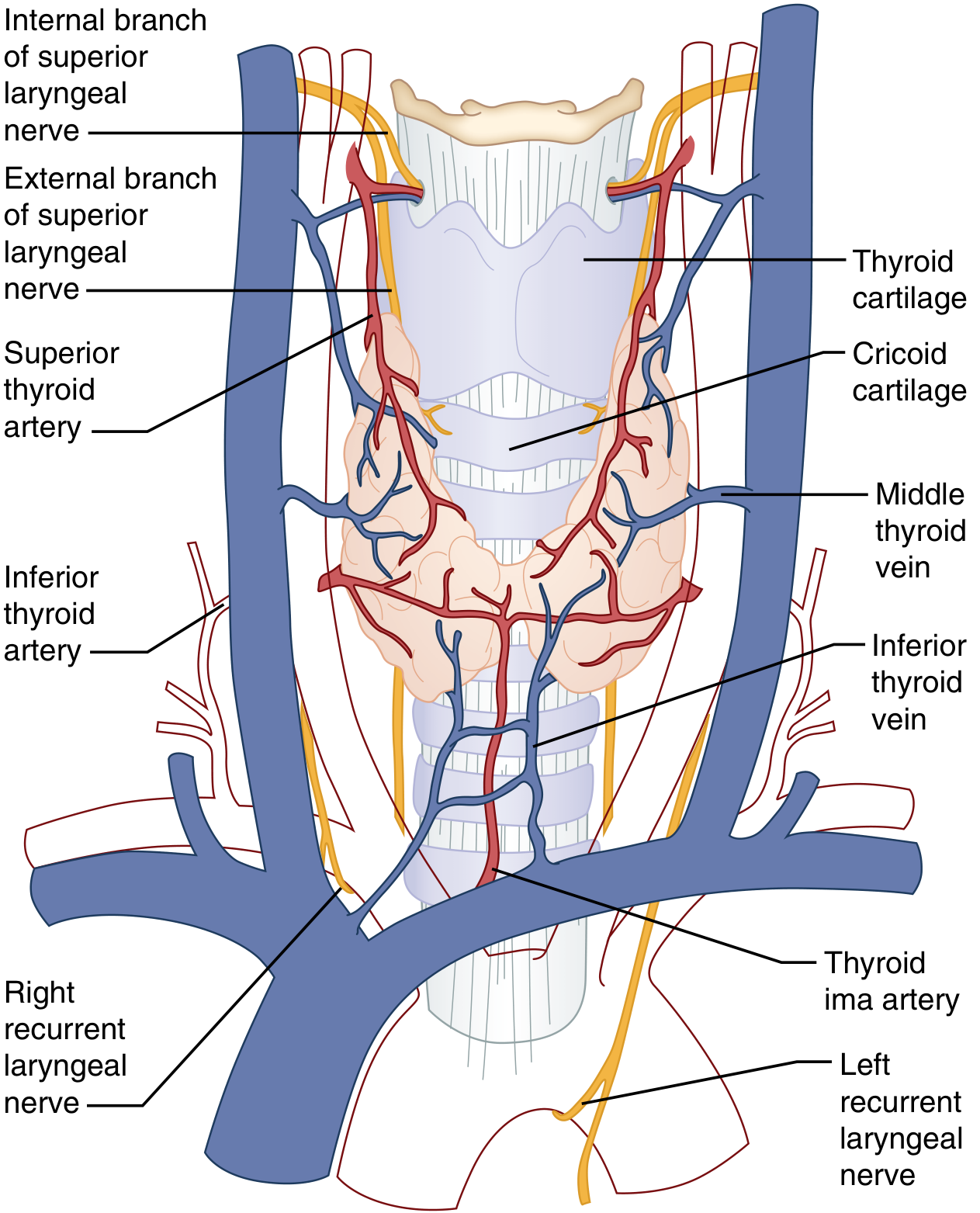
1. Superior Thyroid Artery (Paired)
- Origin: First branch of the external carotid artery (occasionally the common carotid)
- Course: Descends inferiorly along the inferior pharyngeal constrictor muscles toward the superior pole of the thyroid
- Entry point: Enters the superior pole of each thyroid lobe
- Branches: Divides into at least an anterior and posterior branch at the superior pole
- Also supplies: Gives off the superior laryngeal artery and the cricothyroid branch
- Clinical note: The external branch of the superior laryngeal nerve (EBSLN) runs close to the superior thyroid artery - it must be identified and preserved during ligation to avoid voice changes
2. Inferior Thyroid Artery (Paired)
- Origin: Branch of the thyrocervical trunk, which arises from the subclavian artery
- Course: Courses cephalad and posterior to the carotid sheath, then turns medially to enter the thyroid
- Entry point: Enters the mid-thyroid lobe (midportion), near the ligament of Berry in the tracheoesophageal groove
- Branches: Divides into several smaller vessels that enter the gland directly
- Also supplies: Traditionally thought to supply both the superior and inferior parathyroid glands (though there is anatomic variation - superior glands may receive supply from the superior thyroid artery alone, inferior thyroid artery alone, or both)
- Critical relationship: The recurrent laryngeal nerve (RLN) typically crosses the inferior thyroid artery perpendicularly as it travels into the larynx - this is a key surgical landmark. The RLN may pass anterior, posterior, or between branches of the artery. Ligation close to the thyroid capsule helps preserve parathyroid branches
3. Thyroid Ima Artery (Unpaired, Inconstant)
- Presence: Variable - present in approximately 1.5% to 12% of people (about 2-10% depending on the source)
- Origin: Arises directly from the aorta, innominate (brachiocephalic) artery, or occasionally the common carotid or aortic arch
- Course: Follows a midline path, anterior to the trachea
- Entry point: Enters the thyroid isthmus or the inferior poles
- Clinical significance: Can be a significant and unexpected source of bleeding if unrecognized during surgery (e.g., tracheostomy, thyroidectomy approaching from below)
Summary Table
| Artery | Origin | Entry Point | Paired? |
|---|---|---|---|
| Superior thyroid artery | External carotid artery | Superior pole | Yes (bilateral) |
| Inferior thyroid artery | Thyrocervical trunk (subclavian) | Mid-lobe / tracheoesophageal groove | Yes (bilateral) |
| Thyroid ima artery | Aorta / innominate / carotid | Isthmus / inferior poles | No (single, midline) |
Anastomoses
The right and left superior and inferior thyroid arteries anastomose freely on and within the substance of the thyroid capsule, forming a dense connecting vessel system. This redundancy means the gland can maintain perfusion even if one artery is ligated - but it also means blood can be shunted (e.g., in subclavian steal syndrome, blood shunts retrograde into the left inferior thyroid artery).
Sources: Sabiston Textbook of Surgery, p. 2822 | Mulholland & Greenfield's Surgery, p. 4500 | K.J. Lee's Essential Otolaryngology, p. 2478 | Cummings Otolaryngology, p. 3346
This is a shared conversation. Sign in to Orris to start your own chat.