
Explain ECG in detail
Electrocardiogram (ECG) - A Detailed Guide
What Is an ECG?
- Goldman-Cecil Medicine, p. 420
1. The Cardiac Electrical Basis
The Conduction System
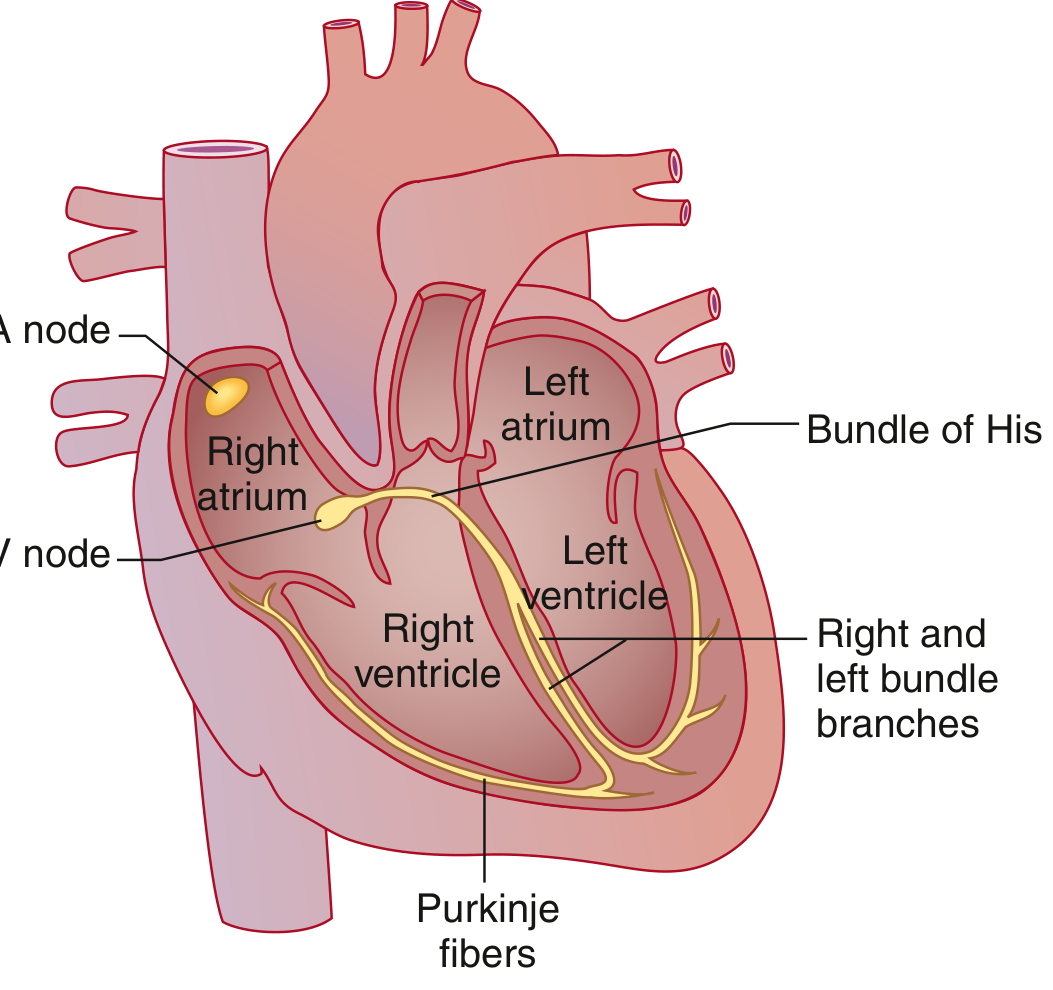
- SA Node (Sinoatrial node) - Located in the high lateral epicardial right atrium near the superior vena cava. It spontaneously depolarizes at the highest rate (~60-100/min), making it the dominant pacemaker. Its depolarization is not visible on the surface ECG.
- Atrial conduction - The depolarizing wavefront spreads through the right and left atria. The Bachmann bundle speeds conduction to the left atrium. Atrial depolarization triggers contraction, pushing blood through the mitral and tricuspid valves.
- AV Node - The only normal electrical bridge between atria and ventricles (the AV valve rings are electrically insulated). The AV node intentionally slows conduction, providing the delay that allows atrial contraction to fill the ventricles before ventricular systole.
- Bundle of His - Exits the AV node; specialized fast-conducting tissue.
- Bundle Branches - The His bundle bifurcates into right bundle branch (RBB) and left bundle branch (LBB). The LBB further divides into left anterior fascicle (LAF) and left posterior fascicle (LPF).
- Purkinje Fibers - The distal ramifications that deliver the impulse rapidly to ventricular myocardium.
- Ventricular myocardium - Depolarizes from endocardium to epicardium, triggering ventricular contraction.
- Goldman-Cecil Medicine, p. 421; Guyton and Hall, p. 142
2. The ECG Waveforms
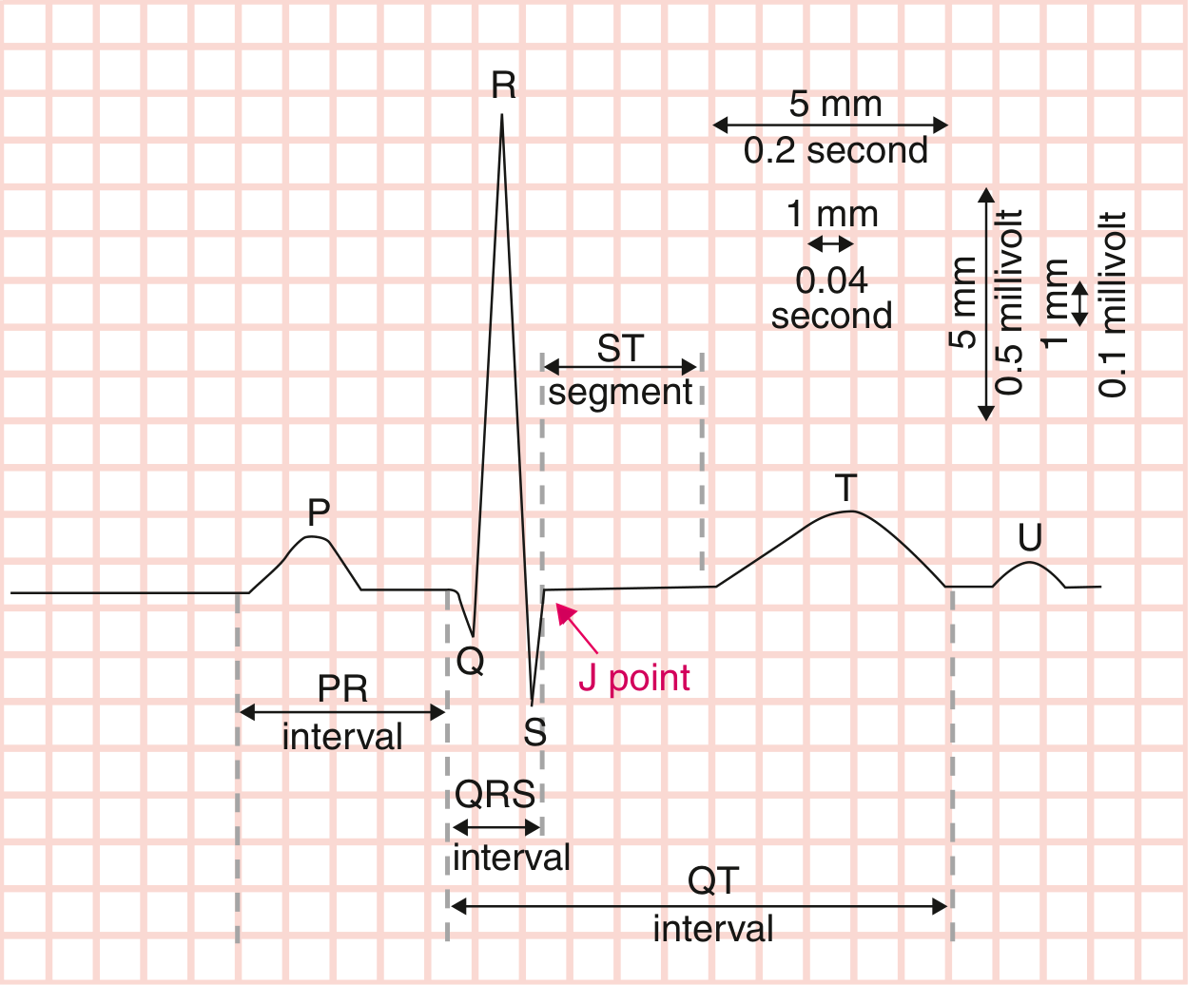
P Wave
- Represents atrial muscular depolarization
- Normally small, rounded, upright in most leads
- Normal amplitude: 0.1-0.3 mV; duration < 120 msec
- Absent in atrial fibrillation; abnormally tall in right atrial enlargement; wide/notched in left atrial enlargement
PR Interval
- Measured from the onset of the P wave to the onset of the QRS complex
- Represents: conduction time through atrial muscle + AV node delay + His-Purkinje system
- Normal: 0.09 to 0.20 second (90-200 msec)
- PR > 200 msec = first-degree AV block (delayed AV conduction)
- Short PR = ventricular preexcitation (Wolff-Parkinson-White syndrome) or junctional rhythm
QRS Complex
- Represents ventricular muscular depolarization
- Much larger than the P wave due to greater ventricular muscle mass
- Normal duration: 75-110 msec (< 3 small boxes); duration ≥ 120 msec = bundle branch block
- Wave naming convention:
- Capital letters (Q, R, S) = large amplitude (≥ 5 mm / 0.5 mV)
- Lowercase letters (q, r, s) = small amplitude (< 5 mm / 0.5 mV)
- Q/q = initial negative deflection
- R/r = positive deflection
- S/s = negative deflection following an R wave
- QS complex = entirely negative deflection
- R' = second positive deflection after S wave
ST Segment
- The flat segment from the end of the QRS (J point) to the start of the T wave
- Normally isoelectric (on the baseline)
- ST elevation = myocardial injury/infarction, pericarditis, Brugada syndrome
- ST depression = ischemia, posterior MI, digitalis effect
T Wave
- Represents ventricular repolarization
- Ventricular repolarization begins ~0.20 seconds after QRS onset and extends for about 0.15 second
- Normally concordant with the QRS (same direction as main QRS deflection)
- Broader and lower amplitude than QRS because repolarization is more prolonged
- Inverted T waves suggest ischemia, ventricular hypertrophy, or bundle branch block
QT Interval
- Measured from QRS onset to end of T wave
- Represents the total ventricular depolarization + repolarization time
- Must be corrected for heart rate using Bazett's formula:
QTc = QT / √RR (RR interval in seconds)
- Normal QTc: < 440 msec in men, < 460 msec in women
- Prolonged QTc increases risk of torsades de pointes (a life-threatening ventricular arrhythmia)
- Shortened by hypercalcemia, digitalis; prolonged by hypokalemia, hypomagnesemia, many drugs
U Wave
- A small, positive deflection after the T wave
- Likely represents late repolarization of Purkinje fibers or mid-myocardial (M) cells
- More prominent at slow heart rates and in hypokalemia
- Prominent U waves are a classic sign of hypokalemia
J Point and J Wave
-
J point = junction between end of QRS and beginning of ST segment
-
J wave (Osborn wave) = positive deflection at the J point; classically seen in hypothermia; also in hypercalcemia and brain injury; may indicate risk of idiopathic ventricular fibrillation
-
Goldman-Cecil Medicine, pp. 421-423; Guyton and Hall, pp. 142-144
3. ECG Paper and Calibration
| Axis | Unit | Value |
|---|---|---|
| Horizontal (time) | Small box (1 mm) | 0.04 seconds (40 msec) |
| Horizontal (time) | Large box (5 mm) | 0.20 seconds (200 msec) |
| Vertical (voltage) | Small box (1 mm) | 0.1 mV |
| Vertical (voltage) | Large box (5 mm) | 0.5 mV |
| Standard speed | - | 25 mm/sec |
| Standard gain | - | 10 mm = 1 mV |
4. The 12 ECG Leads
Limb Leads (Bipolar) - Leads I, II, III
- Lead I: Left arm (+) vs Right arm (-) - views left lateral wall
- Lead II: Left leg (+) vs Right arm (-) - views inferior wall
- Lead III: Left leg (+) vs Left arm (-) - views inferior wall
Augmented Limb Leads (Unipolar) - aVR, aVL, aVF
- aVR (augmented Vector Right): looks at the heart from the right shoulder
- aVL (augmented Vector Left): looks from the left shoulder
- aVF (augmented Vector Foot): looks from below (inferior view)
Precordial (Chest) Leads - V1 through V6
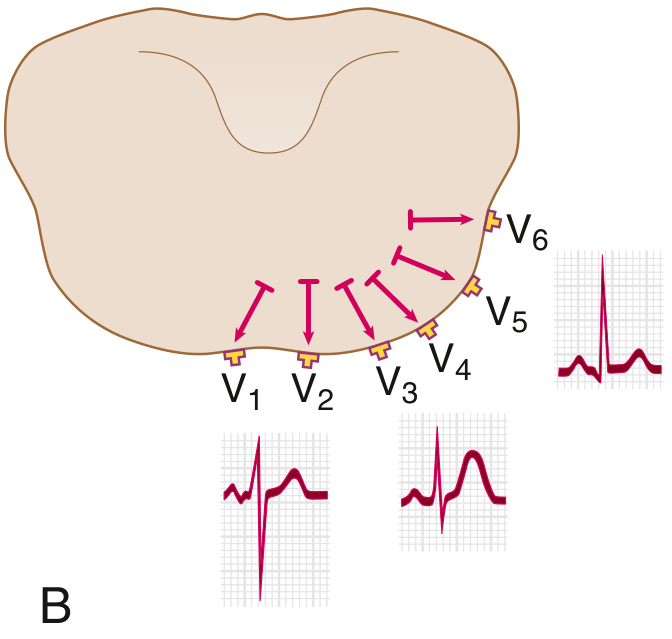
| Lead | Position | Normal QRS |
|---|---|---|
| V1 | 4th intercostal space, right sternal border | Small r, deep S (rS pattern) |
| V2 | 4th intercostal space, left sternal border | Small r, deep S |
| V3 | Between V2 and V4 | Transitional |
| V4 | 5th intercostal space, midclavicular line | Transitional (R wave = S wave) |
| V5 | Anterior axillary line | Tall R, small S |
| V6 | Midaxillary line | Tall R, no S (qR pattern) |
5. Calculating Heart Rate
- Regular rhythm: Rate = 300 ÷ (number of large boxes between R waves)
- Or: Rate = 1500 ÷ (number of small boxes between R waves)
- Irregular rhythm: Count QRS complexes in a 10-second strip × 6
6. Cardiac Axis
| Axis | Degrees |
|---|---|
| Normal | -30° to +90° |
| Left axis deviation (LAD) | -30° to -90° |
| Right axis deviation (RAD) | +90° to +180° |
| Extreme (northwest) axis | -90° to ±180° |
7. Common Abnormal Patterns
Bundle Branch Blocks
- LBBB (Left Bundle Branch Block): QRS ≥ 120 msec; broad notched R in V5/V6 (M-shaped), deep S in V1; no septal q waves in lateral leads; discordant ST-T changes. Isolated LBBB doubles cardiovascular risk.
- RBBB (Right Bundle Branch Block): QRS ≥ 120 msec; RSR' ("rabbit ears") in V1, broad S wave in I, V5, V6.
AV Blocks
- 1st degree: PR > 200 msec; every P wave conducts
- 2nd degree - Mobitz I (Wenckebach): Progressive PR lengthening until a P wave is blocked (non-conducted)
- 2nd degree - Mobitz II: Constant PR, then sudden non-conducted P wave; higher risk of complete block
- 3rd degree (complete): No relationship between P waves and QRS; complete AV dissociation
ST Changes
- ST elevation: STEMI (localized to territory), pericarditis (diffuse, saddle-shaped), Brugada (V1-V2 coved pattern)
- ST depression: NSTEMI/unstable angina, subendocardial ischemia, posterior STEMI (reciprocal)
Hypertrophy
- LVH: Increased QRS voltages (e.g., S in V1 + R in V5 or V6 ≥ 35 mm = Sokolov-Lyon criterion); lateral ST-T changes
- RVH: Dominant R in V1, right axis deviation, deep S in lateral leads
8. Clinical Uses of the ECG
- Arrhythmias (AF, flutter, SVT, VT, VF, bradycardias)
- Acute myocardial infarction (STEMI, NSTEMI)
- Conduction defects (bundle branch blocks, fascicular blocks, AV blocks)
- Electrolyte abnormalities (hyperkalemia peaked T waves and sine wave; hypokalemia U waves; hypercalcemia short QT)
- Drug effects (digoxin "reverse tick" ST depression; QT-prolonging drugs)
- Structural disease (hypertrophy, pre-excitation syndromes)
- Pericarditis and myocarditis
9. Limitations
- A normal ECG does not exclude cardiac disease (e.g., significant CAD between events)
- Single time-point recordings miss intermittent arrhythmias - ambulatory (Holter) monitoring records over 24-48 hours for infrequent events
- Computerized interpretation algorithms improve accuracy but require physician review
- Obesity, emphysema, and poor electrode contact reduce signal quality
Summary Table: Normal ECG Intervals
| Parameter | Normal Range |
|---|---|
| Heart rate | 60-100 bpm |
| PR interval | 120-200 msec (3-5 small boxes) |
| QRS duration | 70-110 msec (< 3 small boxes) |
| QTc | < 440 msec (men), < 460 msec (women) |
| QRS axis | -30° to +90° |
| R wave transition | V3-V4 |
- Goldman-Cecil Medicine International Edition, Chapter 42: Electrocardiography, pp. 420-423
- Guyton and Hall Textbook of Medical Physiology, Chapter 11: Fundamentals of Electrocardiography, pp. 142-148
Create a presentation on ECG interpretation and common pathologic patterns
mkdir -p /home/daytona/workspace/ecg-presentation && ls /home/daytona/workspace/
node /home/daytona/skills/shared/scripts/fetch_images.js \ "https://cdn.orris.care/cdss_images/ed3e36266afd563652d7495682c022c3508452257126640a6ab3375b0b0a7e46.png" \ "https://cdn.orris.care/cdss_images/ef815eeb06c673b405e3c7f9112d1e9ff6fbea96a00a2723b233d384156386bd.png" \ "https://cdn.orris.care/cdss_images/8b26161d5b113aef98766f605c7bba4c915e78cd2023db7dbdc80f9dd92dc48a.png" \ "https://cdn.orris.care/cdss_images/980d49638880f123e60f04d038c1af30751f3ad125962f137d98b37cf6e5d83e.png" \ "https://cdn.orris.care/cdss_images/c77d6d597bfe808053a402fa9624538fe9360e78c43eb10a56369a082b8f37a6.png" \ 2>/dev/null | node -e "const d=require('fs');const chunks=[];process.stdin.on('data',c=>chunks.push(c));process.stdin.on('end',()=>{const arr=JSON.parse(Buffer.concat(chunks).toString());arr.forEach((img,i)=>{if(!img.error){const b64=img.base64.split(',')[1];d.writeFileSync('/home/daytona/workspace/ecg-presentation/img'+i+'.b64',img.base64);}else{console.log('Error img'+i+':',img.error);}});console.log('Done, saved',arr.filter(x=>!x.error).length,'images');})"
~/ecg-presentation/build.js
const pptxgen = require("pptxgenjs");
const fs = require("fs");

// Load pre-fetched images
const img0 = fs.readFileSync("/home/daytona/workspace/ecg-presentation/img0.b64", "utf8"); // conduction system
const img1 = fs.readFileSync("/home/daytona/workspace/ecg-presentation/img1.b64", "utf8"); // ECG waveform labeled
const img2 = fs.readFileSync("/home/daytona/workspace/ecg-presentation/img2.b64", "utf8"); // precordial leads
const img3 = fs.readFileSync("/home/daytona/workspace/ecg-presentation/img3.b64", "utf8"); // Einthoven's triangle
const img4 = fs.readFileSync("/home/daytona/workspace/ecg-presentation/img4.b64", "utf8"); // normal 12-lead ECG

// ─── Color Palette ───────────────────────────────────────────────
const DARK_BG    = "0D1B2A";   // deep navy  (dominant)
const MID_BG     = "1B2A3B";   // mid navy
const CARD_BG    = "162230";   // card background
const ACCENT     = "E63946";   // bold red-crimson (ECG line color)
const ACCENT2    = "26C6DA";   // teal (labels, highlights)
const GOLD       = "FFB703";   // amber (key values)
const WHITE      = "FFFFFF";
const LIGHT_GRAY = "B0C4D8";
const MUTED      = "6E8BA3";

let pres = new pptxgen();
pres.layout = "LAYOUT_16x9";
pres.author  = "Orris Medical";
pres.title   = "ECG Interpretation & Common Pathologic Patterns";

// ─────────────────────────────────────────────────────────────────
// Helper: dark slide background
function darkBg(slide) {
  slide.background = { color: DARK_BG };
}

// Helper: accent bar at top
function topBar(slide, color = ACCENT) {
  slide.addShape(pres.shapes.RECTANGLE, {
    x: 0, y: 0, w: 10, h: 0.08, fill: { color }, line: { type: "none" }
  });
}

// Helper: section heading
function sectionHead(slide, title, subtitle = "") {
  slide.addText(title, {
    x: 0.45, y: 0.18, w: 9.1, h: 0.55,
    fontSize: 22, bold: true, color: WHITE, fontFace: "Calibri",
    margin: 0
  });
  if (subtitle) {
    slide.addText(subtitle, {
      x: 0.45, y: 0.72, w: 9.1, h: 0.3,
      fontSize: 11, color: ACCENT2, fontFace: "Calibri", italic: true, margin: 0
    });
  }
}

// Helper: divider line
function divider(slide, y = 0.65, color = ACCENT, opacity = 0.6) {
  slide.addShape(pres.shapes.RECTANGLE, {
    x: 0.45, y, w: 9.1, h: 0.025,
    fill: { color, transparency: Math.round((1 - opacity) * 100) },
    line: { type: "none" }
  });
}

// Helper: card (rounded rect)
function card(slide, x, y, w, h, fillColor = CARD_BG) {
  slide.addShape(pres.shapes.ROUNDED_RECTANGLE, {
    x, y, w, h,
    fill: { color: fillColor },
    line: { color: ACCENT2, pt: 0.5, transparency: 60 },
    rectRadius: 0.12,
    shadow: { type: "outer", color: "000000", blur: 8, offset: 2, angle: 135, opacity: 0.25 }
  });
}

// ─────────────────────────────────────────────────────────────────
// SLIDE 1: Title
// ─────────────────────────────────────────────────────────────────
{
  const slide = pres.addSlide();
  darkBg(slide);

  // ECG-line decorative band at top
  slide.addShape(pres.shapes.RECTANGLE, {
    x: 0, y: 0, w: 10, h: 0.55, fill: { color: ACCENT }, line: { type: "none" }
  });
  slide.addShape(pres.shapes.RECTANGLE, {
    x: 0, y: 0.55, w: 10, h: 0.06, fill: { color: GOLD }, line: { type: "none" }
  });

  // Title
  slide.addText("ECG Interpretation", {
    x: 0.4, y: 1.0, w: 9.2, h: 0.9,
    fontSize: 46, bold: true, color: WHITE, fontFace: "Calibri",
    align: "center", charSpacing: 2
  });
  slide.addText("& Common Pathologic Patterns", {
    x: 0.4, y: 1.85, w: 9.2, h: 0.6,
    fontSize: 26, color: ACCENT2, fontFace: "Calibri",
    align: "center", italic: true
  });

  // Subtitle bar
  slide.addShape(pres.shapes.RECTANGLE, {
    x: 3.0, y: 2.6, w: 4.0, h: 0.04, fill: { color: GOLD }, line: { type: "none" }
  });

  // Decorative ECG waveform image (labeled waveform)
  slide.addImage({ data: img1, x: 1.2, y: 3.0, w: 7.6, h: 1.9, transparency: 18 });

  // Footer
  slide.addText("Goldman-Cecil Medicine  ·  Guyton & Hall Physiology", {
    x: 0, y: 5.2, w: 10, h: 0.35,
    fontSize: 9, color: MUTED, align: "center", fontFace: "Calibri", italic: true
  });
}

// ─────────────────────────────────────────────────────────────────
// SLIDE 2: Table of Contents
// ─────────────────────────────────────────────────────────────────
{
  const slide = pres.addSlide();
  darkBg(slide);
  topBar(slide, GOLD);
  sectionHead(slide, "Overview", "What this presentation covers");
  divider(slide, 0.65, GOLD);

  const topics = [
    ["01", "The Cardiac Conduction System",    "Anatomy of electrical activation"],
    ["02", "ECG Waveforms & Intervals",         "P, QRS, T, U · PR, QT, QRS durations"],
    ["03", "The 12-Lead System",                "Limb leads, augmented leads, precordial leads"],
    ["04", "Heart Rate & Axis",                 "Rate calculation · frontal plane axis"],
    ["05", "Conduction Abnormalities",          "Bundle branch blocks · fascicular blocks · AV blocks"],
    ["06", "Ischemia & Infarction",             "ST changes · Q waves · territory recognition"],
    ["07", "Hypertrophy & Enlargement",         "LVH · RVH · atrial enlargement criteria"],
    ["08", "Electrolyte & Drug Effects",        "Hypo/hyperkalaemia · hypercalcaemia · QTc drugs"],
  ];

  const colX = [0.4, 4.85];
  topics.forEach((t, i) => {
    const row = i % 4;
    const col = Math.floor(i / 4);
    const x = colX[col];
    const y = 0.9 + row * 1.12;

    card(slide, x, y, 4.22, 0.96);
    slide.addText(t[0], {
      x: x + 0.12, y: y + 0.08, w: 0.48, h: 0.36,
      fontSize: 14, bold: true, color: ACCENT, fontFace: "Calibri", align: "center"
    });
    slide.addText(t[1], {
      x: x + 0.62, y: y + 0.06, w: 3.5, h: 0.36,
      fontSize: 11.5, bold: true, color: WHITE, fontFace: "Calibri", margin: 0
    });
    slide.addText(t[2], {
      x: x + 0.62, y: y + 0.44, w: 3.5, h: 0.3,
      fontSize: 9.5, color: LIGHT_GRAY, fontFace: "Calibri", italic: true, margin: 0
    });
  });
}

// ─────────────────────────────────────────────────────────────────
// SLIDE 3: Cardiac Conduction System
// ─────────────────────────────────────────────────────────────────
{
  const slide = pres.addSlide();
  darkBg(slide);
  topBar(slide, ACCENT);
  sectionHead(slide, "The Cardiac Conduction System", "Normal sequence of electrical activation");
  divider(slide);

  // Image: conduction anatomy
  card(slide, 0.4, 0.85, 4.4, 4.4, "0A1520");
  slide.addImage({ data: img0, x: 0.55, y: 0.95, w: 4.1, h: 4.15 });

  // Steps
  const steps = [
    { num: "1", label: "SA Node",       desc: "Right atrium near SVC. Dominant pacemaker (60-100 bpm). Not visible on surface ECG." },
    { num: "2", label: "Atria",         desc: "Wavefront spreads R→L via Bachmann bundle. Generates P wave." },
    { num: "3", label: "AV Node",       desc: "Only bridge between atria & ventricles. Physiologic delay allows ventricular filling." },
    { num: "4", label: "Bundle of His", desc: "Exits AV node into fast-conducting tissue at the ventricular septum." },
    { num: "5", label: "Bundle Branches", desc: "Right bundle branch + Left bundle branch (anterior & posterior fascicles)." },
    { num: "6", label: "Purkinje Fibers", desc: "Rapid subendocardial distribution → ventricular depolarization → QRS complex." },
  ];

  steps.forEach((s, i) => {
    const y = 0.87 + i * 0.74;
    slide.addShape(pres.shapes.ELLIPSE, {
      x: 5.0, y: y + 0.04, w: 0.32, h: 0.32,
      fill: { color: ACCENT }, line: { type: "none" }
    });
    slide.addText(s.num, {
      x: 5.0, y: y + 0.04, w: 0.32, h: 0.32,
      fontSize: 9, bold: true, color: WHITE, align: "center", valign: "middle", margin: 0
    });
    slide.addText(s.label, {
      x: 5.38, y: y + 0.03, w: 4.2, h: 0.22,
      fontSize: 11, bold: true, color: ACCENT2, fontFace: "Calibri", margin: 0
    });
    slide.addText(s.desc, {
      x: 5.38, y: y + 0.26, w: 4.2, h: 0.38,
      fontSize: 9, color: LIGHT_GRAY, fontFace: "Calibri", margin: 0
    });
  });
}

// ─────────────────────────────────────────────────────────────────
// SLIDE 4: ECG Waveforms & Intervals
// ─────────────────────────────────────────────────────────────────
{
  const slide = pres.addSlide();
  darkBg(slide);
  topBar(slide, ACCENT2);
  sectionHead(slide, "ECG Waveforms & Intervals", "Every deflection has a physiological meaning");
  divider(slide, 0.65, ACCENT2);

  // Large waveform image
  card(slide, 0.4, 0.82, 4.2, 4.5, "080F18");
  slide.addImage({ data: img1, x: 0.5, y: 0.9, w: 4.0, h: 4.3 });

  // Wave table
  const waves = [
    { wave: "P Wave",        color: ACCENT2, normal: "< 120ms, < 0.3mV",          meaning: "Atrial depolarization" },
    { wave: "PR Interval",   color: GOLD,    normal: "120–200 ms",                 meaning: "AV conduction time" },
    { wave: "QRS Complex",   color: ACCENT,  normal: "< 110 ms; 1.0–1.5 mV",      meaning: "Ventricular depolarization" },
    { wave: "ST Segment",    color: WHITE,   normal: "Isoelectric (±0.5mm)",        meaning: "Plateau phase (no net current)" },
    { wave: "T Wave",        color: GOLD,    normal: "0.2–0.3 mV; concordant",     meaning: "Ventricular repolarization" },
    { wave: "QT Interval",   color: ACCENT2, normal: "QTc < 440ms ♂ / 460ms ♀",   meaning: "Total ventricular recovery" },
    { wave: "U Wave",        color: MUTED,   normal: "Small, positive",             meaning: "Purkinje / M-cell repolarization" },
  ];

  waves.forEach((w, i) => {
    const y = 0.85 + i * 0.675;
    card(slide, 4.82, y, 4.75, 0.62, MID_BG);
    slide.addText(w.wave, {
      x: 4.96, y: y + 0.05, w: 1.65, h: 0.26,
      fontSize: 10.5, bold: true, color: w.color, fontFace: "Calibri", margin: 0
    });
    slide.addText(w.normal, {
      x: 4.96, y: y + 0.32, w: 1.65, h: 0.22,
      fontSize: 8.5, color: LIGHT_GRAY, fontFace: "Calibri", margin: 0, italic: true
    });
    slide.addText(w.meaning, {
      x: 6.65, y: y + 0.15, w: 2.78, h: 0.3,
      fontSize: 9.5, color: WHITE, fontFace: "Calibri", margin: 0
    });
  });
}

// ─────────────────────────────────────────────────────────────────
// SLIDE 5: The 12-Lead System
// ─────────────────────────────────────────────────────────────────
{
  const slide = pres.addSlide();
  darkBg(slide);
  topBar(slide, GOLD);
  sectionHead(slide, "The 12-Lead ECG System", "12 views of the heart's electrical activity");
  divider(slide, 0.65, GOLD);

  // Einthoven image
  card(slide, 0.4, 0.85, 3.2, 2.35, "0A1520");
  slide.addImage({ data: img3, x: 0.5, y: 0.88, w: 3.0, h: 2.28 });

  // Precordial image
  card(slide, 0.4, 3.3, 3.2, 2.0, "0A1520");
  slide.addImage({ data: img2, x: 0.5, y: 3.38, w: 3.0, h: 1.85 });

  // Lead groups
  const groups = [
    {
      title: "Bipolar Limb Leads",
      color: ACCENT,
      items: [
        "Lead I   — LA(+) vs RA(−)  →  lateral wall",
        "Lead II  — LL(+) vs RA(−)  →  inferior wall",
        "Lead III — LL(+) vs LA(−)  →  inferior wall",
        "Einthoven's law: I + III = II",
      ]
    },
    {
      title: "Augmented Limb Leads",
      color: ACCENT2,
      items: [
        "aVR — right shoulder view (inverted in normal)",
        "aVL — left shoulder view (lateral)",
        "aVF — inferior view",
        "Normal: upright P & QRS in I, II, III, aVF",
      ]
    },
    {
      title: "Precordial (Chest) Leads  V1–V6",
      color: GOLD,
      items: [
        "V1/V2: right side — rS pattern (negative QRS)",
        "V3/V4: transition zone (R = S at V3 or V4)",
        "V5/V6: left side — tall R wave (positive QRS)",
        "R wave progression: V1→V5 R grows, S shrinks",
      ]
    },
  ];

  groups.forEach((g, i) => {
    const x = 3.82;
    const y = 0.83 + i * 1.55;
    card(slide, x, y, 5.75, 1.42, CARD_BG);
    slide.addShape(pres.shapes.RECTANGLE, {
      x, y, w: 0.12, h: 1.42, fill: { color: g.color }, line: { type: "none" }
    });
    slide.addText(g.title, {
      x: x + 0.2, y: y + 0.06, w: 5.4, h: 0.28,
      fontSize: 11, bold: true, color: g.color, fontFace: "Calibri", margin: 0
    });
    const bullets = g.items.map((t, j) => ({
      text: t, options: { bullet: { code: "2022" }, color: j === 3 ? GOLD : LIGHT_GRAY, fontSize: 9, breakLine: j < g.items.length - 1 }
    }));
    slide.addText(bullets, {
      x: x + 0.22, y: y + 0.36, w: 5.4, h: 0.98,
      fontFace: "Calibri", margin: 0
    });
  });
}

// ─────────────────────────────────────────────────────────────────
// SLIDE 6: Heart Rate & Axis
// ─────────────────────────────────────────────────────────────────
{
  const slide = pres.addSlide();
  darkBg(slide);
  topBar(slide, ACCENT);
  sectionHead(slide, "Heart Rate & Electrical Axis", "Two fundamental parameters in every ECG read");
  divider(slide);

  // Heart rate card
  card(slide, 0.4, 0.85, 4.5, 2.2, CARD_BG);
  slide.addShape(pres.shapes.RECTANGLE, {
    x: 0.4, y: 0.85, w: 0.12, h: 2.2, fill: { color: ACCENT }, line: { type: "none" }
  });
  slide.addText("Heart Rate Calculation", {
    x: 0.62, y: 0.9, w: 4.1, h: 0.32,
    fontSize: 13, bold: true, color: ACCENT, fontFace: "Calibri", margin: 0
  });
  slide.addText([
    { text: "Regular rhythm:", options: { bold: true, color: WHITE, fontSize: 10 } },
    { text: "  300 ÷ (large boxes between R-R peaks)", options: { color: LIGHT_GRAY, fontSize: 10 } },
    { text: "\n   or  1500 ÷ (small boxes between R-R peaks)", options: { color: LIGHT_GRAY, fontSize: 10, italic: true } },
  ], { x: 0.62, y: 1.28, w: 4.1, h: 0.45, fontFace: "Calibri", margin: 0 });

  slide.addText([
    { text: "Irregular rhythm:", options: { bold: true, color: WHITE, fontSize: 10 } },
    { text: "  Count QRS in 10 sec strip × 6", options: { color: LIGHT_GRAY, fontSize: 10 } },
  ], { x: 0.62, y: 1.8, w: 4.1, h: 0.3, fontFace: "Calibri", margin: 0 });

  const rateValues = [
    { label: "Bradycardia",    val: "< 60",   col: ACCENT2 },
    { label: "Normal",         val: "60-100", col: GOLD },
    { label: "Tachycardia",    val: "> 100",  col: ACCENT },
  ];
  rateValues.forEach((r, i) => {
    card(slide, 0.62 + i * 1.46, 2.26, 1.36, 0.65, MID_BG);
    slide.addText(r.val + " bpm", { x: 0.62 + i * 1.46, y: 2.29, w: 1.36, h: 0.28, fontSize: 12, bold: true, color: r.col, align: "center", fontFace: "Calibri", margin: 0 });
    slide.addText(r.label,        { x: 0.62 + i * 1.46, y: 2.56, w: 1.36, h: 0.22, fontSize: 8.5, color: MUTED, align: "center", fontFace: "Calibri", margin: 0 });
  });

  // Axis card
  card(slide, 0.4, 3.22, 4.5, 2.05, CARD_BG);
  slide.addShape(pres.shapes.RECTANGLE, {
    x: 0.4, y: 3.22, w: 0.12, h: 2.05, fill: { color: GOLD }, line: { type: "none" }
  });
  slide.addText("QRS Axis (Frontal Plane)", {
    x: 0.62, y: 3.26, w: 4.1, h: 0.3,
    fontSize: 13, bold: true, color: GOLD, fontFace: "Calibri", margin: 0
  });
  const axes = [
    { range: "−30° to +90°",   label: "Normal axis",              color: GOLD },
    { range: "−30° to −90°",   label: "Left axis deviation (LAD)", color: ACCENT2 },
    { range: "+90° to +180°",  label: "Right axis deviation (RAD)", color: ACCENT },
    { range: "±180° / −90°",   label: "Extreme (NW) axis",         color: LIGHT_GRAY },
  ];
  axes.forEach((a, i) => {
    const y = 3.62 + i * 0.38;
    slide.addText(a.range, { x: 0.62, y, w: 1.6, h: 0.3, fontSize: 9.5, bold: true, color: a.color, fontFace: "Calibri", margin: 0 });
    slide.addText(a.label, { x: 2.25, y, w: 2.5, h: 0.3, fontSize: 9.5, color: WHITE, fontFace: "Calibri", margin: 0 });
  });

  // Right side: 12-lead normal ECG image
  card(slide, 5.15, 0.85, 4.45, 4.45, "060D14");
  slide.addImage({ data: img4, x: 5.22, y: 0.9, w: 4.3, h: 4.35 });
  slide.addText("Normal 12-Lead ECG", {
    x: 5.15, y: 5.3, w: 4.45, h: 0.2,
    fontSize: 8, color: MUTED, align: "center", fontFace: "Calibri", italic: true
  });
}

// ─────────────────────────────────────────────────────────────────
// SLIDE 7: Conduction Abnormalities
// ─────────────────────────────────────────────────────────────────
{
  const slide = pres.addSlide();
  darkBg(slide);
  topBar(slide, ACCENT2);
  sectionHead(slide, "Conduction Abnormalities", "Bundle branch blocks · fascicular blocks · AV blocks");
  divider(slide, 0.65, ACCENT2);

  const blocks = [
    {
      title: "LBBB — Left Bundle Branch Block",
      color: ACCENT,
      criteria: [
        "QRS ≥ 120 msec (broad, ≥ 3 small boxes)",
        "Broad notched R ('M shape') in I, V5, V6",
        "Deep S or QS in V1 — no r wave",
        "No septal q waves in lateral leads",
        "Discordant ST-T changes (opposite to QRS)",
        "Isolated new LBBB → rule out STEMI (Sgarbossa criteria)",
      ]
    },
    {
      title: "RBBB — Right Bundle Branch Block",
      color: ACCENT2,
      criteria: [
        "QRS ≥ 120 msec",
        "RSR' ('rabbit ears') pattern in V1/V2",
        "Wide, slurred S wave in I, V5, V6",
        "ST depression & T-wave inversion in V1-V3",
        "Incomplete RBBB: same morphology, QRS 100-119 ms",
        "RBBB ± LAD → bifascicular block (high-risk)",
      ]
    },
    {
      title: "AV Blocks",
      color: GOLD,
      criteria: [
        "1st degree: PR > 200 ms, every P conducts — benign",
        "2nd Mobitz I (Wenckebach): Progressive PR ↑ then dropped beat",
        "2nd Mobitz II: Fixed PR then sudden non-conducted P — dangerous",
        "3rd degree (complete): P waves & QRS independent — no relationship",
        "3rd degree: narrow escape = junctional (40-60); wide = ventricular (<40)",
        "Mobitz II & 3rd degree → urgent pacemaker evaluation",
      ]
    },
  ];

  blocks.forEach((b, i) => {
    const y = 0.85 + i * 1.58;
    card(slide, 0.4, y, 9.2, 1.44, CARD_BG);
    slide.addShape(pres.shapes.RECTANGLE, {
      x: 0.4, y, w: 0.14, h: 1.44, fill: { color: b.color }, line: { type: "none" }
    });
    slide.addText(b.title, {
      x: 0.65, y: y + 0.07, w: 8.8, h: 0.28,
      fontSize: 12, bold: true, color: b.color, fontFace: "Calibri", margin: 0
    });
    const leftItems = b.criteria.slice(0, 3);
    const rightItems = b.criteria.slice(3);
    const makeBullets = (arr) => arr.map((t, j) => ({
      text: t, options: { bullet: { code: "25B8" }, color: LIGHT_GRAY, fontSize: 9.5, breakLine: j < arr.length - 1 }
    }));
    slide.addText(makeBullets(leftItems),  { x: 0.65, y: y + 0.4, w: 4.35, h: 0.92, fontFace: "Calibri", margin: 0 });
    slide.addText(makeBullets(rightItems), { x: 5.1,  y: y + 0.4, w: 4.4,  h: 0.92, fontFace: "Calibri", margin: 0 });
  });
}

// ─────────────────────────────────────────────────────────────────
// SLIDE 8: Ischemia & Infarction
// ─────────────────────────────────────────────────────────────────
{
  const slide = pres.addSlide();
  darkBg(slide);
  topBar(slide, ACCENT);
  sectionHead(slide, "Ischemia & Myocardial Infarction", "ST changes, Q waves, and territory recognition");
  divider(slide);

  // ST changes table
  const stChanges = [
    { title: "STEMI (Acute MI)", color: ACCENT, bg: "1A0A0A",
      points: [
        "ST elevation ≥ 1mm (limb leads) or ≥ 2mm (chest leads)",
        "Convex ('tombstone') or flat ST elevation in ≥ 2 contiguous leads",
        "Reciprocal ST depression in opposite leads (supports diagnosis)",
        "Early: hyperacute tall T waves (first minutes)",
        "Evolves to: Q waves + T inversion + ST returns to baseline",
      ]
    },
    { title: "NSTEMI / Unstable Angina", color: GOLD, bg: "1A1500",
      points: [
        "Horizontal or downsloping ST depression ≥ 0.5mm",
        "T-wave inversion (symmetric, deep) in ischemic territory",
        "No pathological Q waves (no transmural necrosis)",
        "Differentiate NSTEMI from UAP by troponin elevation",
        "Posterior MI: ST depression V1-V3 + tall R in V1 (mirror image)",
      ]
    },
  ];

  stChanges.forEach((s, i) => {
    const y = 0.85 + i * 2.1;
    card(slide, 0.4, y, 5.5, 1.92, s.bg);
    slide.addShape(pres.shapes.RECTANGLE, { x: 0.4, y, w: 0.14, h: 1.92, fill: { color: s.color }, line: { type: "none" } });
    slide.addText(s.title, { x: 0.64, y: y + 0.07, w: 5.1, h: 0.3, fontSize: 12, bold: true, color: s.color, fontFace: "Calibri", margin: 0 });
    const bullets = s.points.map((t, j) => ({ text: t, options: { bullet: { code: "2022" }, color: LIGHT_GRAY, fontSize: 9, breakLine: j < s.points.length - 1 } }));
    slide.addText(bullets, { x: 0.64, y: y + 0.42, w: 5.1, h: 1.38, fontFace: "Calibri", margin: 0 });
  });

  // Territory table
  card(slide, 6.1, 0.85, 3.5, 4.2, CARD_BG);
  slide.addText("Territory Localization", {
    x: 6.22, y: 0.91, w: 3.26, h: 0.3,
    fontSize: 11, bold: true, color: ACCENT2, fontFace: "Calibri", margin: 0
  });
  const territories = [
    { leads: "II, III, aVF",     artery: "RCA",  wall: "Inferior" },
    { leads: "V1–V4",            artery: "LAD",  wall: "Anterior" },
    { leads: "V1–V2",            artery: "LAD/Sep", wall: "Septal" },
    { leads: "I, aVL, V5–V6",   artery: "LCx",  wall: "Lateral" },
    { leads: "V1–V4 + I,aVL",   artery: "LAD",  wall: "Anterolateral" },
    { leads: "V1–V3 mirror",     artery: "LCx",  wall: "Posterior" },
    { leads: "V3R–V4R",          artery: "RCA",  wall: "Right Ventricle" },
  ];

  const tableRows = [
    [
      { text: "Leads",  options: { bold: true, fill: { color: "2A1515" }, color: ACCENT,  fontSize: 9 } },
      { text: "Artery", options: { bold: true, fill: { color: "2A1515" }, color: ACCENT,  fontSize: 9 } },
      { text: "Wall",   options: { bold: true, fill: { color: "2A1515" }, color: ACCENT,  fontSize: 9 } },
    ],
    ...territories.map(t => [
      { text: t.leads,  options: { color: ACCENT2,    fontSize: 8.5, fill: { color: CARD_BG } } },
      { text: t.artery, options: { color: GOLD,       fontSize: 8.5, fill: { color: CARD_BG } } },
      { text: t.wall,   options: { color: LIGHT_GRAY, fontSize: 8.5, fill: { color: CARD_BG } } },
    ])
  ];
  slide.addTable(tableRows, {
    x: 6.22, y: 1.26, w: 3.26, h: 3.65,
    border: { pt: 0.5, color: "2A3A4A" },
    rowH: 0.38,
    colW: [1.35, 0.82, 1.09],
    fontFace: "Calibri"
  });
}

// ─────────────────────────────────────────────────────────────────
// SLIDE 9: Hypertrophy & Enlargement
// ─────────────────────────────────────────────────────────────────
{
  const slide = pres.addSlide();
  darkBg(slide);
  topBar(slide, GOLD);
  sectionHead(slide, "Hypertrophy & Chamber Enlargement", "Voltage and morphology changes from increased wall stress");
  divider(slide, 0.65, GOLD);

  const conditions = [
    {
      title: "Left Ventricular Hypertrophy (LVH)",
      color: ACCENT,
      criteria: [
        "Sokolov-Lyon: S(V1) + R(V5 or V6) ≥ 35mm",
        "Cornell: R(aVL) + S(V3) ≥ 28mm (♂) / ≥ 20mm (♀)",
        "R in aVL ≥ 11mm alone",
        "ST depression + T inversion in V5-V6, I, aVL (strain pattern)",
        "Left axis deviation common",
        "Cause: hypertension, aortic stenosis, HCM",
      ]
    },
    {
      title: "Right Ventricular Hypertrophy (RVH)",
      color: ACCENT2,
      criteria: [
        "Dominant R wave in V1 (R > S in V1)",
        "R/S ratio > 1 in V1 with R/S ratio < 1 in V6",
        "Right axis deviation (> +90°)",
        "ST depression + T inversion in V1-V3 (right strain)",
        "Cause: pulmonary HTN, pulmonary stenosis, cor pulmonale",
        "P pulmonale in II (tall, peaked P > 2.5mm) suggests RAE",
      ]
    },
    {
      title: "Atrial Enlargement",
      color: GOLD,
      criteria: [
        "LAE (P mitrale): P wave > 120ms; bifid (notched) P in II; biphasic P in V1 with deep negative terminal",
        "RAE (P pulmonale): P wave ≥ 2.5mm tall in II, III, or aVF; peaked (not broad)",
        "Biatrial: features of both LAE + RAE simultaneously",
        "Causes of LAE: mitral stenosis, LV failure, hypertension",
        "Causes of RAE: COPD, pulmonary hypertension, tricuspid disease",
        "Atrial enlargement increases AF risk",
      ]
    },
  ];

  conditions.forEach((c, i) => {
    const y = 0.85 + i * 1.58;
    card(slide, 0.4, y, 9.2, 1.44, CARD_BG);
    slide.addShape(pres.shapes.RECTANGLE, { x: 0.4, y, w: 0.14, h: 1.44, fill: { color: c.color }, line: { type: "none" } });
    slide.addText(c.title, { x: 0.64, y: y + 0.07, w: 8.8, h: 0.28, fontSize: 12, bold: true, color: c.color, fontFace: "Calibri", margin: 0 });
    const left  = c.criteria.slice(0, 3).map((t, j) => ({ text: t, options: { bullet: { code: "25B8" }, color: LIGHT_GRAY, fontSize: 9.5, breakLine: j < 2 } }));
    const right = c.criteria.slice(3).map((t, j) => ({ text: t, options: { bullet: { code: "25B8" }, color: LIGHT_GRAY, fontSize: 9.5, breakLine: j < 2 } }));
    slide.addText(left,  { x: 0.64, y: y + 0.4, w: 4.35, h: 0.92, fontFace: "Calibri", margin: 0 });
    slide.addText(right, { x: 5.1,  y: y + 0.4, w: 4.4,  h: 0.92, fontFace: "Calibri", margin: 0 });
  });
}

// ─────────────────────────────────────────────────────────────────
// SLIDE 10: Electrolyte & Drug Effects
// ─────────────────────────────────────────────────────────────────
{
  const slide = pres.addSlide();
  darkBg(slide);
  topBar(slide, ACCENT2);
  sectionHead(slide, "Electrolyte & Drug Effects on the ECG", "Recognizing systemic disturbances from the trace");
  divider(slide, 0.65, ACCENT2);

  const effects = [
    { condition: "Hypokalaemia (K⁺ ↓)", color: ACCENT2, changes: ["Prominent U waves (after T)", "Flat or inverted T waves", "ST depression", "Prolonged QU interval (appears as long QT)", "Risk: polymorphic VT (Torsades)"] },
    { condition: "Hyperkalaemia (K⁺ ↑)", color: ACCENT, changes: ["Peaked, tall, narrow (tent-like) T waves — earliest sign", "Widened QRS → sine wave pattern (severe)", "Flattened / absent P waves", "PR prolongation", "Risk: VF / asystole"] },
    { condition: "Hypocalcaemia (Ca²⁺ ↓)", color: GOLD, changes: ["Prolonged QT interval (long ST segment)", "T wave may be normal height", "Risk: Torsades de pointes"] },
    { condition: "Hypercalcaemia (Ca²⁺ ↑)", color: WHITE, changes: ["Short QT interval (shortened ST)", "J-wave (Osborn) occasionally", "Bradycardia, PR prolongation in severe cases"] },
    { condition: "Digoxin effect", color: MUTED, changes: ["Down-sloping ST depression ('reverse tick' or 'hockey stick')", "T wave flattening/inversion", "PR prolongation (AV conduction slowing)", "Short QT; does not indicate toxicity alone"] },
    { condition: "QT-prolonging Drugs", color: ACCENT, changes: ["Class Ia antiarrhythmics (quinidine, procainamide)", "Class III antiarrhythmics (amiodarone, sotalol)", "Macrolide antibiotics (azithromycin, clarithromycin)", "Antipsychotics (haloperidol, quetiapine)", "Monitor QTc; risk of Torsades de pointes"] },
  ];

  const positions = [
    { x: 0.4, y: 0.9 }, { x: 3.42, y: 0.9 }, { x: 6.45, y: 0.9 },
    { x: 0.4, y: 3.2 }, { x: 3.42, y: 3.2 }, { x: 6.45, y: 3.2 },
  ];

  effects.forEach((e, i) => {
    const { x, y } = positions[i];
    card(slide, x, y, 2.88, 2.12, CARD_BG);
    slide.addShape(pres.shapes.RECTANGLE, { x, y, w: 2.88, h: 0.08, fill: { color: e.color }, line: { type: "none" } });
    slide.addText(e.condition, {
      x: x + 0.1, y: y + 0.14, w: 2.68, h: 0.3,
      fontSize: 10, bold: true, color: e.color, fontFace: "Calibri", margin: 0
    });
    const bullets = e.changes.map((t, j) => ({ text: t, options: { bullet: { code: "2022" }, color: LIGHT_GRAY, fontSize: 8.5, breakLine: j < e.changes.length - 1 } }));
    slide.addText(bullets, {
      x: x + 0.1, y: y + 0.48, w: 2.68, h: 1.5,
      fontFace: "Calibri", margin: 0
    });
  });
}

// ─────────────────────────────────────────────────────────────────
// SLIDE 11: Normal Intervals Quick Reference Table
// ─────────────────────────────────────────────────────────────────
{
  const slide = pres.addSlide();
  darkBg(slide);
  topBar(slide, GOLD);
  sectionHead(slide, "Quick Reference: Normal ECG Values", "Memorize these before reading any ECG");
  divider(slide, 0.65, GOLD);

  const tableData = [
    [
      { text: "Parameter",      options: { bold: true, fill: { color: "2A2000" }, color: GOLD, fontSize: 11 } },
      { text: "Normal Range",   options: { bold: true, fill: { color: "2A2000" }, color: GOLD, fontSize: 11 } },
      { text: "Abnormal If…",   options: { bold: true, fill: { color: "2A2000" }, color: GOLD, fontSize: 11 } },
      { text: "Clinical Significance", options: { bold: true, fill: { color: "2A2000" }, color: GOLD, fontSize: 11 } },
    ],
    ["Heart Rate",       "60–100 bpm",                 "< 60 bradycardia; > 100 tachycardia", "Pacemaker rate, autonomic tone, medications"],
    ["PR Interval",      "120–200 ms (3–5 small boxes)", "> 200 ms = 1st-degree AV block; < 120 ms = preexcitation", "AV nodal conduction; WPW if short"],
    ["QRS Duration",     "70–110 ms (< 3 small boxes)", "≥ 120 ms = bundle branch block",      "Ventricular conduction; wide → BBB or aberrancy"],
    ["QTc",              "< 440ms ♂ / < 460ms ♀",     "> 500ms = high Torsades risk",         "Drug review; electrolytes; congenital LQTS"],
    ["QRS Axis",         "−30° to +90°",                "< −30° LAD;  > +90° RAD",              "Fascicular block; hypertrophy; COPD"],
    ["P-wave duration",  "< 120 ms",                    "> 120ms = left atrial enlargement",    "Atrial disease; mitral pathology"],
    ["P-wave amplitude", "< 2.5 mm (limb leads)",       "> 2.5mm in II = RAE (P pulmonale)",    "Pulmonary hypertension; COPD"],
    ["R progression",    "Transition at V3 or V4",      "Poor R progression → anterior MI",     "Anterior wall infarction; LBBB"],
    ["ST segment",       "Isoelectric (±0.5mm)",         "Elevation or depression",               "Ischemia, pericarditis, Brugada, LV aneurysm"],
    ["T wave direction", "Concordant with QRS",          "Inversion = ischemia / strain / RBBB", "Follow for dynamic ischemia"],
  ];

  const formattedRows = tableData.map((row, i) => {
    if (i === 0) return row;
    const rowColor = i % 2 === 0 ? CARD_BG : MID_BG;
    return row.map((cell, j) => ({
      text: cell,
      options: {
        fill: { color: rowColor },
        color: j === 0 ? WHITE : (j === 1 ? ACCENT2 : (j === 2 ? GOLD : LIGHT_GRAY)),
        fontSize: 9.5,
      }
    }));
  });

  slide.addTable(formattedRows, {
    x: 0.4, y: 0.88, w: 9.2, h: 4.5,
    border: { pt: 0.5, color: "2A3A4A" },
    rowH: 0.41,
    colW: [1.65, 1.92, 2.68, 2.95],
    fontFace: "Calibri"
  });
}

// ─────────────────────────────────────────────────────────────────
// SLIDE 12: Systematic Approach to ECG Reading
// ─────────────────────────────────────────────────────────────────
{
  const slide = pres.addSlide();
  darkBg(slide);
  topBar(slide, ACCENT);
  sectionHead(slide, "Systematic 10-Step ECG Approach", "Never miss a finding — use the same order every time");
  divider(slide);

  const steps = [
    { n: "1", title: "Calibration",       desc: "Check paper speed (25mm/s) and gain (10mm=1mV). Look for artifacts." },
    { n: "2", title: "Rate",              desc: "300 ÷ large boxes (regular) or count × 6 over 10 seconds (irregular)." },
    { n: "3", title: "Rhythm",            desc: "Is it regular? Are all P waves identical? Is P:QRS ratio 1:1?" },
    { n: "4", title: "P Wave",            desc: "Present? Normal morphology? PR interval 120-200ms? Every P followed by QRS?" },
    { n: "5", title: "PR Interval",       desc: "Fixed or variable? Prolonged (>200ms) or short (<120ms)?" },
    { n: "6", title: "QRS Duration",      desc: "Narrow (<110ms) or wide (≥120ms)? Bundle branch block morphology?" },
    { n: "7", title: "Axis",              desc: "Check leads I and aVF. Calculate or estimate frontal plane axis." },
    { n: "8", title: "ST Segment",        desc: "Elevation? Depression? Contiguous leads? Reciprocal changes?" },
    { n: "9", title: "T Wave & QTc",      desc: "Inverted T waves? Peaked T waves? Calculate QTc with Bazett's formula." },
    { n: "10", title: "Overall Impression", desc: "Integrate all findings. Correlate with clinical context." },
  ];

  const cols = [steps.slice(0, 5), steps.slice(5)];
  cols.forEach((col, ci) => {
    col.forEach((s, si) => {
      const x = 0.4 + ci * 4.85;
      const y = 0.88 + si * 0.93;
      card(slide, x, y, 4.55, 0.82, CARD_BG);
      slide.addShape(pres.shapes.ELLIPSE, {
        x: x + 0.1, y: y + 0.12, w: 0.45, h: 0.45,
        fill: { color: ci === 0 ? ACCENT : ACCENT2 }, line: { type: "none" }
      });
      slide.addText(s.n, {
        x: x + 0.1, y: y + 0.12, w: 0.45, h: 0.45,
        fontSize: 12, bold: true, color: WHITE, align: "center", valign: "middle", margin: 0
      });
      slide.addText(s.title, {
        x: x + 0.65, y: y + 0.07, w: 3.75, h: 0.26,
        fontSize: 11, bold: true, color: WHITE, fontFace: "Calibri", margin: 0
      });
      slide.addText(s.desc, {
        x: x + 0.65, y: y + 0.35, w: 3.75, h: 0.38,
        fontSize: 8.5, color: LIGHT_GRAY, fontFace: "Calibri", margin: 0
      });
    });
  });
}

// ─────────────────────────────────────────────────────────────────
// SLIDE 13: Summary / Key Takeaways
// ─────────────────────────────────────────────────────────────────
{
  const slide = pres.addSlide();
  darkBg(slide);

  slide.addShape(pres.shapes.RECTANGLE, {
    x: 0, y: 0, w: 10, h: 0.55, fill: { color: ACCENT }, line: { type: "none" }
  });
  slide.addShape(pres.shapes.RECTANGLE, {
    x: 0, y: 0.55, w: 10, h: 0.06, fill: { color: GOLD }, line: { type: "none" }
  });

  slide.addText("Key Takeaways", {
    x: 0.4, y: 0.7, w: 9.2, h: 0.55,
    fontSize: 28, bold: true, color: WHITE, fontFace: "Calibri", align: "center"
  });

  const takeaways = [
    { icon: "→", color: ACCENT,  text: "Every ECG wave has a direct physiological correlate — P (atrial depol), QRS (ventricular depol), T (ventricular repol)." },
    { icon: "→", color: ACCENT2, text: "Normal intervals: PR 120-200ms · QRS <110ms · QTc <440ms (♂) / <460ms (♀) · axis -30° to +90°." },
    { icon: "→", color: GOLD,    text: "Wide QRS (≥120ms) = bundle branch block or ventricular rhythm. LBBB obstructs MI diagnosis — apply Sgarbossa criteria." },
    { icon: "→", color: ACCENT,  text: "ST elevation in contiguous leads with reciprocal depression = STEMI until proven otherwise. Localise by territory." },
    { icon: "→", color: ACCENT2, text: "Peaked T waves = hyperkalaemia (tent sign); prominent U waves = hypokalaemia; short QT = hypercalcaemia." },
    { icon: "→", color: GOLD,    text: "Always use a systematic 10-step approach. ECG findings must be interpreted in clinical context — never in isolation." },
  ];

  takeaways.forEach((t, i) => {
    const y = 1.42 + i * 0.67;
    card(slide, 0.4, y, 9.2, 0.58, i % 2 === 0 ? CARD_BG : MID_BG);
    slide.addShape(pres.shapes.RECTANGLE, { x: 0.4, y, w: 0.12, h: 0.58, fill: { color: t.color }, line: { type: "none" } });
    slide.addText(t.text, {
      x: 0.64, y: y + 0.1, w: 8.82, h: 0.38,
      fontSize: 10, color: WHITE, fontFace: "Calibri", margin: 0
    });
  });

  slide.addText("Sources: Goldman-Cecil Medicine · Guyton & Hall Textbook of Medical Physiology · Rosen's Emergency Medicine", {
    x: 0, y: 5.3, w: 10, h: 0.25,
    fontSize: 8, color: MUTED, align: "center", fontFace: "Calibri", italic: true
  });
}

// ─────────────────────────────────────────────────────────────────
// SAVE
// ─────────────────────────────────────────────────────────────────
pres.writeFile({ fileName: "/home/daytona/workspace/ecg-presentation/ECG_Interpretation.pptx" })
  .then(() => console.log("SUCCESS: ECG_Interpretation.pptx saved"))
  .catch(e => { console.error("ERROR:", e); process.exit(1); });
cd /home/daytona/workspace/ecg-presentation && node build.js 2>&1
ELLIPSE shape. Let me check and fix:node -e "const p=require('pptxgenjs'); const pres=new p(); console.log(Object.keys(pres.shapes).filter(k=>k.toLowerCase().includes('ell')||k.toLowerCase().includes('circ')))"
node -e "const p=require('pptxgenjs'); const pres=new p(); console.log(Object.keys(pres.shapes))" | tr ',' '\n' | grep -i oval
node -e "const p=require('pptxgenjs'); const pres=new p(); const keys=Object.keys(pres.shapes); console.log(keys.join('\n'))" 2>&1 | head -40
node -e "const p=require('pptxgenjs'); const pres=new p(); const keys=Object.keys(pres.shapes); console.log(keys.join('\n'))" 2>&1 | grep -E "OVAL|oval"
OVAL not ELLIPSE. Let me fix all occurrences:~/ecg-presentation/build.js
Successfully replaced 2 instance(s) of the string in '/home/daytona/workspace/ecg-presentation/build.js'
cd /home/daytona/workspace/ecg-presentation && node build.js 2>&1
ls -lh /home/daytona/workspace/ecg-presentation/ECG_Interpretation.pptx
ECG Interpretation
Presentation · PPTX
What's inside (13 slides, deep navy + crimson theme):
| # | Slide | Highlights |
|---|---|---|
| 1 | Title | Full-bleed ECG waveform backdrop, crimson/gold header band |
| 2 | Table of Contents | 8 topic cards with section numbers |
| 3 | Cardiac Conduction System | Textbook anatomy diagram + 6-step activation sequence |
| 4 | ECG Waveforms & Intervals | Labeled waveform image + 7-row wave reference (normal values + meaning) |
| 5 | The 12-Lead System | Einthoven triangle image + precordial lead image + lead group descriptions |
| 6 | Heart Rate & Axis | Rate calculation formulas, bradycardia/normal/tachy cards, axis table + real 12-lead ECG |
| 7 | Conduction Abnormalities | LBBB, RBBB, and all AV blocks with criteria |
| 8 | Ischemia & Infarction | STEMI vs NSTEMI criteria + territory localization table (leads → artery → wall) |
| 9 | Hypertrophy & Enlargement | LVH (Sokolov-Lyon, Cornell), RVH, atrial enlargement criteria |
| 10 | Electrolyte & Drug Effects | 6-panel grid: hypo/hyperkalaemia, hypo/hypercalcaemia, digoxin, QT-prolonging drugs |
| 11 | Quick Reference Table | 10-row normal values table with "abnormal if" and clinical significance columns |
| 12 | Systematic 10-Step Approach | Step-by-step reading method in numbered card layout |
| 13 | Key Takeaways | 6 high-yield points for rapid review |