
*****a) Define MALNUTRITION. & classify PEM b) Describe CAUSES & CLINICAL FEATURES of severe form of Malnutrition. List indicators of malnutrition. c) Explain PREVENTIVE measures to reduce PEM in India. d) Discuss in detail the prevention & social measures against malnutrition at family & community level I want this answers in essay form for my university exams of spm subject from standard textbook include flowcharts and diagrams, tables where ever needed
Reading File
Finding Sources
Finding Sources
Finding Sources
Finding Sources
Finding Sources
Finding Sources
Park's Textbook of Preventive and Social Medicine is available - the key SPM textbook. Let me read the relevant sections from it.
Reading File
Finding Sources
Reading File
Reading File
Reading File
Reading File
Reading File
Reading File
Reading File
Now let me get the Kwashiorkor/Marasmus clinical features and classification from Robbins and Park's textbook:
Reading File
Finding Sources
Reading File
Finding Sources
Reading File
Finding Sources
I now have comprehensive textbook content. Let me also fetch the malnutrition image and read the Robbins classification section, then compile the full answer.
Loading Image
Reading File
Reading File
Reading File
I now have all the content needed. Let me compile the comprehensive essay answer.Here is the complete, exam-ready essay for your SPM university examination, compiled from Park's Textbook of Preventive and Social Medicine and Robbins & Kumar Pathologic Basis of Disease.
MALNUTRITION AND PROTEIN-ENERGY MALNUTRITION (PEM)
PART A: DEFINITION OF MALNUTRITION AND CLASSIFICATION OF PEM
Definition of Malnutrition
"Malnutrition is a pathological state resulting from a relative or absolute deficiency or excess of one or more essential nutrients."
- Park's Textbook of Preventive and Social Medicine
Malnutrition is like an iceberg - most people in developing countries live under its burden. Pregnant women, nursing mothers, and children are particularly vulnerable. It begins commonly in the womb and ends in the grave.
Forms of Malnutrition
┌──────────────────────────────────────────────────────────────────────┐
│                         MALNUTRITION                                 │
├─────────────────┬────────────────┬───────────────┬───────────────────┤
│  UNDERNUTRITION │  OVERNUTRITION │   IMBALANCE   │ SPECIFIC          │
│                 │                │               │ DEFICIENCY        │
│ Insufficient    │ Excessive food │ Disproportion │ Lack of a single  │
│ food over       │ over extended  │ among         │ individual        │
│ extended period │ period         │ nutrients     │ nutrient          │
│ (extreme =      │ (Obesity,      │ (with/without │ (Vit A, Iron,     │
│ starvation)     │ Diabetes,      │ absolute      │ Iodine            │
│                 │ Atheroma)      │ deficiency)   │ deficiency etc.)  │
└─────────────────┴────────────────┴───────────────┴───────────────────┘
Classification of Protein-Energy Malnutrition (PEM)
PEM has been identified as a major health and nutrition problem in India. It occurs particularly in weaklings and children in the first years of life.
1. Classification by Clinical Type
┌────────────────────────────────────────────────────────────────────────────┐
│                    PROTEIN-ENERGY MALNUTRITION (PEM)                       │
│                                                                            │
│        ┌──────────────────┐         ┌──────────────────┐                  │
│        │    MARASMUS       │ ←Mixed→ │   KWASHIORKOR    │                  │
│        │  (Energy deficit) │         │ (Protein deficit)│                  │
│        └──────────────────┘         └──────────────────┘                  │
│              ↓                             ↓                               │
│   Both protein + calorie      Protein deprivation >                        │
│   severely deficient          energy reduction                             │
│   Weight <60% of normal       Weight 60-80% (masked                        │
│   No edema                    by edema)                                    │
└────────────────────────────────────────────────────────────────────────────┘
2. Classification by Severity (Gomez Classification - Weight for Age)
| Grade | % of Expected Weight | Degree |
|---|---|---|
| Grade I | 75 - 90% | Mild malnutrition |
| Grade II | 60 - 75% | Moderate malnutrition |
| Grade III | < 60% | Severe malnutrition (Marasmus/Kwashiorkor) |
3. WHO/UNICEF Classification (Acute vs Chronic)
| Type | Indicator | Definition |
|---|---|---|
| Wasting (Acute malnutrition) | Weight-for-Height | < -2 SD below WHO median |
| Stunting (Chronic malnutrition) | Height-for-Age | < -2 SD below WHO median |
| Underweight | Weight-for-Age | < -2 SD below WHO median |
| SAM (Severe Acute Malnutrition) | MUAC or Wt-for-Ht | MUAC < 115 mm OR WHZ < -3 SD OR bilateral pitting edema |
4. MUAC (Mid-Upper Arm Circumference) Classification
| MUAC | Nutritional Status |
|---|---|
| > 13.5 cm | Satisfactory/Normal |
| 12.5 - 13.5 cm | Mild to Moderate malnutrition |
| < 12.5 cm | Severe malnutrition |
PART B: CAUSES AND CLINICAL FEATURES OF SEVERE MALNUTRITION
Causes of Severe Malnutrition (Ecology)
Jelliffe (1966) listed the ecological factors as follows:
                    CAUSES OF PEM / MALNUTRITION
                              │
         ┌────────────────────┼─────────────────────┐
         ▼                    ▼                     ▼
  CONDITIONING          CULTURAL               SOCIO-ECONOMIC
  INFLUENCES            INFLUENCES              FACTORS
  • Diarrhoea           • Food habits,          • Poverty
  • Intestinal           customs, taboos        • Ignorance
    parasites           • Food fads              • Unemployment
  • Measles             • Religious beliefs      • Large family size
  • Whooping cough      • Cooking practices      • Poor education
  • Malaria             • Purdah/gender          • Rapid population
  • Tuberculosis          discrimination           growth
  • Infection-                                   • Inadequate
    malnutrition                                   sanitation
    vicious cycle
         │
         ▼
  FOOD PRODUCTION
  • Low per capita
    arable land
    (0.3 ha in India)
  • Low crop yields
  • Uneven food
    distribution
         │
         ▼
  INADEQUATE
  HEALTH SERVICES
  • Poor surveillance
  • Lack of nutrition
    rehabilitation
  • Inadequate MCH care
Additional Causes (from Robbins & Kumar):
- Poverty - homeless, aged, children of the poor
- Acute and chronic illnesses - increased metabolic demands (cancer, AIDS)
- Chronic alcohol use - poor diet + defective absorption
- Ignorance - failure to recognize increased nutritional needs of infants, adolescents, pregnant women
- Self-imposed dietary restriction - anorexia nervosa, bulimia
- Gastrointestinal diseases - malabsorption syndromes, chronic diarrhea
- Premature weaning - replacing breast milk with carbohydrate-only diets
- Close birth intervals - nutritional depletion of mother and child
Clinical Features of Severe Forms of Malnutrition
A. MARASMUS
Marasmus develops when the diet is severely lacking in both calories and protein. A child is considered to have marasmus when weight falls to 60% of normal for sex, height, and age.
- Robbins, Cotran & Kumar Pathologic Basis of Disease
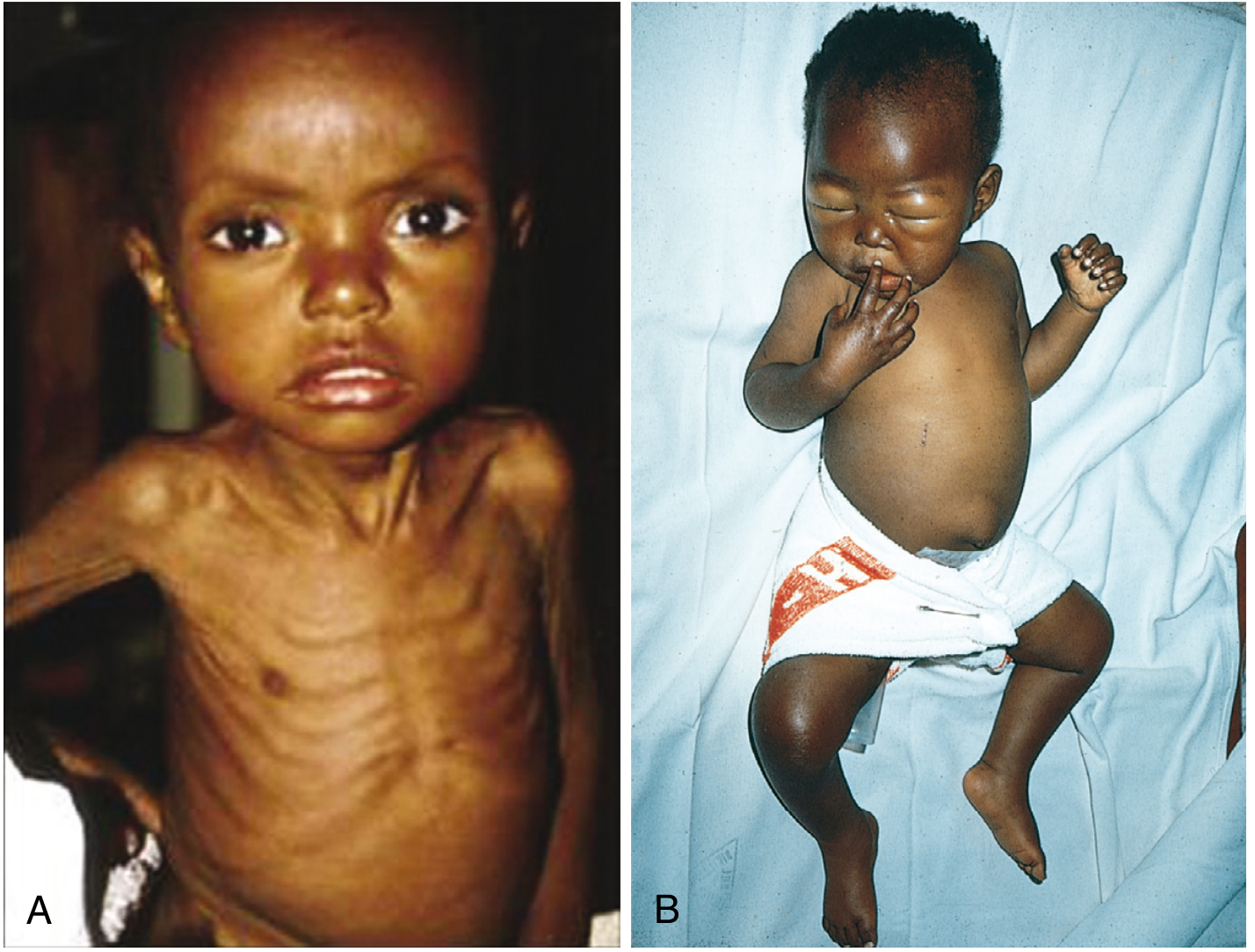
| System | Clinical Feature |
|---|---|
| General | Severe wasting; weight <60% of normal |
| Growth | Severe growth retardation |
| Skin/Subcutaneous | Loss of subcutaneous fat; skin loose and wrinkled |
| Muscle | Gross muscle atrophy; "skin and bone" appearance |
| Face | Head appears too large for emaciated body; "monkey face" or "old man face" |
| Edema | ABSENT |
| Hair | Sparse, dry (less prominent than kwashiorkor) |
| Liver | NOT enlarged |
| Serum Albumin | Normal or only slightly reduced (visceral protein compartment relatively preserved) |
| Appetite | Usually present (hungry child) |
| Mental state | Alert, may be irritable |
| Immunity | Deficient T-cell mediated immunity; concurrent infections common |
Pathophysiology of Marasmus:
- Adaptive response: catabolism of somatic protein (muscle) provides amino acids for energy
- Visceral protein compartment is spared (survival priority)
- Leptin production is low → hypothalamic-pituitary-adrenal axis activation → high cortisol → lipolysis
- Subcutaneous fat mobilized as fuel
B. KWASHIORKOR
Kwashiorkor occurs when protein deprivation is relatively greater than the reduction in total calories.
- Robbins, Cotran & Kumar
| System | Clinical Feature |
|---|---|
| General | Weight 60-80% of normal (masked by edema) |
| Edema | PRESENT - generalized/dependent; characteristic hallmark |
| Skin | "Flaky paint" dermatosis - alternating zones of hyperpigmentation, desquamation, and hypopigmentation |
| Hair | Depigmentation (reddish or pale), straightening, fine texture, flag sign (alternating pale and dark bands), easily pluckable |
| Liver | Enlarged with fatty change (hepatomegaly + steatosis) - due to reduced synthesis of carrier protein for lipoproteins |
| Muscle | Relatively spared (less wasting than marasmus) |
| Subcutaneous fat | Relatively spared |
| Serum Albumin | LOW (hypoalbuminemia - causes edema) |
| Abdomen | Distended (ascites) |
| Face | Moon face (puffiness due to edema) |
| Mental state | Apathetic, listless, unhappy expression, loss of appetite |
| GI tract | Small bowel shows decrease in the height of villi; loss of enzymes |
| Immunity | Defective; prone to secondary infections |
Pathophysiology of Kwashiorkor:
- Marked protein deprivation → reduced synthesis of visceral proteins
- Hypoalbuminemia → reduced oncotic pressure → generalized edema
- Reduced lipoprotein synthesis → fat accumulates in liver (fatty liver)
- Relative sparing of muscle and subcutaneous fat (energy intake relatively maintained)
C. MARASMIC-KWASHIORKOR (Mixed Form)
A mixed form exists where both protein and calorie deficiency co-exist, with features of both. It presents as wasting with some degree of edema.
Comparison Table: Marasmus vs. Kwashiorkor
| Feature | Marasmus | Kwashiorkor |
|---|---|---|
| Primary deficiency | Calories + Protein | Mainly Protein |
| Weight | <60% normal | 60-80% normal (masked by edema) |
| Edema | Absent | Present (bilateral pitting) |
| Subcutaneous fat | Severely depleted | Relatively preserved |
| Muscle wasting | Severe | Less marked |
| Liver | Normal size | Enlarged (fatty) |
| Serum albumin | Normal/slightly reduced | Low |
| Skin changes | Loose, wrinkled | "Flaky paint" dermatosis |
| Hair changes | Less prominent | Depigmentation, flag sign |
| Appetite | Present (hungry) | Poor, anorexia |
| Mood | Alert, irritable | Apathetic, listless |
| Age group | Infants (<1 year) | Toddlers (1-3 years) |
Indicators of Malnutrition
Malnutrition indicators can be classified as:
A. Anthropometric Indicators
| Indicator | Measurement | Significance |
|---|---|---|
| Weight-for-age | Weighing scale | Detects underweight |
| Height/Length-for-age | Measuring board/stadiometer | Detects stunting (chronic malnutrition) |
| Weight-for-height | Both | Detects wasting (acute malnutrition) |
| MUAC (Mid Upper Arm Circumference) | MUAC tape | Simple field tool (see MUAC table above) |
| Skin fold thickness | Skinfold calipers | Estimates fat stores |
| Head circumference | Measuring tape | Brain development |
| BMI | Wt(kg)/Ht(m²) | Adults: <18.5 = chronic energy deficiency |
B. Clinical Indicators
- Presence of edema (bilateral pitting)
- Skin changes ("flaky paint" dermatosis)
- Hair changes (flag sign, depigmentation)
- Hepatomegaly
- Signs of vitamin deficiency (Bitot's spots, rickets, angular stomatitis, etc.)
- Growth faltering on growth chart
C. Biochemical Indicators
| Test | What it reflects |
|---|---|
| Serum albumin | Visceral protein compartment |
| Serum transferrin | Iron status + protein nutrition |
| Serum prealbumin | Short-term protein status |
| Hemoglobin | Nutritional anemia |
| Serum retinol | Vitamin A status |
D. Dietary Indicators
- 24-hour dietary recall
- Food frequency questionnaire
- Diet history
- Food balance sheets (national level)
E. Vital Statistics / Epidemiological Indicators
- Under-5 mortality rate
- Infant mortality rate
- Low birth weight rate
- Prevalence of stunting, wasting, underweight (from NFHS data)
- First indicator of PEM = underweight-for-age (monitored by growth chart)
PART C: PREVENTIVE MEASURES TO REDUCE PEM IN INDIA
"There is no simple solution to the problem of PEM. Many types of actions are necessary."
- Park's Textbook (adapted from 8th FAO/WHO Expert Committee on Nutrition)
Prevention Framework (Levels of Prevention)
┌──────────────────────────────────────────────────────────────────┐
│            PREVENTION OF PEM - A Four-Level Approach             │
├──────────────────┬───────────────────────────────────────────────┤
│ (a) Health       │ (b) Specific     │ (c) Early       │ (d) Re- │
│ Promotion        │ Protection       │ Diagnosis &     │ habili- │
│                  │                  │ Treatment       │ tation  │
└──────────────────┴───────────────────────────────────────────────┘
(a) Health Promotion
- Measures for pregnant and lactating women - education, distribution of nutritional supplements
- Promotion of breast-feeding - exclusive breastfeeding for the first 6 months of life
- Development of low-cost weaning foods - child should eat more food at frequent intervals during the weaning period (6 months to 2 years)
- Measures to improve family diet - balanced diet with locally available foods
- Nutrition education - promotion of correct feeding practices; health education can solve ~50% of nutritional problems
- Home economics - planning nutritionally adequate diets within family budget
- Family planning and spacing of births - prevents maternal depletion; recommended birth spacing of >2 years
- Improving family environment - clean water, sanitation, hygiene
(b) Specific Protection
- Protein and energy-rich diet - milk, eggs, fresh fruits, dal, leafy vegetables
- Immunization - prevents infections that trigger PEM; BCG, OPV, DPT, measles vaccine (prevents post-measles PEM)
- Food fortification - iodized salt (goitre), iron-fortified foods (anemia), vitamin A in oil/vanaspati
(c) Early Diagnosis and Treatment
- Periodic nutritional surveillance - growth monitoring using growth charts (Road to Health card)
- Early diagnosis of growth lag - weight-for-age monitoring; detection of growth faltering
- Early diagnosis and treatment of infections and diarrhoea - ORS, antibiotics
- Rehydration programmes - early rehydration in children with diarrhea
- Supplementary feeding programmes during epidemics
- Deworming - heavily infested children (albendazole 6-monthly)
(d) Rehabilitation
- Nutritional Rehabilitation Services (NRS) - Nutrition Rehabilitation Centres (NRC) for SAM children
- Hospital treatment - for severe cases with complications
- Follow-up care - community follow-up after discharge to prevent relapse
PART D: PREVENTIVE AND SOCIAL MEASURES AT FAMILY AND COMMUNITY LEVEL
"Since malnutrition is the outcome of several factors, the problem can be solved only by taking action simultaneously at various levels - family, community, national and international levels."
- Park's Textbook of Preventive and Social Medicine
Flowchart: Levels of Action Against Malnutrition
PREVENTING MALNUTRITION IN INDIA
             │
    ┌────────┼───────────┬──────────────┐
    ▼        ▼           ▼              ▼
FAMILY   COMMUNITY   NATIONAL    INTERNATIONAL
LEVEL    LEVEL       LEVEL       LEVEL
ACTION AT THE FAMILY LEVEL
The family is the principal target for nutritional improvement. The instrument is nutrition education.
Key Strategies:
-
Nutrition Education for Housewives and Husbands
- Selection of right kinds of local foods
- Planning nutritionally adequate diets within purchasing power limits
- Food expenditure = 50-70% of family budgets; education is a good investment
-
Correction of Harmful Food Practices
- Identify and correct food taboos (e.g., avoiding papaya/leafy vegetables during pregnancy)
- Counter misleading commercial advertising on baby foods
- Correct faulty cooking practices (avoid discarding rice water, prolonged boiling, excessive peeling)
-
Promotion of Breast-feeding
- Exclusive breastfeeding for 6 months
- Continued breastfeeding up to 2 years
- Correct weaning practices with locally available foods
-
Attention to Vulnerable Groups
- Nutritional needs of expectant and nursing mothers
- Adequate complementary feeding for children 6 months to 2 years
- Small, frequent meals for young children
-
Kitchen Garden and Poultry
- Shortage of protective foods can be met by planning a kitchen garden
- Keeping poultry for eggs and protein
- Growing fruits and vegetables at home
-
MCH + Family Planning Integration
- Mother and Child Health services, family planning (birth spacing), and immunization as a "package"
- Community health workers (ANM, ASHA) to impart nutrition education at family level
ACTION AT THE COMMUNITY LEVEL
Community-level action begins with analysis of the nutrition problem in terms of:
- (a) Extent, distribution and types of nutritional deficiencies
- (b) Population groups at risk
- (c) Dietary and non-dietary contributing factors
Direct Intervention Measures:
| Programme | Target | Intervention |
|---|---|---|
| Supplementary Feeding Programmes | Pre-school children | Extra calories + protein |
| Midday School Meals (Mid-Day Meal Scheme) | School-going children | Hot cooked meal; 450 kcal + 12g protein |
| Vitamin A Prophylaxis Programme | Children 6 months - 5 years | 2,00,000 IU every 6 months |
| Iron and Folic Acid Supplementation | Pregnant/Lactating women, children | Weekly/Daily IFA tablets |
| ICDS (Integrated Child Development Services) | Children <6 yrs, pregnant/lactating women, women 15-44 yrs | Supplementary nutrition, immunization, health check-up, nutrition education |
| Applied Nutrition Programme | Community | Production of protective foods by community |
| Nutrition Rehabilitation Centres (NRC) | SAM children | Hospital-grade therapeutic feeding |
          ICDS Programme (Integrated Child Development Services)
                              │
              ┌───────────────┼───────────────┐
              ▼               ▼               ▼
   Supplementary        Immunization     Health Check-ups
   Nutrition            (BCG, OPV,       (Growth monitoring,
   (hot cooked meal)    DPT, Measles)    Referral)
              │
              ▼
   Health and Nutrition Education
   for Mothers
              │
              ▼
   Non-Formal Pre-School Education
   for Children
   (Target: Children <6 yrs; Pregnant/Lactating Women;
    Women 15-44 yrs in identified Anganwadi areas)
Fundamental (Long-term) Measures at Community Level:
- Increasing availability of foods in quantity and quality
- Ensuring access to food for those at risk - income support, food subsidies
- Health education on nutrition, hygiene, infant feeding
- Improvement of water supply and sanitation - prevents infection-malnutrition cycle
- Control of infectious diseases - immunization, vector control
- Broad socio-economic development of the entire community
ACTION AT THE NATIONAL LEVEL (for completeness)
The FAO/WHO Expert Committee (1976) recommended strategies that India has adopted:
| Strategy | Description |
|---|---|
| Rural Development | Socio-economic uplift of rural areas (72% of India's population); raise purchasing power |
| Increasing Agricultural Production | Modern farming, fertilizers, better seeds, irrigation, food distribution system |
| Stabilization of Population | Birth spacing, small family norm - reduces nutritional depletion |
| Nutrition Intervention Programmes | Iodized salt (goitre), IFA tablets (anaemia), Vitamin A (xerophthalmia), supplementary feeding |
| Nutrition-related Health Activities | National Malaria Eradication, immunization, environmental sanitation, family planning |
Summary Flowchart: Comprehensive Strategy Against PEM in India
                        PEM IN INDIA
                             │
            ┌────────────────┼────────────────┐
            ▼                ▼                ▼
     IMMEDIATE          MEDIUM TERM      LONG TERM
     MEASURES           MEASURES         MEASURES

 • Hospital care       • ICDS            • Rural development
 • NRC (SAM           • Midday meals    • Agricultural
   management)        • Vitamin A         production
 • ORS for              prophylaxis     • Population
   diarrhea           • IFA tablets       stabilization
 • Deworming          • Fortification   • Poverty alleviation
 • Immunization       • Growth          • Female education
                        monitoring      • Safe water &
                      • Nutrition         sanitation
                        education
KEY NATIONAL PROGRAMMES RELEVANT TO PEM PREVENTION IN INDIA
| Programme | Year Started | Key Feature |
|---|---|---|
| ICDS (Integrated Child Development Services) | 1975 | Anganwadi-based; 6 services; largest nutrition programme in world |
| Mid-Day Meal Scheme (PM POSHAN) | 1995 | School meals; reduces dropout + improves nutrition |
| National Nutrition Mission (POSHAN Abhiyaan) | 2018 | Target: reduce stunting by 2%, wasting by 2%, underweight by 2% per year |
| NRC (Nutrition Rehabilitation Centre) | National programme | In-patient management of SAM with complications |
| National Iron Plus Initiative | 2013 | IFA supplementation across life cycle |
| Vitamin A Supplementation Programme | 1970 | Prevention of xerophthalmia and nutritional blindness |
| National Food Security Act | 2013 | Legal right to subsidized food grain for 67% of population |
Sources: Park's Textbook of Preventive and Social Medicine (23rd ed.), pp. 735-749; Robbins, Cotran & Kumar Pathologic Basis of Disease (10th ed.), pp. 411-413; Robbins & Kumar Basic Pathology (11th ed.), p. 1860
This is a shared conversation. Sign in to Orris to start your own chat.